Homepage Blank Ohio Mf 2 PDF Form
Content Overview

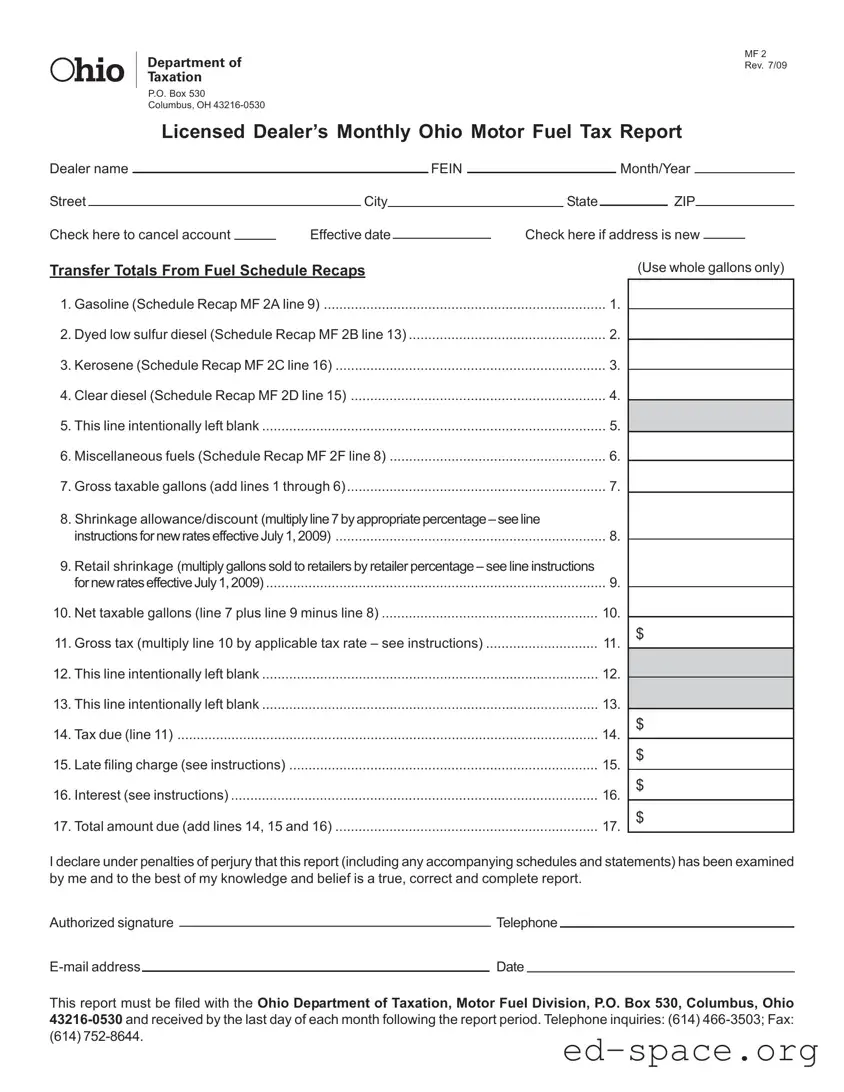
The Ohio MF 2 form is an essential document for licensed dealers involved in the sale of motor fuels within the state. This monthly report serves as a comprehensive record of the dealer's fuel sales, detailing various types of fuels including gasoline, dyed low sulfur diesel, kerosene, clear diesel, and miscellaneous fuels. Each dealer must accurately report their gross taxable gallons, accounting for allowances such as shrinkage and retail shrinkage, which are calculated based on specific percentages that vary by reporting period. The form also requires dealers to calculate the total tax due, which is based on the net taxable gallons multiplied by the applicable tax rate. Timely submission is crucial; the form must reach the Ohio Department of Taxation by the last day of each month following the reporting period. Failure to comply can result in late fees and interest charges, emphasizing the importance of understanding the nuances of the form. Additionally, the MF 2 form includes sections for authorized signatures and contact information, ensuring accountability and transparency in the reporting process.


Document Preview

MF 2
Rev. 7/09
Licensed Dealers Monthly Ohio Motor Fuel Tax Report
Dealer name FEIN Month/Year
Street City State ZIP
Check here to cancel account Effective date Check here if address is new
Transfer Totals From Fuel Schedule Recaps
1. Gasoline (Schedule Recap MF 2A line 9) ......................................................................... 1.
2. Dyed low sulfur diesel (Schedule Recap MF 2B line 13) ................................................... 2.
3. Kerosene (Schedule Recap MF 2C line 16) ...................................................................... 3.
4. Clear diesel (Schedule Recap MF 2D line 15) .................................................................. 4.
5. This line intentionally left blank ......................................................................................... 5.
6. Miscellaneous fuels (Schedule Recap MF 2F line 8) ........................................................ 6.
7. Gross taxable gallons (add lines 1 through 6)................................................................... 7.
8. Shrinkage allowance/discount (multiply line 7 by appropriate percentage – see line
instructions for new rates effective July 1, 2009) ...................................................................... 8.
9. Retail shrinkage (multiply gallons sold to retailers by retailer percentage – see line instructions
for new rates effective July 1, 2009) ........................................................................................ 9.
10. Net taxable gallons (line 7 plus line 9 minus line 8) ........................................................ 10.
11. Gross tax (multiply line 10 by applicable tax rate – see instructions) ............................. 11.
12. This line intentionally left blank ....................................................................................... 12.
13. This line intentionally left blank ....................................................................................... 13.
14. Tax due (line 11) ............................................................................................................. 14.
15. Late filing charge (see instructions) ................................................................................ 15.
16. Interest (see instructions) ............................................................................................... 16.
17. Total amount due (add lines 14, 15 and 16) .................................................................... 17.
I declare under penalties of perjury that this report (including any accompanying schedules and statements) has been examined
by me and to the best of my knowledge and belief is a true, correct and complete report.
Authorized signature Telephone
E-mail address Date
This report must be filed with the Ohio Department of Taxation, Motor Fuel Division, P.O. Box 530, Columbus, Ohio
43216-0530 and received by the last day of each month following the report period. Telephone inquiries: (614) 466-3503; Fax:
(614) 752-8644.
$
$
$
$
$
(Use whole gallons only)
hio
Department of
Taxation
P.O. Box 530
Columbus, OH 43216-0530
Return Instructions
Line 8
Shrinkage – If your tax report is filed and timely paid, multiply the taxable gallons on line 7 by the appropriate
shrinkage percentage. You are not entitled to the shrinkage allowance if your report is filed and/or paid after the
due date.
Reporting Period Shrinkage Percentage
July 1, 1993 to June 30, 2005 3% (.03)
July 1, 2005 to June 30, 2006 2.5% (.025)
July 1, 2006 to June 30, 2007 1.95% (.0195)
July 1, 2007 to June 30, 2009 1.90% (.019) – shrinkage and collection/administration discount
Beginning July 1, 2009 to June 30, 2011 1.0% (.010)
Line 9 Retail shrinkageYou must add back a percentage of all gallons of fuel sold to a retail dealers as defined in
Ohio Revised Code Section 5735.01(O). Do not include gallons sold to retail dealers licensed under your FEIN.
Reporting Period Shrinkage Percentage
July 1, 1993 to June 30, 2005 1% (.01)
July 1, 2005 to June 30, 2006 0.83% (.0083)
July 1, 2006 to June 30, 2007 0.65% (.0065)
July 1, 2007 to June 30, 2011 0.50% (.0050)
Line 11 Tax rate
Reporting Period Tax Rate Per Gallon
July 1, 2003 to June 30, 2004 $0.24
July 1, 2004 to June 30, 2005 $0.26
Beginning July 1, 2005 $0.28
Lines 15/16 According to R.C. 5735.06(C), the tax report must be filed/received with the tax payment shown on the report,
unless required to be submitted by EFT, by the due date. If the tax report and tax payment are not filed/received
on or before the due date, you are liable for a “late filing charge” (line 15) and subject to interest (line 16) in
addition to disallowance of any shrinkage claim. The late filing charge is the greater of 10% of your liability (line
14) or $50. The interest is to be calculated from the date the payment was due until the date the payment was
actually received by the Ohio Treasurer of State or the Department of Taxation. The interest rate is determined on
a calendar year basis and can change from year to year. Please visit our Web site at tax.ohio.gov for the current
interest rate.
MF 2
Rev. 7/09
Page 2

Form Specifications

Fact Name Details
Form Purpose The Ohio MF 2 form is used for reporting the monthly motor fuel tax by licensed dealers.
Filing Requirement Dealers must file the form by the last day of each month following the reporting period.
Governing Law The form is governed by Ohio Revised Code Section 5735.06(C).
Tax Calculation Tax due is calculated by multiplying net taxable gallons by the applicable tax rate.
Shrinkage Allowance Shrinkage allowance is based on taxable gallons and varies by reporting period.
Retail Shrinkage Retail shrinkage must be added back for gallons sold to retail dealers, excluding those under the same FEIN.
Late Filing Charge A late filing charge applies if the form is not submitted by the due date, calculated as 10% of the liability or $50, whichever is greater.
Interest Accrual Interest is charged from the due date until payment is received, with rates determined annually.
Contact Information Inquiries can be directed to the Ohio Department of Taxation at (614) 466-3503.
Form Revision Date The current version of the form was revised in July 2009.

Ohio Mf 2: Usage Guidelines

Filling out the Ohio MF 2 form is essential for licensed dealers to report their monthly motor fuel tax. Once completed, this form must be submitted to the Ohio Department of Taxation by the end of each month following the reporting period.

  1. Begin by entering your Dealer name and FEIN (Federal Employer Identification Number) at the top of the form.
  2. Fill in the Month/Year for which you are reporting.
  3. Provide your Street, City, State, and ZIP code.
  4. If you need to cancel your account, check the box labeled Check here to cancel account and enter the Effective date.
  5. If your address has changed, check the box labeled Check here if address is new.
  6. Transfer totals from the corresponding fuel schedule recaps:
    • Line 1: Enter the total gallons of Gasoline from Schedule Recap MF 2A line 9.
    • Line 2: Enter the total gallons of Dyed low sulfur diesel from Schedule Recap MF 2B line 13.
    • Line 3: Enter the total gallons of Kerosene from Schedule Recap MF 2C line 16.
    • Line 4: Enter the total gallons of Clear diesel from Schedule Recap MF 2D line 15.
    • Line 6: Enter the total gallons of Miscellaneous fuels from Schedule Recap MF 2F line 8.
  7. Line 5 is intentionally left blank; do not enter anything here.
  8. Calculate the Gross taxable gallons by adding lines 1 through 6 and enter the total on line 7.
  9. For line 8, calculate the Shrinkage allowance/discount by multiplying the gross taxable gallons on line 7 by the appropriate percentage based on the reporting period.
  10. For line 9, calculate the Retail shrinkage by multiplying the gallons sold to retailers by the retailer percentage.
  11. Calculate the Net taxable gallons on line 10 by adding line 7 and line 9, then subtracting line 8.
  12. Calculate the Gross tax on line 11 by multiplying the net taxable gallons on line 10 by the applicable tax rate.
  13. Line 12 and line 13 are intentionally left blank; do not enter anything here.
  14. Enter the Tax due on line 14, which is the same as line 11.
  15. For line 15, determine the Late filing charge based on the guidelines provided.
  16. Calculate the Interest due on line 16 according to the instructions.
  17. Finally, calculate the Total amount due on line 17 by adding lines 14, 15, and 16.
  18. Sign the form in the designated area, and provide your Telephone number, E-mail address, and the Date.

Your Questions, Answered

What is the Ohio MF 2 form?

The Ohio MF 2 form is a monthly report that licensed dealers must file to report their motor fuel tax obligations. It includes details about the types and amounts of fuel sold, as well as the taxes owed. This form is essential for compliance with state tax regulations regarding motor fuel sales in Ohio.

Who needs to file the Ohio MF 2 form?

Any licensed dealer who sells motor fuel in Ohio is required to file the MF 2 form. This includes businesses that sell gasoline, diesel, kerosene, and other fuels. If you are a dealer operating under a Federal Employer Identification Number (FEIN), you must submit this report monthly to the Ohio Department of Taxation.

When is the Ohio MF 2 form due?

The Ohio MF 2 form must be filed by the last day of each month following the reporting period. For example, the report for January is due by the end of February. Timely filing is crucial to avoid penalties and interest on unpaid taxes.

What happens if I miss the filing deadline?

If the Ohio MF 2 form is not filed by the due date, a late filing charge will be applied. This charge is either 10% of the tax liability or a flat fee of $50, whichever is greater. Additionally, interest will accrue on the unpaid tax amount from the due date until payment is received.

What is the shrinkage allowance mentioned in the form?

The shrinkage allowance accounts for the loss of fuel due to evaporation, spillage, or other factors during storage and distribution. If the report is filed on time, dealers can claim a percentage of the taxable gallons sold as a shrinkage allowance. The percentage varies depending on the reporting period, so it’s important to check the current rates.

Can I change my address or cancel my account using the Ohio MF 2 form?

Yes, the Ohio MF 2 form provides options to indicate a change of address or to cancel your account. Simply check the appropriate box on the form and provide the effective date for the change. This ensures that the Ohio Department of Taxation has your correct information for future correspondence.

How is the tax calculated on the Ohio MF 2 form?

The tax is calculated by multiplying the net taxable gallons (calculated on the form) by the applicable tax rate. The tax rate can change, so it’s essential to refer to the latest instructions for the correct rate based on the reporting period. Once calculated, this amount is reported on line 11 of the form.

Where do I send the completed Ohio MF 2 form?

After completing the Ohio MF 2 form, it should be sent to the Ohio Department of Taxation, Motor Fuel Division, at P.O. Box 530, Columbus, Ohio 43216-0530. Ensure it is mailed in time to meet the filing deadline to avoid penalties.

Common mistakes

  1. Incorrect or Missing Information: Failing to provide complete details such as the dealer name, FEIN, or address can lead to delays. Ensure all sections are filled out accurately.

  2. Improper Calculation of Taxable Gallons: Mistakes in adding the gallons from the various schedules can result in incorrect totals. Double-check calculations to avoid errors.

  3. Not Using the Correct Shrinkage Percentage: Each reporting period has a specific shrinkage percentage. Using the wrong percentage can affect the tax due. Be sure to reference the correct rates for your reporting period.

  4. Late Submission: Failing to file the form by the deadline may incur late fees and interest. Submit the form on time to avoid these additional charges.

Documents used along the form

The Ohio MF 2 form is an essential document for licensed dealers reporting their monthly motor fuel tax. To ensure compliance and accurate reporting, several other forms and documents may be needed alongside the MF 2. Below is a list of these documents, along with brief descriptions of each.

  • Ohio MF 2A: This schedule is used to report gasoline sales and calculate the total taxable gallons of gasoline sold during the reporting period.
  • Ohio MF 2B: This schedule focuses on dyed low sulfur diesel sales, helping dealers track and report the gallons sold for this specific fuel type.
  • Ohio MF 2C: Dealers use this schedule to report kerosene sales, ensuring that all kerosene transactions are accounted for in the tax calculations.
  • Ohio MF 2D: This form is designated for clear diesel sales, allowing dealers to accurately report the gallons sold and tax owed on clear diesel fuel.
  • Ohio MF 2F: This schedule is for miscellaneous fuels, capturing any other fuel types that may not fall under the standard categories.
  • Tax Payment Voucher: A voucher that accompanies the tax payment, ensuring that the payment is correctly applied to the dealer's account and reporting period.
  • Late Filing Charge Notice: This notice informs dealers of any penalties incurred due to late filing of the MF 2 form, including late fees and interest charges.
  • Interest Rate Notification: A document that provides the current interest rate applicable to late payments, which can change annually.

Having these forms and documents ready can streamline the reporting process and help avoid potential issues with the Ohio Department of Taxation. Proper preparation ensures compliance and can save time and resources in the long run.

Similar forms

The Ohio MF 2 form is a key document for licensed dealers reporting motor fuel tax. Several other forms share similarities with it, primarily in their purpose and structure. Here’s a list of seven documents that are comparable to the Ohio MF 2 form:

  • IRS Form 720: This form is used for reporting and paying federal excise taxes on fuel. Like the Ohio MF 2, it requires detailed reporting of fuel types and tax calculations.
  • California Fuel Tax Return (FTB 400): Similar to the Ohio MF 2, this form is used by fuel sellers in California to report and pay fuel taxes, including calculations for taxable gallons and applicable rates.
  • Texas Motor Fuel Tax Report (Form 05-102): This document serves a similar function in Texas, allowing dealers to report fuel sales and calculate taxes owed, much like the Ohio MF 2.
  • Florida Motor Fuel Tax Return (Form DR-309): This form is used to report motor fuel sales in Florida. It includes similar sections for reporting fuel types and calculating taxes, mirroring the structure of the Ohio MF 2.
  • New York State Motor Fuel Tax Return (Form MT-1): This form is used for reporting motor fuel taxes in New York. It requires similar data on fuel types and tax calculations, akin to the Ohio MF 2.
  • Oregon Motor Fuel Tax Return (Form 100): This document is comparable as it requires fuel sellers to report their sales and taxes owed, following a structure similar to the Ohio MF 2.
  • Illinois Motor Fuel Tax Return (Form RMFT-11): This form is used to report and pay motor fuel taxes in Illinois. It shares similar components with the Ohio MF 2, such as sections for reporting different fuel types and tax calculations.

Dos and Don'ts

When completing the Ohio MF 2 form, it is important to ensure accuracy and compliance. Here are six key do's and don'ts to guide you through the process.

  • Do check your dealer name and FEIN for accuracy.
  • Do use whole gallons only when reporting totals from the fuel schedule.
  • Do file the report by the last day of the month following the reporting period.
  • Do include all required signatures and contact information.
  • Don't forget to calculate the appropriate shrinkage percentages based on the reporting period.
  • Don't submit the form late, as this will incur additional charges and interest.

Following these guidelines will help ensure a smooth filing process. Take the time to review your submission carefully before sending it to the Ohio Department of Taxation.

Misconceptions

Understanding the Ohio MF 2 form is essential for licensed dealers in the state. However, several misconceptions can lead to confusion. Here are eight common misunderstandings about this important tax report:

  • Misconception 1: The Ohio MF 2 form is only for gasoline sales.
  • In reality, this form covers multiple fuel types, including dyed low sulfur diesel, kerosene, clear diesel, and miscellaneous fuels. Dealers must report all applicable fuel sales to ensure compliance.

  • Misconception 2: The shrinkage allowance is automatically granted.
  • The shrinkage allowance is only available if the report is filed and paid on time. Late submissions disqualify dealers from this benefit, emphasizing the importance of timely compliance.

  • Misconception 3: Any percentage can be used for shrinkage calculations.
  • Dealers must use specific percentages based on the reporting period. These percentages change over time, and it’s crucial to refer to the correct rates for accurate calculations.

  • Misconception 4: Retail shrinkage does not need to be reported.
  • Retail shrinkage must be reported and calculated based on gallons sold to retail dealers. This ensures that all fuel sales are accurately accounted for in the tax report.

  • Misconception 5: The tax rate remains constant.
  • The tax rate for motor fuel changes periodically. Dealers should verify the current rate for the applicable reporting period to avoid errors in their calculations.

  • Misconception 6: Late filing charges are minimal and can be ignored.
  • Late filing can lead to significant penalties, including a charge of 10% of the liability or a minimum of $50. Ignoring these charges can result in increased financial burdens.

  • Misconception 7: Interest on late payments is fixed.
  • The interest rate for late payments can vary from year to year. Dealers should check the Ohio Department of Taxation's website for the most current rates to ensure accurate calculations.

  • Misconception 8: The form can be submitted at any time.
  • The Ohio MF 2 form must be filed by the last day of each month following the report period. Late submissions can incur penalties and affect the dealer's standing with the tax authorities.

By clearing up these misconceptions, licensed dealers can better navigate the requirements of the Ohio MF 2 form and ensure compliance with state regulations.

Key takeaways

  • The Ohio MF 2 form is a monthly report required for licensed dealers to report motor fuel tax.
  • It must be submitted to the Ohio Department of Taxation by the last day of each month following the reporting period.
  • Accurate completion is crucial; ensure all fuel types are reported using whole gallons only.
  • Be aware of the shrinkage allowance; it applies only if the report is filed and paid on time.
  • Calculate the gross taxable gallons by adding all fuel types listed on the form.
  • Late submissions incur a charge, which is the greater of 10% of the tax due or $50.
  • Interest may also apply if the payment is late; the rate can change annually.
  • Keep records of all fuel sales, as retail shrinkage must be accounted for separately.
  • Sign and date the report to certify its accuracy and completeness under penalties of perjury.