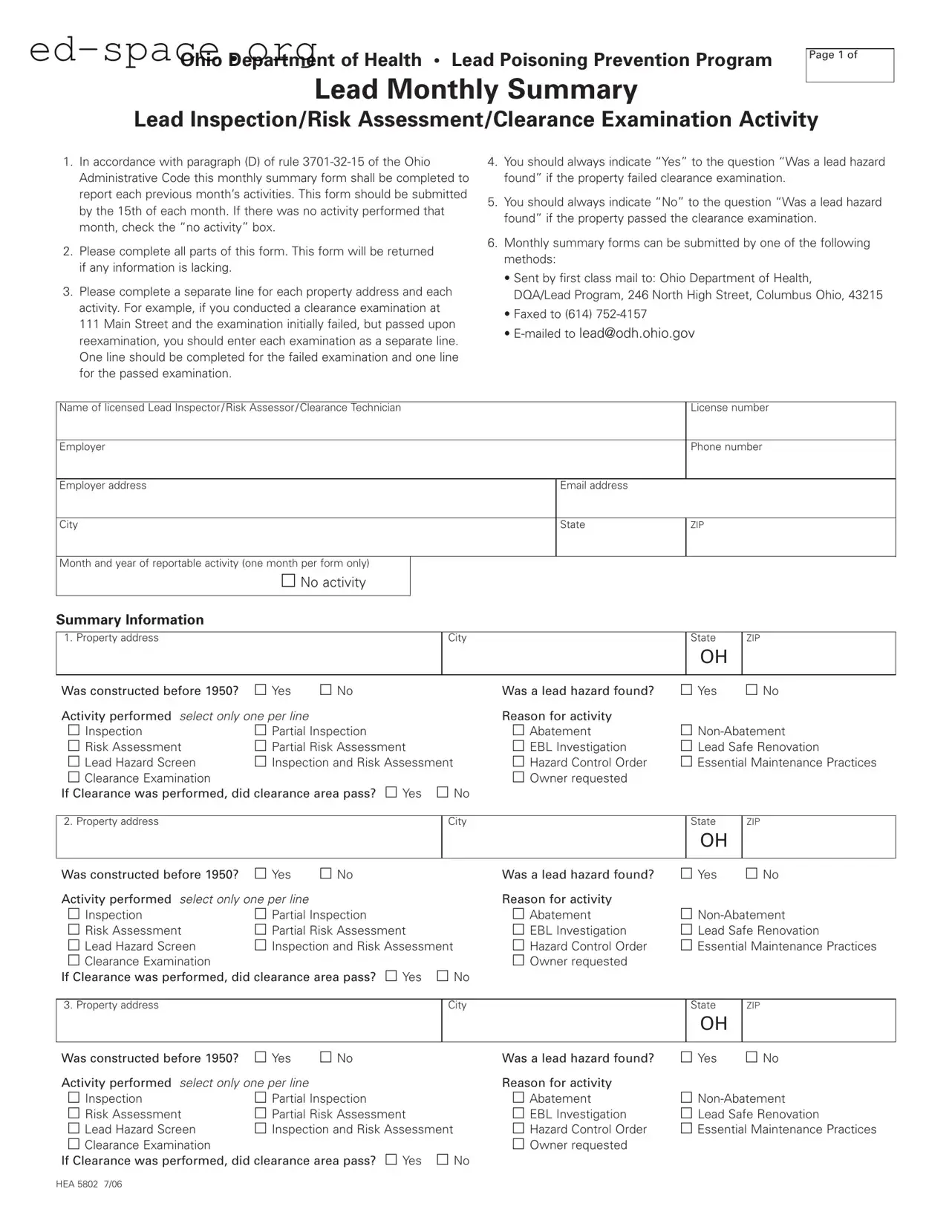
The Ohio HEA 5802 form plays a crucial role in the state’s Lead Poisoning Prevention Program, ensuring that lead inspections, risk assessments, and clearance examinations are properly documented. This monthly summary form must be completed by licensed professionals to report activities from the previous month, and it is due by the 15th of each month. If no activities occurred, the user simply checks the “no activity” box. Each property address and activity requires its own line, providing clarity in reporting. For instance, if a clearance examination initially fails but later passes upon reexamination, both results must be recorded separately. It’s essential to accurately indicate whether a lead hazard was found, as this impacts public health decisions. The form can be submitted via mail, fax, or email, making it accessible for professionals to comply with reporting requirements. Completing the HEA 5802 accurately ensures that Ohio continues to make strides in lead hazard management and protects the health of its residents.
Ohio Department of Health • Lead Poisoning Prevention Program
Lead Monthly Summary
Page 1 of
Lead Inspection/Risk Assessment/Clearance Examination Activity
1.In accordance with paragraph (D) of rule
2.Please complete all parts of this form. This form will be returned if any information is lacking.
3.Please complete a separate line for each property address and each activity. For example, if you conducted a clearance examination at 111 Main Street and the examination initially failed, but passed upon reexamination, you should enter each examination as a separate line. One line should be completed for the failed examination and one line for the passed examination.
4.You should always indicate “Yes” to the question “Was a lead hazard found” if the property failed clearance examination.
5.You should always indicate “No” to the question “Was a lead hazard found” if the property passed the clearance examination.
6.Monthly summary forms can be submitted by one of the following methods:
•Sent by first class mail to: Ohio Department of Health,
DQA/Lead Program, 246 North High Street, Columbus Ohio, 43215
•Faxed to (614)
•
Name of licensed Lead Inspector / Risk Assessor / Clearance Technician |
|
License number |
|
|
|
Employer |
|
Phone number |
|
|
|
Employer address |
Email address |
|
|
|
|
City |
State |
ZIP |
|
|
|
Month and year of reportable activity (one month per form only) |
|
|
A No activity
Summary Information
1. Property address
City
State
OH
ZIP
Was constructed before 1950? |
A Yes |
A No |
Was a lead hazard found? |
A Yes |
A No |
Activity performed select only one per line |
|
Reason for activity |
|
|
|
A Inspection |
A Partial Inspection |
A Abatement |
A |
||
A Risk Assessment |
A Partial Risk Assessment |
A EBL Investigation |
A Lead Safe Renovation |
||
A Lead Hazard Screen |
A Inspection and Risk Assessment |
A Hazard Control Order |
A Essential Maintenance Practices |
||
A Clearance Examination |
|
|
A Owner requested |
|
|
If Clearance was performed, did clearance area pass? A Yes A No
2. Property address
City
State
OH
ZIP
Was constructed before 1950? |
A Yes |
A No |
Was a lead hazard found? |
A Yes |
A No |
Activity performed select only one per line |
|
Reason for activity |
|
|
|
A Inspection |
A Partial Inspection |
A Abatement |
A |
||
A Risk Assessment |
A Partial Risk Assessment |
A EBL Investigation |
A Lead Safe Renovation |
||
A Lead Hazard Screen |
A Inspection and Risk Assessment |
A Hazard Control Order |
A Essential Maintenance Practices |
||
A Clearance Examination |
|
|
A Owner requested |
|
|
If Clearance was performed, did clearance area pass? A Yes A No
3. Property address
City
State
OH
ZIP
Was constructed before 1950? |
A Yes |
A No |
Was a lead hazard found? |
A Yes |
A No |
Activity performed select only one per line |
|
Reason for activity |
|
|
|
A Inspection |
A Partial Inspection |
A Abatement |
A |
||
A Risk Assessment |
A Partial Risk Assessment |
A EBL Investigation |
A Lead Safe Renovation |
||
A Lead Hazard Screen |
A Inspection and Risk Assessment |
A Hazard Control Order |
A Essential Maintenance Practices |
||
A Clearance Examination |
|
|
A Owner requested |
|
|
If Clearance was performed, did clearance area pass? A Yes A No
HEA 5802 7/06
Lead Monthly Summary |
Page _______ of _________ |
|
4. Property address
City
State
OH
ZIP
Was constructed before 1950? |
A Yes |
A No |
Was a lead hazard found? |
A Yes |
A No |
Activity performed select only one per line |
|
Reason for activity |
|
|
|
A Inspection |
A Partial Inspection |
A Abatement |
A |
||
A Risk Assessment |
A Partial Risk Assessment |
A EBL Investigation |
A Lead Safe Renovation |
||
A Lead Hazard Screen |
A Inspection and Risk Assessment |
A Hazard Control Order |
A Essential Maintenance Practices |
||
A Clearance Examination |
|
|
A Owner requested |
|
|
If Clearance was performed, did clearance area pass? A Yes A No
5. Property address
City
State
OH
ZIP
Was constructed before 1950? |
A Yes |
A No |
Was a lead hazard found? |
A Yes |
A No |
Activity performed select only one per line |
|
Reason for activity |
|
|
|
A Inspection |
A Partial Inspection |
A Abatement |
A |
||
A Risk Assessment |
A Partial Risk Assessment |
A EBL Investigation |
A Lead Safe Renovation |
||
A Lead Hazard Screen |
A Inspection and Risk Assessment |
A Hazard Control Order |
A Essential Maintenance Practices |
||
A Clearance Examination |
|
|
A Owner requested |
|
|
If Clearance was performed, did clearance area pass? A Yes A No
6. Property address
City
State
OH
ZIP
Was constructed before 1950? |
A Yes |
A No |
Was a lead hazard found? |
A Yes |
A No |
Activity performed select only one per line |
|
Reason for activity |
|
|
|
A Inspection |
A Partial Inspection |
A Abatement |
A |
||
A Risk Assessment |
A Partial Risk Assessment |
A EBL Investigation |
A Lead Safe Renovation |
||
A Lead Hazard Screen |
A Inspection and Risk Assessment |
A Hazard Control Order |
A Essential Maintenance Practices |
||
A Clearance Examination |
|
|
A Owner requested |
|
|
If Clearance was performed, did clearance area pass? A Yes A No
7. Property address
City
State
OH
ZIP
Was constructed before 1950? |
A Yes |
A No |
Was a lead hazard found? |
A Yes |
A No |
Activity performed select only one per line |
|
Reason for activity |
|
|
|
A Inspection |
A Partial Inspection |
A Abatement |
A |
||
A Risk Assessment |
A Partial Risk Assessment |
A EBL Investigation |
A Lead Safe Renovation |
||
A Lead Hazard Screen |
A Inspection and Risk Assessment |
A Hazard Control Order |
A Essential Maintenance Practices |
||
A Clearance Examination |
|
|
A Owner requested |
|
|
If Clearance was performed, did clearance area pass? A Yes A No
8. Property address
City
State
OH
ZIP
Was constructed before 1950? |
A Yes |
A No |
Was a lead hazard found? |
A Yes |
A No |
Activity performed select only one per line |
|
Reason for activity |
|
|
|
A Inspection |
A Partial Inspection |
A Abatement |
A |
||
A Risk Assessment |
A Partial Risk Assessment |
A EBL Investigation |
A Lead Safe Renovation |
||
A Lead Hazard Screen |
A Inspection and Risk Assessment |
A Hazard Control Order |
A Essential Maintenance Practices |
||
A Clearance Examination |
|
|
A Owner requested |
|
|
If Clearance was performed, did clearance area pass? A Yes A No
9. Property address
City
State
OH
ZIP
Was constructed before 1950? |
A Yes |
A No |
Was a lead hazard found? |
A Yes |
A No |
Activity performed select only one per line |
|
Reason for activity |
|
|
|
A Inspection |
A Partial Inspection |
A Abatement |
A |
||
A Risk Assessment |
A Partial Risk Assessment |
A EBL Investigation |
A Lead Safe Renovation |
||
A Lead Hazard Screen |
A Inspection and Risk Assessment |
A Hazard Control Order |
A Essential Maintenance Practices |
||
A Clearance Examination |
|
|
A Owner requested |
|
|
If Clearance was performed, did clearance area pass? A Yes A No
HEA 5802 7/06
| Fact Name | Details |
|---|---|
| Governing Law | This form is governed by paragraph (D) of rule 3701-32-15 of the Ohio Administrative Code. |
| Submission Deadline | Forms must be submitted by the 15th of each month to report activities from the previous month. |
| No Activity Reporting | If no activities were performed in a month, the “no activity” box must be checked on the form. |
| Separate Reporting for Activities | Each property address and activity must be reported on separate lines, even if related. |
| Submission Methods | Forms can be submitted via mail, fax, or email to the Ohio Department of Health. |
Completing the Ohio HEA 5802 form is essential for reporting lead inspection and risk assessment activities. This form must be filled out accurately and submitted by the 15th of each month for the previous month's activities. If no activities occurred, simply check the "no activity" box. Each property and activity must be recorded on a separate line to ensure clarity and compliance.
What is the purpose of the Ohio HEA 5802 form?
The Ohio HEA 5802 form is designed to report lead inspection, risk assessment, and clearance examination activities conducted in the previous month. This form is essential for tracking lead hazards and ensuring compliance with health regulations aimed at preventing lead poisoning. It provides a structured way to document and communicate findings related to lead hazards in properties, especially those built before 1950.
When is the HEA 5802 form due?
The form must be submitted by the 15th of each month. This deadline ensures that the Ohio Department of Health receives timely information about lead-related activities. If no activities were performed in a given month, the "no activity" box should be checked to indicate that no reportable actions took place.
What information is required on the form?
Completing the HEA 5802 form requires detailed information. Each property address must be listed, along with the activities performed at that location. This includes specifying whether the property was constructed before 1950, whether a lead hazard was found, and the type of activity conducted, such as inspection or clearance examination. Incomplete forms will be returned for additional information.
How should I submit the HEA 5802 form?
The form can be submitted in several ways. You may send it by first-class mail to the Ohio Department of Health, fax it to (614) 752-4157, or email it to [email protected]. Choose the method that best suits your needs, but ensure that it is submitted by the deadline.
What should I do if a property fails the clearance examination?
If a property fails the clearance examination, it is crucial to indicate "Yes" when answering the question regarding whether a lead hazard was found. This documentation is vital for ensuring that appropriate remediation measures are taken to protect the health of occupants and to comply with state regulations.
Can I report multiple activities for a single property on one line?
No, each activity must be reported on a separate line for clarity and accuracy. For instance, if a clearance examination at a property initially fails but passes upon reexamination, both results should be documented on different lines. This allows for a comprehensive overview of the property's lead hazard status.
What happens if I submit an incomplete form?
If any information is lacking on the HEA 5802 form, it will be returned to you for completion. This can delay the reporting process and may impact compliance with health regulations. It is essential to double-check all entries before submission to ensure that the form is complete and accurate.
Who is responsible for filling out the HEA 5802 form?
The form should be completed by a licensed Lead Inspector, Risk Assessor, or Clearance Technician. These professionals are trained to assess lead hazards and are responsible for accurately documenting their findings and activities on the form. Their expertise is vital in protecting public health and ensuring compliance with Ohio's lead safety regulations.
Failing to submit the form by the 15th of each month. Timeliness is essential for compliance.
Not completing all parts of the form. Incomplete forms will be returned, causing delays.
Using a single line for multiple activities. Each property address and activity must have its own line.
Incorrectly marking the lead hazard questions. Always indicate “Yes” for failed examinations and “No” for passed ones.
Neglecting to check the “no activity” box if no inspections were performed during the month.
Submitting the form through the wrong method. Ensure it is sent via first class mail, fax, or email as specified.
Forgetting to include contact information. Always provide your name, license number, employer, and contact details.
Overlooking the construction year of the property. Clearly indicate if it was built before 1950.
Misunderstanding the activity performed. Only select one activity per line to avoid confusion.
Not reviewing the completed form for accuracy before submission. Double-checking can prevent costly mistakes.
When dealing with lead poisoning prevention and related inspections in Ohio, several forms and documents accompany the Ohio HEA 5802 form. These documents ensure that all necessary information is collected and reported accurately, contributing to the health and safety of residents. Below is a list of commonly used forms that may be required in conjunction with the HEA 5802.
Each of these documents plays a vital role in ensuring compliance with health regulations and protecting the well-being of individuals, particularly children, who may be at risk of lead exposure. Proper documentation not only aids in effective communication among stakeholders but also supports public health initiatives aimed at reducing lead poisoning incidents.
When filling out the Ohio HEA 5802 form, there are several important guidelines to follow. Here’s a list of things you should and shouldn't do:
Understanding the Ohio HEA 5802 form is crucial for compliance with lead inspection and risk assessment regulations. However, several misconceptions can lead to confusion. Here are five common misconceptions about the form:
This form is mandatory for reporting monthly activities related to lead inspections and assessments. Failure to submit it may result in penalties.
The form must be submitted by the 15th of each month for the previous month’s activities. Late submissions can lead to complications.
Each activity at a property must be reported on a separate line. This ensures clarity and accuracy in reporting.
The HEA 5802 form can be submitted via mail, fax, or email, providing flexibility in how you report your activities.
The Ohio HEA 5802 form is essential for documenting lead inspection and risk assessment activities. Below are key takeaways regarding its completion and use: