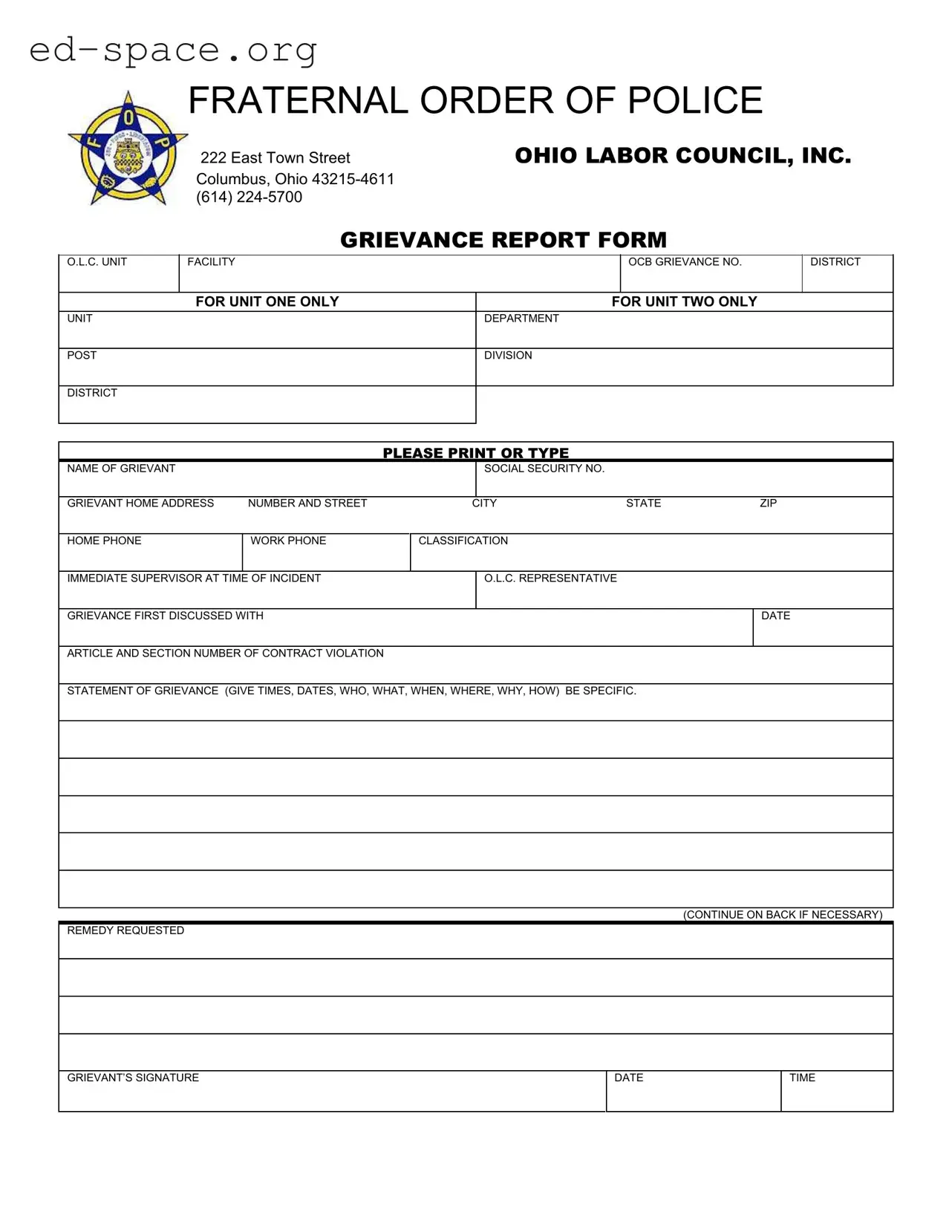
The Ohio Fraternal Order of Police Grievance Report Form serves as an essential tool for members seeking to address workplace issues within law enforcement agencies. This comprehensive document facilitates the reporting of grievances by allowing individuals to detail the specifics of their concerns, including the nature of the incident, the parties involved, and relevant dates and times. Members are encouraged to provide a clear statement of the grievance, referencing specific articles and sections of the applicable contract to substantiate their claims. The form also requires the grievant's personal information, such as their name, social security number, and contact details, ensuring that the process is streamlined and organized. Additionally, the form outlines a multi-step process for resolution, enabling grievances to be escalated through various levels of management if necessary. Each step includes spaces for dates of meetings and responses, ensuring that all actions are documented. By following this structured approach, members can effectively communicate their issues and seek appropriate remedies, fostering a more supportive work environment.

FRATERNAL ORDER OF POLICE
222 EAST TOWN STREET COLUMBUS, OHIO
OHIO LABOR COUNCIL, INC.
GRIEVANCE REPORT FORM
O.L.C. UNIT
FACILITY
OCB GRIEVANCE NO.
DISTRICT
FOR UNIT ONE ONLY |
|
|
|
FOR UNIT TWO ONLY |
||||
|
|
|
|
|
|
|
|
|
UNIT |
|
|
|
DEPARTMENT |
|
|
|
|
|
|
|
|
|
|
|
|
|
POST |
|
|
|
DIVISION |
|
|
|
|
|
|
|
|
|
|
|
|
|
DISTRICT |
|
|
|
|
|
|
|
|
|
|
|
|
|
|
|
|
|
|
|
|
|
|
|
|
|
|
|
|
PLEASE PRINT OR TYPE |
|
|
|
|
||
NAME OF GRIEVANT |
|
|
|
SOCIAL SECURITY NO. |
|
|
|
|
|
|
|
|
|
|
|
|
|
GRIEVANT HOME ADDRESS |
NUMBER AND STREET |
|
CITY |
STATE |
|
ZIP |
||
|
|
|
|
|
|
|
|
|
HOME PHONE |
WORK PHONE |
|
CLASSIFICATION |
|
|
|
|
|
|
|
|
|
|
|
|
|
|
IMMEDIATE SUPERVISOR AT TIME OF INCIDENT |
|
|
O.L.C. REPRESENTATIVE |
|
|
|
||
|
|
|
|
|
|
|
|
|
GRIEVANCE FIRST DISCUSSED WITH |
|
|
|
|
|
DATE |
||
|
|
|
|
|
||||
ARTICLE AND SECTION NUMBER OF CONTRACT VIOLATION |
|
|
|
|
||||
|
|
|
|
|
||||
STATEMENT OF GRIEVANCE (GIVE TIMES, DATES, WHO, WHAT, WHEN, WHERE, WHY, HOW) BE SPECIFIC. |
|
|
|
|||||
|
|
|
|
|
|
|
|
|
|
|
|
|
|
|
|
|
|
|
|
|
|
|
|
|
|
|
|
|
|
|
|
|
|
|
|
|
|
|
|
|
|
|
|
|
|
|
|
|
|
|
|
|
|
|
|
|
|
|
|
(CONTINUE ON BACK IF NECESSARY) |
||
REMEDY REQUESTED |
|
|
|
|
|
|
|
|
|
|
|
|
|
|
|
|
|
|
|
|
|
|
|
|
|
|
|
|
|
|
|
|
|
|
|
|
|
|
|
|
|
|
|
|
GRIEVANT’S SIGNATURE |
|
|
|
|
DATE |
|
|
TIME |
|
|
|
|
|
|
|
|
|

GRIEVANT MUST SEND A COPY OF THIS FORM TO THE FOP/OLC OFFICE IMMEDIATELY
STEP ONE
DATE RECEIVED
DATE OF MEETING
DATE OF ANSWER
(SEE ANSWER ATTACHED)
SIGNATURE
STEP TWO
DATE RECEIVED
DATE OF MEETING
DATE OF ANSWER
(SEE ANSWER ATTACHED)
SIGNATURE
STEP THREE
DATE RECEIVED
DATE OF MEETING
DATE OF ANSWER
(SEE ANSWER ATTACHED)
SIGNATURE
STEP FOUR
DATE RECEIVED
DATE OF MEETING
DATE OF ANSWER
(SEE ANSWER ATTACHED)
SIGNATURE
STATEMENT OF GRIEVANCE (CONTINUED FROM FRONT)
| Fact Name | Fact Description |
|---|---|
| Form Title | This is the Ohio Fraternal Order of Police Grievance Report Form. |
| Organization | The form is associated with the Ohio Labor Council, Inc. |
| Contact Information | The office address is 222 East Town Street, Columbus, Ohio 43215-4611, with a phone number of (614) 224-5700. |
| Purpose | This form is used to report grievances by members of the Fraternal Order of Police. |
| Grievant Information | The form requires the grievant's name, social security number, and contact details. |
| Incident Details | Grievants must provide specific details about the grievance, including times and dates. |
| Contract Violation | Grievants must cite the article and section number of the contract that they believe has been violated. |
| Remedy Requested | The form includes a section for the grievant to specify the remedy they are seeking. |
| Submission Requirement | A copy of the completed form must be sent to the FOP/OLC office immediately. |
| Steps for Resolution | The form outlines a multi-step grievance process, requiring signatures and dates at each stage. |
Completing the Ohio Fraternal Order of Police Grievance Report Form requires careful attention to detail. Each section of the form must be filled out accurately to ensure that the grievance is properly documented and addressed. Following these steps will help guide you through the process of filling out the form correctly.
After completing the form, it is essential to submit it promptly to ensure that your grievance is addressed in a timely manner. Keep a copy for your records, as it may be needed for future reference during the grievance process.
What is the purpose of the Ohio Fraternal Order of Police grievance report form?
The Ohio Fraternal Order of Police grievance report form is designed for members to formally document and report grievances related to their employment. It allows individuals to outline specific issues they have encountered, including violations of their contract, and to seek remedies for those issues. The form serves as a structured way to communicate concerns and initiate the grievance process within the organization.
Who should fill out the grievance report form?
The grievance report form should be filled out by the grievant, who is the individual experiencing the issue. This could be any member of the Fraternal Order of Police who believes their rights or terms of employment have been violated. It is important for the grievant to provide accurate and detailed information to ensure the grievance is addressed appropriately.
What information is required on the form?
The form requires several key pieces of information. This includes the grievant's name, social security number, home address, and contact information. Additionally, the grievant must provide details about the incident, including the date, time, and specific nature of the grievance. It is also necessary to state the remedy requested and to sign and date the form. If more space is needed, the back of the form can be used for additional details.
What steps should be taken after submitting the form?
After submitting the grievance report form, the grievant must send a copy to the FOP/OLC office immediately. The grievance will then go through a series of steps, typically starting with a meeting to discuss the issue. Dates for each step, including when the grievance is received and when meetings occur, should be documented on the form. It is important to keep track of these dates and any responses received at each step of the process.
What happens if the grievance is not resolved?
If the grievance is not resolved after the initial steps, the grievant may have the option to escalate the issue further within the organization. This could involve additional meetings or potentially moving to higher levels of review. Each step of the process is outlined on the form, and it is crucial for the grievant to follow the established procedures to ensure their concerns are adequately addressed.
When filling out the Ohio Fraternal Order of Police form, individuals often make several common mistakes. Here are five mistakes to avoid:
Failing to provide all required personal details, such as the grievant’s name, social security number, and contact information, can lead to delays or rejection of the form.
Writing a grievance statement that lacks specifics can weaken the case. Be clear about the times, dates, and individuals involved in the incident.
Neglecting to sign the form or forgetting to date it can result in processing issues. Ensure that the grievant’s signature is included and dated correctly.
Incorrectly citing the article and section number of the contract violation can lead to confusion. Double-check these references for accuracy.
Not sending a copy of the completed form to the FOP/OLC office promptly may hinder the grievance process. Submit the form immediately after filling it out.
The Ohio Fraternal Order of Police form serves as a crucial document for filing grievances within the law enforcement community. Alongside this form, there are several other documents that may be utilized to support the grievance process. Each of these documents plays a significant role in ensuring that grievances are properly recorded, addressed, and resolved. Below is a list of common forms and documents that are often used in conjunction with the Ohio Fraternal Order of Police form.
Understanding these documents and their purposes can significantly enhance the grievance process. Each form serves to protect the rights of the grievant while ensuring that issues are addressed in a structured and fair manner. Proper documentation is essential for achieving a just resolution, and familiarity with these forms can empower individuals in their pursuit of fairness and accountability.
When filling out the Ohio Fraternal Order of Police grievance report form, it is essential to approach the process with care. The following list outlines five key do's and don'ts to ensure the form is completed accurately and effectively.
By adhering to these guidelines, individuals can help facilitate a smoother grievance process and ensure their concerns are addressed appropriately.
Misconceptions about the Ohio Fraternal Order of Police grievance form can lead to confusion and missteps in the grievance process. Below are some common misunderstandings:
Understanding these misconceptions can help ensure that grievances are filed correctly and effectively. Always refer to the guidelines provided by the Ohio Fraternal Order of Police for the most accurate and up-to-date information.
When filling out the Ohio Fraternal Order of Police Grievance Report Form, consider the following key points: