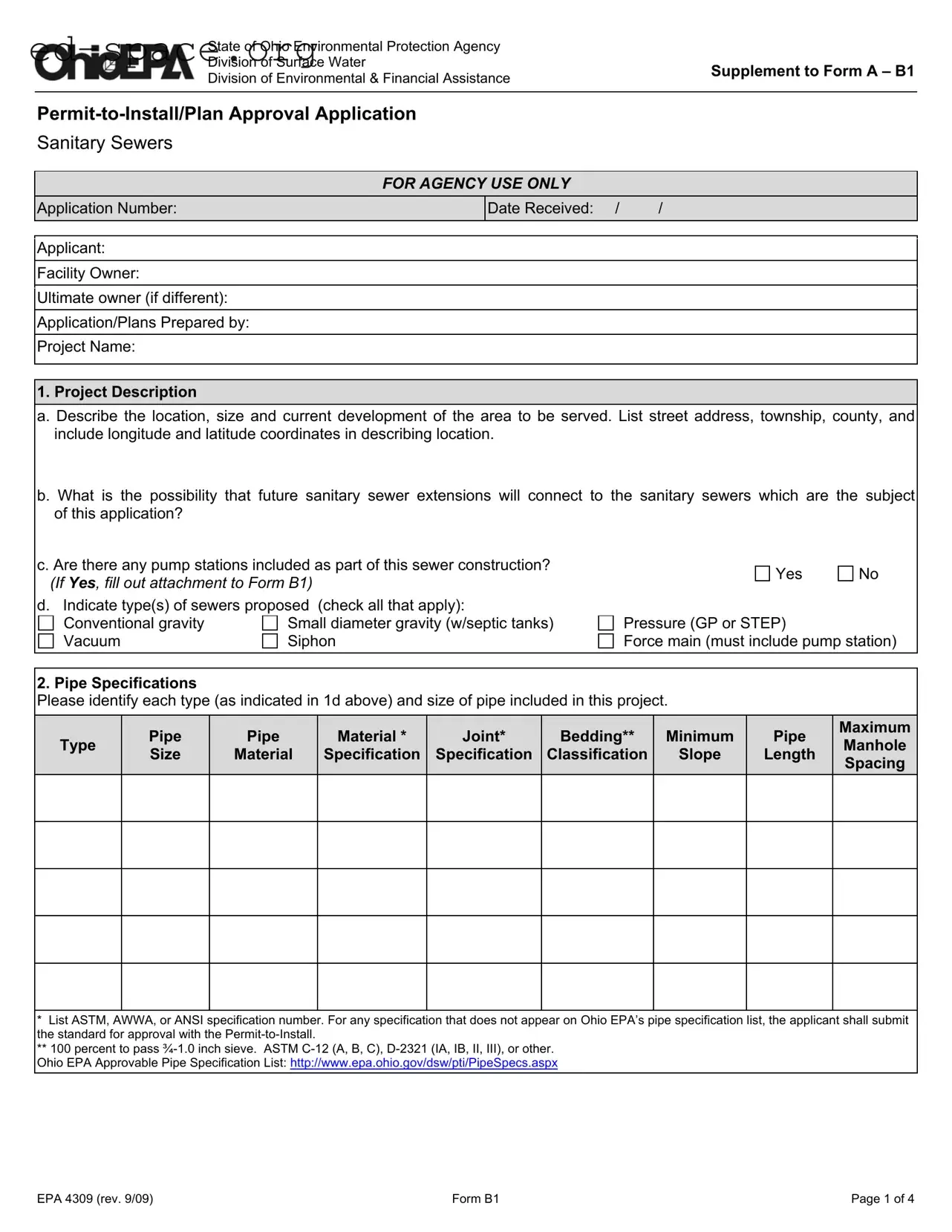
The Ohio EPA 4309 form plays a crucial role in the process of applying for a permit to install or seek plan approval for sanitary sewer systems. This form, specifically a supplement to Form A – B1, is designed for applicants looking to ensure compliance with environmental regulations. It requires detailed information about the project, including the location, size, and current development of the area that will be served by the proposed sewer system. Applicants must describe the potential for future sewer extensions and indicate whether pump stations are part of the construction. The form also collects technical specifications, such as pipe types and sizes, design flow estimates, and the capacity of the receiving wastewater treatment facility. Furthermore, it addresses critical considerations like stream protection, manhole design, and the protection of water supplies. Each section of the form is essential for evaluating the project’s impact on the environment and ensuring that it meets state standards. By providing comprehensive information, applicants contribute to a thorough review process that prioritizes public health and environmental safety.
State of Ohio Environmental Protection Agency |
|
|
Division of Surface Water |
Supplement to Form A – B1 |
|
Division of Environmental & Financial Assistance |
||
|
||
|
|
Sanitary Sewers
FOR AGENCY USE ONLY
Application Number:
Date Received: / |
/ |
|
|
Applicant:
Facility Owner:
Ultimate owner (if different):
Application/Plans Prepared by:
Project Name:
1. Project Description
a. Describe the location, size and current development of the area to be served. List street address, township, county, and include longitude and latitude coordinates in describing location.
b. What is the possibility that future sanitary sewer extensions will connect to the sanitary sewers which are the subject of this application?
c. Are there any pump stations included as part of this sewer construction? (If Yes, fill out attachment to Form B1)
d. Indicate type(s) of sewers proposed (check all that apply):
Conventional gravity |
Small diameter gravity (w/septic tanks) |
Vacuum |
Siphon |
Yes |
No |
Pressure (GP or STEP)
Force main (must include pump station)
2. Pipe Specifications
Please identify each type (as indicated in 1d above) and size of pipe included in this project.
Type |
Pipe |
Pipe |
Material * |
Joint* |
Bedding** |
Minimum |
|
Size |
Material |
Specification |
Specification |
Classification |
Slope |
||
|
Pipe
Length
Maximum
Manhole
Spacing
*List ASTM, AWWA, or ANSI specification number. For any specification that does not appear on Ohio EPA’s pipe specification list, the applicant shall submit the standard for approval with the
** 100 percent to pass
EPA 4309 (rev. 9/09) |
Form B1 |
Page 1 of 4 |
3. Design Flow in Proposed Sewer
Identify flows expected at
|
Average Daily Flow |
|
Peak Hourly Flow |
||
|
MGD |
|
|
MGD |
|
Design Flows (based on planned area served) |
|
MGD |
|
|
MGD |
|
|
|
|||
Hydraulic Capacity of Sewer |
|
MGD |
|
|
MGD |
|
|
|
|||
|
|
|
|
|
|
Assumptions used to calculate above flows: (check all that apply) |
|
|
|
Design |
|
|||||
Residential Population at: |
|
gal/home* |
|
homes |
|
|
|
homes |
|
|
|
|
|
|
|
|
|
|
|
|
|
Residential Population at: |
|
gal/cap/day |
|
people |
|
|
|
people |
|
|
|
|
|
|
|
|
|
|
|
|
|
|
MGD |
|
|
|
MGD |
|
||||
|
|
|
|
|
|
|
|
|
||
Computer Flow Modeling Results (attach explanation and data) |
|
|
|
|
|
|
|
|||
*120 gallon/bedroom in accordance w/ OAC
4. Receiving Wastewater Treatment Facility
a. What treatment facility will be receiving flow from these sewers?
Present treatment facility average daily flow |
|
MGD (based on |
/20 |
(month/year) ADF)* |
|
|
|
|
|
Proposed treatment facility average daily flow (based on present average daily flow plus all connections currently under construction or being designed)
Design average daily flow of the treatment facility |
MGD (based on |
b.Does the treatment facility have adequate capacity to treat anticipated flows from existing sewers plus the proposed sewers based on the sewer's design capacity?
If No, on a separate sheet, please describe the steps being taken to ensure that the treatment facility has adequate capacity. Include specific work items and schedules as appropriate.
MGD design year)
Yes No
c. Is there intent to expand the treatment facility to treat additional flows?
Yes
No
*Note: Flow data to be no older than one calendar year from date of PTI submission
5. Sewer Design
a. Are the sewers deep enough to serve all adjacent basements?
(refer to GLUMRB, Recommended Standards for Wastewater Facilities, 2004, Section 33.2)
If No, please explain how the basements will be served:
b. Are sewers at a sufficient depth to prevent freezing? (GLUMRB Section 33.2)
If No, please explain how freezing will be prevented:
c. Where small sewers join larger ones, have the inverts of the larger sewers been lowered sufficiently to maintain the same energy gradient? (GLUMRB Section 33.6)
d. Have provisions been made to protect sewers against displacement by erosion and impact at velocities over 15 fps? (GLUMRB Section 33.45)
e. Are sewers with slopes greater than 20 percent secured with concrete anchors (or equal), spaced as required? (GLUMRB Section 33.46)
f. Are there any overflows or bypasses upstream of the point of connection that may be impacted by the flows from the new sewer?
g. Are there any sanitary overflows or bypasses or combined sewer overflows downstream of the point of connection?
* (If Yes to f. or g., on a separate sheet provide a description of the exact location of any overflows or bypasses)
Yes No
Yes No
Yes No
Yes No
Yes No
Yes* No
Yes* No
N/A
N/A
N/A
h. Is the force main designed to withstand water hammer pressures and associated cyclic reversal of stresses that are expected with the cycling of wastewater pump stations?
(GLUMRB Section 49.4)
If No, please explain:
Yes
No
N/A
EPA 4309 (rev. 9/09) |
Form B1 |
Page 2 of 4 |
6. Stream Protection
a. Are there any stream crossings? (If Yes, fill out the stream evaluation addendum) |
|
Yes* |
No |
|
||
If Yes, |
|
|
|
|
|
|
1. |
How many crossings are made? (GLUMRB Section 36.14) |
Number of crossings: |
|
|
|
|
|
|
|
|
|
|
|
2. |
Are the crossings perpendicular to the stream? (GLUMRB Section 36.14) |
|
|
Yes |
No |
|
3. |
Are crossings to be made at previously disturbed areas? |
|
|
Yes |
No |
|
4. |
Is the streambed substrate composed primarily of solid rock, sand and gravel, or silt? |
Rock |
Sand/gravel |
Silt |
||
5. |
In areas of steep slope or unstable soils, are the sewers located on more level, terraced areas? |
Yes |
No |
N/A |
||
6. |
Are the sewers at a sufficient depth to protect the sewer line? (GLUMRB Section 36.11) |
|
Yes |
No |
N/A |
|
b. Do any sewers run parallel to any streams? |
|
|
Yes* |
No |
|
|
If Yes, |
|
|
|
|
|
|
1. |
Is there any woody vegetation along the stream banks? |
|
|
Yes |
No |
|
2. |
Are the sewers and construction easements located outside of the vegetated areas? |
|
Yes |
No |
N/A |
|
3. |
In areas of steep slope or unstable soils, are the sewers located on more level, terraced areas? |
Yes |
No |
N/A |
||
*If the response to either a. or b. is Yes, please provide the specific measures in the detail plans and specifications that will be used to ensure that damage to the stream corridor is minimized to the greatest extent possible and that the stream corridor is restored to original condition.
7. Manhole Design
a. Manhole type (precast
b. Material specification (ASTM):
c. Joint specification (ASTM):
d. Are watertight frames and covers used wherever manhole tops may be flooded by street runoff or high water?
If No, explain*:
e. Are manholes provided at the upstream end of each line? (GLUMRB Section 34.1)
If No, explain*:
Yes
Yes
No
No
N/A
f. Are manholes provided at all changes in size, grade, and alignment? (GLUMRB Section 34.1)
If No, explain*:
Yes
No
g. Are manholes provided at all sewer intersections? (GLUMRB Section 34.1)
If No, explain*:
Yes
No
h. Are drop manholes provided where the entrance sewer invert is 24 inches or more above the manhole invert?
If No, explain*:
i. Are inlet/outlet pipes connected with gasketed flexible watertight connections? (GLUMRB Section 34.6)
If No, explain*:
* Attach any additional sheets necessary for explanations.
Yes
Yes
No
No
N/A
8. Protection of Water Supplies
a. Are there any physical connections between the sewer and a public or private potable water supply system (including all appurtenances)?
b. Are any existing public waterworks units (for example public supply wells, water treatment facilities, storage facilities) within 200 feet of the proposed sewer or any private wells within
50 feet of the proposed sewer?
Yes
Yes
No
No
If Yes, specify the plan sheets on which the sources are shown: |
|
|
|
If Yes, will sewers be encased or constructed of watertight pipe? |
Encased |
Watertight |
|
c. Are the sewers at least 10 feet horizontally separated from water lines? (GLUMRB Section 38.31) |
Yes |
||
If No, please specify the plan sheets where these conditions are not met & describe the measures taken to ensure protection of the water system:
No
d. When crossing water mains, are the sewers at least 18 inches below water lines? |
Yes |
If No, please specify the plan sheets on which these conditions are not met and describe the measures taken to ensure protection of the water system:
No
EPA 4309 (rev. 9/09) |
Form B1 |
Page 3 of 4 |
9. Installation and Testing
a. Installation Inspector:
Name:Firm:
Street Address:
City:State:
b. What type of sewer leakage test will be used? (GLUMRB 33.9)
Page numbers in specifications for testing requirements of gravity and pressure sewers:
c. Is flexible pipe deflection testing specified? (GLUMRB 33.85)
Page numbers in specifications for testing requirements of flexible pipe:
d. What type of manhole testing will be used? (GLUMRB Section 34.7)
Page numbers in specifications for testing requirements of manholes:
Phone: ( ) |
- |
|||
|
Zip: |
|
|
|
|
|
|
||
|
|
|
|
|
Hydrostatic |
Air |
|||
|
|
|
|
|
Yes |
No |
N/A |
||
|
|
|
|
|
|
|
|
|
|
|
|
|
|
|
|
|
|
|
|
10. Sewer Use Ordinance
A statement that "Roof drains, foundation drains, and other clean water connections to the sanitary sewer system are prohibited" must be shown on the plans. Copies of the ordinances or regulations providing for the enforcement of this requirement must be on file with Ohio EPA.
a. An ordinance/regulation to this effect was adopted on: |
/ / |
(date). |
|
|
|
||
|
|
|
|
|
|
|
|
b. Enforcement of this ordinance/regulation is the responsibility of: |
|
|
|
|
|||
Name: |
|
|
|
|
|
||
|
|
|
|
|
|
|
|
Title: |
|
|
|
|
|
||
|
|
|
|
|
|||
c. It is the opinion of the engineer submitting these plans that adequate enforcement |
|
|
|
||||
of this ordinance/regulation is being properly carried out. |
|
Yes |
No |
Unknown |
|||
11. Authorities
a. Plans for the proposed installation of a county, village, or municipal sewer that is tributary to a sewage treatment plant with another political entity must be accompanied by written consent of both entities.
Is a written
Yes
No
N/A
12. Submittals:
This application must include the following unless otherwise directed by Ohio EPA:
Four copies of the detail plans including profile and plan views of all sewers (shown on the same sheet), existing (as applicable) and proposed pump station facilities, incorporating all of the details outlined in Section 20.1, 20.2 and 20.3 of Recommended Standards for Wastewater Facilities.
Two copies of complete technical specifications.
Two copies of the Application including Form A, pertinent B & C form(s), and antidegradation addendum (if applicable)
13. The foregoing data is a true statement of facts pertaining to this proposed sanitary sewer installation.
Date: |
/ |
/ |
Signed: |
|
P.E. |
|
|
|
|
|
|
Plans prepared by:
EPA 4309 (rev. 9/09) |
Form B1 |
Page 4 of 4 |
| Fact Name | Details |
|---|---|
| Form Title | Supplement to Form A – B1 for Permit-to-Install/Plan Approval Application related to Sanitary Sewers |
| Governing Laws | Ohio Administrative Code (OAC) 3745-42-05 and GLUMRB Recommended Standards for Wastewater Facilities |
| Application Requirement | Must include four copies of detailed plans and two copies of technical specifications |
| Submission Deadline | Flow data must be no older than one calendar year from the date of submission |
| Manhole Specifications | Watertight frames and covers are required where flooding may occur |
| Stream Protection | Specific measures must be taken to minimize damage to the stream corridor if stream crossings are present |
Completing the Ohio EPA 4309 form is an essential step in the application process for sanitary sewer installations. This form gathers detailed information about the project, including the design, specifications, and anticipated flows. Once the form is filled out correctly, it will be submitted for review by the Ohio Environmental Protection Agency.
What is the purpose of the Ohio EPA 4309 form?
The Ohio EPA 4309 form is a supplementary application used for the Permit-to-Install or Plan Approval for sanitary sewer systems. It provides detailed information about the proposed project, including the location, design specifications, and anticipated flow rates. This form is essential for ensuring that the proposed sewer system complies with environmental regulations and meets the necessary standards for public health and safety.
What information is required to complete the Ohio EPA 4309 form?
To complete the Ohio EPA 4309 form, applicants must provide various details. This includes a project description, pipe specifications, expected design flows, and information about the wastewater treatment facility that will receive the sewage. Additionally, the form requires details about sewer design, stream protection measures, manhole design, and any potential impacts on water supplies. It is crucial to ensure that all information is accurate and complete, as this will facilitate the review process by the Ohio EPA.
How does the Ohio EPA evaluate the submitted form?
The Ohio EPA reviews the submitted Ohio EPA 4309 form to assess compliance with environmental regulations and standards. This evaluation includes examining the proposed sewer system's design, capacity, and potential impacts on the surrounding environment. The agency may also consider any existing infrastructure and future development plans. If the application meets all requirements, the Ohio EPA will issue the necessary permits for installation or approval.
What should an applicant do if their project involves stream crossings?
If a project involves stream crossings, the applicant must fill out a stream evaluation addendum as part of the Ohio EPA 4309 form submission. This addendum should detail the number of crossings, their alignment relative to the stream, and any protective measures planned to minimize environmental impact. The applicant should also ensure that the sewer design accounts for the specific conditions of the stream corridor to protect it during construction and operation.
Incomplete Information: Failing to provide all required details, such as the project description, can lead to delays. Ensure every section is filled out completely.
Incorrect Measurements: Providing inaccurate longitude and latitude coordinates can result in misidentification of the project location. Double-check all measurements before submission.
Missing Attachments: Neglecting to include necessary attachments, like the pump station details, can cause the application to be rejected. Review the checklist to ensure all documents are included.
Failure to Update Flow Data: Using outdated flow data can misrepresent the capacity needs of the treatment facility. Ensure that flow data is current and reflects the latest conditions.
Ignoring Design Standards: Not adhering to the recommended design standards for sewer depth and slope can lead to operational issues. Review guidelines to ensure compliance.
Inadequate Stream Protection Measures: Failing to address stream crossings or parallel sewer lines can result in environmental damage. Include detailed plans to protect water bodies.
Neglecting Manhole Specifications: Not specifying the type and material of manholes can lead to structural failures. Clearly indicate all specifications in the application.
Improper Sewer Use Ordinance: Not including the required statement about prohibiting clean water connections can lead to legal complications. Ensure this statement is clearly stated on the plans.
The Ohio EPA 4309 form is an essential document used in the permitting process for sanitary sewer installations. However, it often accompanies several other forms and documents that provide additional information and support for the application. Here’s a list of related documents that may be necessary or beneficial when submitting the Ohio EPA 4309 form.
Each of these documents plays a crucial role in the successful submission and approval of the Ohio EPA 4309 form. They collectively ensure that all aspects of the proposed sewer installation are thoroughly evaluated and compliant with state and federal regulations. Understanding these forms and their purposes can help streamline the application process and contribute to the effective management of Ohio’s water resources.
The Ohio EPA 4309 form is crucial for the application process related to sanitary sewer installations. Several other documents share similarities with this form, primarily in their focus on environmental compliance and infrastructure planning. Below are six documents that are comparable to the Ohio EPA 4309 form:
When filling out the Ohio EPA 4309 form, it's crucial to follow certain guidelines to ensure your application is processed smoothly. Here are six do's and don'ts to keep in mind:
This form is also used for modifications or expansions of existing sanitary sewer systems. It ensures that any changes comply with environmental regulations.
Filling out the Ohio EPA 4309 requires detailed information about the project. This includes technical specifications and flow calculations, which can take time to gather.
While engineers often complete the form, anyone involved in the project, such as the facility owner or applicant, should understand its requirements and implications.
Submitting the form does not guarantee that the project will be approved. The Ohio EPA reviews each application carefully to ensure compliance with regulations.
The Ohio EPA requires specific supporting documents, such as plans and technical specifications, to accompany the form for it to be considered complete.
Applicants can amend the form if necessary. However, it’s important to communicate any changes to the Ohio EPA promptly.
Even small towns or individual projects may need to fill out this form. It applies to any sanitary sewer installation or modification.
Even if a project is not near a stream, the form requires consideration of potential impacts on water supplies and ecosystems. This is to ensure comprehensive environmental protection.
Filling out the Ohio EPA 4309 is just one part of a larger permitting process. Additional approvals and inspections may be needed before a project can proceed.
When filling out and using the Ohio EPA 4309 form, there are several key points to keep in mind to ensure a smooth application process. Here are some important takeaways:
By keeping these points in mind, applicants can navigate the Ohio EPA 4309 form more effectively, helping to facilitate the approval process for their sanitary sewer projects.