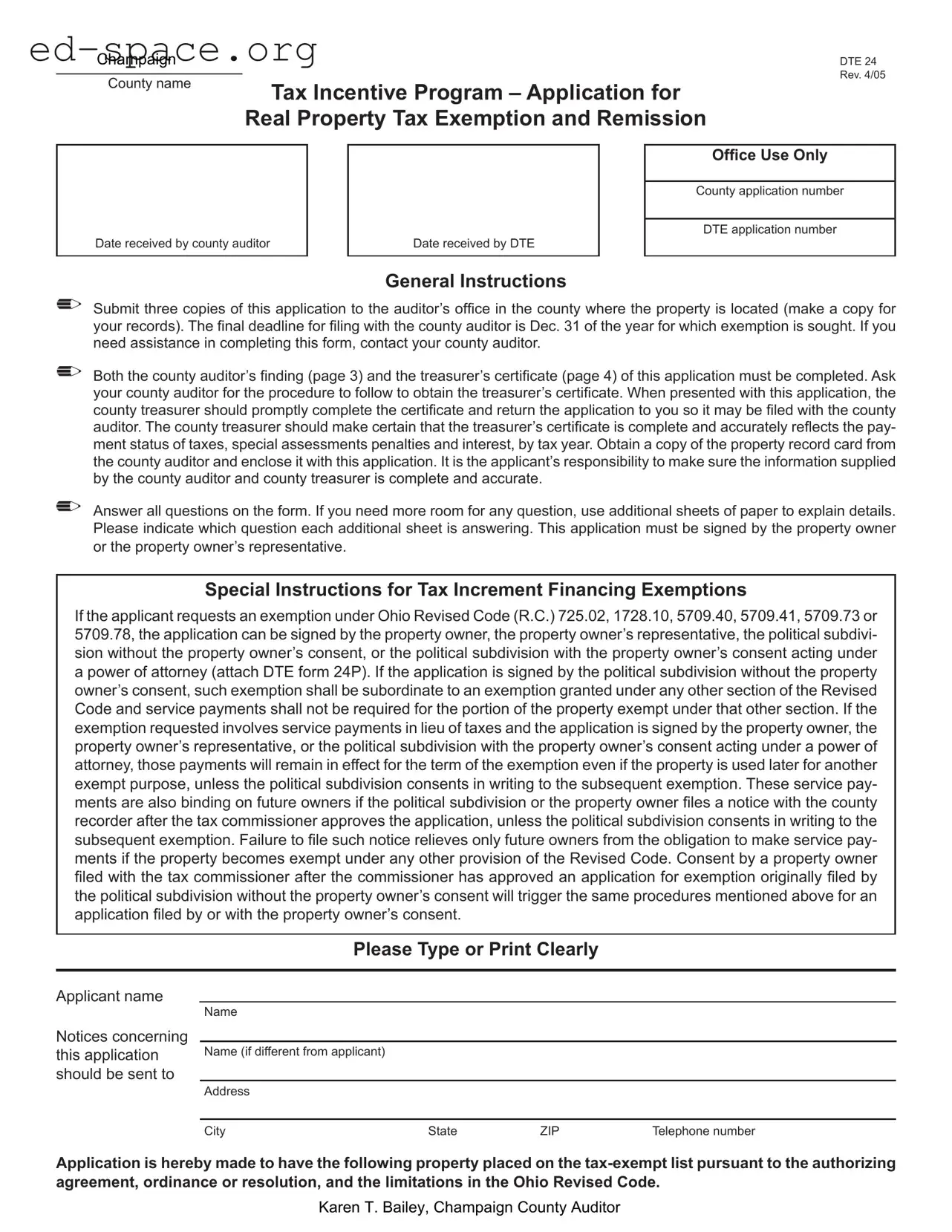
The Ohio DTE 24 form serves as a vital tool for property owners seeking tax exemptions or remissions under various tax incentive programs in Ohio. This application is specifically designed for real property tax exemption requests and must be submitted to the county auditor's office where the property is located. To ensure a smooth application process, individuals must provide three copies of the completed form, along with a copy of the property record card. Key deadlines are crucial; the final date for filing with the county auditor is December 31 of the year for which the exemption is requested. The form includes sections for detailed information about the property, including parcel numbers, school district, and the specific sections of the Ohio Revised Code under which the exemption is sought. Additionally, it requires signatures from the property owner or their representative, and includes special instructions for those applying under tax increment financing provisions. The application also mandates the completion of both the county auditor's findings and the treasurer’s certificate, ensuring that all taxes and assessments on the property are accounted for. Failure to adhere to these requirements may result in delays or denial of the exemption request.

Champaign
County name
DTE 24
Rev. 4/05
Tax Incentive Program – Application for
Real Property Tax Exemption and Remission
Date received by county auditor
Date received by DTE
Offi ce Use Only
County application number
DTE application number
General Instructions
Submit three copies of this application to the auditor’s office in the county where the property is located (make a copy for your records). The final deadline for filing with the county auditor is Dec. 31 of the year for which exemption is sought. If you need assistance in completing this form, contact your county auditor.
Both the county auditor’s finding (page 3) and the treasurer’s certificate (page 4) of this application must be completed. Ask your county auditor for the procedure to follow to obtain the treasurer’s certificate. When presented with this application, the county treasurer should promptly complete the certificate and return the application to you so it may be filed with the county auditor. The county treasurer should make certain that the treasurer’s certificate is complete and accurately reflects the pay- ment status of taxes, special assessments penalties and interest, by tax year. Obtain a copy of the property record card from the county auditor and enclose it with this application. It is the applicant’s responsibility to make sure the information supplied by the county auditor and county treasurer is complete and accurate.
Answer all questions on the form. If you need more room for any question, use additional sheets of paper to explain details. Please indicate which question each additional sheet is answering. This application must be signed by the property owner or the property owner’s representative.
Special Instructions for Tax Increment Financing Exemptions
If the applicant requests an exemption under Ohio Revised Code (R.C.) 725.02, 1728.10, 5709.40, 5709.41, 5709.73 or 5709.78, the application can be signed by the property owner, the property owner’s representative, the political subdivi- sion without the property owner’s consent, or the political subdivision with the property owner’s consent acting under a power of attorney (attach DTE form 24P). If the application is signed by the political subdivision without the property owner’s consent, such exemption shall be subordinate to an exemption granted under any other section of the Revised Code and service payments shall not be required for the portion of the property exempt under that other section. If the exemption requested involves service payments in lieu of taxes and the application is signed by the property owner, the property owner’s representative, or the political subdivision with the property owner’s consent acting under a power of attorney, those payments will remain in effect for the term of the exemption even if the property is used later for another exempt purpose, unless the political subdivision consents in writing to the subsequent exemption. These service pay- ments are also binding on future owners if the political subdivision or the property owner files a notice with the county recorder after the tax commissioner approves the application, unless the political subdivision consents in writing to the subsequent exemption. Failure to file such notice relieves only future owners from the obligation to make service pay- ments if the property becomes exempt under any other provision of the Revised Code. Consent by a property owner filed with the tax commissioner after the commissioner has approved an application for exemption originally filed by the political subdivision without the property owner’s consent will trigger the same procedures mentioned above for an application fi led by or with the property owner’s consent.
Please Type or Print Clearly
Applicant name
Name
Notices concerning
this application Name (if different from applicant) should be sent to
Address
City |
State |
ZIP |
Telephone number |
Application is hereby made to have the following property placed on the
Karen T. Bailey, Champaign County Auditor

1.Parcel number(s).(If more than four, continue on an attached sheet.) All parcels must be in the same school district.
a)
b)
c)
d)
DTE 24
Rev. 4/05
Page 2
2.School district where located
3.Street address or location of property
4.a) Title to this property is in the name of b) Address of owner
5.Date title was acquired
6.If title holder is different from applicant, please explain
7.Under what section(s) of the Ohio Revised Code is exemption sought?
§725.02 |
§1728.10 |
§5709.40(B) |
§5709.40(C) |
§5709.41 |
|
|
|
|
|
§5709.62 |
§5709.63 |
§5709.71 |
§5709.73(B) |
§5709.73(C) |
§5709.78(A) |
§5709.78(B) |
§5709.88 |
|
|
|
|
|
|
|
Other incentive program, specify R.C. section
8.Explain terms and details of incentive (real property included, percentage exempted, number of years, etc.).
9.a) Attach a copy of the resolution or ordinance of the subdivision granting the incentive and/or the applicant’s incentive agreement with the subdivision.
b) Attach a copy of school district approval (if required).
10.If this application requests exemption under a tax increment financing provision (see special instructions), please indicate whether the application is being filed.
By the property owner |
By the political subdivision without owner consent |
By the political subdivision with owner consent (attach copies of DTE form 24P)
I declare under penalty of perjury that I have examined this application and, to the best of my knowledge and belief, it is true, correct and complete.
Applicant or representative signature
Print name and title
Address
City |
State |
ZIP code |
Telephone number |
Date |
DTE 24
Rev. 4/05
Page 3
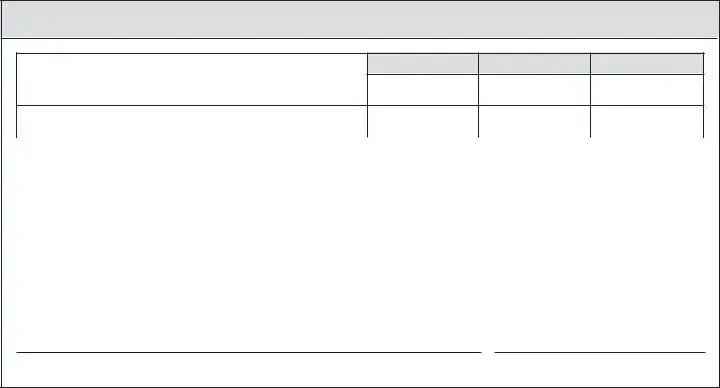
County Auditor’s Finding
Taxable value in year of application |
|
(tax year) |
Land
Building
Total
Taxable value in prior year |
|
(tax year) |
|
|
|
|
|
|
|||
|
|
|
|
||
This application covers property that is (check all that apply): |
|
|
|||
Currently exempt* |
New construction on previously exempted parcel |
Currently on CAUV |
|||
Previously exempt |
Previously on CAUV |
|
|
||
Auditor’s recommendation Grant |
Partial grant |
Deny |
None |
||
Comments: |
|
|
|
|
|
County auditor (signature) |
Date |
Forward two copies of the completed application to the Ohio Department of Taxation, Tax Equalization Division, P.O. Box 530, Columbus, OH
*If the property or any portion of the property is currently exempt, please indicate below the type of exemption, the portion of property exempted and the tax years to which the current exemption applies.
DTE 24
Rev. 4/05
Page 4
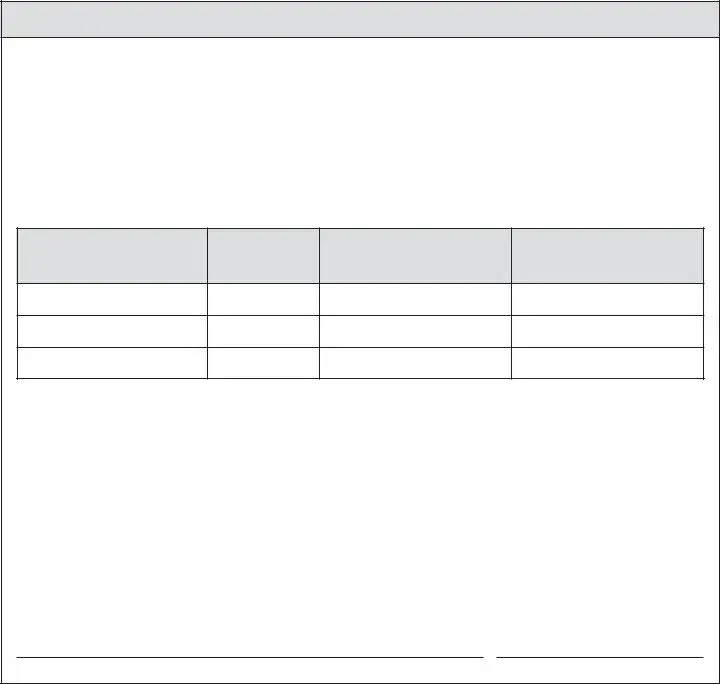
Treasurer’s Certificate
If the treasurer’s certifi cate is not properly fi lled out and signed, the tax commissioner will have no jurisdiction to act on the application and it will be subject to dismissal.
(Notice to treasurer: The fi rst paragraph of this certifi cate must always be complete.)
I hereby certify that all taxes, special assessments, penalties and interest levied and assessed against the above
described property have been paid in full to up and including the tax year |
|
|
. The most recent year for which |
|
|
|
|||
taxes and special assessments have been charged is tax year |
|
|
. |
|
|
|
|
||
I further certify that the only unpaid taxes, special assessments, penalties and interest that have been charged against this property are as follows:
Parcel Number
Tax Year
Taxes
(including penalties
and interest)
Special Assessments (including penalties and interest)
If additional years are unpaid, please list on an attached sheet.
Have tax certifi cates been sold under R.C. 5721.32 or 5721.33 for any of the property |
Yes |
No |
|
subject to this application? |
|
|
|
Are any unpaid taxes listed on this certifi cate subject to a valid delinquent tax contract |
Yes |
No |
|
under R.C. 323.31(A)? If unpaid taxes are subject to a valid delinquent tax contract, |
|
|
|
please indicate which tax years’ charges are included in the contract. |
|
|
|
If yes, list tax years |
|
|
|
Comments: |
|
|
|
County treasurer (signature) |
Date |
| Fact Name | Description |
|---|---|
| Form Purpose | The Ohio DTE 24 form is used to apply for real property tax exemptions and remissions under various tax incentive programs. |
| Filing Deadline | Applicants must submit the DTE 24 form to the county auditor by December 31 of the year for which the exemption is requested. |
| Required Copies | Three copies of the application must be submitted to the county auditor's office, along with a property record card. |
| Governing Laws | This form is governed by various sections of the Ohio Revised Code, including R.C. 725.02, 1728.10, and 5709.40 through 5709.78. |
| Signature Requirement | The application must be signed by the property owner or their representative. If signed by a political subdivision, specific conditions apply. |
Filling out the Ohio DTE 24 form is an essential step in applying for a real property tax exemption. This process requires careful attention to detail, as accurate information is crucial for a successful application. After completing the form, it will need to be submitted to the county auditor's office along with any required documents.
What is the Ohio DTE 24 form?
The Ohio DTE 24 form is an application used to request a real property tax exemption and remission under specific tax incentive programs. It is necessary for property owners seeking to have their property placed on the tax-exempt list as authorized by various sections of the Ohio Revised Code.
How do I submit the Ohio DTE 24 form?
To submit the DTE 24 form, you must provide three copies to the auditor’s office in the county where the property is located. It is also advisable to keep one copy for your records. The final deadline for filing this application with the county auditor is December 31 of the year for which the exemption is being sought.
What information is required on the DTE 24 form?
The form requires various details including the applicant's name, property parcel number, school district, street address, and the section of the Ohio Revised Code under which the exemption is sought. Additionally, the applicant must provide information about the property’s title and any relevant agreements or resolutions related to the exemption.
Who can sign the DTE 24 form?
The application must be signed by the property owner or their representative. If the application is being filed for tax increment financing exemptions, it can also be signed by a political subdivision either with or without the property owner's consent. In cases where consent is given, a power of attorney must be attached.
What happens if I miss the filing deadline?
If the application is not filed by the December 31 deadline, the request for exemption may be denied. It is crucial to adhere to this timeline to ensure eligibility for tax exemption in the intended year.
What is the role of the county auditor in this process?
The county auditor reviews the application and provides a finding on the taxable value of the property. The auditor also completes a section of the application, indicating whether the exemption is recommended, partially granted, or denied.
What is the purpose of the treasurer's certificate?
The treasurer's certificate is a critical part of the application. It certifies that all taxes, special assessments, penalties, and interest on the property have been paid in full. If this certificate is not properly filled out and signed, the application may be dismissed.
What should I do if I need more space to answer questions on the form?
If additional space is needed, you can use extra sheets of paper. It is important to indicate which question each additional sheet is addressing to maintain clarity in your application.
What happens after I submit the DTE 24 form?
After submission, the county auditor will review the application and make a determination. Two copies of the completed application are then forwarded to the Ohio Department of Taxation for further processing. You will receive notification regarding the status of your application.
What are the consequences of not providing accurate information?
Providing inaccurate information can lead to the denial of the exemption request. It is the applicant's responsibility to ensure that all information is complete and correct, as any discrepancies may affect the outcome of the application.
Not submitting the required three copies of the application to the county auditor’s office. It's essential to keep one copy for personal records.
Missing the deadline for filing. The final deadline is December 31 of the year for which the exemption is sought.
Failing to complete both the county auditor’s finding and the treasurer’s certificate sections. These are crucial for the application to be processed.
Not obtaining a copy of the property record card from the county auditor. This document must be enclosed with the application.
Overlooking the need to answer all questions on the form. If more space is needed, use additional sheets and clearly indicate which question they address.
Forgetting to sign the application. It must be signed by the property owner or their representative.
Not attaching necessary documents, such as the resolution or ordinance granting the incentive and any required school district approval.
Failing to specify under which section(s) of the Ohio Revised Code the exemption is sought. This is a critical part of the application.
Submitting an incomplete treasurer’s certificate. If this section is not properly filled out and signed, the application may be dismissed.
Not checking the status of unpaid taxes or assessments. This information is vital and must be accurately reported in the application.
The Ohio DTE 24 form is a crucial document for those seeking a real property tax exemption or remission. However, several other forms and documents often accompany it to ensure a smooth application process. Below is a list of these essential documents, each serving a specific purpose in the overall application procedure.
Understanding the purpose of these accompanying documents can significantly enhance the likelihood of a successful application for tax exemption. Each form plays a vital role in demonstrating eligibility and ensuring compliance with local regulations. By preparing these documents thoroughly, applicants can navigate the process more effectively and with greater peace of mind.
When filling out the Ohio DTE 24 form, here are five things you should and shouldn't do:
Understanding the Ohio DTE 24 form can be challenging, and several misconceptions often arise. Here are six common misunderstandings about this form:
This is not true. The final deadline for filing the DTE 24 form with the county auditor is December 31 of the year for which the exemption is sought. Timely submission is crucial to ensure eligibility.
While property owners typically submit the form, it can also be signed by a representative or a political subdivision with or without the property owner's consent. This flexibility allows for various scenarios in which the form can be completed.
This is incorrect. Along with the DTE 24 form, applicants must attach a copy of the resolution or ordinance granting the incentive, as well as any necessary school district approvals. Missing documents can lead to delays or denial of the application.
This is a critical misunderstanding. The treasurer's certificate must be properly filled out and signed; otherwise, the tax commissioner will dismiss the application. Ensuring this document is complete is essential for the process to proceed.
This is misleading. If there are unpaid taxes, special assessments, penalties, or interest on the property, it could impact the eligibility for the exemption. The treasurer's certificate must accurately reflect the payment status.
Submitting the form does not guarantee an exemption. The county auditor will review the application and make a recommendation, which may result in a grant, partial grant, or denial based on the provided information and compliance with the relevant laws.
Here are some key takeaways about filling out and using the Ohio DTE 24 form:
Following these guidelines will help ensure that your application is processed smoothly.