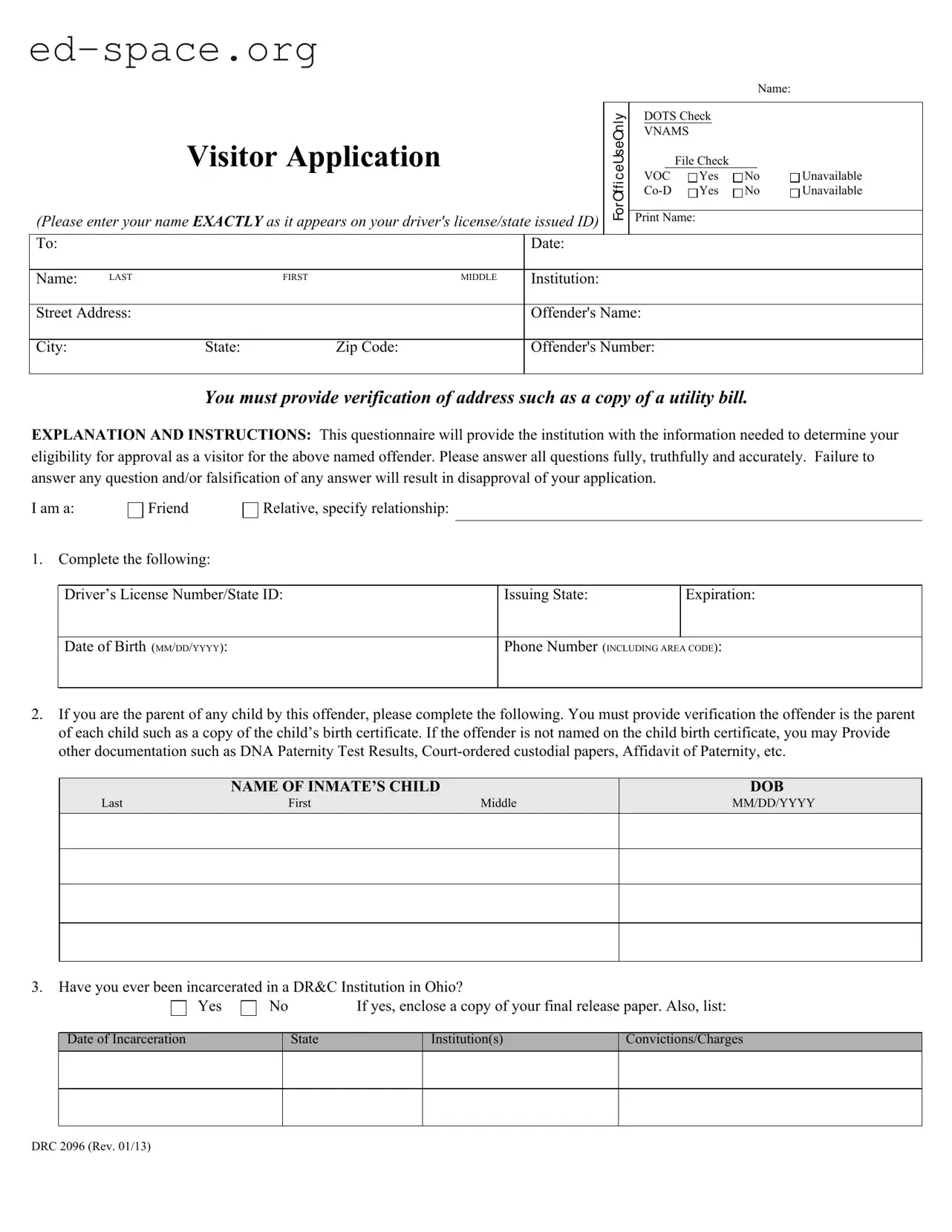
The Ohio DRC 2096 form is a crucial document for anyone wishing to visit an offender in a correctional facility in Ohio. This application serves as a means for the Department of Rehabilitation and Correction to assess the eligibility of potential visitors. It requires personal information, including your name, address, and relationship to the offender, along with necessary verification documents such as utility bills or birth certificates for children of the offender. The form also delves into your criminal history, asking if you have ever been incarcerated or involved in any legal proceedings. If you have, you will need to provide additional documentation, such as release papers or letters from your probation officer. This thorough approach ensures that all visitors are screened properly, maintaining safety and security within the facilities. After submitting the form, your status will initially be tentatively approved, pending verification during your first visit. Understanding the details and requirements of the DRC 2096 form is essential for a smooth application process, allowing you to focus on reconnecting with your loved one.
|
|
|
|
|
|
|
|
|
|
|
Name: |
|
|
|
|
|
|
|
|
|
|
|
|
|
|
|
|
|
|
|
|
y |
DOTS Check |
|
|
|
||
|
|
Visitor Application |
|
|
eUseOc nl |
VNAMS |
|
|
|
|
||
|
|
|
|
VOC |
Yes |
No |
Unavailable |
|||||
|
|
|
|
|
|
|
|
File Check |
|
|
|
|
|
|
|
|
|
|
ForOffi |
Print Name: |
Yes |
No |
Unavailable |
||
|
|
|
|
|
|
|
||||||
(Please enter your name EXACTLY as it appears on your driver's license/state issued ID) |
|
|
|
|
|
|
|
|||||
|
|
|
|
|
|
|
|
|
|
|
|
|
To: |
|
|
|
|
Date: |
|
|
|
|
|
|
|
|
|
|
|
|
|
|
|
|
|
|
|
|
Name: |
LAST |
|
FIRST |
MIDDLE |
Institution: |
|
|
|
|
|
|
|
|
|
|
|
|
|
|
|
|
|
|||
|
|
|
|
|
|
|
|
|
|
|
|
|
Street Address: |
|
|
|
Offender's Name: |
|
|
|
|
||||
|
|
|
|
|
|
|
|
|
|
|
|
|
City: |
|
State: |
Zip Code: |
|
Offender's Number: |
|
|
|
|
|||
|
|
|
|
|
|
|
|
|
|
|
|
|
You must provide verification of address such as a copy of a utility bill.
EXPLANATION AND INSTRUCTIONS: This questionnaire will provide the institution with the information needed to determine your eligibility for approval as a visitor for the above named offender. Please answer all questions fully, truthfully and accurately. Failure to
answer any question and/or falsification of any answer will result in disapproval of your application.
I am a: |
Friend |
Relative, specify relationship: |
1.Complete the following:
Driver’s License Number/State ID:
Issuing State:
Expiration:
Date of Birth (MM/DD/YYYY):
Phone Number (INCLUDING AREA CODE):
2.If you are the parent of any child by this offender, please complete the following. You must provide verification the offender is the parent of each child such as a copy of the child’s birth certificate. If the offender is not named on the child birth certificate, you may Provide other documentation such as DNA Paternity Test Results,
NAME OF INMATE’S CHILD
Last |
First |
Middle |
DOB
MM/DD/YYYY
3.Have you ever been incarcerated in a DR&C Institution in Ohio?
Yes |
No |
If yes, enclose a copy of your final release paper. Also, list: |
Date of Incarceration
State
Institution(s)
Convictions/Charges
DRC 2096 (Rev. 01/13)

4.Are you now a party to any criminal action or proceeding?
5.Are you now or have you ever been on probation or parole?
Yes
Yes
No
No
If you answered “yes” to questions 4 or 5 attach a letter detailing any indictments, convictions, sentencing information, details of the offense, State and County involved, name and phone number of your probation/parole officer. Also include a copy of your final release papers along with a letter from your probation/parole officer granting permission to visit.
6. Are you now or have you ever been employed by the DR&C? |
(Contract Employee, Volunteer, Intern or Unpaid Staff) |
||
Yes |
No |
if yes, |
|
Location/Institution:
Position/Job Title:
Dates:
7. |
Have you ever been an accomplice or |
Yes |
No |
||
|
If yes, please explain: |
|
|
|
|
8. |
Have you ever been the victim of any crime committed by this offender? |
Yes |
No |
|
|
|
If yes, please explain: |
|
|
|
|
If your application to visit is accepted, your initial status will be tentatively approved pending verification of your identity at the time of
your first visit. If accepted after this verification, your status will be changed to approved . It is the offender’s responsibility to notify
you of your status.
I certify all answers to the above are true to the best of my knowledge.
Signature of Applicant:
Dates:
RETURN PROMPTLY TO:
Institution Name: |
|
Contact Person: |
|
|
|
Address:

State of Ohio
Ohio Department of Rehabilitation and Correction
General Visiting Instructions
1.All attire worn upon entry into the facility must be worn throughout the duration of the visit, with the exception of appropriate outerwear such as a coat and gloves.
2.Appropriate undergarments must be worn (i.e., bra, slip, and underwear).
3.No additional clothing is permitted to be carried into the facility.
4.Inappropriate attire includes, but is not limited to:
a.
b.Tops or dresses that expose the midriff or have open backs or open sides (such as any sleeveless clothing such as halter tops, tube tops, cropped tops, tank tops, and muscle shirts).
c.
d.Any clothing that inappropriately exposes undergarments.
e.Skirts, dresses, shorts, skorts, or culottes with the hem or slit above the
f.
g.Clothing with any gang related markings.
h.Clothing with obscene and/or offensive pictures, slogans, language and/or gestures.
i.
as leotards, unitards, bicycle shorts, tight jeans, or tight pants.
j.Clothing with inappropriate holes/rips, including shoulder
5.No more than one wristwatch or pocket watch will be permitted.
6.Purses, handbags, backpacks, or similar items are not permitted. Diaper bags and infant carriers, are permitted, but are subject to regular search procedures Clear plastic bags are preferred in place of diaper bags. Diaper bags may include:
a.A reasonable number of diapers and baby wipes
b.Three plastic baby bottles
c.Three plastic containers of baby food
d.One pacifier
7)All visitors are subject to clear the metal detector. The following items often prevent clearance of the metal detector:
a.Hairpins
b.Bras with metal underwires
c.Certain boots and shoes
d.Clothing with multiple zippers
e.Excessive jewelry
Name:
Date:
Wearing inappropriate clothing may result in a
visitor not being allowed to visit or not clearing the metal detector.
For directions and other information visit our web site - http://www.drc.ohio.gov/
DRC2274 (Rev. 01/06)

Declaration of Understanding
The Ohio Department of Rehabilitation and Correction has a zero tolerance for the conveyance of drugs, alcohol, and weapons into its correctional institutions. Any such act will constitute a violation of section 2921.36 of the Ohio Revised Code which states in part that “No person shall knowingly convey, or attempt to convey, onto the grounds of a detention facility (including prisons, owned and operated by the Ohio Department of Rehabilitation and Correction) or of an institution that is under the control of the department of mental health or the department of mental retardation and developmental disabilities, any of the following items:
(1)Any deadly weapon or dangerous ordnance, or any part of or ammunition for use in such deadly weapon or dangerous ordnance;
(2)Any drug of abuse, as defined in section 3719.011 of the Revised Code;
(3)Any intoxicating liquor, as defined in section 4301.01 of the Revised Code;
(4)Cash;
(5)Cellular telephone,
(6)Any product that contains tobacco including but not be limited to cigarettes, loose tobacco, cigar, snuff, chewing tobacco, or any other preparation of tobacco, tobacco substitutes, smoking paraphernalia (i.e., matches, lighter, cigarette papers, and rolling machine)
Every effort will be made to prosecute to the fullest extent of the law, any person found to be in violation of this section of the Ohio Revised Code.
I have read or it has been read to me, and I understand the above declaration. I will not bring any weapon, dangerous ordnance, ammunition, drug, intoxicating liquor, cash, cellular telephone,
Visitor |
Contractor |
Volunteer |
Other |
Name (typed or printed):
Signature:
Date:
Witness:
Date:
DRC 2554 (rev. 07/09)
| Fact Name | Details |
|---|---|
| Form Purpose | The Ohio DRC 2096 form is used to apply for visitor approval for inmates in Ohio correctional facilities. |
| Eligibility Criteria | Applicants must provide truthful and complete information. Falsifying information can lead to disapproval. |
| Required Documentation | Verification of identity and relationship to the inmate is necessary. This may include utility bills or birth certificates. |
| Criminal History Disclosure | Applicants must disclose any past incarcerations or current criminal proceedings. Additional documentation may be required. |
| Dress Code Regulations | Visitors must adhere to strict clothing guidelines, prohibiting items like see-through clothing and gang-related attire. |
| Governing Law | This form is governed by Ohio Revised Code section 2921.36, which prohibits the conveyance of contraband into correctional facilities. |
Completing the Ohio DRC 2096 form is essential for those seeking to visit an inmate. The information provided will be used to determine eligibility for visitation. It is crucial to answer all questions accurately and provide any necessary documentation to avoid disapproval.
What is the Ohio DRC 2096 form used for?
The Ohio DRC 2096 form, also known as the DOTS Check Visitor Application, is utilized by individuals seeking approval to visit offenders in Ohio correctional facilities. The form collects essential information about the applicant, including their relationship to the offender, personal identification details, and any relevant legal history. This information helps the institution determine the applicant's eligibility to visit the specified offender.
What information do I need to provide on the form?
Applicants must provide a range of information to complete the Ohio DRC 2096 form. This includes personal details such as full name, date of birth, driver's license or state ID number, and contact information. Additionally, applicants must disclose their relationship to the offender and any history of incarceration or legal issues. If applicable, documentation verifying the relationship to the offender's children must also be submitted. Failing to provide complete and truthful answers can lead to disapproval of the application.
What happens after I submit the form?
Once the Ohio DRC 2096 form is submitted, the institution will review the application to determine eligibility. If approved, the applicant will initially receive a tentative approval status, pending verification of identity during their first visit. Upon successful verification, the status will change to approved, allowing the applicant to visit the offender. It is crucial for the offender to inform the applicant of their approval status.
Are there any restrictions on what I can wear during my visit?
Yes, there are strict dress code requirements for visitors at Ohio correctional facilities. Attire must be appropriate and adhere to specific guidelines. Inappropriate clothing includes see-through garments, low-cut tops, and clothing that exposes undergarments. Visitors must also wear appropriate undergarments and are not allowed to carry additional clothing into the facility. Failure to comply with these regulations may result in being denied entry.
What are the consequences of bringing prohibited items into the facility?
Bringing prohibited items into an Ohio correctional facility is taken very seriously. The Ohio Department of Rehabilitation and Correction has a zero-tolerance policy regarding the conveyance of drugs, weapons, or other unauthorized items. Violations can lead to criminal prosecution under Ohio law. Visitors must be aware of the rules and ensure that they do not carry any restricted items, such as drugs, alcohol, or electronic devices, to avoid severe legal repercussions.
Incorrect Personal Information: Failing to enter your name exactly as it appears on your driver's license or state-issued ID can lead to application rejection.
Missing Verification Documents: Not providing necessary documents, such as a utility bill for address verification or a child’s birth certificate if applicable, can result in delays or denials.
Incomplete Answers: Leaving questions unanswered or providing vague responses will likely lead to disapproval of your application.
Failure to Disclose Criminal History: Not mentioning past incarcerations or current criminal proceedings can be seen as a lack of transparency and may harm your application.
Not Following Instructions: Ignoring the specific instructions for documentation, such as attaching letters from probation or parole officers when required, is a common mistake.
Providing Inaccurate Contact Information: Listing an incorrect phone number or failing to include an area code can hinder communication about your application status.
Neglecting to Sign the Application: Forgetting to sign and date the application can lead to automatic rejection.
Ignoring Dress Code Guidelines: Not adhering to the dress code outlined in the visiting instructions may result in being denied entry on the day of your visit.
The Ohio DRC 2096 form is a vital document for those wishing to visit an inmate. However, several other forms and documents often accompany this application to ensure a smooth process. Below is a list of these essential documents, each serving a specific purpose in the visitor approval process.
Having these documents ready can significantly streamline the application process for visiting an inmate in Ohio. It is always best to prepare in advance to avoid any delays or complications. Understanding what is needed not only helps the visitor but also supports the institution in maintaining a secure environment.
The Ohio DRC 2096 form is essential for individuals seeking to visit inmates. It collects vital information to ensure the safety and security of both visitors and inmates. Several other documents serve similar purposes in different contexts. Here are six documents that share similarities with the Ohio DRC 2096 form:
When filling out the Ohio DRC 2096 form, it is important to follow certain guidelines to ensure your application is processed smoothly. Here are some do's and don'ts to keep in mind:
There are several misconceptions about the Ohio DRC 2096 form that can lead to confusion. Here are some common misunderstandings:
This form can be completed by friends, relatives, or anyone seeking to visit an offender. It is not limited to just family members.
Identification is crucial. Applicants must provide their driver's license or state ID number, along with verification of their address.
While you must disclose any past incarcerations, having been incarcerated does not automatically disqualify you from visiting an offender.
All questions must be answered fully and truthfully. Incomplete applications can lead to disapproval.
Visitors are not allowed to bring personal items such as bags or additional clothing. Only approved items for infants are permitted.
Submitting the form does not guarantee approval. Your application will be tentatively approved pending verification of your identity during your first visit.
The facility has strict dress code rules. Inappropriate attire can result in being denied entry.
If you are on probation or parole, you must include a letter from your probation or parole officer granting permission to visit.
Different institutions may have specific requirements or additional forms. Always check the guidelines for the specific facility you plan to visit.
Filling out and using the Ohio DRC 2096 form is an important step in the visitation process for inmates. Here are some key takeaways to keep in mind:
By following these guidelines, you can ensure a smoother application process and a more positive experience during your visits. Always remember to check for any updates or changes to the visitation rules on the Ohio Department of Rehabilitation and Correction website.