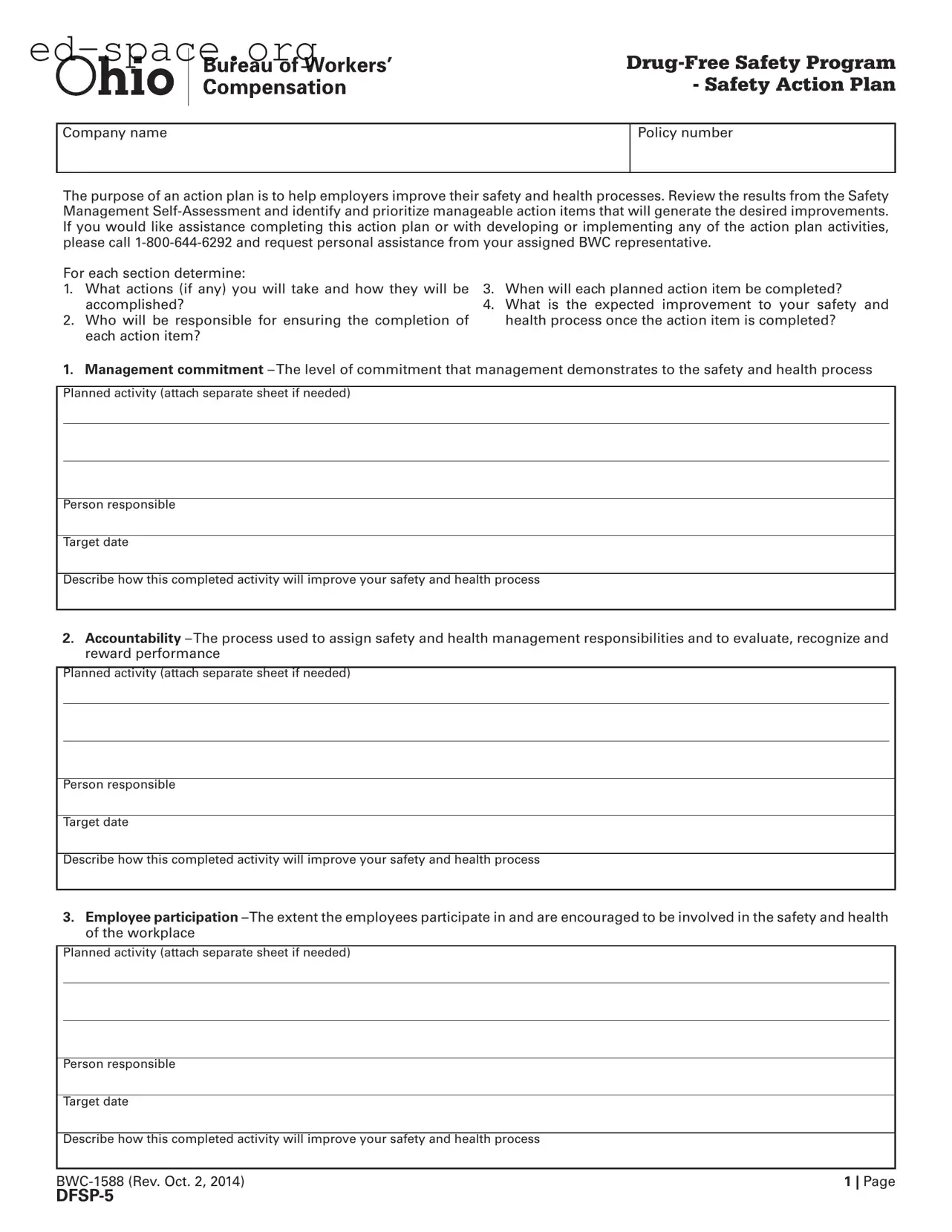
The Ohio DFSP 5 form is a crucial tool for employers participating in the Drug-Free Safety Program. This form serves as a structured Safety Action Plan, designed to enhance workplace safety and health processes. It requires employers to assess their current safety management practices through a Safety Management Self-Assessment. By identifying and prioritizing actionable items, employers can implement changes that lead to significant improvements. The form outlines ten key areas of focus, including management commitment, employee participation, and hazard prevention and control. Each section prompts employers to specify planned activities, assign responsibilities, and set target completion dates. Additionally, it emphasizes the expected outcomes of these actions on overall safety and health processes. For those needing assistance, support is available through a dedicated BWC representative, ensuring that employers can effectively navigate the requirements of the form and enhance their workplace safety culture.
Company name
Policy number
The purpose of an action plan is to help employers improve their safety and health processes. Review the results from the Safety Management
For each section determine:
1.What actions (if any) you will take and how they will be accomplished?
2.Who will be responsible for ensuring the completion of each action item?
3.When will each planned action item be completed?
4.What is the expected improvement to your safety and health process once the action item is completed?
1.Management commitment
Planned activity (attach separate sheet if needed)
Person responsible
Target date
Describe how this completed activity will improve your safety and health process
2.Accountability
Planned activity (attach separate sheet if needed)
Person responsible
Target date
Describe how this completed activity will improve your safety and health process
3.Employee participation
Planned activity (attach separate sheet if needed)
Person responsible
Target date
Describe how this completed activity will improve your safety and health process
1 | Page |

4.Safety culture
Planned activity (attach separate sheet if needed)
Person responsible
Target date
Describe how this completed activity will improve your safety and health process
5.Hazard prevention and control
Planned activity (attach separate sheet if needed)
Person responsible
Target date
Describe how this completed activity will improve your safety and health process
6.Safety and health training and education – The process of ensuring safety education and training is provided to people at all levels, and that skills are assessed to ensure understanding
Planned activity (attach separate sheet if needed)
Person responsible
Target date
Describe how this completed activity will improve your safety and health process
7.Accident analysis – The method of gathering and analyzing accident information; determining root causes and identifying safety improvements to prevent future accidents
Planned activity (attach separate sheet if needed)
Person responsible
Target date
Describe how this completed activity will improve your safety and health process
2 | Page |

8.Workers’ compensation claims management
Planned activity (attach separate sheet if needed)
Person responsible
Target date
Describe how this completed activity will improve your safety and health process
9.
Planned activity (attach separate sheet if needed)
Person responsible
Target date
Describe how this completed activity will improve your safety and health process
10.Employee health promotion (wellness) – The organization’s efforts to encourage personal health improvement and health maintenance among its employees
Planned activity (attach separate sheet if needed)
Person responsible
Target date
Describe how this completed activity will improve your safety and health process
X
Signature of company official responsible for this action plan |
Date submitted |
3 | Page |
| Fact Name | Description |
|---|---|
| Form Title | The form is known as the Drug-Free Safety Program - Safety Action Plan (DFSP-5). |
| Governing Law | This form is governed by Ohio Revised Code § 4123.54, which outlines requirements for workplace safety programs. |
| Purpose | The action plan aims to assist employers in enhancing their safety and health processes. |
| Self-Assessment | Employers must review results from the Safety Management Self-Assessment to identify action items. |
| Contact Information | For assistance, employers can call 1-800-644-6292 for help from their assigned BWC representative. |
| Management Commitment | The form emphasizes the importance of management's commitment to safety and health processes. |
| Accountability | It outlines the need for assigning responsibilities and evaluating safety performance. |
| Employee Participation | The action plan encourages employee involvement in workplace safety and health initiatives. |
Completing the Ohio Dfsp 5 form involves providing specific details about your company's safety action plan. After filling out this form, you will have a clearer understanding of the steps needed to enhance your workplace safety and health processes. This plan is crucial for identifying action items and assigning responsibilities, ultimately leading to a safer work environment.
What is the purpose of the Ohio DFSP 5 form?
The Ohio DFSP 5 form is designed to help employers create a Safety Action Plan. This plan aims to enhance safety and health processes within the workplace. By reviewing results from the Safety Management Self-Assessment, employers can identify and prioritize actionable steps that lead to meaningful improvements in safety practices.
Who is responsible for completing the DFSP 5 form?
What information is required on the DFSP 5 form?
The form requires details about planned activities, the individuals responsible for each activity, target completion dates, and descriptions of how each completed activity will improve safety and health processes. It is also important to attach separate sheets if more space is needed to outline specific actions.
How can I seek assistance with the DFSP 5 form?
If you need help completing the DFSP 5 form or implementing the action plan activities, you can contact your assigned Bureau of Workers' Compensation (BWC) representative. Simply call 1-800-644-6292 for personal assistance tailored to your needs.
What areas does the DFSP 5 form cover?
The form addresses several critical areas, including management commitment, accountability, employee participation, safety culture, hazard prevention, safety training, accident analysis, claims management, return-to-work practices, and employee health promotion. Each section focuses on improving specific aspects of workplace safety and health.
What happens after submitting the DFSP 5 form?
Once the DFSP 5 form is submitted, the company is expected to implement the planned activities within the designated time frames. Regular evaluations should be conducted to assess progress and make necessary adjustments to ensure continuous improvement in safety and health practices.
Is the DFSP 5 form mandatory for all employers in Ohio?
The DFSP 5 form is a requirement for employers participating in the Drug-Free Safety Program. While not all employers may be required to participate, those who do must complete this form to demonstrate their commitment to workplace safety and health initiatives.
Not including the company name or policy number at the top of the form. This information is essential for identifying your action plan.
Failing to prioritize action items. It's important to focus on the most impactful changes first.
Leaving sections blank. Each section must be completed to provide a comprehensive safety action plan.
Not specifying who is responsible for each action item. Assigning a person ensures accountability.
Setting unrealistic target dates. Make sure deadlines are achievable to promote follow-through.
Neglecting to describe how each activity will improve safety. Clear explanations help justify the actions taken.
Not attaching separate sheets when needed. If there’s too much information for the form, provide additional details.
Overlooking the importance of employee participation. Engaging employees is key to a successful safety culture.
Ignoring the need for regular review and updates. Safety plans should evolve as conditions change.
Forgetting to obtain the necessary signature. A signed action plan indicates management's commitment to safety.
The Ohio DFSP 5 form, which outlines a Drug-Free Safety Program's Safety Action Plan, is often accompanied by several other important documents. Each of these documents plays a crucial role in enhancing workplace safety and ensuring compliance with regulations. Below is a list of forms and documents commonly used alongside the DFSP 5 form.
Understanding these documents can help organizations create a comprehensive safety plan that not only complies with regulations but also fosters a culture of safety within the workplace. Each form contributes to a holistic approach to employee health and safety, ultimately benefiting both the employees and the organization as a whole.
When filling out the Ohio DFSP 5 form, it is important to approach the task with care and attention to detail. Here are six guidelines that can help ensure a successful submission:
Understanding the Ohio DFSP 5 form can be challenging, and misconceptions often lead to confusion. Here’s a list of common misunderstandings, along with clarifications to help you navigate this important document.
This form is applicable to businesses of all sizes. Small businesses can benefit just as much from implementing a Drug-Free Safety Program.
While having a Drug-Free Safety Program can help reduce costs, completion of the form alone does not automatically lead to lower premiums. It’s part of a broader strategy.
The action plan is a critical component of the DFSP 5 form. It outlines necessary steps to improve safety and health processes, making it essential for compliance.
Active management involvement is crucial. Their commitment drives the success of the safety program and ensures accountability throughout the organization.
Involving employees is vital for a successful safety culture. Their insights can lead to more effective safety measures and a greater sense of ownership.
The DFSP 5 form encompasses a broader safety strategy, including training, hazard prevention, and overall health promotion, not just drug testing.
Submitting the plan is just the beginning. Continuous evaluation and adjustment of the action items are necessary to ensure ongoing safety improvements.
While HR plays a significant role, input from various departments can enhance the action plan. Collaboration leads to a more comprehensive approach to workplace safety.
Although compliance is important, the primary goal of the DFSP 5 form is to foster a safer work environment. It aims to improve health and safety practices actively.
Action items should be flexible and adaptable. As workplace conditions change, the action plan should evolve to address new challenges effectively.
Here are some key takeaways about filling out and using the Ohio DFSP 5 form:
Completing the DFSP 5 form accurately can significantly enhance workplace safety and health initiatives.