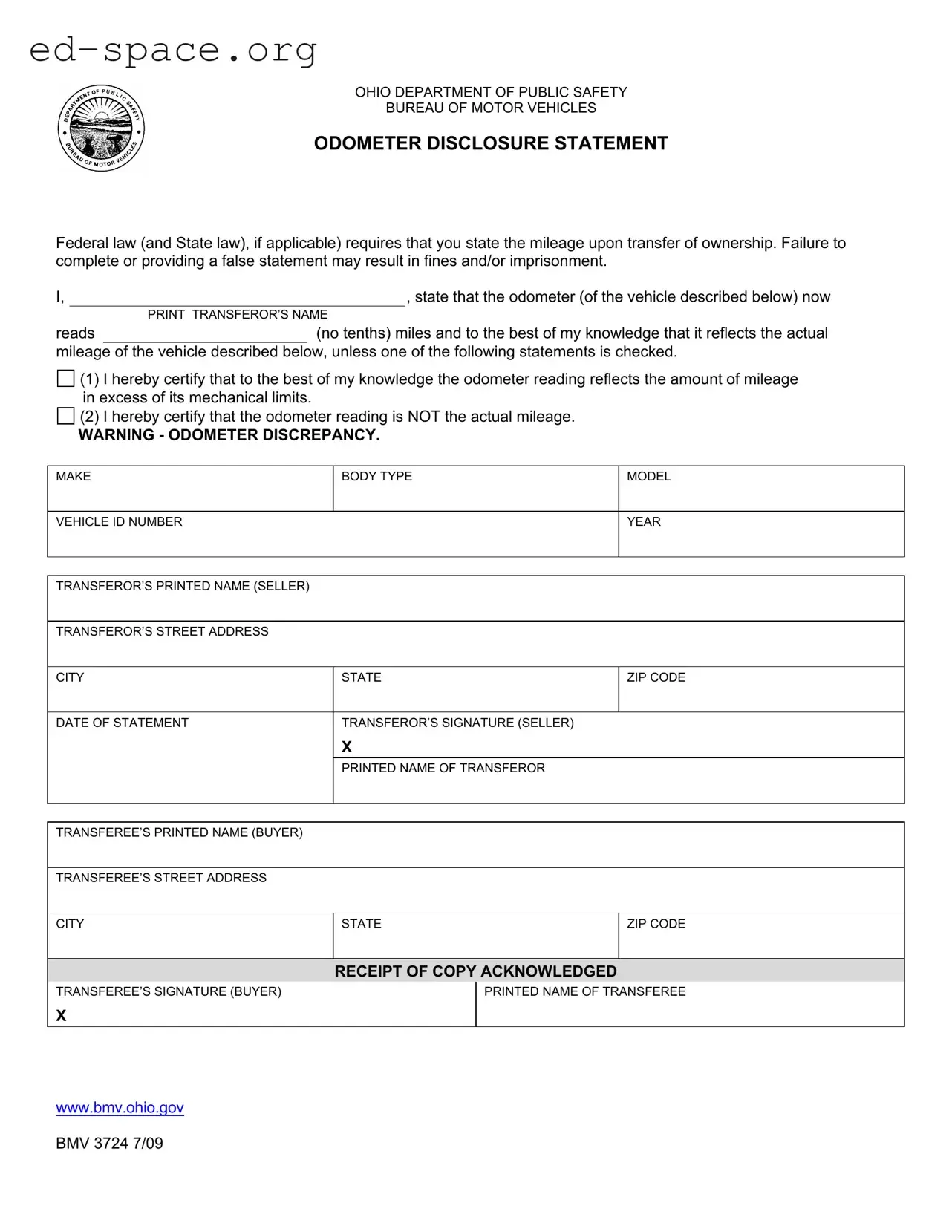
The Ohio Department of Public Safety form, specifically the Odometer Disclosure Statement, plays a crucial role in the transfer of vehicle ownership. This form ensures that both buyers and sellers accurately report the vehicle's mileage at the time of sale. Federal law mandates this disclosure to prevent fraud and protect consumers. When completing the form, the transferor, or seller, must provide their name, address, and the vehicle's details, including the make, model, year, and Vehicle Identification Number (VIN). They must also state the current odometer reading, confirming whether it reflects the actual mileage or if there are discrepancies. The form includes important certifications, allowing the seller to indicate if the odometer reading exceeds mechanical limits or is not accurate. Both parties must sign the document, which serves as a legal acknowledgment of the mileage and protects against potential fines or legal issues that may arise from inaccurate reporting. By following the guidelines set forth in this form, individuals can ensure a smoother and more transparent vehicle transfer process.

OHIO DEPARTMENT OF PUBLIC SAFETY
BUREAU OF MOTOR VEHICLES
ODOMETER DISCLOSURE STATEMENT
Federal law (and State law), if applicable) requires that you state the mileage upon transfer of ownership. Failure to complete or providing a false statement may result in fines and/or imprisonment.
I, |
|
|
|
, state that the odometer (of the vehicle described below) now |
|
|
PRINT TRANSFEROR’S NAME |
||
reads |
|
(no tenths) miles and to the best of my knowledge that it reflects the actual |
||
mileage of the vehicle described below, unless one of the following statements is checked.
(1) I hereby certify that to the best of my knowledge the odometer reading reflects the amount of mileage in excess of its mechanical limits.
(2) I hereby certify that the odometer reading is NOT the actual mileage.
WARNING - ODOMETER DISCREPANCY.
MAKE |
BODY TYPE |
MODEL |
|
|
|
|
|
VEHICLE ID NUMBER |
|
|
YEAR |
|
|
|
|
|
|
|
|
TRANSFEROR’S PRINTED NAME (SELLER) |
|
|
|
|
|
|
|
TRANSFEROR’S STREET ADDRESS |
|
|
|
|
|
|
|
CITY |
STATE |
ZIP CODE |
|
|
|
|
|
DATE OF STATEMENT |
TRANSFEROR’S SIGNATURE (SELLER) |
|
|
|
X |
|
|
|
|
|
|
|
PRINTED NAME OF TRANSFEROR |
|
|
|
|
|
|
|
|
|
|
TRANSFEREE’S PRINTED NAME (BUYER) |
|
|
|
|
|
|
|
TRANSFEREE’S STREET ADDRESS |
|
|
|
|
|
|
|
CITY |
STATE |
ZIP CODE |
|
|
|
|
|
|
RECEIPT OF COPY ACKNOWLEDGED |
|
|
|
|
|
|
TRANSFEREE’S SIGNATURE (BUYER) |
|
PRINTED NAME OF TRANSFEREE |
|
X |
|
|
|
|
|
|
|
www.bmv.ohio.gov
BMV 3724 7/09
| Fact Name | Details |
|---|---|
| Governing Law | Federal law and Ohio state law require accurate odometer disclosures during vehicle ownership transfers. |
| Purpose | This form is used to disclose the vehicle's odometer reading at the time of transfer. |
| Consequences of False Information | Providing false information may lead to fines or imprisonment. |
| Odometer Reading Certification | The transferor must certify the accuracy of the odometer reading or indicate discrepancies. |
| Required Signatures | Both the transferor (seller) and transferee (buyer) must sign the form to acknowledge the transfer. |
| Contact Information | For more details, visit the Ohio Bureau of Motor Vehicles website at www.bmv.ohio.gov. |
Filling out the Ohio Department of Public Safety form is an essential step when transferring vehicle ownership. This form requires accurate information about the vehicle's odometer reading and the parties involved in the transaction. Below are the steps to ensure you complete the form correctly.
Once you have completed all these steps, ensure that both parties retain a copy of the signed form for their records. This will serve as proof of the odometer disclosure during the transfer of ownership.
What is the purpose of the Ohio Department of Public Safety Odometer Disclosure Statement?
The Odometer Disclosure Statement is a legal document required when transferring ownership of a vehicle. It ensures that the mileage on the vehicle's odometer is accurately reported. This is important because it helps prevent fraud and protects buyers from purchasing vehicles with rolled-back odometers. Both federal and state laws mandate that this information be disclosed during the transfer process.
What happens if I provide false information on the Odometer Disclosure Statement?
Providing false information on this form can lead to serious consequences. Individuals may face fines and, in some cases, imprisonment. It is crucial to provide accurate information to avoid legal issues. If you are unsure about the mileage, it is better to state that the odometer reading is not the actual mileage rather than guessing or providing incorrect information.
Who needs to fill out the Odometer Disclosure Statement?
Both the seller (transferor) and the buyer (transferee) must fill out the Odometer Disclosure Statement. The seller must provide the current odometer reading and certify that it reflects the actual mileage or indicate if there are discrepancies. The buyer must also acknowledge receipt of this information by signing the document. This ensures that both parties are aware of the vehicle's mileage status at the time of transfer.
What should I do if the odometer reading exceeds its mechanical limits?
If the odometer reading exceeds its mechanical limits, you must check the corresponding box on the form to certify this fact. This situation typically occurs when the odometer has rolled over, meaning it has gone past its maximum reading and started again at zero. It’s important to disclose this accurately, as it provides clarity about the vehicle’s true mileage history.
Can I complete the Odometer Disclosure Statement electronically?
Failing to provide the transferor's name clearly. This is essential for identifying the seller.
Not stating the odometer reading accurately. The mileage must be reported without any tenths.
Leaving out the vehicle identification number (VIN). This number uniquely identifies the vehicle and is crucial for the record.
Neglecting to check one of the odometer certification boxes. This step clarifies the condition of the odometer reading.
Forgetting to include the date of the statement. This date is important for legal purposes and record-keeping.
Not signing the form. Both the transferor and transferee must provide their signatures to validate the transaction.
Omitting the transferee’s address. This information is necessary for the buyer's identification and future correspondence.
Using illegible handwriting. Clear and readable writing is essential to avoid confusion and ensure accuracy.
Failing to keep a copy of the completed form. This serves as a record for both parties in case of future disputes.
When dealing with vehicle ownership transfers in Ohio, several important forms accompany the Ohio Department of Public Safety form. Each document serves a specific purpose, ensuring that the transfer process is smooth, legal, and transparent. Understanding these forms is crucial for both buyers and sellers to avoid potential legal issues.
Being well-informed about these forms can greatly ease the vehicle transfer process. Each document plays a critical role in ensuring that ownership is transferred legally and transparently. Neglecting to complete any of these forms may lead to complications down the line, so it is advisable to handle them with care and attention.
The Ohio Department of Public Safety form, specifically the Odometer Disclosure Statement, serves a critical function in vehicle ownership transfers. It is similar to several other documents in terms of purpose and requirements. Here are five documents that share similarities with this form:
When filling out the Ohio Department of Public Safety form, it’s essential to approach the task with care and attention to detail. Here are five important do's and don'ts to keep in mind:
Here are five common misconceptions about the Ohio Department of Public Safety form, specifically the Odometer Disclosure Statement:
When filling out the Ohio Department of Public Safety form, keep the following key points in mind: