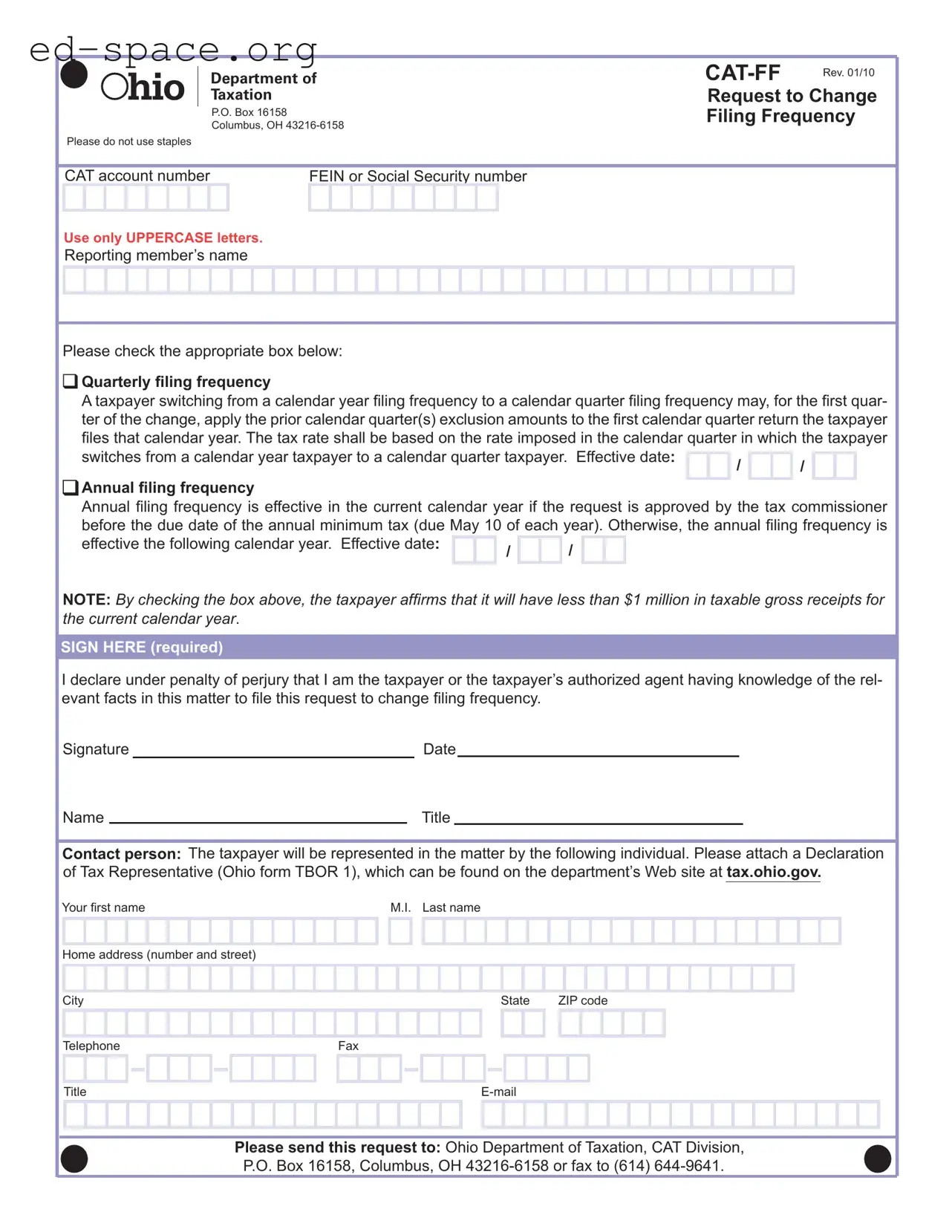
The Ohio CAT Ff form is an essential document for taxpayers looking to adjust their filing frequency for the Commercial Activity Tax (CAT). This form allows individuals and businesses to switch between quarterly and annual filing frequencies, depending on their specific financial situations. When completing the form, taxpayers must provide their CAT account number, FEIN, or Social Security number, and the name of the reporting member. Importantly, the form requires the use of uppercase letters for clarity. Taxpayers can select either a quarterly or annual filing frequency, with specific conditions tied to each option. For instance, if a taxpayer opts to switch to quarterly filing, they may apply prior exclusion amounts to their first quarterly return of that calendar year. Conversely, if they choose annual filing, the request must be approved by the tax commissioner before the due date of the annual minimum tax, which falls on May 10 each year. Additionally, by selecting the annual option, the taxpayer affirms that their gross receipts will be below $1 million for the current year. The form also necessitates a signature, affirming the accuracy of the information provided, and includes a section for appointing a tax representative if needed. Clear instructions guide taxpayers on where to submit the completed form, ensuring a smooth process for those navigating their tax obligations in Ohio.

HIO
Please do not use staples
Department of |
Rev. 01/10 |
||
Taxation |
Request to Change |
||
P.O. Box 16158 |
Filing Frequency |
||
Columbus, OH |
|||
|
|
||
CAT account number |
FEIN or Social Security number |
|||||||||||||||||
|
|
|
|
|
|
|
|
|
|
|
|
|
|
|
|
|
|
|
Use only UPPERCASE letters.
Reporting member’s name
Please check the appropriate box below:
Quarterly filing frequency
A taxpayer switching from a calendar year filing frequency to a calendar quarter filing frequency may, for the first quar-
ter of the change, apply the prior calendar quarter(s) exclusion amounts to the first calendar quarter return the taxpayer files that calendar year. The tax rate shall be based on the rate imposed in the calendar quarter in which the taxpayer
switches from a calendar year taxpayer to a calendar quarter taxpayer. Effective date: |
|
|
/ |
|
|
/ |
|
|
|
|
|
||
|
|
|
|
|
|
|
Annual filing frequency |
|
|
|
|
|
|
Annual filing frequency is effective in the current calendar year if the request is approved by the tax commissioner before the due date of the annual minimum tax (due May 10 of each year). Otherwise, the annual filing frequency is
effective the following calendar year. Effective date: |
/ |
/ |
|
NOTE: By checking the box above, the taxpayer affi rms that it will have less than $1 million in taxable gross receipts for the current calendar year.
SIGN HERE (required)
I declare under penalty of perjury that I am the taxpayer or the taxpayer’s authorized agent having knowledge of the rel- evant facts in this matter to fi le this request to change filing frequency.
Signature |
|
|
Date |
|
|
||
Name |
|
|
|
Title |
|
||
Contact person: The taxpayer will be represented in the matter by the following individual. Please attach a Declaration of Tax Representative (Ohio form TBOR 1), which can be found on the department’s Web site at tax.ohio.gov.
Your fi rst name |
|
|
|
|
M.I. Last name |
|
|
|
|
|
|
|
|
|
|
|
|
|
|
|
|
|
|
||||||||||||||||||||||
|
|
|
|
|
|
|
|
|
|
|
|
|
|
|
|
|
|
|
|
|
|
|
|
|
|
|
|
|
|
|
|
|
|
|
|
|
|
|
|
|
|
|
|
|
|
|
|
|
|
|
|
|
|
|
|
|
|
|
|
|
|
|
|
|
|
|
|
|
|
|
|
|
|
|
|
|
|
|
|
|
|
|
|
|
|
|
|
|
|
|
|
Home address (number and street) |
|
|
|
|
|
|
|
|
|
|
|
|
|
|
|
|
|
|
|
|
|
|
|
|
|
|
|
|
|
|
|
|
|||||||||||||
|
|
|
|
|
|
|
|
|
|
|
|
|
|
|
|
|
|
|
|
|
|
|
|
|
|
|
|
|
|
|
|
|
|
|
|
|
|
|
|
|
|
|
|
|
|
|
|
|
|
|
|
|
|
|
|
|
|
|
|
|
|
|
|
|
|
|
|
|
|
|
|
|
|
|
|
|
|
|
|
|
|
|
|
|
|
|
|
|
|
|
|
City |
|
|
|
|
|
|
|
|
|
|
|
|
State |
ZIP code |
|
|
|
|
|
|
|
|
|
|
|
||||||||||||||||||||
|
|
|
|
|
|
|
|
|
|
|
|
|
|
|
|
|
|
|
|
|
|
|
|
|
|
|
|
|
|
|
|
|
|
|
|
|
|
|
|
|
|
|
|
|
|
|
|
|
|
|
|
|
|
|
|
|
|
|
|
|
|
|
|
|
|
|
|
|
|
|
|
|
|
|
|
|
|
|
|
|
|
|
|
|
|
|
|
|
|
|
|
Telephone |
|
Fax |
|
|
|
|
|
|
|
|
|
|
|
|
|
|
|
|
|
|
|||||||||||||||||||||||||
|
|
|
|
|
|
|
|
|
|
|
|
|
|
|
|
|
|
|
|
|
|
|
|
|
|
|
|
|
|
|
|
|
|
|
|
|
|
|
|
|
|
|
|
|
|
|
|
|
|
|
|
|
|
|
|
|
|
|
|
|
|
|
|
|
|
|
|
|
|
|
|
|
|
|
|
|
|
|
|
|
|
|
|
|
|
|
|
|
|
|
|
Title |
|
|
|
|
|
|
|
|
|
|
|
|
|
|
|
|
|
|
|
|
|
|
|
|
|
|
|
|
|
||||||||||||||||
|
|
|
|
|
|
|
|
|
|
|
|
|
|
|
|
|
|
|
|
|
|
|
|
|
|
|
|
|
|
|
|
|
|
|
|
|
|
|
|
|
|
|
|
|
|
Please send this request to: Ohio Department of Taxation, CAT Division, P.O. Box 16158, Columbus, OH
| Fact Name | Description |
|---|---|
| Form Title | The form is officially titled "Request to Change Filing Frequency" and is designated as CAT-FF. |
| Governing Law | This form is governed by the Ohio Revised Code, specifically under the Commercial Activity Tax (CAT) regulations. |
| Filing Options | Taxpayers can choose between quarterly and annual filing frequencies when completing the form. |
| Quarterly Filing | If a taxpayer switches to quarterly filing, they may apply prior calendar quarter exclusion amounts to their first return of the year. |
| Annual Filing Deadline | The annual filing frequency request must be approved by the tax commissioner before May 10 to be effective for the current calendar year. |
| Taxpayer Affirmation | By selecting the annual filing option, the taxpayer affirms they will have less than $1 million in taxable gross receipts for the current year. |
| Signature Requirement | The form requires a signature from the taxpayer or their authorized agent, affirming the accuracy of the information provided. |
| Submission Instructions | Requests can be mailed to the Ohio Department of Taxation or faxed to the provided fax number. |
Filling out the Ohio CAT FF form requires careful attention to detail. Completing this form accurately is essential for ensuring your request to change the filing frequency is processed without delays. Follow the steps below to fill out the form correctly.
What is the Ohio CAT Ff form?
The Ohio CAT Ff form is a request form used by businesses to change their filing frequency for the Commercial Activity Tax (CAT). Businesses can choose between quarterly or annual filing frequencies, depending on their taxable gross receipts and preferences.
Who needs to file the Ohio CAT Ff form?
What are the filing frequency options available on the form?
The form provides two options for filing frequency: quarterly and annual. A taxpayer can choose quarterly filing if they expect to have more than $1 million in taxable gross receipts. If a taxpayer expects to have less than that amount, they can opt for annual filing.
When is the effective date for the new filing frequency?
The effective date of the new filing frequency depends on when the request is approved. For quarterly filing, the change is effective immediately if approved. For annual filing, the request must be approved by the tax commissioner before the due date of the annual minimum tax, which is May 10 each year. If approved after that date, the change will take effect the following calendar year.
What should I do if I am switching from calendar year to calendar quarter filing?
If you are switching from a calendar year filing frequency to a calendar quarter frequency, you can apply prior calendar quarter exclusion amounts to your first quarter return for that calendar year. This means you may benefit from deductions based on your previous filings.
What happens if I do not file this form?
If you do not file the Ohio CAT Ff form and wish to change your filing frequency, you will continue to be subject to your current filing schedule. This could lead to complications, including potential penalties if your business's financial situation no longer aligns with your existing filing frequency.
Is there a penalty for filing the form late?
Filing the Ohio CAT Ff form late may not incur a direct penalty, but it can affect your tax obligations. If the request for annual filing is submitted after the due date of the minimum tax, the change will not take effect until the following year, which may not align with your business's needs.
How do I submit the Ohio CAT Ff form?
You can submit the completed Ohio CAT Ff form by mailing it to the Ohio Department of Taxation, CAT Division, at P.O. Box 16158, Columbus, OH 43216-6158. Alternatively, you can fax it to (614) 644-9641. Make sure to keep a copy for your records.
Using Incorrect Case for Text: The form requires that all entries be made using UPPERCASE letters. Failing to follow this instruction can lead to processing delays or rejection of the form.
Not Checking the Appropriate Filing Frequency Box: Taxpayers must select either quarterly or annual filing frequency. Omitting this step can result in confusion regarding the taxpayer's intent and may lead to incorrect filing status.
Missing Signature: The form must be signed by the taxpayer or their authorized agent. A missing signature invalidates the request and could cause significant delays in processing.
Failing to Provide Accurate Contact Information: It is essential to include complete and accurate contact details for the representative. Incomplete information can hinder communication and affect the processing of the request.
Not Submitting Required Attachments: If applicable, a Declaration of Tax Representative must be attached. Neglecting to include this document can result in the request being deemed incomplete.
When dealing with the Ohio CAT (Commercial Activity Tax), it's essential to understand that the CAT Ff form is just one piece of the puzzle. Several other forms and documents may be needed to ensure compliance and smooth processing. Here’s a brief overview of six commonly used forms that often accompany the Ohio CAT Ff form:
Understanding these forms and their purposes can help streamline the filing process and avoid potential issues with the Ohio Department of Taxation. Make sure to gather all necessary documents to ensure a smooth transition to your new filing frequency.
The Ohio Cat Ff form is an important document for taxpayers who need to change their filing frequency. It shares similarities with several other documents used in tax reporting and compliance. Below are six documents that are comparable to the Ohio Cat Ff form:
When filling out the Ohio CAT Ff form, it's important to follow specific guidelines to ensure your submission is correct. Here’s a list of things you should and shouldn't do:
When dealing with the Ohio CAT Ff form, it’s essential to understand the common misconceptions that can lead to confusion. Here are nine prevalent myths surrounding this form, along with clarifications to help you navigate the process more smoothly.
Understanding these misconceptions can help ensure that you complete the Ohio CAT Ff form correctly and efficiently. Always double-check your submissions and consult with a tax professional if you have further questions.
Here are some key takeaways about filling out and using the Ohio CAT Ff form:
Make sure to follow these guidelines closely to avoid any delays or issues with your filing.