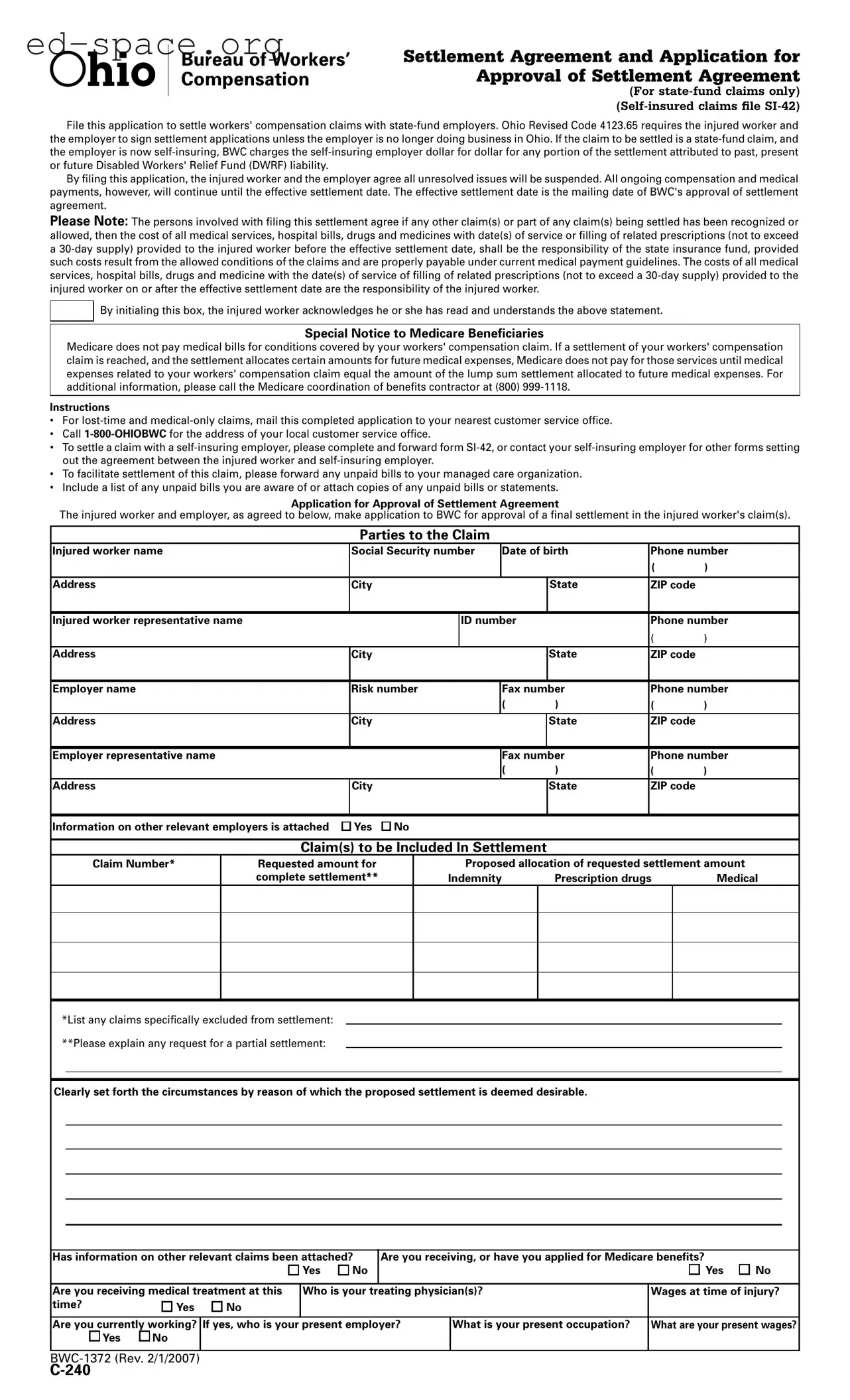
The Ohio C 240 form serves as a vital tool in the settlement process for workers' compensation claims, specifically for those involving state-fund employers. This form, officially titled the Settlement Agreement and Application for Approval of Settlement Agreement, is essential for injured workers seeking to resolve their claims. It requires signatures from both the injured worker and the employer, except in cases where the employer is no longer operational in Ohio. By submitting this application, both parties agree to suspend any unresolved issues, although ongoing compensation and medical payments will continue until the settlement is officially approved by the Bureau of Workers' Compensation (BWC). The form also outlines the responsibilities regarding medical expenses, particularly noting that the injured worker will be liable for costs incurred after the effective settlement date. Additionally, it includes important provisions for Medicare beneficiaries, emphasizing that Medicare will not cover medical expenses related to the claim until certain conditions are met. Completing the Ohio C 240 form accurately is crucial, as it not only facilitates the settlement process but also ensures compliance with Ohio Revised Code 4123.65, protecting the rights of both the injured worker and the employer.
Settlement Agreement and Application for
Approval of Settlement Agreement
(For
File this application to settle workers' compensation claims with
By iling this application, the injured worker and the employer agree all unresolved issues will be suspended. All ongoing compensation and medical payments, however, will continue until the effective settlement date. The effective settlement date is the mailing date of BWC's approval of settlement agreement.
Please Note: The persons involved with iling this settlement agree if any other claim(s) or part of any claim(s) being settled has been recognized or allowed, then the cost of all medical services, hospital bills, drugs and medicines with date(s) of service or illing of related prescriptions (not to exceed a
By initialing this box, the injured worker acknowledges he or she has read and understands the above statement.
Special Notice to Medicare Beneficiaries
Medicare does not pay medical bills for conditions covered by your workers' compensation claim. If a settlement of your workers' compensation claim is reached, and the settlement allocates certain amounts for future medical expenses, Medicare does not pay for those services until medical expenses related to your workers' compensation claim equal the amount of the lump sum settlement allocated to future medical expenses. For additional information, please call the Medicare coordination of beneits contractor at (800)
Instructions
•For
•Call
•To settle a claim with a
•To facilitate settlement of this claim, please forward any unpaid bills to your managed care organization.
•Include a list of any unpaid bills you are aware of or attach copies of any unpaid bills or statements.
Application for Approval of Settlement Agreement
The injured worker and employer, as agreed to below, make application to BWC for approval of a inal settlement in the injured worker's claim(s).
Parties to the Claim
Injured worker name |
Social Security number |
Date of birth |
Phone number |
||||
|
|
|
|
|
|
( |
) |
|
|
|
|
|
|
|
|
Address |
City |
|
|
|
State |
ZIP code |
|
|
|
|
|
|
|
|
|
Injured worker representative name |
|
|
ID number |
|
Phone number |
||
|
|
|
|
|
|
( |
) |
Address |
City |
|
|
|
State |
ZIP code |
|
|
|
|
|
|
|
||
Employer name |
Risk number |
Fax number |
Phone number |
||||
|
|
|
|
( |
) |
( |
) |
Address |
City |
|
|
|
State |
ZIP code |
|
|
|
|
|
|
|
|
|
Employer representative name |
|
|
|
Fax number |
Phone number |
||
|
|
|
|
( |
) |
( |
) |
Address |
City |
|
|
|
State |
ZIP code |
|
|
|
|
|
|
|
|
|
Information on other relevant employers is attached |
Yes |
No |
|
|
|
|
|
Claim(s) to be Included In Settlement
|
Claim Number* |
Requested amount for |
|
|
Proposed allocation of requested settlement amount |
|
|
||||||||
|
|
|
|
complete settlement** |
|
Indemnity |
Prescription drugs |
Medical |
|||||||
|
|
|
|
|
|
|
|
|
|
|
|
|
|
|
|
|
|
|
|
|
|
|
|
|
|
|
|
|
|
|
|
|
|
|
|
|
|
|
|
|
|
|
|
|
|
|
|
|
|
|
|
|
|
|
|
|
|
|
|
|
|
|
|
*List any claims speciically excluded from settlement: |
|
|
|
|
|
|
|
|
|
|
|||||
**Please explain any request for a partial settlement: |
|
|
|
|
|
|
|
|
|
|
|||||
|
|
|
|
|
|
|
|
||||||||
|
|
|
|
|
|
|
|||||||||
Clearly set forth the circumstances by reason of which the proposed settlement is deemed desirable. |
|
|
|
|
|
||||||||||
|
|
|
|
|
|
|
|||||||||
|
|
|
|
|
|
|
|||||||||
|
|
|
|
|
|
|
|||||||||
|
|
|
|
|
|
|
|||||||||
|
|
|
|
|
|
|
|||||||||
|
|
|
|
|
|
||||||||||
Has information on other relevant claims been attached? |
Are you receiving, or have you applied for Medicare benefits? |
|
|
|
|||||||||||
|
|
|
|
|
Yes |
No |
|
|
|
|
|
|
Yes |
No |
|
|
|
|
|
|
|
|
|
|
|
||||||
Are you receiving medical treatment at this |
Who is your treating physician(s)? |
|
Wages at time of injury? |
||||||||||||
time? |
Yes |
No |
|
|
|
|
|
|
|
|
|
|
|
||
|
|
|
|
|
|
|
|
|
|
|
|
|
|||
|
|
|
|
|
|
|
|
|
|
||||||
Are you currently working? |
If yes, who is your present employer? |
|
What is your present occupation? |
What are your present wages? |
|||||||||||
|
Yes |
No |
|
|
|
|
|
|
|
|
|
|
|
|
|
|
|
|
|
|
|
|
|
|
|
|
|
|
|
|
|
Employer Signature
(Required by ORC 4123.65 unless the employer is no longer doing business in Ohio)
Instructions
•Please check one of the following boxes and sign below. Your signature does not waive the employer's right to withdraw consent to the settlement by providing written notice to the employee and the BWC administrator within 30 days after the administrator issues the approval of the settlement agreement.
A. The employer is supportive of and agreeable to a settlement up to the amount listed on the front of this application.
B. The employer does not agree with the requested settlement terms but will participate with the BWC in the negotiation process.
C. The employer is supportive of and agreeable to settlement of the claims listed on the front of this application. However, the employer will not participate in the settlement negotiations and requests the BWC to negotiate the settlement on behalf of the employer.
D. The employer is not agreeable to settlement of the claim(s) listed on the front of this application.
By signing this agreement, an employer that is currently
Employer signature
Telephone number
()
Title |
Date |
|
|
Fax number
()
Settlement Agreement and Release
As set forth in this agreement, the injured worker for and in consideration of the receipt of the settlement amount approved by the BWC, which sum will be paid from the appropriate fund on behalf of the employer after approval by the BWC administrator, unless within 30 days after such approval the administrator, the employer or the injured worker, withdraws consent to, or unless the Industrial Commission of Ohio (IC) disapproves the agreement, does hereby for him/herself and for anyone claiming by, through or under him/her, forever release and discharge the above referenced employer, its oficers, employees, agents, representatives, successors and assigns, the IC, the BWC, the appropriate fund, and all persons, irms or corporations from any or all claims, demands, actions or causes of action incurred on or prior to the date of the approval of this agreement, arising out of Ohio Revised Code Chapter 4121. or 4123., which he/she now has or which he/she hereafter claim to have, whether known or unknown by reason of or in any manner growing out of the claims or parts thereof set forth above. The injured worker further understands and agrees that any amount paid pursuant to this agreement is subject to any valid
By initialing this box, the injured worker acknowledges he or she has read and understands the above statement.
Also as set forth above, the injured worker understands that any settlement amounts allocated for future medical services must be used for medical services before Medicare will consider payment for services for the conditions of the workers' compensation claim.
Settlement of any claim(s) included in this agreement in no way impairs BWC's statutory rights to subrogation recovery. Also, be advised that upon a inding of fraud, the administrator retains the right to rescind this settlement agreement and
Injured worker signature
Date
Power of Attorney
By signing below the injured worker grants a limited power of attorney to the attorney of record for the purpose of receiving the warrant issued because of this settlement agreement.
Injured worker signature
Date
Representative signature
Date
| Fact Name | Description |
|---|---|
| Purpose | The Ohio C 240 form is used to apply for the approval of a settlement agreement in workers' compensation claims for state-fund employers. |
| Governing Law | This form is governed by Ohio Revised Code 4123.65, which outlines the requirements for settlement applications. |
| Signatures Required | Both the injured worker and the employer must sign the application unless the employer is no longer in business in Ohio. |
| Ongoing Payments | All ongoing compensation and medical payments will continue until the settlement date, which is the date BWC approves the settlement. |
| DWRF Liability | If the employer becomes self-insured, they are responsible for any settlement amounts related to the Disabled Workers' Relief Fund (DWRF). |
| Medicare Notice | Medicare does not cover medical expenses for conditions related to a workers' compensation claim until the settlement amount for future medical expenses is exhausted. |
| Application Submission | The completed application should be mailed to the nearest customer service office of the BWC. |
| Unpaid Bills | Injured workers should forward any unpaid bills to their managed care organization to facilitate the settlement process. |
| Power of Attorney | The injured worker can grant a limited power of attorney to their attorney for receiving the settlement warrant. |
Filling out the Ohio C 240 form is an important step in settling a workers' compensation claim with a state-fund employer. This form requires detailed information about both the injured worker and the employer, as well as specifics about the claim being settled. Completing it accurately ensures that the settlement process can move forward smoothly.
What is the Ohio C 240 form?
The Ohio C 240 form is an application used to settle workers' compensation claims for state-fund employers in Ohio. It serves as a Settlement Agreement and Application for Approval of Settlement Agreement. This form must be completed and submitted by both the injured worker and the employer to finalize the settlement of a claim. It is crucial for ensuring that all parties involved agree to the terms of the settlement.
Who needs to sign the Ohio C 240 form?
Both the injured worker and the employer are required to sign the Ohio C 240 form, as stipulated by Ohio Revised Code 4123.65. However, if the employer is no longer in business in Ohio, their signature is not necessary. This ensures that all parties are in agreement regarding the settlement terms before it is submitted for approval.
What happens to ongoing compensation and medical payments after filing the form?
Once the Ohio C 240 form is filed, all unresolved issues related to the claim will be suspended. However, ongoing compensation and medical payments will continue until the effective settlement date, which is the date BWC approves the settlement agreement. This means that the injured worker will still receive necessary support until the settlement is finalized.
What are the responsibilities regarding medical costs after the settlement?
After the effective settlement date, the injured worker is responsible for all medical services, hospital bills, drugs, and medicines incurred. These costs are applicable to services provided on or after the effective date of the settlement. However, any medical expenses incurred prior to that date will be covered by the state insurance fund, provided they relate to the allowed conditions of the claims.
What should Medicare beneficiaries know about the settlement?
Medicare beneficiaries must be aware that Medicare does not cover medical expenses for conditions related to a workers' compensation claim. If a settlement allocates funds for future medical expenses, Medicare will not pay for those services until the total medical expenses related to the claim equal the amount allocated in the settlement. For further assistance, beneficiaries can contact the Medicare coordination of benefits contractor.
How should the completed Ohio C 240 form be submitted?
The completed Ohio C 240 form should be mailed to the nearest customer service office of the Bureau of Workers' Compensation (BWC). For guidance on where to send the form, individuals can call 1-800-OHIOBWC. If the claim involves a self-insuring employer, the appropriate forms should be obtained from them, and any unpaid bills should be forwarded to the managed care organization to facilitate the settlement process.
Failing to read the entire form carefully. Many individuals rush through the application, missing crucial details that could affect their settlement.
Not providing accurate personal information. Errors in the injured worker's name, Social Security number, or date of birth can lead to delays or rejections.
Neglecting to include all relevant claims. Omitting any claim numbers or details can complicate the settlement process.
Forgetting to sign the form. Both the injured worker and the employer must sign the application; otherwise, it is considered incomplete.
Overlooking the requirement for employer consent. If the employer is still in business, their signature is necessary for the settlement to proceed.
Not initialing the acknowledgment box. This step confirms that the injured worker understands their responsibilities regarding medical costs post-settlement.
Ignoring the instructions for submitting the application. Each claim type has specific mailing addresses, and sending it to the wrong location can cause delays.
Failing to attach supporting documents. Unpaid bills or statements related to the claim should be included to facilitate the settlement process.
Not consulting with a legal representative. Some individuals attempt to navigate the process without professional guidance, which can lead to mistakes.
Neglecting to check Medicare eligibility. If the injured worker is a Medicare beneficiary, they must understand how the settlement affects their benefits.
The Ohio C 240 form is crucial for settling workers' compensation claims, particularly for state-fund claims. Alongside this form, several other documents may be necessary to ensure a smooth settlement process. Below are four commonly used forms and documents that often accompany the Ohio C 240 form.
Using these documents in conjunction with the Ohio C 240 form can streamline the settlement process and help avoid potential complications. It’s essential to ensure all necessary paperwork is complete and accurate for a successful resolution of your claim.
When filling out the Ohio C 240 form, it's important to approach the process carefully. Here’s a list of what you should and shouldn't do to ensure a smooth application experience.
Understanding the Ohio C 240 form can be challenging, and several misconceptions often arise. Here are eight common misunderstandings regarding this important document:
This form is primarily designed for state-fund claims but can also apply to self-insured claims when certain conditions are met. It is essential to check the specifics of your situation.
Signing this form does not automatically forfeit the right to future claims. It only pertains to the claims specified in the settlement agreement.
The employer's signature is required unless the employer is no longer doing business in Ohio. This ensures that both parties agree to the terms of the settlement.
While some medical expenses may be covered, the injured worker is responsible for any medical services received after the effective settlement date. Understanding these responsibilities is crucial.
The effective settlement date is actually the mailing date of the Bureau of Workers' Compensation's approval of the settlement agreement, not the date when the form is signed.
Medicare does not pay for medical bills associated with conditions covered by the workers' compensation claim until the expenses equal the settlement amount allocated for future medical expenses.
The settlement can be rescinded within 30 days of approval if any party withdraws consent. This allows for some flexibility in the process.
In reality, the C 240 form contains many important details that require careful consideration. Misunderstandings can lead to significant consequences, so it is advisable to review it thoroughly.
When filling out and using the Ohio C 240 form, several key points should be kept in mind: