The Ohio Bureau of Workers' Compensation (BWC) Writable C-9 form plays a critical role in the process of requesting medical services for injured workers. This form is designed to facilitate reimbursement for medical services related to industrial injuries or occupational diseases. It is essential for both self-insuring employers and state-fund employers, as it directs the appropriate channels for submitting requests. When completing the C-9, the injured worker's details, including their name and claim number, must be accurately provided. Additionally, the form requires specific information about the requested medical services, including the diagnosis, treatment dates, and relevant CPT codes. If there are recommendations for additional conditions, supporting medical documentation is also necessary. This ensures that all parties involved have a clear understanding of the medical needs arising from the injury. Furthermore, the form includes sections for the physician or provider's information, ensuring that the services requested are linked to a qualified provider. Timeliness is crucial; if the form is not processed within a specified timeframe, authorization for the requested services may be automatically granted. By understanding the nuances of the C-9 form, stakeholders can navigate the complexities of medical service requests more effectively, ultimately ensuring that injured workers receive the care they need.
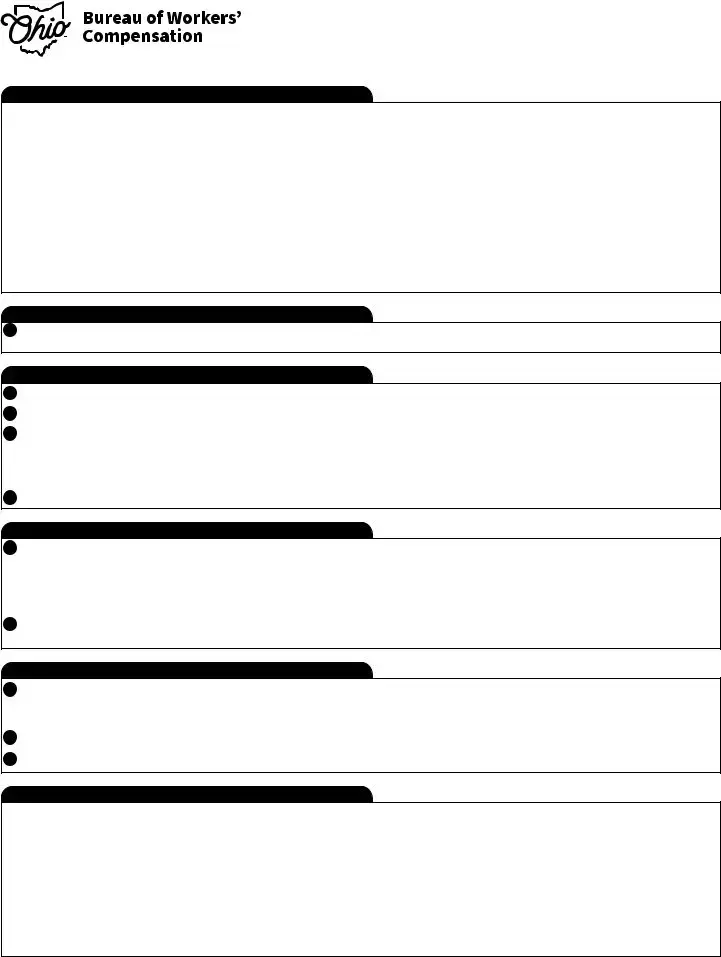
Completing the Request for Medical Service
Reimbursement or Recommendation for Additional
Conditions for Industrial Injury or Occupational
Instructions
•Please print or type this report.
•If injured worker is employed by a
•If injured worker is employed by a
•To determine the appropriate MCO, ask the injured worker or employer to visit BWC’s Web site at bwc.ohio.gov, or call BWC at
•Use this form if this is a request for services even if services are being provided under the
•Complete all applicable sections of the form to avoid possible delays in processing this request.
•You can obtain additional copies of this form at bwc.ohio.gov or by calling BWC at
Section I – Injured worker
1Enter the injured worker’s name, BWC claim number, the date the injured worker was injured or contracted an occupational disease.
Section II – Requested services
2Treating diagnosis for this request to include body part/levels.
3Indicate the beginning and ending date of the requested service. Indicate the last exam or treatment date.
4List the requested services and CPT codes, including frequency and duration. Attach copies of current medical reports necessary to support request. Include any referrals, therapy, medications, diagnostic testing, expected outcomes of medical interventions, results of treatment and office notes that contain subjective and objective findings and
*Failure to add CPT codes may delay processing.
5Provide the
Section III – Additional conditions
6Complete if you are recommending additional conditions to the claim. Provide a narrative diagnosis. Supporting medical documentation is required for all conditions listed. Include any referrals, therapy, medications, diagnostic testing, expected outcomes of medical interventions, results of treatment and office notes that contain subjective and objective findings and
• BWC will notify all parties and the MCO of the decision.
7This refers to the establishment of a relationship between the injury or occupational disease and the industrial accident or exposure. An explanation is required when answering yes or no.
Section IV – Physician/provider information
8Identify the provider who will render the requested services and the address where he or she will provide the services (required). Travel reimbursement may not be authorized when the service provided is available within 45 miles round trip from the injured worker’s residence.
9Print, type or stamp requesting physician/provider name and address.
10Physician/provider signature, individual BWC provider number and date of this report are mandatory.
Section V –
•If completed by
•If the
•Claim inactive (further investigation required)
•An MCO can only use the disclaimer box on the
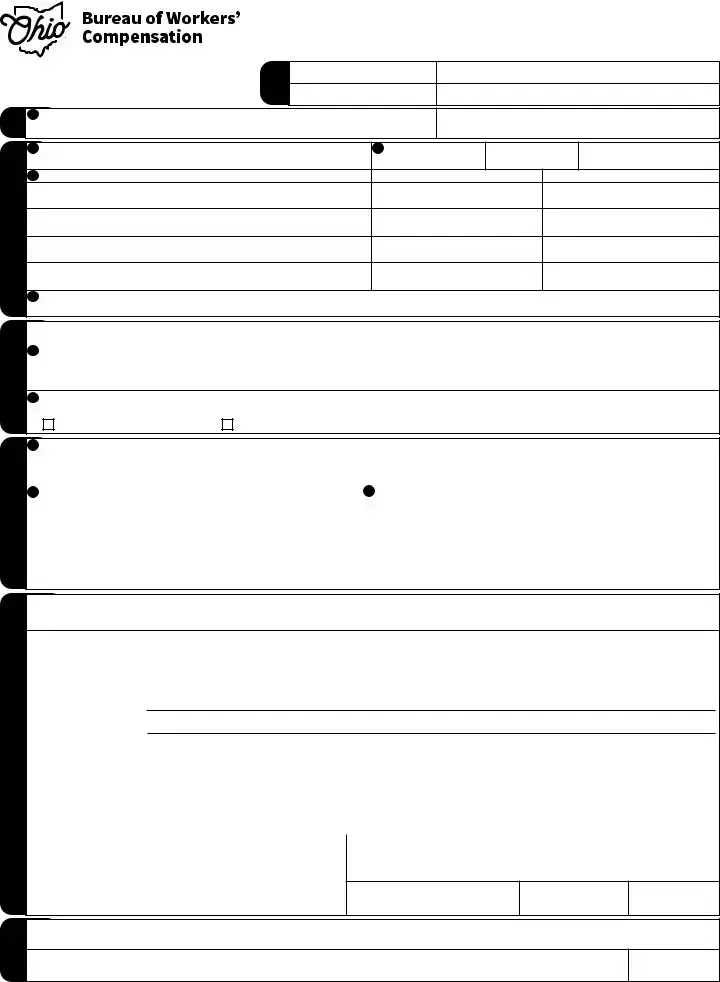
Request for Medical Service Reimbursement or Recommendation for Additional Conditions for Industrial Injury or Occupational Disease
• Instructions for completing the |
Fax note |
||
|
|||
IW |
|
1 Injured worker name |
|
|
|
||
|
|
|
|
|
|
|
|
To
From
|
Phone number |
|
Phone number |
|
Fax number |
⁜Claim number |
|
⁜Date of injury |
|
||
|
||
|
|
|
IV. Physician/providerinformation III. Additional conditions II. Requested services
V.
2 |
Treating diagnosis for this request to include body part/levels. |
3 Date service begins |
⁜Date service ends ⁜Date of last exam or treatment |
4 |
Requested services with CPT/HCPCS codes (required) |
Frequency |
Duration |
1. |
|
|
|
|
2. |
|
|
⁜3.
4.
5Provide the
If you are recommending additional conditions to the claim, supporting documentation is required. You may not use the C9 to request
additional conditions for claims of
6Provide diagnosis (narrative description only), and location and site for conditions you are requesting.
7In your opinion, based on the history from the injured worker, your clinical evaluation and expertise, is the diagnosis or condition causally related, either directly or proximately, to the alleged industrial accident or exposure?
|
Yes, please attach explanation. |
|
No, please attach explanation. |
8Identify the provider who will render the requested services and the address where he or she will provide the services (required).Travel reimbursement may not be authorized when the service provided is available within 45 miles round trip from the injured worker’s residence.
9 |
Requesting physician/provider name and address (please print, type, or |
10 Physician/provider/authorized signature (required) |
n POR |
|
stamp) |
|
n Not POR — but treating |
|
|
|
physician/provider |
|
|
Individual BWC provider number (required) |
Date (M/D/Y) (required) |
|
|
|
|
I certify the above information is correct to the best of my knowledge. I am aware that any person who knowingly makes a false statement, misrepresentation, concealment of fact or any other act of fraud to obtain payment as provided by BWC or who knowingly accepts payment to which that person is not entitled, is subject to felony criminal prosecution and may, under appropriate criminal provisions, be punished by a fine, imprisonment, or both.
Managed care organization (MCO) — If this page is not faxed or mailed back to the submitting physician/provider within three business days of receipt or within five business days of receipt of information requested on the
nApproved with disclaimer — This medical payment authorization is based upon a claim or additional condition that BWC/IC is considering as of the date of the MCO’s signature. If the claim or additional condition is ultimately disallowed, BWC may not cover the services/supplies to which this medical payment authorization applies.These services/supplies may be the responsibility of the injured worker (for MCO use only).
n Approved |
Date service begins |
Date service ends |
nAmended approval:
nDenied explanation:
You may file disputes to the decision in writing with supporting documentation to the MCO.
nPending: The documentation requested must be submitted to n Claim inactive: MCO cannot make a decision on this request,
the MCO case manager within 10 business days to allow for a |
further investigation required. BWC will issue a decision in writing |
||
treatment decision. Failure to respond may result in denial. |
|
within 28 days. |
|
n Withdrawn |
n Dismissed |
|
|
BWC claim status: n Allowed n Denied n Pending |
|
|
|
MCO |
MCO name and signature (print, type or stamp and sign) |
||
(please print, type or stamp) |
|
|
|
MCO number
Telephone number
Date
Date |
| Fact Name | Description |
|---|---|
| Purpose | The Ohio BWC Writable C-9 form is used to request medical service reimbursement or to recommend additional conditions for an industrial injury or occupational disease. |
| Submission Process | If the injured worker is employed by a self-insuring employer, the completed form must be mailed or faxed to that employer. For state-fund employers, it should be sent to the appropriate managed care organization (MCO). |
| Required Information | Complete all relevant sections to avoid delays. This includes providing the injured worker's name, claim number, requested services, and supporting medical documentation. |
| Authorization Timeline | The MCO must return the completed form to the submitting physician/provider within three business days. If not, the authorization for services is deemed granted, subject to BWC policies. |
| Governing Law | This form is governed by Ohio Administrative Code 4123-19-03, which outlines the rules for processing medical service requests in workers' compensation cases. |
Filling out the Ohio BWC Writable C-9 form requires careful attention to detail to ensure that all necessary information is provided. This process is essential for obtaining medical service reimbursement or recommending additional conditions related to an industrial injury or occupational disease. Below are the steps to complete the form accurately.
After completing the form, it is important to submit it promptly to the appropriate party. This will help facilitate the processing of the request and ensure that necessary services are authorized in a timely manner.
What is the purpose of the Ohio BWC Writable C-9 form?
The Ohio BWC Writable C-9 form serves as a request for medical service reimbursement or a recommendation for additional conditions related to an industrial injury or occupational disease. It allows healthcare providers to formally submit requests for treatment services on behalf of injured workers. This form is crucial for ensuring that medical expenses are covered and that any new conditions related to the original injury are recognized and treated appropriately.
Who should complete the C-9 form?
The C-9 form should be completed by the healthcare provider treating the injured worker. If the worker is employed by a self-insuring employer, the form must be sent directly to that employer. Conversely, if the worker is under a state-fund employer, the form should be submitted to the appropriate managed care organization (MCO). It’s essential for the provider to fill out all relevant sections accurately to avoid delays in processing the request.
What information is required on the C-9 form?
Several key pieces of information must be included on the C-9 form. First, the injured worker’s name, BWC claim number, and the date of the injury or disease onset are essential. Additionally, the treating diagnosis, requested services with corresponding CPT codes, and the dates for service need to be clearly specified. Supporting medical documentation, such as exam results and treatment notes, should also be attached to substantiate the request. Failure to provide complete information may lead to processing delays.
What should be done if additional conditions are being recommended?
If the healthcare provider believes that additional conditions related to the original claim should be recognized, they must complete the relevant section of the C-9 form. A narrative diagnosis is required, along with supporting medical documentation for each additional condition. This includes any necessary referrals, therapies, and diagnostic testing results. It’s important to note that the C-9 cannot be used for requesting additional conditions for claims associated with self-insuring employers.
What happens after the C-9 form is submitted?
Once the C-9 form is submitted, the MCO or self-insuring employer is responsible for reviewing the request. If the MCO does not respond within three business days, the authorization for the requested services is automatically granted, subject to certain policies. If further investigation is needed, the MCO will notify the provider, and a written decision will be issued within 28 days. Communication regarding the decision will also be sent to all parties involved, including the injured worker.
How can one obtain additional copies of the C-9 form?
Additional copies of the C-9 form can be easily obtained online at the Ohio Bureau of Workers' Compensation (BWC) website, ohiobwc.com. Alternatively, individuals can call BWC at 1-800-OHIOBWC and follow the prompts to request more forms. It’s advisable to have the form readily available, as it is a critical document in the workers' compensation process.
Not Printing or Typing the Form: Many individuals overlook the instruction to print or type the report. Handwritten forms can be difficult to read, leading to potential processing delays.
Incorrect Submission Address: Submitting the form to the wrong entity is a common mistake. Ensure that if the injured worker is with a self-insuring employer, the form goes directly to them, while state-fund employers should send it to the appropriate managed care organization (MCO).
Missing CPT Codes: Failing to include the required CPT codes can significantly delay the processing of the request. Always double-check that these codes are accurately filled in.
Incomplete Sections: Not completing all applicable sections can result in delays. Each part of the form is crucial for a smooth processing experience.
Omitting Supporting Documentation: Neglecting to attach necessary medical reports or documentation can lead to a denial of the request. Always include all relevant information to support the request.
Failure to Provide Facility Site Code: If applicable, the two-digit facility site of service code must be included. This oversight can complicate the authorization process.
Ignoring the Relationship Between Injury and Condition: When recommending additional conditions, an explanation of how the new condition relates to the original injury is essential. Failing to provide this can result in confusion and delays.
Missing Signatures and Provider Information: The form requires the physician/provider's signature, BWC provider number, and date. Omitting any of this information can render the form invalid.
The Ohio BWC Writable C-9 form is essential for requesting medical service reimbursement or recommending additional conditions related to industrial injuries or occupational diseases. Several other documents complement this form, ensuring a comprehensive approach to managing workers' compensation claims. Below is a list of these documents along with brief descriptions of their purposes.
Understanding these forms and documents is crucial for navigating the workers' compensation process in Ohio. Each plays a specific role in ensuring that injured workers receive the necessary medical care and financial support while also facilitating effective communication between all parties involved.
The Ohio BWC Writable C-9 form serves a specific purpose in the realm of workers' compensation, particularly regarding medical service reimbursement and recommendations for additional conditions related to industrial injuries or occupational diseases. Several other documents share similarities with the C-9 form, each fulfilling related functions in the claims process. Below is a detailed comparison of the C-9 form with eight similar documents:
Each of these documents plays a critical role in the workers' compensation system in Ohio, ensuring that injured workers receive the necessary medical care and compensation for their injuries or occupational diseases. The C-9 form, while distinct, shares essential features with these other forms, underscoring the interconnected nature of the claims process.
When filling out the Ohio BWC Writable C-9 form, following certain guidelines can help ensure a smooth process. Here’s a list of what to do and what to avoid:
Misconception 1: The C-9 form can only be used for initial requests.
Many believe that the C-9 form is only for initial service requests. In reality, it can also be used to recommend additional conditions or when the diagnosis has changed, even if services are under the 60-day presumptive authorization.
Misconception 2: Self-insuring employers can use the C-9 form for any request.
This is incorrect. The C-9 form cannot be used to request additional conditions for claims involving self-insuring employers. It is essential to follow the specific guidelines for these cases.
Misconception 3: CPT codes are optional when completing the form.
Some may think that including CPT codes is not necessary. However, failing to provide these codes can lead to delays in processing the request. It is crucial to include them to ensure timely approval.
Misconception 4: The MCO must respond immediately to the C-9 submission.
People often assume that the MCO will respond to the C-9 form right away. In fact, if the C-9 is not returned within three business days, the authorization for service is automatically deemed granted, subject to BWC policies.
Misconception 5: Travel reimbursement is always available for services provided far from home.
This is misleading. Travel reimbursement is not authorized if the service is available within a 45-mile round trip from the injured worker's residence. Understanding this limitation is important for managing expectations regarding reimbursement.
Filling out the Ohio BWC Writable C-9 form correctly is essential for ensuring that injured workers receive the medical services they need. Here are some key takeaways to keep in mind:
By following these guidelines, you can help ensure a smoother process for obtaining medical service reimbursement or recommendations for additional conditions related to industrial injuries or occupational diseases.