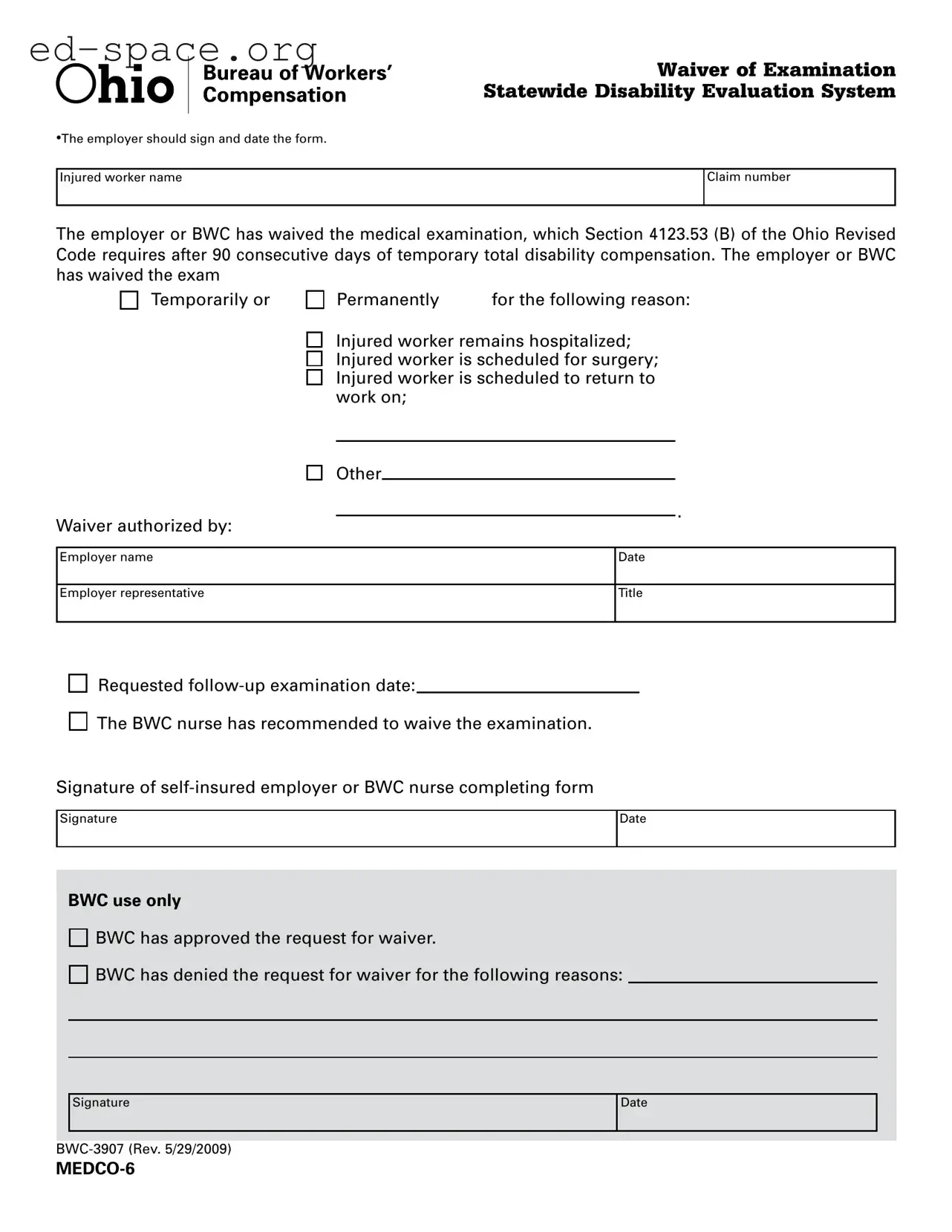
The Ohio BWC 3907 form plays a crucial role in the management of temporary total disability compensation for injured workers. This form is essential when an employer or the Bureau of Workers' Compensation (BWC) decides to waive the required medical examination after an injured worker has been receiving benefits for 90 consecutive days. Key details included in the form are the injured worker's name, claim number, and the specific reasons for the waiver, such as hospitalization, scheduled surgery, or an upcoming return to work. The form must be signed and dated by the employer, along with the name and title of the representative authorizing the waiver. Additionally, it outlines the recommended follow-up examination date as advised by a BWC nurse. The BWC uses this form to either approve or deny the waiver request, ensuring that all necessary protocols are followed in the management of workers' compensation claims. Understanding the components of the BWC 3907 form is essential for both employers and injured workers to navigate the complexities of the workers' compensation system in Ohio.
Waiver of Examination
Statewide Disability Evaluation System
•The employer should sign and date the form.
Injured worker name
Claim number
The employer or BWC has waived the medical examination, which Section 4123.53 (B) of the Ohio Revised
Code requires after 90 consecutive days of temporary total disability compensation. The employer or BWC
has waived the exam Temporarily or
Permanently |
for the following reason: |
Injured worker remains hospitalized; Injured worker is scheduled for surgery; Injured worker is scheduled to return to work on;
Other
.
Waiver authorized by:
Employer name
Date
Employer representative
Title
Requested
The BWC nurse has recommended to waive the examination.
Signature of
Signature
Date
BWC use only
BWC has approved the request for waiver.
BWC has denied the request for waiver for the following reasons:
Signature
Date
| Fact Name | Description |
|---|---|
| Form Title | The form is officially known as the BWC 3907, Waiver of Examination Statewide Disability Evaluation System. |
| Governing Law | This form is governed by Section 4123.53 (B) of the Ohio Revised Code. |
| Employer Signature | The employer must sign and date the form to validate the waiver. |
| Injured Worker Information | Details required include the injured worker's name and claim number. |
| Reason for Waiver | The waiver can be granted temporarily or permanently for reasons such as hospitalization, scheduled surgery, or return to work. |
| Follow-Up Examination | The form includes a section for the requested follow-up examination date, as recommended by the BWC nurse. |
| BWC Approval | The BWC must approve the request for waiver, and this is indicated on the form. |
| Denial Reasons | If the waiver is denied, the form must specify the reasons for the denial. |
Filling out the Ohio BWC 3907 form is an essential step in the process of managing temporary total disability compensation. This form facilitates the waiver of a medical examination that is usually required after a specific period of receiving benefits. Completing it accurately ensures that the necessary information is communicated effectively.
What is the purpose of the Ohio BWC 3907 form?
The Ohio BWC 3907 form is used to document a waiver of the medical examination that is typically required after 90 consecutive days of temporary total disability compensation. This waiver can be granted either temporarily or permanently based on specific circumstances related to the injured worker's condition.
Who needs to sign the Ohio BWC 3907 form?
The form must be signed and dated by the employer. Additionally, a representative from the Bureau of Workers' Compensation (BWC) may also need to sign the form, especially if they are the ones granting the waiver.
What information is required on the form?
The form requires the injured worker's name, claim number, and the reason for the waiver. It also includes sections for the employer's name, date, representative's title, and the requested follow-up examination date. This information helps ensure that all parties are aware of the waiver's details and the injured worker's status.
What reasons can lead to a waiver of the medical examination?
There are several reasons that may justify a waiver, including if the injured worker remains hospitalized, is scheduled for surgery, or is scheduled to return to work. The form allows for these specific reasons to be noted, ensuring clarity in the waiver process.
What happens if the BWC denies the waiver request?
If the BWC denies the waiver request, the form will include a section where the reasons for the denial are documented. This ensures that the employer and the injured worker are informed of the decision and can take appropriate next steps if necessary.
How does the BWC approve a waiver request?
The BWC reviews the submitted form and the circumstances surrounding the injured worker's situation. If the request meets the necessary criteria, the BWC will approve the waiver and sign the form, confirming that the examination requirement has been waived.
What is the significance of the follow-up examination date?
The follow-up examination date is important as it indicates when the injured worker may need to be re-evaluated. This helps ensure that their recovery is monitored and that any necessary medical assessments are scheduled in a timely manner.
Is there a specific format for completing the form?
While there is no strict format, it is essential to fill out the form completely and accurately. All required fields should be filled in, and signatures must be provided where indicated. This helps prevent delays in processing the waiver.
How often is the Ohio BWC 3907 form updated?
The Ohio BWC 3907 form is periodically reviewed and updated to reflect changes in regulations or procedures. The version date is noted on the form, and it is advisable to use the most current version to ensure compliance with the latest requirements.
Not including the injured worker's name clearly at the top of the form. This can lead to confusion and delays in processing.
Failing to provide the claim number. This number is crucial for identifying the specific case.
Overlooking the requirement for the employer's signature and date. Without this, the form may be considered incomplete.
Not indicating whether the waiver is temporary or permanent. Clarity on this point is essential for proper evaluation.
Leaving the reason for the waiver blank. This information helps justify the request for the examination waiver.
Neglecting to include the requested follow-up examination date. This date is important for scheduling and tracking purposes.
Not having the BWC nurse's signature if applicable. This signature is necessary for validation of the waiver.
Failing to check for any BWC comments or notes that may be included in the "BWC use only" section. These can provide important context.
Not reviewing the form for errors or omissions before submission. A thorough review can prevent unnecessary delays.
When navigating the complexities of workers' compensation in Ohio, several forms and documents may accompany the Ohio BWC 3907 form. Each document serves a unique purpose in the claims process, ensuring that both injured workers and employers meet their obligations and rights under the law. Below is a list of some commonly used forms.
Understanding these forms and their purposes can significantly ease the process of filing a workers' compensation claim in Ohio. Each document plays a vital role in ensuring that injured workers receive the support and benefits they deserve. Always consider seeking assistance if you have questions about any of these forms or the claims process.
The Ohio BWC 3907 form, which serves as a Waiver of Examination in the Statewide Disability Evaluation System, shares similarities with several other important documents related to workers' compensation and disability claims. Here are six documents that have comparable purposes or functions:
Understanding these documents can help navigate the complexities of workers' compensation claims in Ohio. Timely and accurate submissions can significantly impact the outcome of your case.
When filling out the Ohio BWC 3907 form, it is crucial to approach the process with care. Here are some important do's and don'ts to keep in mind:
By following these guidelines, you can help ensure that the process goes smoothly and that your claims are handled efficiently.
Understanding the Ohio BWC 3907 form can be challenging, and several misconceptions often arise regarding its purpose and use. Here are seven common misconceptions explained:
By addressing these misconceptions, both employers and injured workers can better navigate the complexities of the BWC 3907 form and ensure they are making informed decisions regarding their cases.
When filling out and using the Ohio BWC 3907 form, consider the following key takeaways: