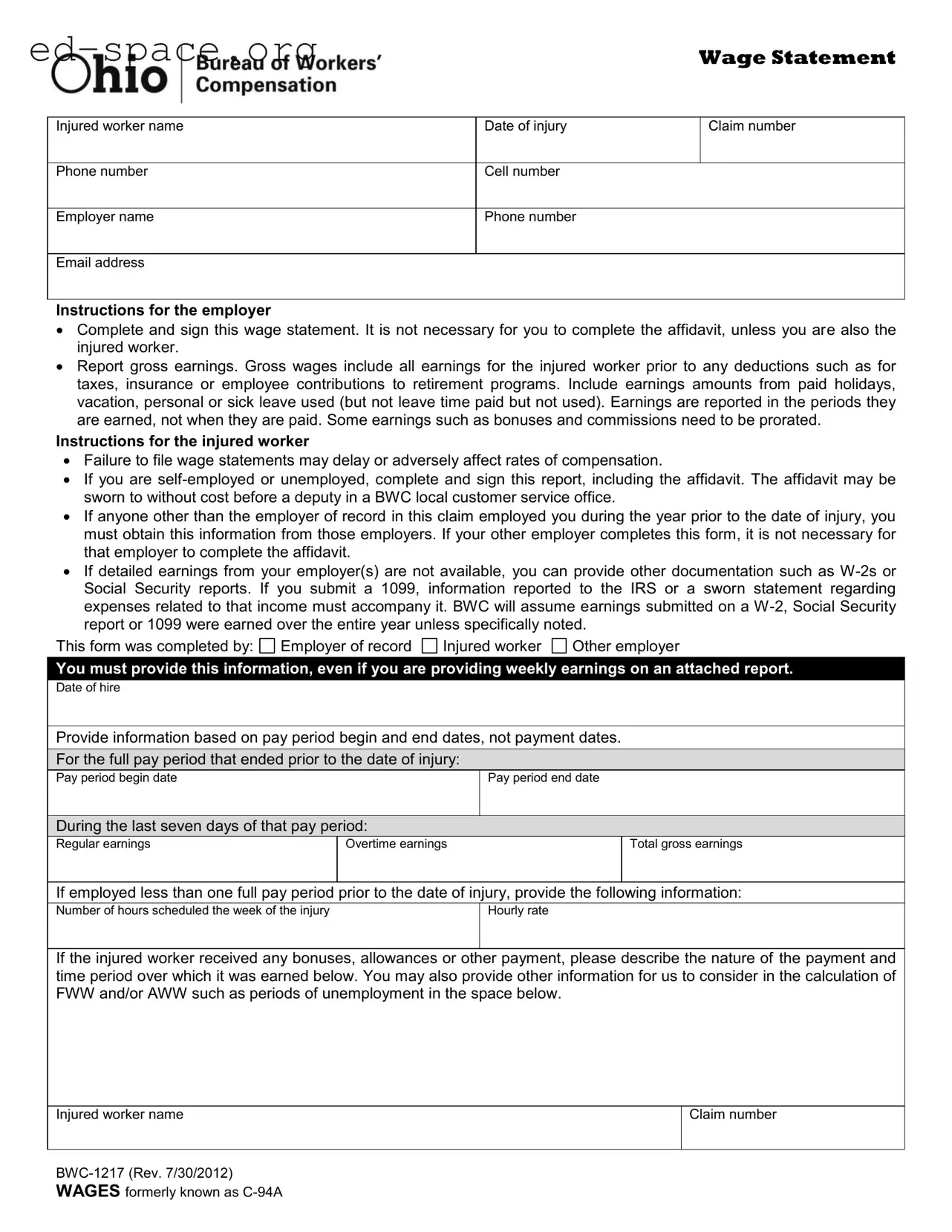
The Ohio BWC 1217 form, also known as the Wage Statement, plays a crucial role in the workers' compensation process. It is essential for both injured workers and their employers. This form collects vital information such as the injured worker's name, date of injury, claim number, and contact details. Employers are instructed to report gross earnings accurately, including wages from holidays and any bonuses or commissions, while ensuring that the information reflects the periods those earnings were accrued. For injured workers, timely submission of this wage statement is critical, as delays can affect compensation rates. If a worker is self-employed or has worked for multiple employers, they must provide detailed earnings information from all relevant sources. The form also includes sections for reporting periods of unemployment and any additional earnings, ensuring a comprehensive overview of the worker's financial situation prior to the injury. By adhering to the guidelines laid out in the BWC 1217 form, both parties can facilitate a smoother claims process and ensure that the injured worker receives the appropriate compensation for their loss of income.
|
|
Wage Statement |
|
|
|
Injured worker name |
Date of injury |
Claim number |
|
|
|
Phone number |
Cell number |
|
|
|
|
Employer name |
Phone number |
|
|
|
|
Email address |
|
|
|
|
|
Instructions for the employer
Complete and sign this wage statement. It is not necessary for you to complete the affidavit, unless you are also the injured worker.
Report gross earnings. Gross wages include all earnings for the injured worker prior to any deductions such as for taxes, insurance or employee contributions to retirement programs. Include earnings amounts from paid holidays, vacation, personal or sick leave used (but not leave time paid but not used). Earnings are reported in the periods they are earned, not when they are paid. Some earnings such as bonuses and commissions need to be prorated.
Instructions for the injured worker
Failure to file wage statements may delay or adversely affect rates of compensation.
If you are
If anyone other than the employer of record in this claim employed you during the year prior to the date of injury, you must obtain this information from those employers. If your other employer completes this form, it is not necessary for that employer to complete the affidavit.
If detailed earnings from your employer(s) are not available, you can provide other documentation such as
This form was completed by:
Employer of record
Injured worker
Other employer
You must provide this information, even if you are providing weekly earnings on an attached report.
Date of hire
Provide information based on pay period begin and end dates, not payment dates.
For the full pay period that ended prior to the date of injury:
Pay period begin date
Pay period end date
During the last seven days of that pay period:
Regular earnings
Overtime earnings
Total gross earnings
If employed less than one full pay period prior to the date of injury, provide the following information:
Number of hours scheduled the week of the injury
Hourly rate
If the injured worker received any bonuses, allowances or other payment, please describe the nature of the payment and time period over which it was earned below. You may also provide other information for us to consider in the calculation of FWW and/or AWW such as periods of unemployment in the space below.
Injured worker name
Claim number
Wage Statement
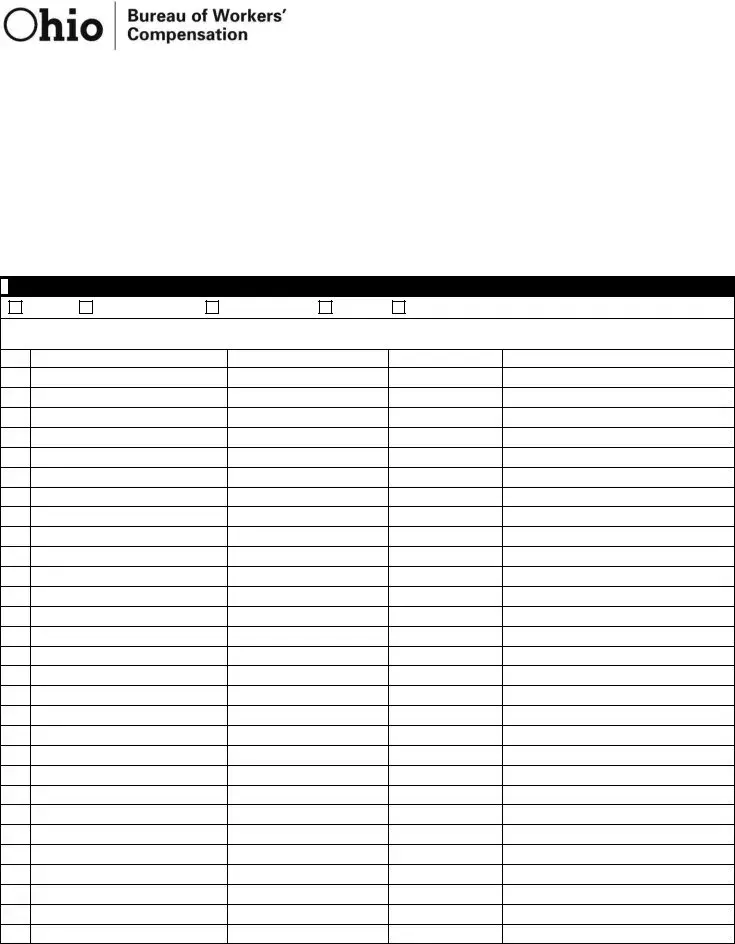
You may submit earnings by providing a report that includes the required information as described below or by completing this worksheet.
Report the pay period dates, not the date payment was made.
Report any periods the injured worker did not work. If payment was made during those periods, report the amount and description of payment the injured worker received.
If the employee received an allowance for meals, lodging, tips, etc in addition to wages, report as other earnings with a description of the earnings. It is not necessary to report reimbursements made to the injured for travel, uniforms, etc. BWC does not consider reimbursements earnings for calculations of wages.
If the injured worker received a bonus during the reporting period, report as other earnings with a description of the earnings which includes the period of time over which it was earned.
Report earnings beginning with the full pay period that ended prior to the date of injury. When setting the
periods to report, you may adjust the reporting periods backward to line up the reporting time frames with the employer’s pay cycle. Do not report wages earned on or after the date of injury.
Payment is made (check one)
Weekly |
Every two weeks |
Twice a month |
Monthly |
Other |
Use the worksheet below, or attach other documentation to provide earnings information for the 52 weeks prior to the date of injury, beginning with the full pay period prior to the date of injury.
Pay period end date |
Gross amount earned |
Other earnings |
Description of exceptions |
1
2
3
4
5
6
7
8
9
10
11
12
13
14
15
16
17
18
19
20
21
22
23
24
25
26
27
28
29
WAGES formerly known as
Wage Statement
30
31
32
33
34
35
36
37
38
39
40
41
42
43
44
45
46
47
48
49
50
51
52
I certify the information provided is correct to the best of my knowledge. I am aware that any person who knowingly makes a false statement, misrepresentation, concealment of fact, or any other act of fraud to obtain payment as provided by the BWC or who knowingly accepts payment to which that person is not entitled, is subject to felony criminal prosecution and may, under appropriate criminal provisions, be punished by a fine, imprisonment or both.
Signature
Date
Employer name and title
X
Employer signature and title
Affidavit
State of Ohio, County of __________________________________ Social Security number: __________________________________
being first duly sworn, says that the entire earnings from ___________________ to ___________________ ; as listed above is correct.
If unable to write, mark must be witnessed by two persons.
Sworn to before me, and subscribed in my presence
Signature of applicant
day of |
. |
|
|
|
|
|
|
|
Official title
WAGES formerly known as
| Fact Name | Fact Description |
|---|---|
| Form Purpose | The Ohio BWC 1217 form is used to report wage information for injured workers to the Bureau of Workers' Compensation. |
| Governing Law | This form is governed by the Ohio Revised Code, specifically sections related to workers' compensation. |
| Injury Reporting | Employers must report gross earnings for the injured worker prior to any deductions, ensuring accurate compensation calculations. |
| Filing Consequences | Failure to submit the wage statement can delay or negatively impact the injured worker's compensation rates. |
| Self-Employment | Self-employed or unemployed individuals must complete the form and may need to include an affidavit. |
| Documentation | Alternative documentation, such as W-2s or Social Security reports, can be provided if detailed earnings are unavailable. |
| Payment Frequency | Employers must indicate the payment frequency, which can be weekly, bi-weekly, monthly, or other specified intervals. |
| Reporting Periods | Only earnings from the full pay period prior to the date of injury should be reported, not the date of payment. |
| Signature Requirement | The form must be signed by the employer or the injured worker, certifying the accuracy of the provided information. |
| Fraud Penalties | Submitting false information can lead to felony charges, fines, or imprisonment under Ohio law. |
Completing the Ohio BWC 1217 form is essential for reporting wage information related to an injury claim. Follow these steps carefully to ensure accurate and complete submission.
After completing the form, review it for accuracy. Submit it to the appropriate authority as directed. Make sure to keep a copy for your records.
What is the Ohio BWC 1217 form?
The Ohio BWC 1217 form, also known as the Wage Statement, is used to report the gross earnings of an injured worker. It collects essential information such as the worker's name, date of injury, claim number, and employer details. This form is crucial for determining compensation rates for injured workers.
Who needs to complete the BWC 1217 form?
The form must be completed by the employer of record or, if applicable, the injured worker themselves. If the injured worker is self-employed or unemployed, they are responsible for filling out the report, including the affidavit. Other employers who may have employed the worker in the year prior to the injury should also provide information if relevant.
What information is required on the form?
Key information includes the injured worker's gross earnings, which must be reported before any deductions. This includes wages from paid holidays, vacation, personal or sick leave used, and any bonuses or commissions that need to be prorated. Employers must report earnings based on the pay period dates, not payment dates.
What happens if the wage statement is not filed?
Failure to file the wage statement can lead to delays or negative impacts on the injured worker's compensation rates. It is vital for both the employer and the injured worker to ensure timely and accurate submission of this form.
How should bonuses and other earnings be reported?
Bonuses and other payments should be described in detail and reported as "other earnings" on the form. The report must include the time period over which these earnings were accrued. If allowances for meals, lodging, or tips are provided, they should also be reported as additional earnings.
What if the injured worker has multiple employers?
If the injured worker had employment with other employers during the year before the injury, they must gather wage information from those employers. If those employers complete the BWC 1217 form, they do not need to fill out the affidavit.
Can I use other documentation instead of the form?
Yes, if detailed earnings from the employer are not available, other documentation such as W-2 forms or Social Security reports can be submitted. If a 1099 is provided, it must be accompanied by a sworn statement regarding related expenses.
How should the pay periods be reported?
Employers should report the pay period dates rather than the payment dates. The report must include earnings for the full pay period that ended before the date of injury. If the worker was employed for less than a full pay period, information on scheduled hours and hourly rates should be provided.
What are the consequences of providing false information?
Providing false information on the BWC 1217 form can lead to serious consequences, including felony criminal prosecution. Individuals who knowingly misrepresent facts or receive payments they are not entitled to may face fines, imprisonment, or both.
Missing Required Information: Many people forget to fill in essential details such as the injured worker's name, date of injury, or claim number. Each piece of information is crucial for processing the claim correctly.
Incorrect Earnings Reporting: Some individuals report net earnings instead of gross earnings. Remember, gross earnings include all income before any deductions, so be sure to report accurately.
Not Reporting All Employers: If the injured worker had multiple employers in the year leading up to the injury, it’s vital to include earnings from all of them. Failing to do so can lead to complications.
Ignoring Pay Period Dates: People often confuse payment dates with pay period dates. The form requires the pay period begin and end dates, not when the payment was actually made.
Overlooking Bonuses and Other Earnings: Bonuses, allowances, and other earnings should be reported separately. Failing to include these can result in an inaccurate wage statement.
Not Signing the Form: A common mistake is forgetting to sign the form. Without a signature, the document may be considered incomplete and could delay processing.
Using Inaccurate Documentation: Submitting incorrect or incomplete documentation, such as W-2s or 1099s, can lead to misunderstandings. Ensure that all supporting documents are accurate and match the information on the form.
Failing to Include Periods of Unemployment: If there were times when the injured worker was unemployed, these periods should be reported. Omitting this information can affect the overall calculation of wages.
The Ohio BWC 1217 form is an essential document for reporting an injured worker's wages. Alongside this form, several other documents are commonly used to ensure accurate reporting and compliance with the Bureau of Workers' Compensation (BWC) requirements. Below is a list of these documents, each with a brief description.
These documents, when used in conjunction with the Ohio BWC 1217 form, help ensure that all relevant earnings information is accurately reported, which is vital for the processing of workers' compensation claims.
The Ohio BWC 1217 form, also known as the Wage Statement, shares similarities with several other important documents used in the context of workers' compensation and employment. Here are six documents that are comparable to the BWC 1217 form, along with a brief explanation of how they relate:
When filling out the Ohio BWC 1217 form, there are important dos and don'ts to keep in mind. Following these guidelines can help ensure that your submission is accurate and complete.
This form is applicable not just to employees but also to self-employed individuals and those who may be unemployed. Anyone who has earnings related to the claim must complete the form.
While the employer typically completes the form, injured workers must also provide information, especially if they are self-employed or have multiple employers.
The BWC 1217 form requires a comprehensive report of earnings from the 52 weeks prior to the injury. This includes all types of earnings, not just those received immediately before the injury.
Bonuses and commissions must be reported. They should be prorated and included in the total earnings for the relevant periods.
Periods of unemployment should be reported on the form. This information helps the Bureau of Workers' Compensation accurately assess the injured worker's financial situation.
While a 1099 can be submitted, it must be accompanied by additional documentation, such as a sworn statement regarding expenses related to that income.
The affidavit is only necessary if the employer is also the injured worker. If another employer is involved, they do not need to complete the affidavit.
Filling out and using the Ohio BWC 1217 form is essential for accurately reporting wage information related to an injury claim. Here are key takeaways to consider:
Understanding these points will help ensure compliance with the requirements of the Ohio BWC 1217 form, facilitating a smoother claims process.