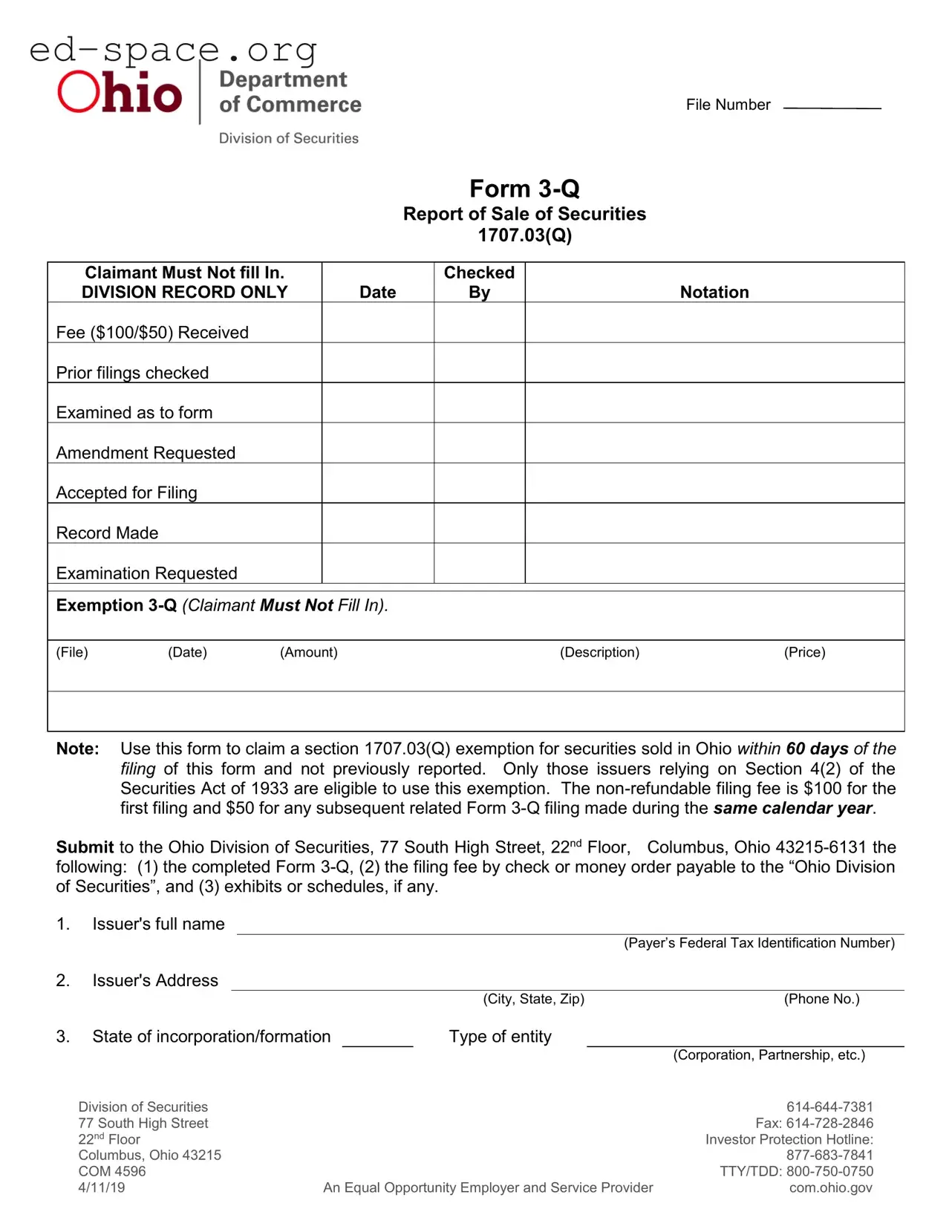
The Ohio 3 Q form serves as a critical tool for issuers seeking to claim an exemption for securities sold within the state, specifically under Section 1707.03(Q) of the Ohio Revised Code. This form must be filed within 60 days of the sale and is intended for those transactions that have not been previously reported. To qualify for this exemption, issuers must rely on Section 4(2) of the Securities Act of 1933, which pertains to private placements. The filing process requires the submission of a completed form along with a non-refundable fee—$100 for the initial filing and $50 for any subsequent related filings within the same calendar year. Essential details must be provided, including the issuer's name, address, and federal tax identification number, as well as specifics about the securities sold, such as the type, number of units, and sale price. Additionally, the form prompts issuers to disclose any commissions or remuneration related to the sale, ensuring transparency in the transaction process. This comprehensive approach not only aids in regulatory compliance but also protects both issuers and investors by providing a structured framework for reporting securities sales in Ohio.

File Number
|
|
|
|
|
|
Form |
|
|
|
|
|
|
|
Report of Sale of Securities |
|
||
|
|
|
|
|
|
1707.03(Q) |
|
|
|
|
|
|
|
|
|
||
Claimant Must Not fill In. |
|
|
|
Checked |
|
|
||
DIVISION RECORD ONLY |
|
Date |
|
By |
|
Notation |
||
Fee ($100/$50) Received |
|
|
|
|
|
|
|
|
Prior filings checked |
|
|
|
|
|
|
|
|
Examined as to form |
|
|
|
|
|
|
|
|
Amendment Requested |
|
|
|
|
|
|
|
|
Accepted for Filing |
|
|
|
|
|
|
|
|
Record Made |
|
|
|
|
|
|
|
|
Examination Requested |
|
|
|
|
|
|
|
|
|
|
|
|
|
||||
Exemption |
|
|
|
|
||||
|
|
|
|
|
|
|
|
|
(File) |
(Date) |
(Amount) |
|
|
|
(Description) |
(Price) |
|
|
|
|
|
|
|
|
|
|
|
|
|
|
|
|
|
|
|
Note: Use this form to claim a section 1707.03(Q) exemption for securities sold in Ohio within 60 days of the filing of this form and not previously reported. Only those issuers relying on Section 4(2) of the Securities Act of 1933 are eligible to use this exemption. The
Submit to the Ohio Division of Securities, 77 South High Street, 22nd Floor, Columbus, Ohio
1.Issuer's full name
(Payer’s Federal Tax Identification Number)
2.Issuer's Address
(City, State, Zip)(Phone No.)
3. State of incorporation/formation |
|
Type of entity |
|
||
|
|
|
|
|
(Corporation, Partnership, etc.) |
Division of Securities |
|
|
|
|
|
77 South High Street |
|
|
|
|
Fax: |
22nd Floor |
|
|
|
|
Investor Protection Hotline: |
Columbus, Ohio 43215 |
|
|
|
|
|
COM 4596 |
|
|
|
|
TTY/TDD: |
4/11/19 |
An Equal Opportunity Employer and Service Provider |
com.ohio.gov |
|||

Ohio Department of Commerce |
FORM |
4.Correspondence regarding this report should be sent to:
(Name) |
(Street) |
(City, State, Zip Code) |
(Phone No.) |
5.A section 1707.03(Q) claim of exemption is being made for the following securities sold in Ohio within 60 days of the filing of this form and not previously reported (use additional sheet, if necessary):
Type of |
|
Date of |
|
Number of |
|
Price |
|
Number of |
Securities Sold |
|
Sale |
|
Units Sold |
|
per Unit |
|
Purchasers |
|
|
|
|
|
|
|
|
|
|
|
|
|
|
|
|
|
|
|
|
|
|
|
|
|
|
|
Note: |
O.A.C. rule |
|
agreement or its equivalent, signed by the purchaser, is received by the issuer or the dealer, or the purchaser |
|
transfers or loses control of the purchase funds, whichever is earlier; or (b) the first date of disbursement of |
|
any proceeds of the sale of the securities which have been deposited directly into an escrow account. |
6.Confirm that the basis in law for this claim of exemption from Section 5 of the Securities Act of 1933 is pursuant to Section 4(2) of that Act. Note that Rules 504, 505 and 506 cannot be used as a basis for claiming the exemption pursuant to Section 1707.03(Q).
7.List the total number of persons who have purchased this offering to date, both in and outside of Ohio, including persons claimed on all previous Form
8.(a) List any commissions, discounts, or other remuneration paid or to be paid or given to any person,
directly or indirectly, for sales in Ohio of the securities claimed on the Form
Name and address of person |
|
Amount of |
|
Percentage of |
receiving commission, etc. |
|
commission, etc. |
|
the Initial Offering Price |
|
|
|
|
|
|
|
|
|
|
(b)Were above commissions, discounts, or other remuneration paid or given only to dealers or
salesmen licensed under Chapter 1707 of the Revised Code? |
YES |
NO |
9.Was an offering circular used in connection with the sales reported on this Form
YES |
NO |
|
If yes, |
Copy attached or |
Previously submitted |

Ohio Department of Commerce |
FORM |
|
10. Has this offering been terminated? YES |
NO |
|
If yes, date of termination |
|
|
11.Incorporated issuers not domiciled in this state or unincorporated issuers having a situs of its principal place of business outside this state must file a Form 11 or Form
SIGNATURE
The undersigned represents that the foregoing information is true as of the date hereof and agrees that this report shall be considered a written statement used for the purpose of selling securities in Ohio within the meaning of Section 1707.44(B) of the Ohio Revised Code. The individual signing this report on behalf of the issuer further represents that he/she is duly authorized by the issuer to execute and file this report.
Issuer or Dealer
|
|
(Full Name) |
By |
|
|
|
(Signature) |
(Date) |
|
|
|
|
(Name) |
(Official Capacity) |
The Division suggests Form
COM 4596 |
Updated 4/11/19 |
| Fact Name | Description |
|---|---|
| Purpose of Form | The Ohio 3-Q form is used to claim an exemption under Section 1707.03(Q) for securities sold in Ohio. |
| Filing Deadline | It must be filed within 60 days of the sale of securities to be eligible for the exemption. |
| Filing Fee | The non-refundable fee is $100 for the first filing and $50 for subsequent filings in the same calendar year. |
| Governing Law | This form is governed by Ohio Revised Code Section 1707.03(Q) and the Securities Act of 1933. |
| Eligibility Criteria | Only issuers relying on Section 4(2) of the Securities Act of 1933 can use this exemption. |
| Submission Requirements | To submit, include the completed form, filing fee, and any necessary exhibits or schedules. |
| Sales Reporting | Report the total number of purchasers for the offering, both in and outside of Ohio. |
| Commissions Disclosure | Disclose any commissions or remuneration related to the sales of securities in Ohio. |
| Offering Circular | Indicate if an offering circular was used in connection with the sales reported on the form. |
| Signature Requirement | The form must be signed by an authorized individual representing the issuer, affirming the truth of the information provided. |
Completing the Ohio 3 Q form requires careful attention to detail. Once the form is filled out, it must be submitted to the Ohio Division of Securities along with the required filing fee and any additional documents. Below are the steps to accurately fill out the form.
What is the Ohio 3 Q form used for?
The Ohio 3 Q form is used to claim an exemption under Section 1707.03(Q) for securities sold in Ohio. This exemption applies to securities sold within 60 days of filing the form and not previously reported. Only issuers relying on Section 4(2) of the Securities Act of 1933 can use this exemption.
What is the filing fee for the Ohio 3 Q form?
The filing fee for the first submission of the Ohio 3 Q form is $100. If you need to file additional related forms within the same calendar year, the fee is reduced to $50 for each subsequent filing.
Where do I submit the Ohio 3 Q form?
You should submit the completed Ohio 3 Q form, along with the filing fee and any necessary exhibits, to the Ohio Division of Securities. The address is 77 South High Street, 22nd Floor, Columbus, Ohio 43215-6131.
What information is required on the Ohio 3 Q form?
The form requires several pieces of information, including the issuer's full name, address, federal tax identification number, and the type of entity. Additionally, details about the securities sold, including the date of sale, number of units sold, and price per unit, must be included.
Can I use the Ohio 3 Q form if I have previously reported the same securities?
No, the Ohio 3 Q form is specifically for securities that have not been previously reported. If you have already reported the securities, you cannot use this form for those sales.
What should I do if I need to amend my filing?
If you need to amend your filing, you should indicate this on the form and provide the necessary information for the amendment. It is advisable to consult with a legal advisor to ensure compliance with all requirements.
What happens if I do not include the required fee with my submission?
Your submission may be rejected if the required fee is not included. It is essential to ensure that your payment is made via check or money order, payable to the “Ohio Division of Securities,” to avoid any issues with your filing.
Is there a specific format for the information I provide on the Ohio 3 Q form?
Yes, the form has specific sections that must be filled out in a particular order. Follow the instructions carefully, and ensure that all required information is provided accurately to avoid delays in processing.
Can I file the Ohio 3 Q form electronically?
Currently, the Ohio 3 Q form must be submitted in hard copy. It is recommended to send the form via certified mail for verification of receipt, or you can send a copy along with a self-addressed, stamped envelope for confirmation.
Incomplete Information: One common mistake is failing to provide complete information in the required fields. For instance, omitting the issuer's full name, address, or contact information can lead to delays in processing the form. Each section must be filled out accurately to avoid complications.
Incorrect Filing Fee: Applicants sometimes overlook the filing fee structure. The fee is $100 for the first filing and $50 for subsequent filings within the same calendar year. Submitting an incorrect amount can result in the form being rejected, requiring resubmission with the correct fee.
Failure to Confirm Legal Basis: It is essential to confirm the legal basis for the exemption being claimed. Many individuals neglect to check that the exemption is pursuant to Section 4(2) of the Securities Act of 1933. Misunderstanding this requirement can lead to the form being deemed invalid.
Not Using the Correct Format: The form must be submitted in the correct format. Some individuals fail to attach necessary documents, such as exhibits or schedules, or do not follow the specified instructions for submission. This oversight can delay the processing of the claim.
When dealing with the Ohio 3-Q form, several other documents may be needed to support your filing or to provide additional information about your securities transactions. Below is a list of forms and documents that are often used in conjunction with the Ohio 3-Q form, each serving a specific purpose.
Having these documents prepared and readily available can streamline the process of filing the Ohio 3-Q form and ensure compliance with both state and federal regulations. Always consider consulting with a legal professional to ensure that all necessary forms are accurately completed and submitted on time.
The Ohio 3-Q form is primarily used to report the sale of securities and claim an exemption under Ohio law. It shares similarities with several other documents related to securities transactions. Here are four documents that are similar to the Ohio 3-Q form:
Each of these forms plays a critical role in the regulatory landscape of securities, promoting transparency and protecting investors in their respective jurisdictions.
When filling out the Ohio 3-Q form, there are important guidelines to follow. Here’s a list of things you should and shouldn’t do:
Following these guidelines will help ensure a smoother filing process for your Ohio 3-Q form.
Misconceptions about the Ohio 3 Q form can lead to confusion and errors in the filing process. Here are six common misconceptions clarified:
Understanding these misconceptions can help ensure compliance with the filing requirements and streamline the process for all parties involved.
Here are key takeaways for filling out and using the Ohio 3 Q form:
Filing this form accurately is crucial for compliance with Ohio securities laws. Ensure all information is complete and truthful, as it serves as a formal report for selling securities in the state.