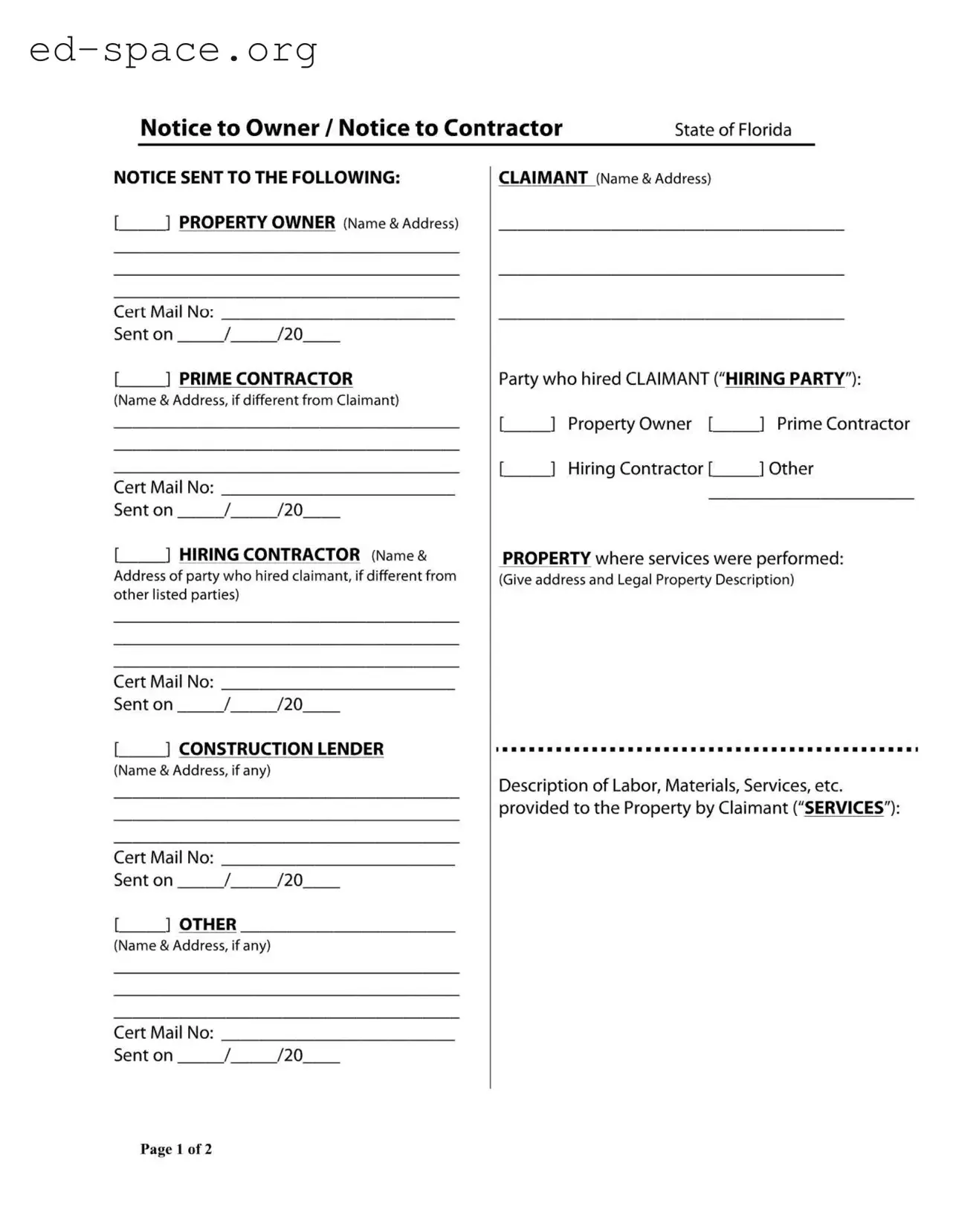
The Notice Owner Florida form is an essential document in the construction industry, designed to protect the rights of those providing labor and materials on a property. This form serves as a formal notification to property owners, contractors, and lenders about the services rendered by a claimant. It includes crucial information such as the names and addresses of all parties involved, including the property owner, prime contractor, hiring contractor, and any construction lender. Each party receives a copy of the notice, which is sent via certified mail, ensuring that all relevant individuals are informed. The form also outlines the specific property where services were performed, along with a description of the labor, materials, and services provided. Importantly, the Notice Owner Florida form warns property owners about the potential for construction liens. Under Florida law, unpaid contractors, subcontractors, and material suppliers can file liens against a property, even if the owner has made full payment to the contractor. To avoid the risk of double payment, property owners are advised to obtain written releases from contractors upon making payments. This form is not just a notification; it is a vital step in safeguarding the financial interests of all parties involved in a construction project.
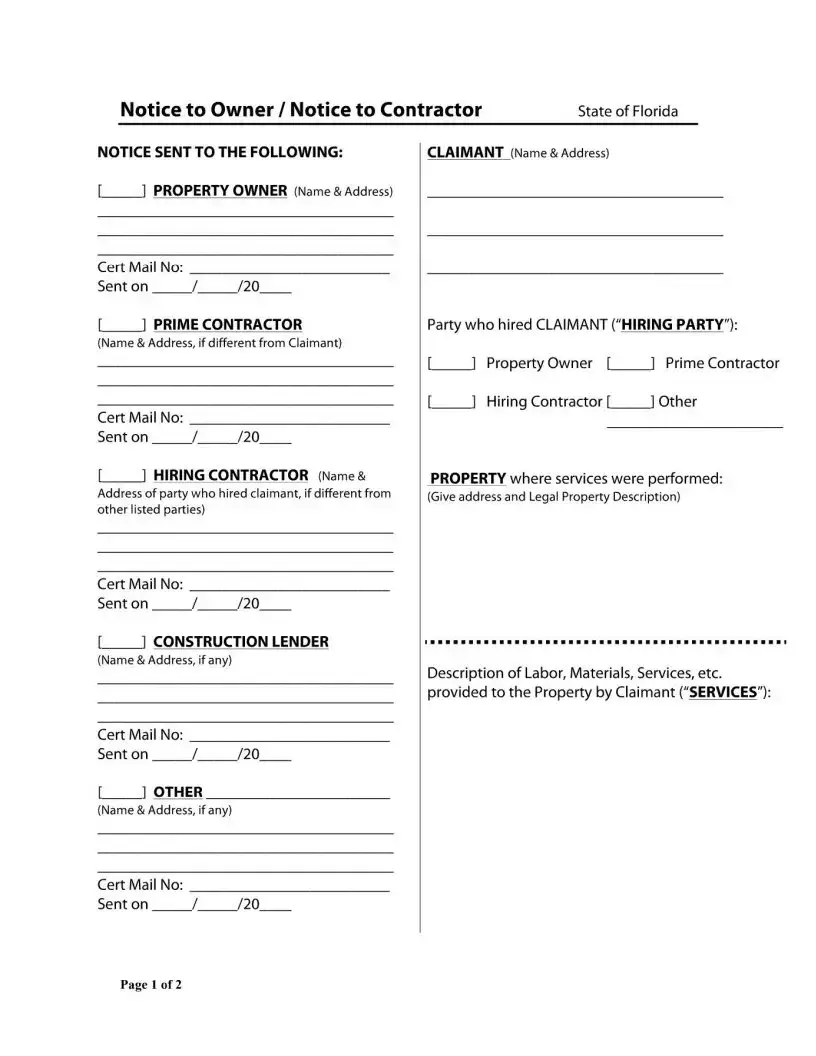
Notice to Owner/ Notice to Contractor |
State of Florida |
NOTICE SENT TO THE FOLLOWING:
~_ _,) PROPERTY OWNER (Name & Address)
Cert Mail No: ___________
Sent on __!__!20
..__..) PRIME CONTRACTOR
(Name & Address, if different from Claimant)
Cert Mail No: ___________
Senton __/__/20__
..__..) HIRING CONTRACTOR (Name &
Address of party who hired claimant, if different from other listed parties)
Cert Mail No:
Senton __/ __/20__
..__..) CONSTRUCTION LENDER
(Name & Address, if any)
Cert Mail No:
Sent on __/__/20__
~_ _,] OTHER __________
(Name & Address, if any)
CLAIMANT (Name & Address)
Party who hired CLAIMANT ("HIRING PARTY"):
Property Owner .__[_ __,) Prime Contractor
Hiring Contractor.__[_ __,) Other
PROPERTY where services were performed:
(Give address and Legal Property Description)
..........•.•.... |
• |
• |
• |
• |
Description of Labor, Materials, Services, et c. provided to t he Property by Claimant ("SERVICES"):
Cert Mail No:
Sent on __/__/20__
Page 1 of2
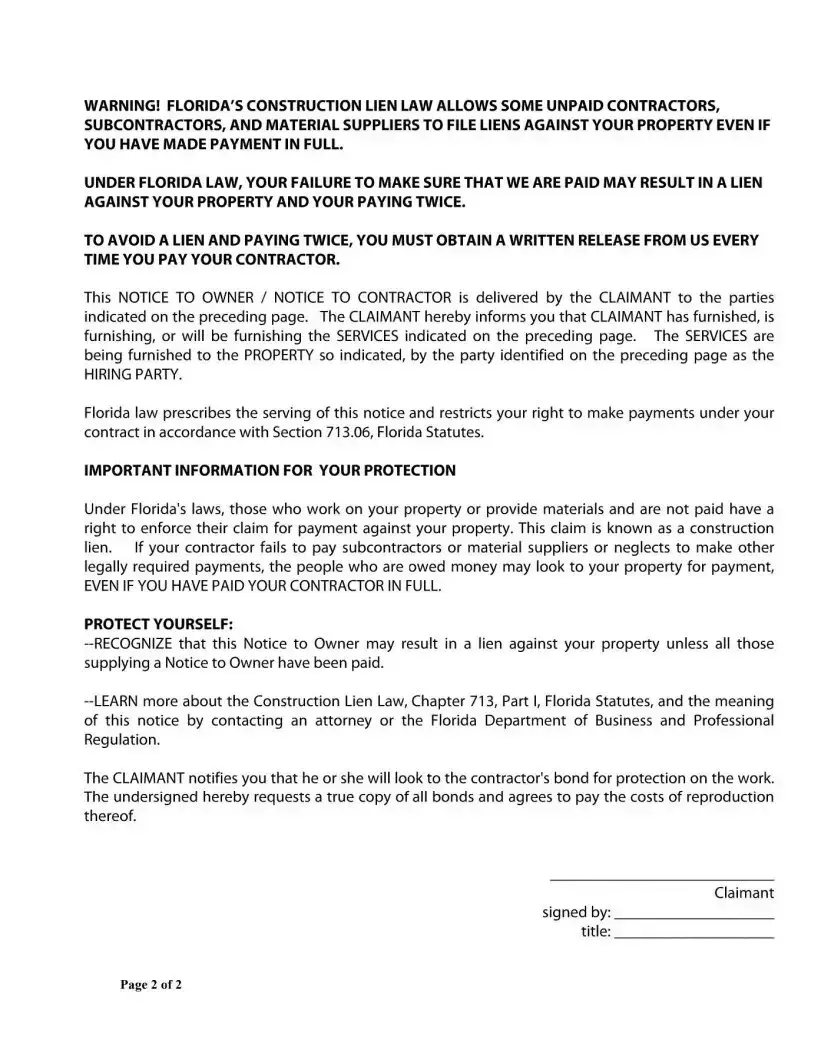
WARNING! FLORIDA'SCONSTRUCTION LIEN LAW ALLOWS SOME UNPAID CONTRACTORS, SUBCONTRACTORS, AND MATERIAL SUPPLIERS TO FILE LIENS AGAINST YOUR PROPERTY EVEN IF YOU HAVE MADE PAYMENT IN FULL.
UNDER FLORIDA LAW, YOUR FAILURE TO MAKE SURE THAT WE ARE PAID MAY RESULT IN A LIEN AGAINST YOUR PROPERTY AND YOUR PAYING TWICE.
TO AVOID A LIEN AND PAYING TWICE, YOU MUST OBTAIN A WRITTEN RELEASE FROM US EVERY TIME YOU PAY YOUR CONTRACTOR.
This NOTICE TO OWNER / NOTICE TO CONTRACTOR is delivered by the CLAIMANT to the parties indicated on the preceding page. The CLAIMANT hereby informs you that CLAIMANT has furnished, is furnishing, or will be furnishing the SERVICES indicated on the preceding page. The SERVICES are being furnished to the PROPERTY so indicated, by the party identified on the preceding page as the
HIRING PARTY.
Florida law prescribes the serving of this notice and restricts your right to make payments under your contract in accordance with Section 713.06, Florida Statutes.
IMPORTANT INFORMATION FOR YOUR PROTECTION
Under Florida'slaws, those who work on your property or provide materials and are not paid have a right to enforce their claim for payment against your property. This claim is known as a construction lien. If your contractor fails to pay subcontractors or material suppliers or neglects to make other legally required payments, the people who are owed money may look to your property for payment,
EVEN IF YOU HAVE PAID YOUR CONTRACTOR IN FULL.
PROTECT YOURSELF:
The CLAIMANT notifies you that he or she will look to the contractor'sbond for protection on the work. The undersigned hereby requests a true copy of all bonds and agrees to pay the costs of reproduction thereof.
Claimant
signed by: ________
title:
Page 2 of2
| Fact Name | Details |
|---|---|
| Purpose | The Notice to Owner informs property owners and other parties about services provided and potential lien rights. |
| Governing Law | This form is governed by Florida Statutes, specifically Section 713.06. |
| Parties Involved | The form includes information about the property owner, prime contractor, hiring contractor, construction lender, and claimant. |
| Delivery Method | The notice must be sent via certified mail to ensure proper delivery and record-keeping. |
| Claimant's Rights | The claimant has the right to file a lien against the property if not paid for services rendered. |
| Warning | Failure to ensure payment to all parties may result in a lien against the property, even if the owner has paid in full. |
| Legal Protection | Property owners are advised to obtain written releases from contractors each time a payment is made. |
| Request for Bonds | The claimant may request a true copy of all bonds related to the work and agrees to cover reproduction costs. |
To complete the Notice Owner Florida form, it is essential to provide accurate information regarding the involved parties and the services rendered. This form must be filled out carefully to ensure compliance with Florida's construction lien laws. Below are the steps to fill out the form correctly.
After completing the form, ensure that all information is accurate and clear. It is advisable to keep a copy for your records and send the form to the relevant parties as required by Florida law.
What is the Notice Owner Florida form?
The Notice Owner Florida form is a legal document used in the state of Florida to inform property owners, contractors, and other involved parties about services provided on a property. This notice is crucial for ensuring that all parties are aware of potential claims for payment, particularly in the context of construction projects. It serves as a warning that unpaid contractors, subcontractors, or material suppliers may file a lien against the property, even if the property owner has paid their contractor in full.
Who should receive the Notice Owner Florida form?
The form should be sent to various parties involved in a construction project. This includes the property owner, the prime contractor, the hiring contractor, any construction lender, and any other relevant parties. Each party’s name and address must be clearly indicated on the form to ensure proper notification. This is essential for protecting the rights of all parties involved and for complying with Florida’s construction lien laws.
What are the risks of not responding to the Notice Owner Florida form?
Failure to respond or act upon the Notice Owner can lead to significant financial risks for property owners. If the contractors or subcontractors are not paid, they have the right to file a lien against the property. This means that even if the owner has paid their contractor in full, they could still face claims from unpaid parties, resulting in the potential for double payment. It is crucial for property owners to take this notice seriously and ensure that all parties who provided services are compensated appropriately.
What should a property owner do upon receiving the Notice Owner Florida form?
Upon receiving the Notice Owner Florida form, property owners should take immediate action to verify that all contractors and subcontractors have been paid for their services. It is advisable to request a written release from each contractor or subcontractor every time a payment is made. This helps prevent any future claims against the property. Additionally, consulting with a legal expert familiar with Florida’s construction lien laws can provide further protection and clarity on the next steps.
How does the construction lien process work in Florida?
The construction lien process in Florida allows unpaid contractors, subcontractors, and material suppliers to enforce their claims against a property. If a contractor fails to pay their subcontractors or suppliers, those owed money can file a lien against the property. The property owner must then address these claims, which may involve paying the outstanding amounts or negotiating with the parties involved. It is essential for property owners to understand this process and take proactive measures to protect their interests.
Incomplete Information: Failing to provide all required names and addresses can lead to significant issues. Ensure that the property owner, prime contractor, hiring contractor, and any construction lender are correctly listed.
Incorrect Dates: Dates are crucial in this form. Missing or incorrect dates for when the notice was sent can cause confusion and may invalidate the notice.
Neglecting Legal Descriptions: A vague or incomplete legal property description can lead to disputes. Always provide a precise legal description of the property where services were performed.
Missing Signature: Forgetting to sign the notice can render it ineffective. A signature is necessary to validate the document.
Failing to Send via Certified Mail: Not sending the notice through certified mail can compromise its legal standing. Always use certified mail to ensure delivery and obtain proof.
Ignoring the Warning: The warning about potential liens is not just a formality. Ignoring this can lead to financial repercussions if payments are not managed properly.
Not Keeping Copies: Failing to keep copies of the sent notices can create issues later on. Always retain copies for your records.
Overlooking Communication with Contractors: Not communicating with the contractors involved can lead to misunderstandings. Clear communication is essential to avoid disputes over payments.
The Notice to Owner form is an essential document in Florida's construction industry, designed to protect the rights of those providing labor and materials on a property. Along with this form, several other documents are commonly used to ensure compliance with state laws and to safeguard the interests of all parties involved in a construction project. Below is a list of these documents, along with a brief description of each.
Using these documents in conjunction with the Notice to Owner form helps to ensure that all parties are aware of their rights and responsibilities. This proactive approach can prevent disputes and protect property owners from potential liens and legal issues down the line.
The Notice Owner Florida form is similar to several other important documents related to construction and property rights. Here are six documents that share similarities:
When filling out the Notice Owner Florida form, it is crucial to approach the task with care and attention to detail. This ensures that all necessary information is accurately conveyed and helps avoid potential issues down the line. Below is a list of things you should and shouldn't do during this process.
By following these guidelines, you can navigate the process of completing the Notice Owner Florida form with confidence and clarity. Taking the time to ensure everything is done correctly can save you from complications later on.
Understanding the Notice to Owner form in Florida can be challenging. Here are eight common misconceptions that many people have about this important document:
Being informed about these misconceptions can help you navigate the construction process more effectively and protect your interests.
Understanding the Notice Owner Florida form is crucial for property owners involved in construction projects. Here are key takeaways to keep in mind:
By understanding these aspects, property owners can better navigate the complexities of construction contracts and protect their investments.