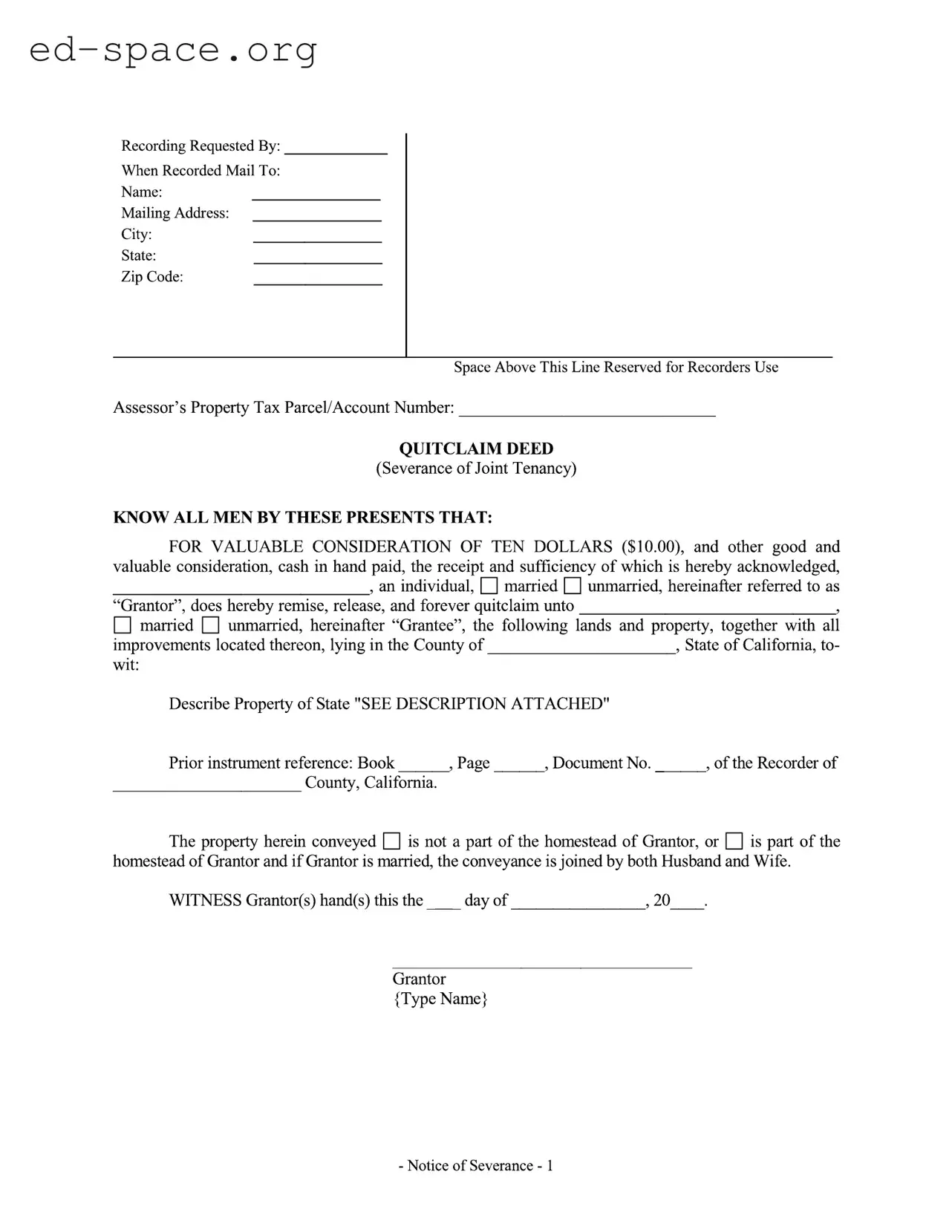
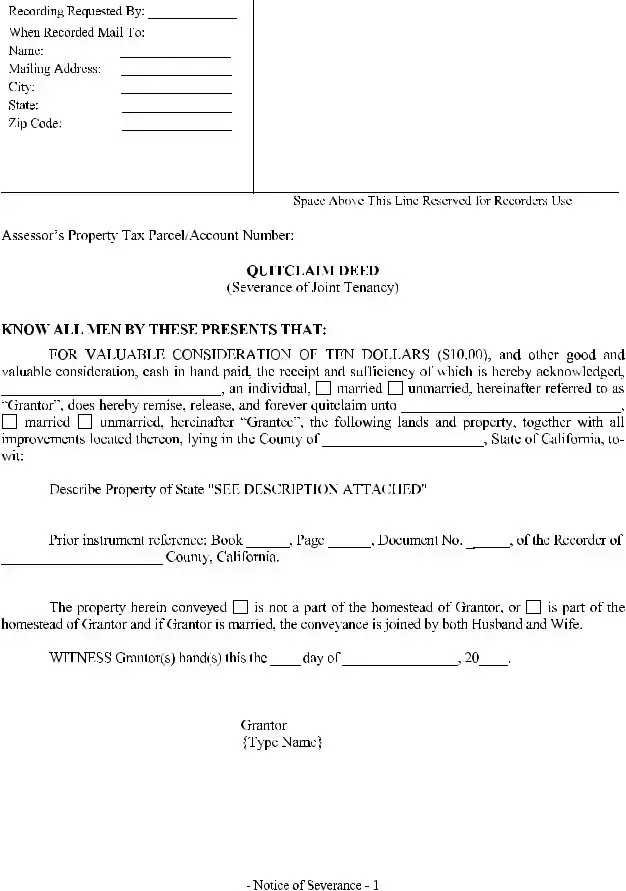
The Notice of Severance of Joint Tenancy form is a critical document for individuals navigating the complexities of divorce in California. This form serves as a formal declaration that a joint tenancy has been severed, allowing the parties involved to transition from joint ownership to tenancy in common. The document includes essential details such as the names and addresses of the parties, property descriptions, and the specific legal language required to effectuate the severance. Notably, it requires acknowledgment by a notary public, ensuring that the signatures are verified and the intent to sever is clear. This form also addresses whether the property in question is part of a homestead, which can have significant implications in divorce proceedings. By filing this notice, individuals can protect their interests and clarify ownership rights, thereby facilitating a smoother transition during a challenging time. Understanding the nuances of this form is vital for anyone involved in a divorce where joint property is at stake.
| Fact Name | Details |
|---|---|
| Purpose | The Notice of Severance of Joint Tenancy is used to formally sever a joint tenancy in California, particularly in the context of divorce. |
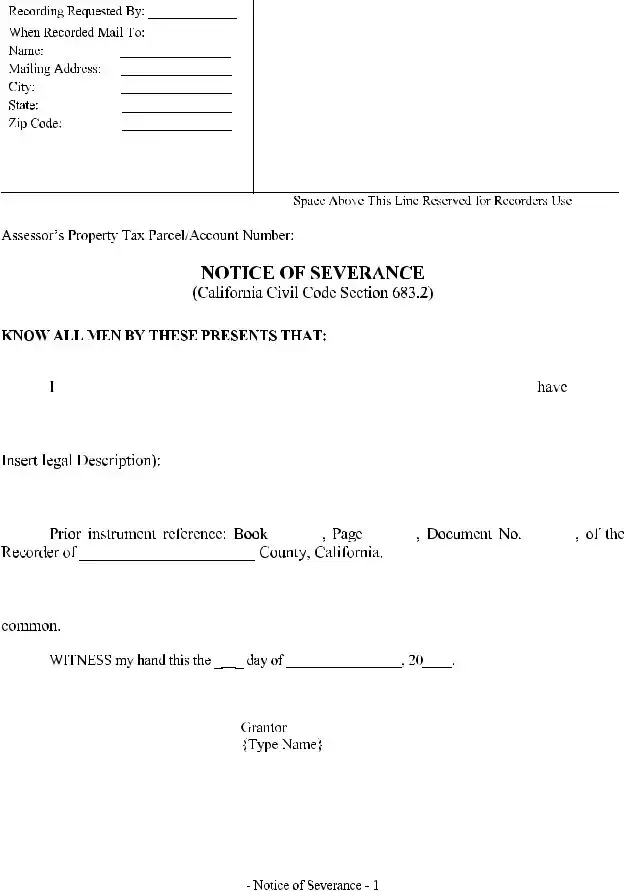
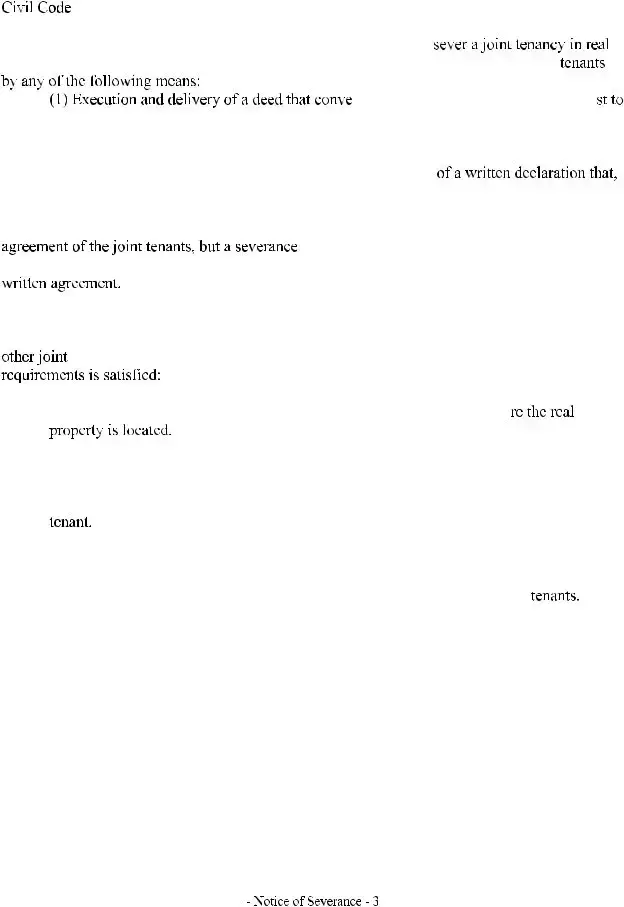
| Governing Law | This form is governed by California Civil Code Section 683.2, which outlines the procedures for severing joint tenancies. |
| Execution Requirement | The severance can be executed by one joint tenant without the consent of the other joint tenants. |
| Recording | To be effective, the Notice must be recorded in the county where the property is located. |
| Legal Title Transfer | The form allows for the transfer of legal title to a joint tenant's interest, which converts joint tenancy into tenancy in common. |
| Homestead Status | The form includes a declaration regarding whether the property is part of the homestead of the Grantor. |
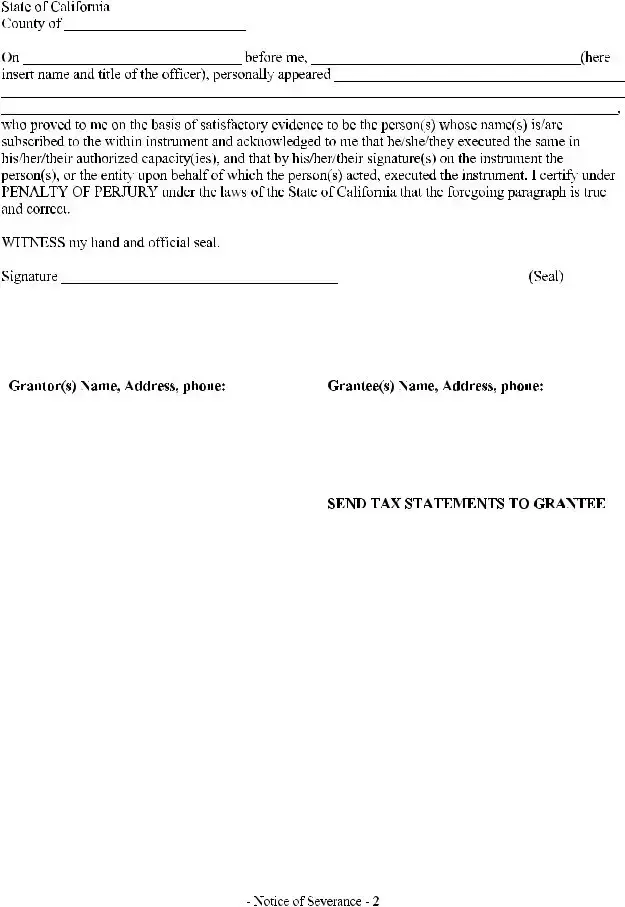
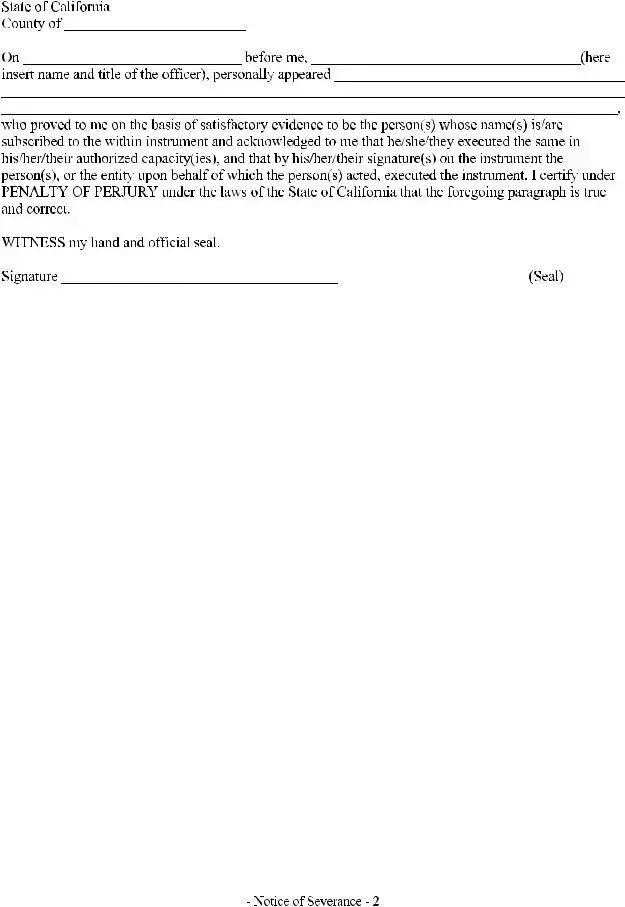
| Notary Requirement | The signature of the Grantor must be acknowledged before a notary public to validate the severance. |
Filling out the Notice of Severance of Joint Tenancy form is an important step in the process of separating ownership interests in property during a divorce. Once you complete this form, you will need to file it with the appropriate county recorder's office to officially sever the joint tenancy.
What is the Notice of Severance of Joint Tenancy form?
The Notice of Severance of Joint Tenancy form is a legal document used in California to officially sever a joint tenancy between co-owners of real property. This action changes the ownership from joint tenancy to tenants in common, which allows each owner to independently manage their share of the property.
When should I use this form?
You should use this form when you want to terminate a joint tenancy with another person, especially during or after a divorce. It is important to ensure that both parties are aware of the change in ownership structure, as it affects property rights and responsibilities.
Who can complete the Notice of Severance of Joint Tenancy?
The form can be completed by any joint tenant who wishes to sever the joint tenancy. The individual must have the legal capacity to execute the document and should be aware of their rights and obligations regarding the property.
Do I need both parties to sign the form?
No, the form can be executed by one joint tenant without the consent of the other. However, it is advisable to inform the other party to avoid potential disputes in the future.
How do I record the Notice of Severance of Joint Tenancy?
To record the Notice, you must submit it to the county recorder’s office where the property is located. Ensure that the form is properly filled out and signed. There may be a small fee for recording the document.
What happens after I file the Notice of Severance?
Once the Notice is recorded, the joint tenancy is severed, and the property will be owned as tenants in common. Each party will then have individual rights to their share of the property, including the ability to sell or transfer their interest independently.
Will severing the joint tenancy affect my rights to the property?
Yes, severing the joint tenancy changes your ownership rights. As tenants in common, you will no longer have survivorship rights. If one owner passes away, their share will not automatically go to the other owner but will instead be distributed according to their will or state law.
Is there a deadline for filing the Notice of Severance?
There is no specific deadline for filing the Notice of Severance, but it is advisable to do so as soon as the decision to sever the joint tenancy is made. Delaying could lead to complications, especially if one party passes away before the severance is recorded.
Can I revoke the Notice of Severance after it has been filed?
Once the Notice of Severance is filed, it cannot be revoked unilaterally. If both parties agree to restore the joint tenancy, they must execute a new legal document to re-establish the joint ownership.
Where can I find assistance with filling out this form?
You can seek assistance from a legal professional, such as an attorney specializing in family law or real estate. Additionally, some legal aid organizations may offer resources or guidance for completing the form.
Failing to include the correct names of all parties involved. Ensure that both the Grantor and Grantee are accurately named to avoid legal complications.
Not providing a complete property description. It’s crucial to describe the property clearly and accurately, as any ambiguity can lead to disputes later.
Omitting the Assessor’s Property Tax Parcel/Account Number. This number helps identify the property in question and is essential for proper record-keeping.
Forgetting to indicate whether the property is part of the homestead. This distinction can affect rights and obligations in the event of a divorce or separation.
Not obtaining the necessary notary acknowledgment. The form must be notarized to ensure its validity and to prevent future challenges to its authenticity.
Leaving out the date of execution. This is important for establishing timelines and can be critical in legal proceedings.
Failing to send tax statements to the correct Grantee address. This oversight can lead to missed tax payments and potential penalties.
Not keeping a copy of the completed form. It’s wise to retain a copy for your records, as it may be needed for future reference or legal matters.
Neglecting to check for local recording requirements. Different counties may have specific rules or additional forms that need to be submitted along with the Notice of Severance.
The Notice of Severance of Joint Tenancy is a critical document in the context of divorce proceedings in California, particularly when addressing the division of property. Several other forms and documents often accompany this notice to ensure that the severance is legally recognized and properly executed. Below is a list of related documents that may be necessary during this process.
Each of these documents plays a significant role in the property division process during divorce proceedings. Understanding their functions can help individuals navigate the complexities of legal property transfers and ensure compliance with California law.
The Notice of Severance of Joint Tenancy in California is an important legal document used during a divorce to sever joint ownership of property. Several other documents serve similar purposes in the context of property ownership and transfers. Here’s a look at five of them:
When filling out the Notice of Severance of Joint Tenancy California Divorce form, it is important to approach the task with care. Here is a list of things you should and shouldn't do:
Taking these steps can help ensure that the process goes smoothly and that your interests are protected.
This form can be utilized by any joint tenants, regardless of marital status. It serves to sever the joint tenancy for both married and unmarried individuals.
The Notice of Severance does not transfer ownership; it simply changes the nature of ownership from joint tenancy to tenants in common.
A joint tenant can sever the joint tenancy without the consent of the other joint tenants. This can be done through a written declaration or deed.
The Notice of Severance can apply to any type of real property, including commercial and agricultural properties.
The severance can be reversed if all joint tenants agree to restore the joint tenancy through a new deed or written agreement.
A notarized signature is required to ensure the validity of the notice. This provides legal assurance that the parties involved have acknowledged the document.
The notice does not affect the rights of creditors. Any existing liens or claims against the property remain in effect regardless of the severance.
While legal assistance can be helpful, individuals can file the Notice of Severance on their own. The form is designed to be straightforward and accessible.
Filling out and using the Notice of Severance of Joint Tenancy form in California requires careful attention to detail. Here are some key takeaways to keep in mind:
By following these takeaways, individuals can navigate the process of severing a joint tenancy more effectively and understand the implications of their actions.