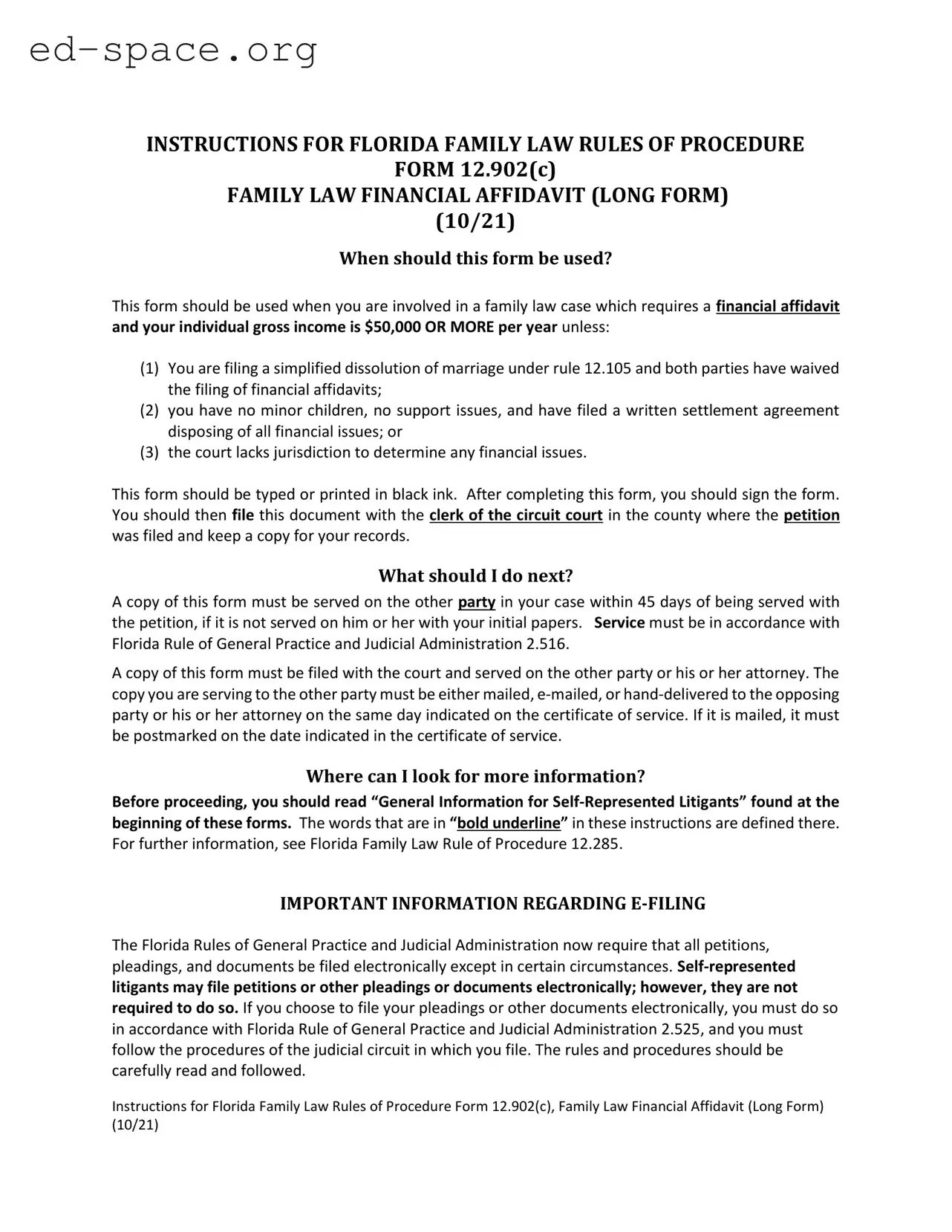
The Notice Florida form is an essential document utilized in family law cases, particularly when financial disclosures are required. Specifically, it is designed for individuals whose gross annual income meets or exceeds $50,000. This form plays a crucial role in ensuring transparency and fairness during legal proceedings, especially when determining financial responsibilities such as child support or alimony. It is important to note that there are specific circumstances under which this form may not be necessary, such as in simplified dissolutions of marriage or when all financial issues have been settled in writing. Once completed, the form must be filed with the circuit court and served to the other party involved in the case, adhering to strict timelines and methods of service. Additionally, the form requires detailed information about income, expenses, and deductions, and it must be filled out accurately to reflect one’s financial situation. Self-represented litigants are encouraged to familiarize themselves with the e-filing and e-service requirements, as these modern practices streamline the process but also require adherence to specific rules. Overall, the Notice Florida form is a vital tool that facilitates the fair resolution of financial matters in family law cases.
INSTRUCTIONS FOR FLORIDA FAMILY LAW RULES OF PROCEDURE
FORM 12.902(c)
FAMILY LAW FINANCIAL AFFIDAVIT (LONG FORM)
(10/21)
When should this form be used?
This form should be used when you are involved in a family law case which requires a financial affidavit and your individual gross income is $50,000 OR MORE per year unless:
(1)You are filing a simplified dissolution of marriage under rule 12.105 and both parties have waived the filing of financial affidavits;
(2)you have no minor children, no support issues, and have filed a written settlement agreement disposing of all financial issues; or
(3)the court lacks jurisdiction to determine any financial issues.
This form should be typed or printed in black ink. After completing this form, you should sign the form. You should then file this document with the clerk of the circuit court in the county where the petition was filed and keep a copy for your records.
What should I do next?
A copy of this form must be served on the other party in your case within 45 days of being served with the petition, if it is not served on him or her with your initial papers. Service must be in accordance with Florida Rule of General Practice and Judicial Administration 2.516.
A copy of this form must be filed with the court and served on the other party or his or her attorney. The copy you are serving to the other party must be either mailed,
Where can I look for more information?
Before proceeding, you should read “General Information for
IMPORTANT INFORMATION REGARDING
The Florida Rules of General Practice and Judicial Administration now require that all petitions, pleadings, and documents be filed electronically except in certain circumstances.
Instructions for Florida Family Law Rules of Procedure Form 12.902(c), Family Law Financial Affidavit (Long Form) (10/21)
IMPORTANT INFORMATION REGARDING
After the initial service of process of the petition or supplemental petition by the Sheriff or certified process server, the Florida Rules of General Practice and Judicial Administration now require that all documents required or permitted to be served on the other party must be served by electronic mail (e- mail) except in certain circumstances. You must strictly comply with the format requirements set forth in the Florida Rules of General Practice and Judicial Administration. If you elect to participate in electronic service, which means serving or receiving pleadings by electronic mail
To serve and receive documents by
Special notes . . .
If you want to keep your address confidential because you have been found by a judge to be the victim of sexual battery, aggravated child abuse, aggravated stalking, harassment, aggravated battery, or domestic violence do not enter the address, telephone, and fax information at the bottom of this form. Instead, file Request for Confidential Filing of Address, Florida Supreme Court Approved Family Law Form 12.980(h).
The affidavit must be completed using monthly income and expense amounts. If you are paid or your bills are due on a schedule which is not monthly, you must convert those amounts. Hints are provided below for making these conversions.
Instructions for Florida Family Law Rules of Procedure Form 12.902(c), Family Law Financial Affidavit (Long Form) (10/21)
Hourly - If you are paid by the hour, you may convert your income to monthly as follows:
Hourly amount |
x |
Hours worked per week |
= |
Weekly amount |
Weekly amount |
x |
52 Weeks per year |
= |
Yearly amount |
Yearly amount |
÷ |
12 Months per year |
= |
Monthly Amount |
Daily - If you are paid by the day, you may convert your income to monthly as follows: |
||||
Daily amount |
x |
Days worked per week |
= |
Weekly amount |
Weekly amount |
x |
52 Weeks per year |
= |
Yearly amount |
Yearly amount |
÷ |
12 Months per year |
= |
Monthly Amount |
Weekly - If you are paid by the week, you may convert your income to monthly as follows:
Weekly amount |
x |
52 Weeks per year |
= |
Yearly amount |
Yearly amount |
÷ |
12 Months per year |
= |
Monthly Amount |
x |
26 |
= |
Yearly amount |
|
Yearly amount |
÷ |
12 Months per year |
= |
Monthly Amount |
follows: |
|
|
|
2 |
= |
Monthly Amount |
Expenses may be converted in the same manner.
Remember, a person who is NOT an attorney is called a nonlawyer. If a nonlawyer helps you fill out these forms, that person must give you a copy of a Disclosure from Nonlawyer, Florida Family Law Rules of Procedure Form 12.900(a), before he or she helps you. A nonlawyer helping you fill out these forms also must put his or her name, address, and telephone number on the bottom of the last page of every form he or she helps you complete.
Instructions for Florida Family Law Rules of Procedure Form 12.902(c), Family Law Financial Affidavit (Long Form) (10/21)

IN THE CIRCUIT COURT OF THE |
JUDICIAL CIRCUIT, |
IN AND FOR |
COUNTY, FLORIDA |
Case No.:
Division:
,
Petitioner,
and
,
Respondent.
FAMILY LAW FINANCIAL AFFIDAVIT (LONG FORM)
($50,000 or more Individual Gross Annual Income)
I, {full legal name} |
, being sworn, certify |
that the following information is true: |
|
SECTION I. INCOME
1.My age is:
2.My occupation is:
3.I am currently
[Check all that apply]
a.Unemployed
Describe your efforts to find employment, how soon you expect to be employed, and the pay you expect to receive:
b.Employed by:
Address: |
|
|
City, State, Zip code: |
Telephone Number: |
|
Pay rate: $ |
( ) every week ( |
) every other week ( ) twice a month |
( ) monthly ( |
) other: |
|
If you are expecting to become unemployed or change jobs soon, describe the change you expect and why and how it will affect your income:
.
_______Check here if you currently have more than one job. List the information above for the
second job(s) on a separate sheet and attach it to this affidavit.
Florida Family Law Rules of Procedure Form 12.902(c), Family Law Financial Affidavit (Long Form) (10/21)

c._ Retired. Date of retirement: Employer from whom retired: Address:
City, State, Zip code: |
|
Telephone Number: |
LAST YEAR’S GROSS INCOME: |
Your Income |
Other Party’s Income (if known) |
YEAR _____ |
$ _______ |
$ _______ |
PRESENT MONTHLY GROSS INCOME:
All amounts must be MONTHLY. See the instructions with this form to figure out money amounts for anything that is NOT paid monthly. Attach more paper, if needed. Items included under “other” should be listed separately with separate dollar amounts.
1.$______ Monthly gross salary or wages
2._______ Monthly bonuses, commissions, allowances, overtime, tips, and similar payments
3._______ Monthly business income from sources such as
4._______ Monthly disability benefits/SSI
5._______ Monthly Workers’ Compensation
6._______ Monthly Unemployment Compensation
7._______ Monthly pension, retirement, or annuity payments
8._______ Monthly Social Security benefits
9._______ Monthly alimony actually received (Add 9a and 9b)
9a. From this case: $________
9b. From other case(s): $________
10._______ Monthly interest and dividends
11._______ Monthly rental income (gross receipts minus ordinary and necessary expenses required to produce income) (Attach sheet itemizing such income and expense items.)
12._______ Monthly income from royalties, trusts, or estates
13._______ Monthly reimbursed expenses and
14._______ Monthly gains derived from dealing in property (not including nonrecurring gains)
_______ Any other income of a recurring nature (identify source):
15._______________________________________________________________________________
16._______________________________________________________________________________
17.$_________ TOTAL PRESENT MONTHLY GROSS INCOME (Add lines 1 through 16.)
PRESENT MONTHLY DEDUCTIONS:
All amounts must be MONTHLY. See the instructions with this form to figure out money amounts for anything that is NOT paid monthly.
18.$_______ Monthly federal, state, and local income tax (corrected for filing status and allowable dependents and income tax liabilities)
a.Filing Status
b.Number of dependents claimed
19. _______ Monthly FICA or
Florida Family Law Rules of Procedure Form 12.902(c), Family Law Financial Affidavit (Long Form) (10/21)

20._______ Monthly Medicare payments
21._______ Monthly mandatory union dues
22._______ Monthly mandatory retirement payments
23._______ Monthly health insurance payments (including dental insurance), excluding portion paid for any minor children of this relationship
24._______ Monthly
25._______ Monthly
25a. from this case: $ _________
25b. from other case(s): $ _________
26.$______ TOTAL DEDUCTIONS ALLOWABLE UNDER SECTION 61.30, FLORIDA STATUTES (Add lines 18 through 25.)
27.$______ PRESENT NET MONTHLY INCOME
(Subtract line 26 from line 17.)
SECTION II. AVERAGE MONTHLY EXPENSES
Proposed/Estimated Expenses. If this is a dissolution of marriage case and your expenses as listed below do not reflect what you actually pay currently, you should write “estimate” next to each amount that is estimated.
HOUSEHOLD:
1.$______ Monthly mortgage or rent payments
2._______ Monthly property taxes (if not included in mortgage)
3._______ Monthly insurance on residence (if not included in mortgage)
4._______ Monthly condominium maintenance fees and homeowner’s association fees
5._______ Monthly electricity
6._______ Monthly water, garbage, and sewer
7._______ Monthly telephone
8._______ Monthly fuel oil or natural gas
9._______ Monthly repairs and maintenance
10._______ Monthly lawn care
11._______ Monthly pool maintenance
12._______ Monthly pest control
13._______ Monthly misc. household
14._______ Monthly food and home supplies
15._______ Monthly meals outside home
16._______ Monthly cable t.v.
17._______ Monthly alarm service contract
18._______ Monthly service contracts on appliances
19._______ Monthly maid service
Other:
20.__________________________________________________________________________________
21.__________________________________________________________________________________
22.__________________________________________________________________________________
23.__________________________________________________________________________________
24.__________________________________________________________________________________
25.$__________ SUBTOTAL (Add lines 1 through 24.)
Florida Family Law Rules of Procedure Form 12.902(c), Family Law Financial Affidavit (Long Form) (10/21)
AUTOMOBILE:
26.$______ Monthly gasoline and oil
27._______ Monthly repairs
28._______ Monthly auto tags and emission testing
29._______ Monthly insurance
30._______ Monthly payments (lease or financing)
31._______ Monthly rental/replacements
32._______ Monthly alternative transportation (bus, rail, car pool, etc.)
33._______ Monthly tolls and parking
34._______ Other: _________________________________________________
35.$_______ SUBTOTAL (Add lines 26 through 34.)
MONTHLY EXPENSES FOR CHILDREN COMMON TO BOTH PARTIES:
36.$______ Monthly nursery, babysitting, or day care
37._______ Monthly school tuition
38._______ Monthly school supplies, books, and fees
39._______ Monthly after school activities
40._______ Monthly lunch money
41._______ Monthly private lessons or tutoring
42._______ Monthly allowances
43._______ Monthly clothing and uniforms
44._______ Monthly entertainment (movies, parties, etc.)
45._______ Monthly health insurance
46._______ Monthly medical, dental, prescriptions (nonreimbursed only)
47._______ Monthly psychiatric/psychological/counselor
48._______ Monthly orthodontic
49._______ Monthly vitamins
50._______ Monthly beauty parlor/barber shop
51._______ Monthly nonprescription medication
52._______ Monthly cosmetics, toiletries, and sundries
53._______ Monthly gifts from child(ren) to others (other children, relatives, teachers, etc.)
54._______ Monthly camp or summer activities
55._______ Monthly clubs (Boy/Girl Scouts, etc.)
56._______ Monthly
57._______ Monthly miscellaneous
58.$_______ SUBTOTAL (Add lines 36 through 57.)
MONTHLY EXPENSES FOR CHILD(REN) FROM ANOTHER RELATIONSHIP (other than
59.$________________________________________________________________________________
60.__________________________________________________________________________________
61.__________________________________________________________________________________
62.__________________________________________________________________________________
63.$_______ SUBTOTAL (Add lines 59 through 62.)
Florida Family Law Rules of Procedure Form 12.902(c), Family Law Financial Affidavit (Long Form) (10/21)
MONTHLY INSURANCE:
64.$______ Health insurance (if not listed on lines 23 or 45)
65._______ Life insurance
66._______ Dental insurance.
Other:
67.________________________________________________________________________________
68.________________________________________________________________________________
69. $_______ SUBTOTAL (Add lines 66 through 68, exclude lines 64 and 65.)
OTHER MONTHLY EXPENSES NOT LISTED ABOVE:
70.$______ Monthly dry cleaning and laundry
71._______Monthly clothing
72._______ Monthly medical, dental, and prescription (unreimbursed only)
73._______ Monthly psychiatric, psychological, or counselor (unreimbursed only)
74._______ Monthly
75._______ Monthly grooming
76._______ Monthly gifts
77._______ Monthly pet expenses
78._______ Monthly club dues and membership
79._______ Monthly sports and hobbies
80._______ Monthly entertainment
81._______ Monthly periodicals/books/tapes/CDs
82._______ Monthly vacations
83._______ Monthly religious organizations
84._______ Monthly bank charges/credit card fees
85._______ Monthly education expenses
86._______ Other: (include any usual and customary expenses not otherwise mentioned in the items
listed above)________________________________________________________________
87.__________________________________________________________________________________
88.__________________________________________________________________________________
89.__________________________________________________________________________________
90. $_______ SUBTOTAL (Add lines 70 through 89.)
MONTHLY PAYMENTS TO CREDITORS: (only when payments are currently made by you on outstanding balances). List only last 4 digits of account numbers.
MONTHLY PAYMENT AND NAME OF CREDITOR(s):
91.$_________________________________________________________________________________
92.__________________________________________________________________________________
93.__________________________________________________________________________________
94.__________________________________________________________________________________
95.__________________________________________________________________________________
96.__________________________________________________________________________________
97.__________________________________________________________________________________
98.__________________________________________________________________________________
99.__________________________________________________________________________________
100._________________________________________________________________________________
101._________________________________________________________________________________
Florida Family Law Rules of Procedure Form 12.902(c), Family Law Financial Affidavit (Long Form) (10/21)

102._________________________________________________________________________________
103.______________________________________________________________________________
104. $_______ SUBTOTAL (Add lines 91 through 103.)
105. $_______ TOTAL MONTHLY EXPENSES:
(Add lines 25, 35, 58, 63, 69, 90, and 104 of Section II, Expenses.)
SUMMARY
106. $_______ TOTAL PRESENT MONTHLY NET INCOME (from line 27 of SECTION I. INCOME)
107. $_______ TOTAL MONTHLY EXPENSES (from line 105 above)
108. $_______ SURPLUS (If line 106 is more than line 107, subtract line 107 from line 106. This is the
amount of your surplus. Enter that amount here.)
109. ($______) (DEFICIT) (If line 107 is more than line 106, subtract line 106 from line 107. This is
the amount of your deficit. Enter that amount here.)
SECTION III. ASSETS AND LIABILITIES
A.ASSETS (This is where you list what you OWN.)
INSTRUCTIONS:
STEP 1: In column A, list a description of each separate item owned by you (and/or your spouse, if this is a petition for dissolution of marriage). Blank spaces are provided if you need to list more than one of an item.
STEP 2: If this is a petition for dissolution of marriage, check the line in Column A next to any item that you are requesting the judge award to you.
STEP 3: In column B, write what you believe to be the current fair market value of all items listed.
STEP 4: Use column C only if this is a petition for dissolution of marriage and you believe an item is “nonmarital,” meaning it belongs to only one of you and should not be divided. You should indicate to whom you believe the item belongs. (Typically, you will only use Column C if property was owned by one spouse before the marriage. See the “General Information for
Florida Family Law Rules of Procedure Form 12.902(c), Family Law Financial Affidavit (Long Form) (10/21)

A
ASSETS: DESCRIPTION OF ITEM(S)
LIST ONLY LAST FOUR DIGITS OF ACCOUNT NUMBERS. Check the line next to any asset(s) which you are requesting the judge award to you.
Cash (on hand)
Cash (in banks or credit unions)
Stocks/Bonds
Notes (money owed to you in writing)
Money owed to you (not evidenced by a note)
Real estate: (Home) (Other)
Business interests
Automobiles
Boats
B |
C |
|
Current |
Nonmarital |
|
Fair |
(Check correct column) |
|
Market |
|
|
Value |
|
|
|
Petitioner |
Respondent |
$ |
|
|
Florida Family Law Rules of Procedure Form 12.902(c), Family Law Financial Affidavit (Long Form) (10/21)
| Fact Name | Details |
|---|---|
| Purpose | This form is used in family law cases requiring a financial affidavit for individuals with a gross income of $50,000 or more per year. |
| Exceptions | The form is not needed if filing a simplified dissolution, if there are no minor children or support issues, or if the court lacks jurisdiction over financial matters. |
| Submission | After completion, the form must be signed and filed with the circuit court clerk in the county where the petition was filed. |
| Service Requirement | A copy of the form must be served to the other party within 45 days of being served with the petition, following specific rules for service. |
| Electronic Filing | All documents must be filed electronically, except in certain circumstances, as per Florida Rules of General Practice and Judicial Administration. |
| Electronic Service | Documents must be served by email after initial service of process, unless exceptions apply. |
| Confidential Address | If you need to keep your address confidential due to safety concerns, file a Request for Confidential Filing of Address. |
| Income Calculation | The affidavit must include monthly income and expenses, with instructions provided for converting different payment schedules into monthly amounts. |
Completing the Notice Florida form requires careful attention to detail. The information provided will be crucial for your family law case. Ensure that all sections are filled out accurately and completely to avoid any delays in processing.
After filing and serving the form, you will need to follow up on any required responses or additional documentation that may be necessary for your case. Staying organized and adhering to deadlines will help facilitate the process.
1. When should I use the Notice Florida form?
This form is essential for individuals involved in family law cases requiring a financial affidavit, particularly when your individual gross income is $50,000 or more annually. However, there are exceptions. You do not need to use this form if you are filing for a simplified dissolution of marriage with both parties waiving the need for financial affidavits, if there are no minor children or support issues and you have already filed a written settlement agreement, or if the court does not have jurisdiction to address financial matters.
2. What steps should I take after completing the Notice Florida form?
Once you have filled out the form, it is crucial to sign it and file it with the clerk of the circuit court in the county where your petition was submitted. Additionally, you must serve a copy of this form to the other party within 45 days of being served with the petition, unless it was included with your initial papers. This service can be done via mail, email, or hand delivery, and must comply with the specified rules to ensure proper notification.
3. How can I ensure I am following the e-filing requirements?
All petitions and documents must now be filed electronically, according to the Florida Rules of General Practice and Judicial Administration. While self-represented litigants can choose to file electronically, it is not mandatory. If you decide to file electronically, ensure that you follow the specific procedures outlined for your judicial circuit and adhere to the formatting requirements. It is advisable to familiarize yourself with these rules to avoid any complications.
4. What if I need to keep my address confidential?
If you have been identified as a victim of certain crimes, such as domestic violence or aggravated stalking, and wish to keep your address confidential, you should not include your address, telephone, or fax information on the form. Instead, file a Request for Confidential Filing of Address using the appropriate Florida Supreme Court form. This step is vital to protect your privacy and safety.
5. How do I convert my income to a monthly amount if it is not already monthly?
It is important to report your income on a monthly basis. If you receive payments weekly, bi-weekly, or in another frequency, you can convert those amounts using specific formulas provided in the instructions. For example, if you are paid hourly, multiply your hourly rate by the number of hours you work each week, then multiply that weekly amount by 52 to find your yearly income. Finally, divide by 12 to determine your monthly income. This method applies to all types of income, ensuring accurate reporting.
Incorrect Income Reporting: Many individuals fail to accurately report their total monthly gross income. It is crucial to include all sources of income, such as bonuses, commissions, and any self-employment earnings. Missing even a small amount can impact the overall financial picture.
Neglecting to Convert Income: Some people forget to convert their income to a monthly format. If you are paid weekly, bi-weekly, or annually, ensure you calculate your income correctly to reflect a monthly total. This step is essential for clarity and accuracy.
Failure to Update Information: If your financial situation changes, such as a new job or a change in income, it is important to update the affidavit promptly. Outdated information can lead to misunderstandings and complications in your case.
Omitting Necessary Attachments: Individuals sometimes forget to attach required documentation, such as itemized lists of income or expenses. These attachments provide necessary context and support for the figures presented in the affidavit.
Not Following Filing Procedures: Many people overlook the specific filing and service requirements outlined in the instructions. Ensure you file the affidavit with the correct court and serve it to the other party within the designated time frame to avoid delays or issues.
When navigating family law cases in Florida, several forms and documents may be used alongside the Notice Florida form. Each of these documents serves a specific purpose and is crucial for ensuring that all necessary information is properly presented to the court.
Understanding these additional forms can significantly ease the process of managing a family law case. Each document plays a vital role in ensuring that all parties are informed and that the court has the necessary information to proceed fairly.
The Notice Florida form is similar to several other legal documents used in family law cases. Each of these documents serves a unique purpose but shares common elements, such as the requirement for financial disclosure or notification to the other party. Below are seven documents that are comparable to the Notice Florida form:
When filling out the Notice Florida form, it’s essential to follow specific guidelines to ensure accuracy and compliance. Here’s a list of what you should and shouldn’t do:
Following these guidelines will help you navigate the process more smoothly and avoid potential issues. Always refer to the specific instructions provided with the form for additional details.
Here are some common misconceptions about the Notice Florida form:
Here are key takeaways about filling out and using the Notice Florida form: