When embarking on a construction project in Michigan, understanding the Notice of Commencement form is essential for all parties involved. This important document serves as a formal declaration that construction work is about to begin on a specific property. It is designed to protect the rights of contractors, subcontractors, and suppliers by notifying them of the project and establishing a framework for lien claims. The form requires details such as the legal description of the property, the names and addresses of the property owner or lessee, and the general contractor, if applicable. Additionally, it outlines the necessary steps for property owners and lessees, including recording the notice with the county register of deeds before any work starts. This proactive measure not only safeguards the interests of those providing labor and materials but also ensures that everyone involved is informed of their rights and responsibilities. By adhering to the guidelines set forth in the Notice of Commencement, parties can navigate the complexities of construction projects with greater confidence and clarity.

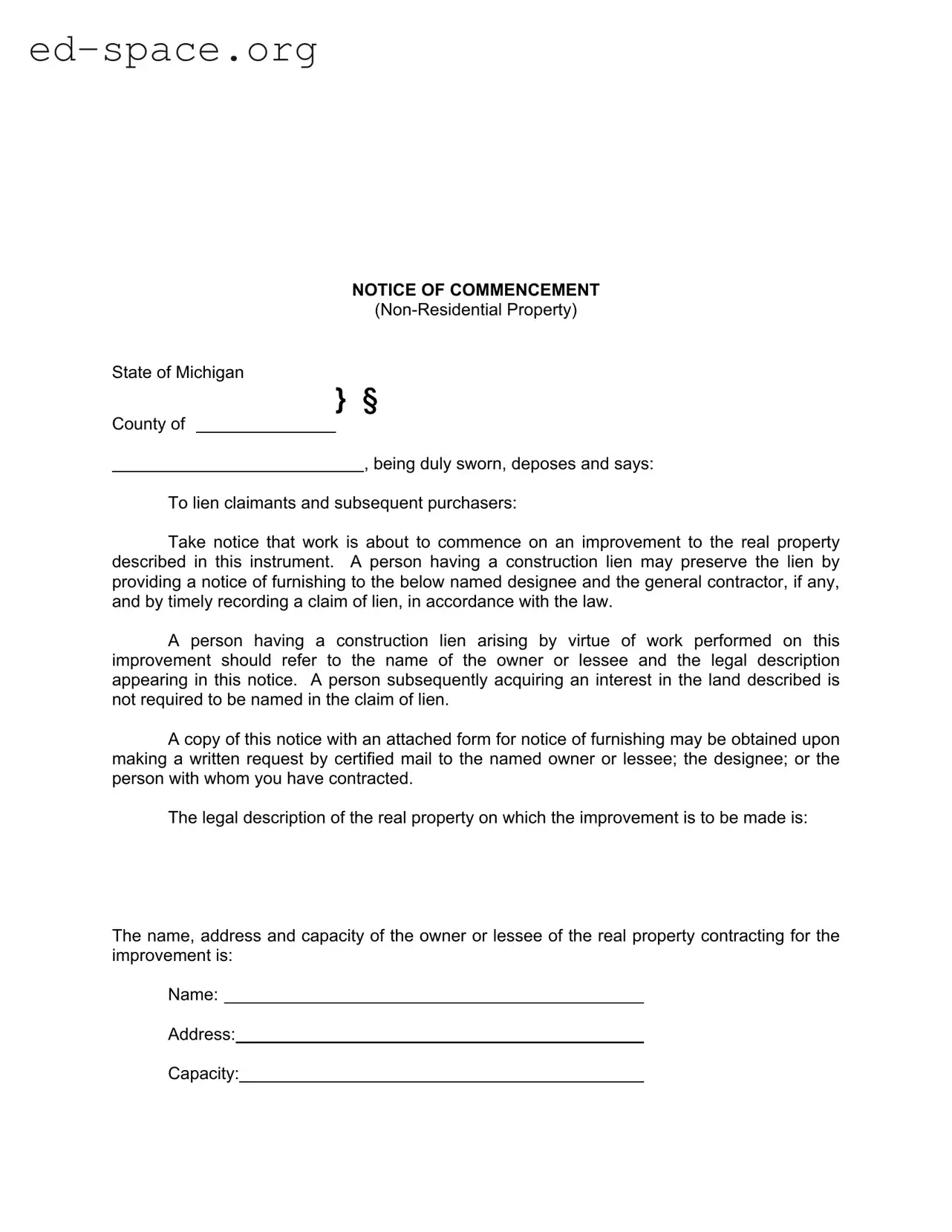
NOTICE OF COMMENCEMENT
State of Michigan
}§
County of
,being duly sworn, deposes and says:
To lien claimants and subsequent purchasers:
Take notice that work is about to commence on an improvement to the real property described in this instrument. A person having a construction lien may preserve the lien by providing a notice of furnishing to the below named designee and the general contractor, if any, and by timely recording a claim of lien, in accordance with the law.
A person having a construction lien arising by virtue of work performed on this improvement should refer to the name of the owner or lessee and the legal description appearing in this notice. A person subsequently acquiring an interest in the land described is not required to be named in the claim of lien.
A copy of this notice with an attached form for notice of furnishing may be obtained upon making a written request by certified mail to the named owner or lessee; the designee; or the person with whom you have contracted.
The legal description of the real property on which the improvement is to be made is:
The name, address and capacity of the owner or lessee of the real property contracting for the improvement is:
Name:
Address:
Capacity:

The name and address of the fee owner of the real property if the person contracting for the improvement is a land contract or lessee, is:
Name:
Address:
The name and address of the owner’s or lessee’s designee is:
Name:
Address:
The name and address of the general contractor, if any is:
Name:
Address:
WARNING TO PROPERTY OWNER, LESSEE OR DESIGNEE
MICHIGAN LAW REQUIRES THAT YOU DO THE FOLLOWING:
1.Before the commencement of any actual physical improvement, the owner or lessee shall record in the office of the register of deeds this notice of commencement.
2.Complete and return this form to the person who formally request in writing, within 10 days after the postmark on the request. The completed form shall be provided with a blank notice of furnishing to the requestor.
3.Provide a copy of this notice to the general contractor.
4.Post and keep posted a copy of this notice in a conspicuous place on the real property during the course of the actual physical improvement project.
_____________________________ |
_________________________________ |
|
(Printed Name and Capacity) |
(Signature of Owner, Lessee or Designee) |
|
Prepared by:
Name:
Address:
Subscribed, sworn to and acknowledged before me this |
|
day of |
|
||
NOTARY PUBLIC: |
My commission expires: |
|
|||
County, MI
(Signature/Printed Name)
| Fact Name | Details |
|---|---|
| Purpose | The Notice of Commencement informs lien claimants and subsequent purchasers that construction work is about to begin on a specified property. |
| Governing Law | This form is governed by Michigan law, specifically the Michigan Construction Lien Act (MCL 570.1101 et seq.). |
| Requirements | The owner or lessee must record this notice with the county register of deeds before any physical improvements start. |
| Distribution | A copy of the notice must be provided to the general contractor and posted visibly on the property during the construction project. |
Filling out the Notice Commencement form in Michigan is an important step before starting any construction work on non-residential properties. Once the form is completed, it must be recorded with the local register of deeds to ensure that all parties involved are aware of the upcoming improvements. Here’s how to fill out the form step by step:
After completing these steps, ensure that the form is recorded at the office of the register of deeds. You will also need to provide a copy of this notice to the general contractor and keep it posted on the property throughout the duration of the improvement project.
What is the Notice of Commencement in Michigan?
The Notice of Commencement is a legal document required in Michigan for non-residential property improvements. It serves as a formal notification that construction work is about to begin on a specified property. This notice is essential for protecting the rights of contractors and subcontractors, as it allows them to preserve their lien rights by providing a notice of furnishing to the property owner or lessee and the general contractor, if applicable.
Who is responsible for filing the Notice of Commencement?
The property owner or lessee is responsible for recording the Notice of Commencement with the county register of deeds before any physical improvement begins. This requirement is mandated by Michigan law to ensure that all parties involved in the construction project are informed of the impending work and can take necessary actions to protect their interests.
What information must be included in the Notice of Commencement?
The Notice of Commencement must include several key pieces of information: the legal description of the property, the name and address of the owner or lessee, the name and address of the fee owner if different from the contractor, the designee’s contact information, and details of the general contractor, if there is one. This information is critical for any lien claimants and subsequent purchasers to understand who is involved in the project.
How can someone obtain a copy of the Notice of Commencement?
A copy of the Notice of Commencement can be obtained by making a written request via certified mail to the property owner or lessee, the designee, or the contractor. This request should specify the need for a copy of the notice along with an attached form for notice of furnishing, which is also part of the process for preserving lien rights.
What are the consequences of not filing the Notice of Commencement?
If the Notice of Commencement is not filed as required, the property owner or lessee may face legal repercussions, including the inability of contractors and subcontractors to enforce their lien rights. This could lead to complications in the event of payment disputes or claims related to the construction work. Therefore, it is crucial to comply with this requirement to protect all parties involved in the construction process.
Failing to provide the correct legal description of the property. This description is essential for identifying the location of the improvement.
Omitting the name and address of the owner or lessee. This information is crucial for ensuring that all parties are aware of who is responsible for the project.
Not including the capacity of the owner or lessee. Indicating whether they are the owner, lessee, or a representative helps clarify their role in the project.
Neglecting to list the general contractor if one is involved. This omission can lead to confusion regarding who is managing the construction work.
Failing to submit the form within the required timeframe. The law specifies that this notice must be recorded before any physical work begins.
Not providing a copy of the notice to the general contractor. This step is necessary to keep all parties informed and compliant with legal requirements.
Forgetting to post the notice in a conspicuous place on the property. This is important for informing anyone who may have a claim related to the construction.
Inaccurately filling out the designee's information. The designee acts on behalf of the owner or lessee, so accurate details are vital.
Not including the signature of the owner, lessee, or designee. This signature is a declaration of intent and is legally required.
Failing to keep a copy of the completed form for personal records. Having a copy can be beneficial in case of disputes or for future reference.
The Notice of Commencement is an important document in Michigan's construction process, but it is often accompanied by other forms and documents that help clarify roles, responsibilities, and rights. Below is a list of additional forms frequently used in conjunction with the Notice of Commencement.
Understanding these documents and their purposes can help ensure a smoother construction process and protect the rights of all parties involved. Proper documentation is essential in managing expectations and responsibilities effectively.
The Notice of Commencement form in Michigan serves a crucial role in construction projects, particularly in protecting the rights of lien claimants and ensuring transparency in property improvements. Several other documents share similarities with the Notice of Commencement, each serving distinct but related purposes in the realm of property and construction law. Below is a list of seven documents that are similar to the Notice of Commencement, along with explanations of how they are alike.
Understanding these documents and their similarities to the Notice of Commencement can help all parties involved in a construction project navigate the complexities of property improvements more effectively. Each document plays a vital role in ensuring that rights are protected and that the construction process is transparent and legally compliant.
When filling out the Notice Commencement Michigan form, it’s important to follow certain guidelines to ensure accuracy and compliance. Here are some do's and don'ts:
This form is specifically designed for non-residential properties. It serves as a formal notification that construction work is about to begin, ensuring that all parties involved are informed.
While the property owner or lessee is responsible for filing the notice, it is essential for all parties involved in the construction project, including contractors and subcontractors, to be aware of its existence.
Although this notice helps protect lien rights, it does not guarantee payment. Contractors and suppliers must still follow proper procedures to secure their rights to payment.
In fact, Michigan law requires that a copy of the notice be posted in a conspicuous location on the property during the construction project. This ensures that anyone involved in the project is aware of the work being done.
This notice is mandatory for all construction projects, regardless of size. Failing to file it can result in losing lien rights and other legal protections.
The Notice of Commencement form is an essential document in Michigan for anyone involved in non-residential property improvements. Here are four key takeaways regarding its completion and use: