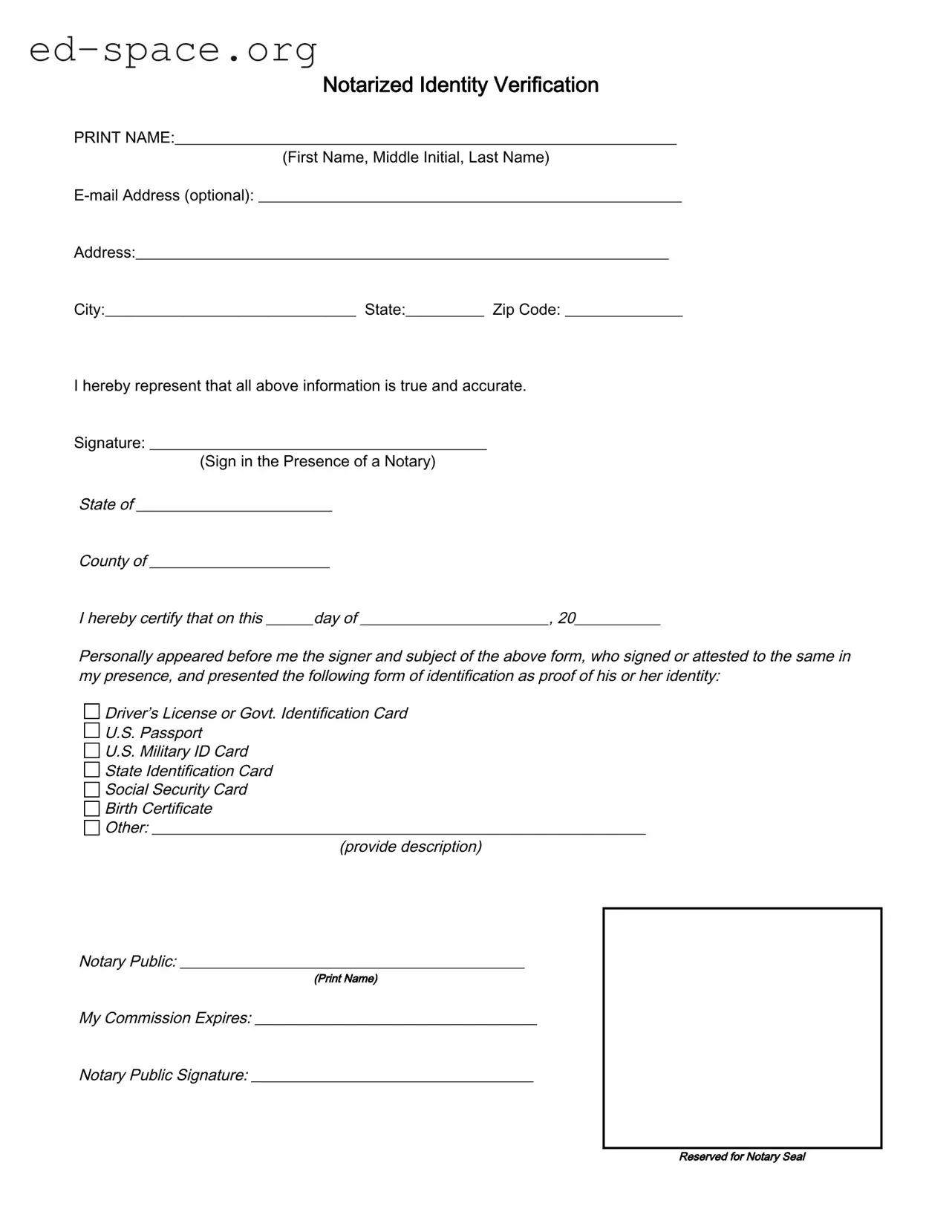
The Notarized Identity Verification form serves as a crucial tool for confirming an individual’s identity in various legal and official contexts. This form requires the individual to provide their full name, optional email address, and residential address, ensuring that all provided information is accurate and truthful. A signature must be affixed in the presence of a notary public, who plays a vital role in authenticating the document. The notary is responsible for certifying the date of the signing and confirming the identity of the signer through acceptable forms of identification, such as a driver’s license, passport, or military ID. Additionally, the form allows for the inclusion of other forms of identification, should they be necessary. This process not only enhances the integrity of the verification but also protects against identity fraud. The notary public’s signature and seal further validate the document, making it a reliable source of identity verification for various legal purposes.

Notarized Identity Verification
PRINT NAME:________________________________________________________________
(First Name, Middle Initial, Last Name)
Address:____________________________________________________________________
City:________________________________ State:__________ Zip Code: _______________
I hereby represent that all above information is true and accurate.
Signature: ___________________________________________
(Sign in the Presence of a Notary)
State of _________________________
County of _______________________
I hereby certify that on this ______day of ________________________, 20___________
Personally appeared before me the signer and subject of the above form, who signed or attested to the same in my presence, and presented the following form of identification as proof of his or her identity:
Driver’s License or Govt. Identification Card
U.S. Passport
U.S. Military ID Card
State Identification Card
Social Security Card
Birth Certificate
Other: _______________________________________________________________
(provide description)
Notary Public: ____________________________________________
(Print Name)
My Commission Expires: ____________________________________
Notary Public Signature: ____________________________________
Reserved for Notary Seal
| Fact Name | Description |
|---|---|
| Purpose | The Notarized Identity Verification form is used to confirm the identity of an individual through notarization. |
| Required Information | Individuals must provide their full name, email address (optional), address, city, state, and zip code. |
| Signature Requirement | The signer must sign the form in the presence of a notary public to validate the information provided. |
| Identification | Acceptable forms of identification include a driver's license, passport, military ID, state ID, social security card, or birth certificate. |
| Notary Certification | The notary public certifies the identity of the signer by noting the date and details of the identification presented. |
| State-Specific Forms | Each state may have its own version of the Notarized Identity Verification form, governed by state laws regarding notarization. |
| Notary Public Details | The notary public must print their name, sign the document, and indicate the expiration date of their commission. |
| Reserved Space | A designated area is reserved for the notary seal, which is essential for the document's authenticity. |
Completing the Notarized Identity Verification form is an important step in confirming your identity. After filling out the form, you will need to present it to a notary public, who will verify your identity and sign the document. Follow these steps to ensure you fill out the form correctly.
What is the Notarized Identity Verification form?
The Notarized Identity Verification form is a document used to confirm a person's identity. It requires the individual to provide personal information, such as their name, address, and a signature, in the presence of a notary public. The notary then verifies the identity of the signer by checking their identification.
Why do I need to complete this form?
This form is often required for various legal and financial processes. It helps to ensure that the person signing a document is who they claim to be, thus preventing fraud and protecting both parties involved in a transaction.
What information do I need to provide on the form?
You need to provide your full name, email address (optional), address, city, state, and zip code. Additionally, you must sign the form in front of a notary public, who will also need to complete their section of the form.
What forms of identification can I use?
You can use several types of identification to verify your identity. Acceptable forms include a driver’s license, government identification card, U.S. passport, U.S. military ID card, state identification card, social security card, or birth certificate. If you have another form of ID, you can describe it in the provided space.
Who can serve as a notary public?
A notary public is an official appointed by the state to witness the signing of documents and verify identities. They must be impartial and have no personal interest in the transaction. You can usually find notaries at banks, law offices, and certain public offices.
Do I need to pay a fee for notarization?
Yes, notaries may charge a fee for their services. The fee can vary depending on the state and the notary's policies. It’s a good idea to ask about any fees before you meet with the notary.
Can I fill out the form before meeting the notary?
Yes, you can fill out most of the form before meeting the notary. However, do not sign the form until you are in the presence of the notary, as they need to witness your signature.
What happens after I complete the form?
Once the form is completed and signed in front of the notary, the notary will fill out their section, including their signature and seal. You will then have a notarized document that you can use for your intended purpose.
How long is the notarized form valid?
The validity of a notarized form can depend on the specific requirements of the institution or agency requesting it. Generally, a notarized document remains valid as long as the information it contains is accurate and relevant.
Where can I find a notary public?
You can find a notary public at various locations, including banks, law offices, and public libraries. Many online directories also list notaries by location. Make sure to check their availability and any fees they may charge.
Failing to print the name clearly. Ensure that the first name, middle initial, and last name are legible. Illegible handwriting can lead to delays or rejections.
Omitting the email address. While optional, providing an email can facilitate communication regarding the form.
Not including a complete address. Missing components such as city, state, or zip code can render the form incomplete.
Neglecting to sign in the presence of a notary. The signature must be witnessed by the notary to validate the form.
Using an incorrect form of identification. Make sure to present an accepted form of ID, like a driver’s license or passport. Failure to do so may invalidate the verification.
Forgetting to provide the date of notarization. This date is essential for the notary’s records and your verification process.
Leaving the notary section incomplete. Ensure that the notary public fills in their name, commission expiration date, and signature. An incomplete notary section can compromise the form's validity.
The Notarized Identity Verification form is often used in various situations where identity confirmation is required. Alongside this form, several other documents may also be necessary to complete the verification process. Below is a list of commonly used forms and documents that accompany the Notarized Identity Verification form.
These documents, when used in conjunction with the Notarized Identity Verification form, help ensure a thorough and accurate identity verification process. It is important to have the appropriate documents ready to facilitate any necessary verification efficiently.
The Notarized Identity Verification form serves an essential function in confirming an individual's identity. Several other documents share similarities with this form, primarily in their purpose of verifying identity or providing proof of personal information. Below is a list of ten such documents, each accompanied by a brief explanation of how they relate to the Notarized Identity Verification form.
When filling out the Notarized Identity Verification form, follow these guidelines to ensure accuracy and compliance.
Here are four common misconceptions about the Notarized Identity Verification form:
Filling out the Notarized Identity Verification form correctly is essential for ensuring that your identity is verified smoothly. Here are some key takeaways to keep in mind:
By following these guidelines, you can ensure that your Notarized Identity Verification form is filled out correctly and serves its intended purpose effectively.