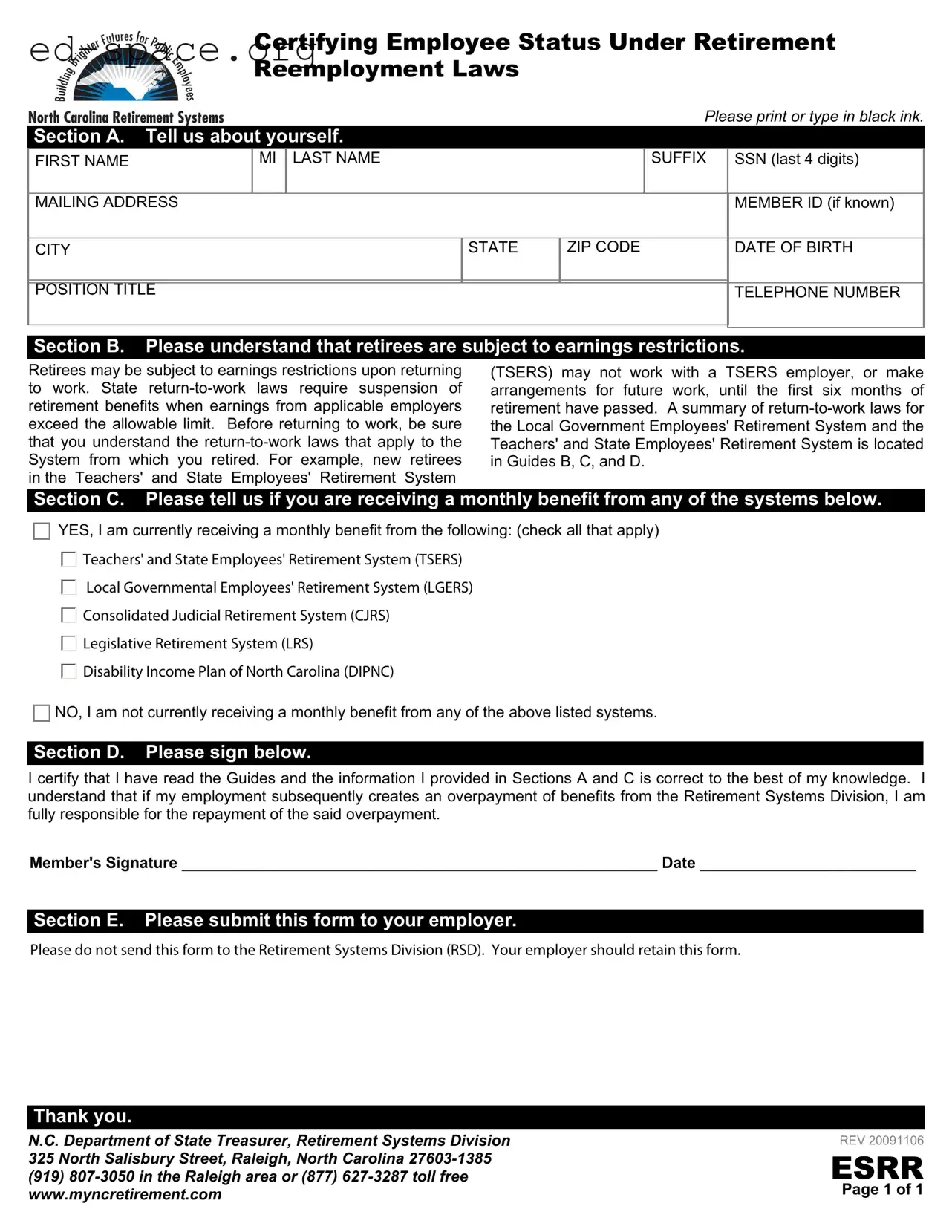
The North Carolina ESRR form is an essential document for retirees who wish to return to work while receiving retirement benefits. This form is designed to certify an employee's status under the retirement reemployment laws, ensuring compliance with state regulations. It requires retirees to provide personal information, such as their name, Social Security number, and contact details, in Section A. Section B highlights the importance of understanding earnings restrictions that apply to retirees returning to work, detailing how exceeding these limits can result in the suspension of retirement benefits. Section C asks retirees to confirm whether they are currently receiving benefits from various retirement systems, including the Teachers' and State Employees' Retirement System (TSERS) and the Local Governmental Employees' Retirement System (LGERS). In Section D, retirees must sign to certify the accuracy of the information provided. Finally, Section E instructs retirees to submit the completed form to their employer, emphasizing that it should not be sent to the Retirement Systems Division. Understanding these components is crucial for retirees to navigate the complexities of reemployment while safeguarding their benefits.

Certifying Employee Status Under Retirement
Reemployment Laws
|
|
|
|
|
Please print or type in black ink. |
||
Section A. Tell us about yourself. |
|
|
|
|
|
||
FIRST NAME |
MI |
LAST NAME |
|
|
SUFFIX |
SSN (last 4 digits) |
|
|
|
|
|
|
|
|
|
MAILING ADDRESS |
|
|
|
|
|
MEMBER ID (if known) |
|
|
|
|
|
|
|
|
|
CITY |
|
|
STATE |
ZIP CODE |
|
DATE OF BIRTH |
|
|
|
|
|
|
|
|
|
|
|
|
|
|
|
|
|
POSITION TITLE |
|
|
|
|
|
TELEPHONE NUMBER |
|
|
|
|
|
|
|
|
|
|
|
|
|
|
|
|
|
Section B. Please understand that retirees are subject to earnings restrictions.
Retirees may be subject to earnings restrictions upon returning to work. State
(TSERS) may not work with a TSERS employer, or make arrangements for future work, until the first six months of retirement have passed. A summary of
Section C. Please tell us if you are receiving a monthly benefit from any of the systems below.
YES, I am currently receiving a monthly benefit from the following: (check all that apply)
Teachers' and State Employees' Retirement System (TSERS)
Local Governmental Employees' Retirement System (LGERS)
Consolidated Judicial Retirement System (CJRS)
Legislative Retirement System (LRS)
Disability Income Plan of North Carolina (DIPNC)
NO, I am not currently receiving a monthly benefit from any of the above listed systems.
Section D. Please sign below.
I certify that I have read the Guides and the information I provided in Sections A and C is correct to the best of my knowledge. I understand that if my employment subsequently creates an overpayment of benefits from the Retirement Systems Division, I am fully responsible for the repayment of the said overpayment.
Member's Signature _______________________________________________________ Date _________________________
Section E. Please submit this form to your employer.
Please do not send this form to the Retirement Systems Division (RSD). Your employer should retain this form.
Thank you.
N.C. Department of State Treasurer, Retirement Systems Division 325 North Salisbury Street, Raleigh, North Carolina
(919)
REV 20091106
ESRR
Page 1 of 1

Guides for Certifying Employee Status |
Page 1 of 2 |
Under Retirement Reemployment Laws |
|
Guide A. What is the purpose of this form and why does this form need to be completed?
Effective July 1, 2009, employers are required to report any rehired retirees to the Retirement Systems Division (RSD) or the employer will incur a penalty. In order for employers to avoid a potenial penalty, RSD asks employers to take the following steps:
•Obtain signed documentation (Form ESRR) from the employee stating he/she is or is not currently receiving a monthly benefit from RSD.
•Report any known rehired retirees who may be subject to
the earnable allowance, or the 11.7% contribution under the exception for nursing instructors in TSERS, to RSD through the ORBIT system.
If a member falsifies this document (Form ESRR) by not reporting himself/herself as a benefit recipient, the employer will not be penalized. However, if the employee exceeds his/her earnable allowance, or violates other
Guide B. What are the
After you have officially retired and are receiving monthly benefits, if you perform work in any capacity for an employer under the same Retirement System from which you retired, you will be subject to the reemployment provisions described below. These provisions may require you to work under an earnings limitation or to reenroll as a contributing member of the Retirement System. You will be subject to reemployment provisions based on the nature of the particular work you perform for a covered employer, regardless of your job classification or your technical employment status (which may include being assigned to work for a covered employer by a private company such as a temporary agency).
If you retired from LGERS, see Guide C for more detailed information. If you retired from TSERS, see Guide D for more detailed information.
If you retired from the Consolidated Judicial Retirement System, or the Legislative Retirement System, or if you receive disability benefits from any System, please contact the Retirement Systems Division for information on reemployment provisions that apply to you.
Guide C.
Reemployment After Receiving Early Or Service Retirement Benefits. If you retire with monthly early or service retirement benefits from LGERS and are reemployed by an employer that participates in LGERS, the following applies:
If you are reemployed in an LGERS position, the duties of which require 1,000 hours or more per year, your monthly retirement payment must be stopped on the first day of the month following the month of reemployment and you will again become a contributing member in the month in which you are restored to service.
At any time you are reemployed and become a member of the Retirement System again, your retirement benefits will be greater at the time of your second early/service retirement. If you return to service and contribute for at least three additional years, your service from your first and second periods of employment will be combined and you can change the retirement payment plan and/or beneficiary you selected at the time of your original retirement. If you return to service for less than three years, your first retirement benefit will be reinstated upon
If you are reemployed on a
LGERS, your retirement payment must be stopped if your earnings during the
•$28,080 (2009 amount), or
•50% of your compensation, excluding termination payments, reported to the Retirement System during the 12 months of service preceding the effective date of your retirement.
The above amounts will be increased on January 1 each year by the percentage increase in the Consumer Price Index, which is a national measure of the increase in the cost of living from one year to the next.
Your retirement payment must be stopped for the remainder of the calendar year on the first day of the month following the month in which your earnings exceed the greater of the two limits stated above. Your retirement payment will start again on January 1 of the year after your benefit is stopped. If your earnings exceed the allowable amount in the month of December, your benefit will not be suspended.
Please note that retirement law requires your retirement date to be on the first day of the month, and for your retirement to become effective on the first day of a month, you must not work for a covered employer at any time during that month.
Please continue to the next page.
N.C. Department of State Treasurer, Retirement Systems Division 325 North Salisbury Street, Raleigh, North Carolina
(919)
REV 20091106
ESRR
GUIDES

Guides for Certifying Employee Status Under Retirement Reemployment Laws
Page 2 of 2
Guide D.
Reemployment After Receiving Early Or Service Retirement Benefits. If you retired before November 1, 2005, with monthly early or service retirement benefits from TSERS and are reemployed by an employer that participates in TSERS, the following apply:
If you are reemployed in a position that requires membership in the Teachers' and State Employees' Retirement System, your retirement payment must be stopped on the first day of the month following the month of reemployment and you will again become a contributing member in the month in which you are restored to service.
At any time you are reemployed and become a member of the Retirement System again, your retirement benefits will be greater at the time of your second early/service retirement. If you return to service and contribute for at least three additional years, your service from your first and second periods of employment will be combined and you can change the retirement payment plan and/or beneficiary you selected at the time of your original retirement. If you return to service for less than three years, your first retirement benefit will be reinstated and you will have a choice of either receiving a lump sum refund of contributions or another (generally smaller) monthly benefit from your second period of employment.
If you are reemployed on a
•$28,080 (2009 amount), or
•50% of your compensation, excluding termination payments, reported to the Retirement System during the 12 months of service preceding the effective date of your retirement.
The above amounts will be increased on January 1 each year by the percentage increase in the Consumer Price Index, which is a national measure of the increase in the cost of living from one year to the next.
Your retirement payment must be stopped for the remainder of the calendar year on the first day of the month following the month in which your earnings exceed the greater of the two limits stated above. Your retirement payment will start again on January 1 of the year after your benefit is stopped. If your earnings exceed the allowable amount in the month of December, your benefit will not be suspended.
Reemployment which causes suspension of your retirement allowance will also cause suspension of your health coverage under the retiree group of the State Health Plan. Before accepting such reemployment, you should ask the new employer if you will qualify for continued coverage under the active group of the State Health Plan, and if you will qualify for
the State's contribution toward your coverage. Upon restoration of your retirement allowance, your health coverage under the retiree group will be reinstated the first of the month following the month your retirement allowance is restored.
If you retire on or after November 1, 2005, in addition to the above provisions, the following applies:
A
Reemployment Exception for TSERS retirees who return to work as Nursing Instructors.
If you are a Teachers' and State Employees' Retirement System (TSERS) retiree who retired on or before June 1, 2009 with a reduced or unreduced benefit, or if you retired on or after July 1, 2009 with an unreduced beneift, and you wish to return to work as a nursing instructor exempt from the earnings limitations, you may do so provided you meet all of the following conditions:
•you have a
•you return to work as a nursing instructor for a maximum of three years in a permanent
•you have been certified by your North Carolina Community College System or University of North Carolina System employer to teach as a nursing instructor; and
•your employer has certified to the TSERS that it has a shortage of qualified nursing instructors and has met all required conditions of making a good faith effort to hire
Unless legislation extends this reemployment exception for nursing instructors, the above provisions are in effect through June 30, 2013.
Reemployment under the Consolidated Judicial Retirement System (CJRS).
If you are retired from TSERS and are reemployed under CJRS, please contact the Retirement Systems Division for provisions that apply to you.
These guides are subject to and governed by the General Statutes of the State of North Carolina.
REV 20091106
ESRR
GUIDES
| Fact Name | Details |
|---|---|
| Form Purpose | This form certifies employee status under retirement reemployment laws in North Carolina. |
| Governing Law | The form is governed by the General Statutes of the State of North Carolina. |
| Submission Requirement | Retirees must submit the form to their employer, not to the Retirement Systems Division. |
| Earnings Restrictions | Retirees face earnings limits that may suspend their retirement benefits if exceeded. |
| Reemployment Guidelines | Specific guidelines apply based on the retirement system from which the individual retired. |
| Penalties for Employers | Employers must report rehired retirees to avoid potential penalties from the Retirement Systems Division. |
| Return-to-Work Waiting Period | New retirees in TSERS must wait six months before returning to work with a TSERS employer. |
Completing the North Carolina ESRR form is a straightforward process that requires careful attention to detail. This form is essential for retirees who wish to return to work while receiving retirement benefits. It ensures compliance with state regulations and helps avoid potential penalties for both the retiree and the employer. Follow the steps outlined below to accurately fill out the form.
Once you have submitted the form to your employer, they will handle the necessary reporting to the Retirement Systems Division. It is crucial to keep a copy for your own records, as it serves as proof of your compliance with the return-to-work laws. If you have any questions or need further clarification, do not hesitate to reach out to your employer or the Retirement Systems Division for assistance.
1. What is the North Carolina ESRR form?
The North Carolina ESRR form is used to certify an employee's status under retirement reemployment laws. It helps employers report rehired retirees to the Retirement Systems Division (RSD) and ensures compliance with state regulations. The form requires information about the retiree's current employment status and any benefits they may be receiving.
2. Why do I need to complete the ESRR form?
Completing the ESRR form is essential for employers to avoid penalties for failing to report rehired retirees. The form confirms whether the retiree is receiving benefits and helps ensure that the employer complies with reemployment laws. If an employee does not disclose their benefit status, they may be responsible for repaying any overpayments made by the RSD.
3. What information do I need to provide on the form?
The form requires personal details such as your first name, last name, Social Security number (last four digits), mailing address, date of birth, position title, and telephone number. You must also indicate whether you are currently receiving a monthly benefit from any of the retirement systems listed.
4. What are the return-to-work laws for retirees?
Return-to-work laws dictate that retirees may face earnings restrictions when returning to work. If you exceed the allowable earnings limit, your retirement benefits may be suspended. Specific rules apply depending on the retirement system from which you retired, such as the Teachers' and State Employees' Retirement System (TSERS) or the Local Government Employees' Retirement System (LGERS).
5. What happens if I return to work before the required six-month period?
If you return to work for a TSERS employer before the six-month separation period, your retirement benefits will be revoked retroactively to your retirement date. This means you will need to repay all benefits received during that time. It's crucial to understand these rules before accepting any reemployment.
6. How do earnings limits affect my retirement benefits?
Earnings limits vary based on your retirement system. For example, retirees from LGERS must stop receiving benefits if their earnings exceed $28,080 or 50% of their compensation from the previous year. These limits are adjusted annually based on the Consumer Price Index. If you exceed these limits, your retirement payment will be suspended until the following year.
7. Can I work as a nursing instructor after retirement?
Yes, TSERS retirees can return to work as nursing instructors without facing earnings limitations, provided they meet specific conditions. These include having a six-month separation from service, working in a certified nursing program, and being certified by the appropriate educational system. Your employer must also demonstrate a shortage of qualified instructors.
8. Where do I submit the ESRR form?
You must submit the completed ESRR form to your employer, not the Retirement Systems Division. Your employer is responsible for retaining the form for their records. Ensure that all information is accurate to avoid any issues with your retirement benefits.
9. What should I do if I have questions about the form or reemployment laws?
If you have questions about the ESRR form or the reemployment laws, contact the Retirement Systems Division. They can provide guidance based on your specific situation and help clarify any uncertainties you may have.
10. What are the consequences of falsifying information on the ESRR form?
Falsifying information on the ESRR form can lead to significant consequences. While the employer may not face penalties for reporting, the employee will be held responsible for repaying any overpayments received if they exceed the allowable earnings limit or violate reemployment laws. It's essential to provide accurate information to avoid these issues.
Inaccurate Personal Information: One common mistake is providing incorrect personal details in Section A. This includes misspelling names, using incorrect Social Security numbers, or failing to include the member ID. Such errors can delay processing and lead to complications in verifying your status.
Ignoring Earnings Restrictions: Many retirees overlook the importance of understanding earnings restrictions outlined in Section B. Failing to acknowledge these limits can result in unintentional overpayments, which the retiree will be responsible for repaying.
Not Reporting Benefits: In Section C, some individuals mistakenly check the wrong box regarding their receipt of monthly benefits. This can lead to significant issues, including penalties for the employer and potential loss of benefits for the retiree.
Improper Submission: A frequent error occurs when retirees send the ESRR form directly to the Retirement Systems Division instead of submitting it to their employer as instructed in Section E. This misstep can cause delays in processing and create unnecessary confusion.
The North Carolina ESRR form is crucial for retirees seeking reemployment while receiving retirement benefits. It helps ensure compliance with state laws regarding earnings restrictions and reemployment provisions. Alongside the ESRR form, several other documents may be necessary to facilitate the process of returning to work after retirement. Below is a list of commonly used forms and documents that complement the ESRR form.
These documents play a significant role in ensuring that retirees navigate the complexities of reemployment while adhering to state regulations. Understanding and utilizing these forms can help retirees manage their benefits effectively and avoid potential penalties.
The North Carolina ESRR form has similarities with several other documents related to retirement and reemployment. Here are five documents that share common features with the ESRR form:
When filling out the North Carolina ESRR form, it’s important to be careful and thorough. Here’s a list of things you should and shouldn’t do:
Understanding the North Carolina ESRR form is crucial for retirees looking to return to work. However, several misconceptions can lead to confusion. Here are eight common misunderstandings:
Understanding these misconceptions can help retirees navigate their return to work more effectively and avoid potential pitfalls.
Filling out and using the North Carolina ESRR form requires careful attention to detail. Here are key takeaways to ensure compliance and understanding: