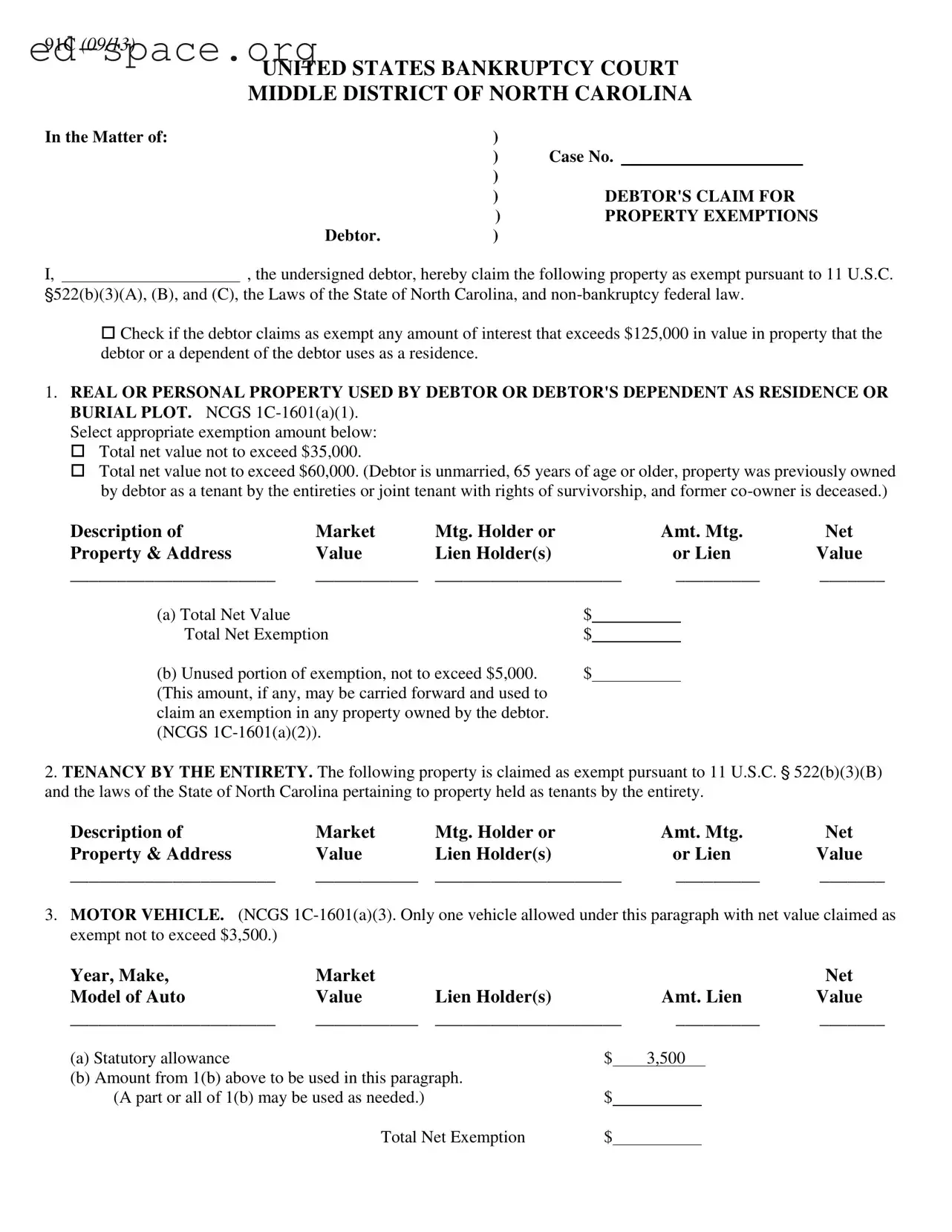
The North Carolina 91C form is a crucial document used in bankruptcy proceedings, specifically designed for debtors to claim exemptions for their property. This form allows individuals to identify and protect certain assets from liquidation during bankruptcy. Under federal and state law, debtors can claim exemptions for various categories of property, including real estate, personal belongings, vehicles, and tools of the trade. The form outlines specific exemption amounts, such as up to $35,000 for a primary residence, with increased limits for individuals over 65 years of age. Additionally, it addresses exemptions for personal property needed for household purposes, life insurance policies, and retirement accounts. The form also includes provisions for claims related to personal injury compensation and college savings plans. It is essential for debtors to accurately complete the 91C form to ensure they receive the protections afforded to them under North Carolina law, as well as to comply with federal regulations. Understanding the intricacies of this form can significantly impact a debtor's financial future.
91C (09/13)
UNITED STATES BANKRUPTCY COURT
MIDDLE DISTRICT OF NORTH CAROLINA
In the Matter of: |
|
) |
|
|
|
|
|
|
|
) |
Case No. |
||
|
|
|
) |
|
|
|
|
|
|
) |
DEBTOR'S CLAIM FOR |
||
|
|
|
) |
PROPERTY EXEMPTIONS |
||
|
|
Debtor. |
) |
|
|
|
I, |
|
, the undersigned debtor, hereby claim the following property as exempt pursuant to 11 U.S.C. |
||||
'522(b)(3)(A), (B), and (C), the Laws of the State of North Carolina, and
Check if the debtor claims as exempt any amount of interest that exceeds $125,000 in value in property that the debtor or a dependent of the debtor uses as a residence.
1.REAL OR PERSONAL PROPERTY USED BY DEBTOR OR DEBTOR'S DEPENDENT AS RESIDENCE OR BURIAL PLOT. NCGS
Select appropriate exemption amount below:
Total net value not to exceed $35,000.
Total net value not to exceed $60,000. (Debtor is unmarried, 65 years of age or older, property was previously owned by debtor as a tenant by the entireties or joint tenant with rights of survivorship, and former
Description of |
Market |
Mtg. Holder or |
Amt. Mtg. |
Net |
Property & Address |
Value |
Lien Holder(s) |
or Lien |
Value |
______________________ |
___________ |
____________________ |
_________ |
_______ |
(a) Total Net Value |
$ |
|
|
Total Net Exemption |
$ |
|
|
(b) Unused portion of exemption, not to exceed $5,000. |
$ |
|
|
(This amount, if any, may be carried forward and used to |
|
|
|
claim an exemption in any property owned by the debtor. |
|
|
|
(NCGS |
|
|
|
2.TENANCY BY THE ENTIRETY. The following property is claimed as exempt pursuant to 11 U.S.C. ' 522(b)(3)(B) and the laws of the State of North Carolina pertaining to property held as tenants by the entirety.
Description of |
Market |
Mtg. Holder or |
Amt. Mtg. |
Net |
Property & Address |
Value |
Lien Holder(s) |
or Lien |
Value |
______________________ |
___________ |
____________________ |
_________ |
_______ |
3.MOTOR VEHICLE. (NCGS
Year, Make, |
Market |
|
|
|
|
|
|
Net |
Model of Auto |
Value |
Lien Holder(s) |
|
|
Amt. Lien |
Value |
||
______________________ |
___________ |
____________________ |
_________ |
_______ |
||||
(a) Statutory allowance |
|
|
$ |
|
3,500 |
|
|
|
(b) Amount from 1(b) above to be used in this paragraph. |
|
|
|
|
|
|
||
(A part or all of 1(b) may be used as needed.) |
|
$ |
|
|
|
|
|
|
|
Total Net Exemption |
$ |
|
|
|
|
|
|

91C (09/13)
4.TOOLS OF TRADE, IMPLEMENTS, OR PROFESSIONAL BOOKS. (NCGS
|
Market |
|
|
|
|
Net |
Description |
Value |
Lien Holder(s) |
|
|
Amt. Lien |
Value |
______________________ |
___________ |
____________________ |
|
_________ |
_______ |
|
______________________ |
___________ |
____________________ |
|
_________ |
_______ |
|
(a) Statutory allowance |
|
$ |
2,000 |
|
|
|
(b) Amount from 1(b) above to be used in this paragraph. |
|
|
|
|
||
(A part or all of 1 (b) may be used as needed.) |
$ |
|
|
|
|
|
Total Net Exemption $
5.PERSONAL PROPERTY USED FOR HOUSEHOLD OR PERSONAL PURPOSES NEEDED BY DEBTOR OR DEBTOR'S DEPENDENTS. (NCGS
|
|
Market |
|
|
|
|
|
|
|
Net |
|
Description |
|
Value |
Lien Holder(s) |
|
Amt. Lien |
Value |
|||||
Clothing & Personal |
|
___________ |
____________________ |
|
_________ |
_______ |
|||||
Kitchen Appliances |
|
___________ |
____________________ |
|
_________ |
_______ |
|||||
Stove |
|
___________ |
____________________ |
|
_________ |
_______ |
|||||
Refrigerator |
|
___________ |
____________________ |
|
_________ |
_______ |
|||||
Freezer |
|
___________ |
____________________ |
|
_________ |
_______ |
|||||
Washing Machine |
|
___________ |
____________________ |
|
_________ |
_______ |
|||||
Dryer |
|
___________ |
____________________ |
|
_________ |
_______ |
|||||
China |
|
___________ |
____________________ |
|
_________ |
_______ |
|||||
Silver |
|
___________ |
____________________ |
|
_________ |
_______ |
|||||
Jewelry |
|
___________ |
____________________ |
|
_________ |
_______ |
|||||
Living Room Furniture |
___________ |
____________________ |
|
_________ |
_______ |
||||||
Den Furniture |
|
___________ |
____________________ |
|
_________ |
_______ |
|||||
Bedroom Furniture |
|
___________ |
____________________ |
|
_________ |
_______ |
|||||
Dining Room Furniture |
___________ |
____________________ |
|
_________ |
_______ |
||||||
Lawn Furniture |
|
___________ |
____________________ |
|
_________ |
_______ |
|||||
Television |
|
___________ |
____________________ |
|
_________ |
_______ |
|||||
( ) Stereo ( ) Radio |
___________ |
____________________ |
|
_________ |
_______ |
||||||
Musical Instruments |
|
___________ |
____________________ |
|
_________ |
_______ |
|||||
( ) Piano ( ) Organ |
___________ |
____________________ |
|
_________ |
_______ |
||||||
Air Conditioner |
|
___________ |
____________________ |
|
_________ |
_______ |
|||||
Paintings & Art |
|
___________ |
____________________ |
|
_________ |
_______ |
|||||
Lawn Mower |
|
___________ |
____________________ |
|
_________ |
_______ |
|||||
Yard Tools |
|
___________ |
____________________ |
|
_________ |
_______ |
|||||
Crops |
|
___________ |
____________________ |
|
_________ |
_______ |
|||||
Animals |
|
___________ |
____________________ |
|
_________ |
_______ |
|||||
Other ( |
) |
___________ |
____________________ |
|
_________ |
_______ |
|||||
|
|
|
|
|
Total Net Value $ |
|
|||||
(a) Statutory allowance for debtor |
|
|
|
|
$ |
5,000 |
|
|
|
|
|
(b) Statutory allowance for debtor's dependents: |
|
|
dependents |
|
|
|
|
|
|
||
at $1,000 each (not to exceed $4,000 total for dependents) |
$ |
|
|
|
|
|
|||||

91C (09/13)
(c) Amount from 1(b) above to be used in this paragraph. |
|
|
|
|
|
|
|
|
|
||
(A part or all of 1 (b) may be used as needed.) |
$ |
|
|
|
|
|
|
||||
|
|
|
Total Net Exemption $ |
|
|
||||||
6. LIFE INSURANCE. (As provided in Article X, Section 5 of North Carolina Constitution.) |
|||||||||||
Name of Insurance Company |
|
|
|
Policy No. |
|
||||||
Name of Insured |
|
|
|
Policy Date |
|
||||||
Name of Beneficiary
7.PROFESSIONALLY PRESCRIBED HEALTH AIDS (FOR DEBTOR OR DEBTOR'S DEPENDENTS). (NCGS
Description:
__________________________________________________________________________________
8.DEBTOR'S RIGHT TO RECEIVE FOLLOWING COMPENSATION: (NCGS
A. |
$ |
|
Compensation for personal injury to debtor or to person whom debtor was dependent for support. |
B. |
$ |
|
Compensation for death of person of whom debtor was dependent for support. |
C. |
$ __________ |
Compensation from private disability policies or annuities. |
|
9.INDIVIDUAL RETIREMENT PLANS AS DEFINED IN THE INTERNAL REVENUE CODE AND ANY PLAN TREATED IN THE SAME MANNER AS AN INDIVIDUAL RETIREMENT PLAN UNDER THE INTERNAL REVENUE CODE (NCGS
DEFINED IN 11 U.S.C. § 522(b)(3)(c).
Detailed Description |
|
Value |
|
|
|
|
|
|
10.COLLEGE SAVINGS PLANS QUALIFIED UNDER SECTION 529 OF THE INTERNAL REVENUE CODE.
(NCGS
Detailed Description |
|
Value |
|
|
|
|
|
|
11.RETIREMENT BENEFITS UNDER A RETIREMENT PLAN OF OTHER STATE AND GOVERNMENTAL UNITS OF OTHER STATES, TO THE EXTEND THOSE BENEFITS ARE EXEMPT UNDER THE LAWS OF THAT STATE OR GOVERNMENTAL UNIT. (NCGS
Description:
__________________________________________________________________________________
12.ALIMONY, SUPPORT, SEPARATION MAINTENANCE AND CHILD SUPPORT. (NCGS

91C (09/13)
Description:
__________________________________________________________________________________
13.ANY OTHER REAL OR PERSONAL PROPERTY WHICH DEBTOR DESIRES TO CLAIM AS EXEMPT THAT HAS NOT PREVIOUSLY BEEN CLAIMED ABOVE. (NCGS
|
Market |
|
|
Net |
Description |
Value |
Lien Holder(s) |
Amt. Lien |
Value |
______________________ |
___________ |
____________________ |
_________ |
_______ |
______________________ |
___________ |
____________________ |
_________ |
_______ |
(a) Total Net Value of property claimed in paragraph 13. |
|
|
|
$ |
(b) Total amount available from paragraph 1(b). |
$ |
|
|
|
(c) Less amounts from paragraph 1(b) which were |
|
|
|
|
Used in the following paragraphs: |
|
|
|
|
Paragraph 3(b) |
$ |
|
|
|
Paragraph 4(b) |
$ |
|
|
|
Paragraph 5(c) |
$ |
|
|
|
Net Balance Available from paragraph 1(b) |
$ |
|||
|
Total Net Exemption |
$ |
||
14.OTHER EXEMPTIONS CLAIMED UNDER THE LAWS OF THE STATE OF NORTH CAROLINA:
Aid to the Aged, Disabled and Families with Dependent Children, NCGS
Yearly Allowance for Surviving Spouse, NCGS
North Carolina Local Government Employees Retirement Benefits, NCGS
Workers Compensation Benefits, NCGS
Unemployment Benefits, so long as not commingled and except for debts for necessities purchased while unemployed, NCGS
Group Insurance Proceeds, NCGS
Partnership Property, except on a claim against the partnership, NCGS
Other |
|
TOTAL VALUE OF PROPERTY CLAIMED AS EXEMPT |
$ |
15.EXEMPTIONS CLAIMED UNDER
Foreign Service Retirement and Disability Payments, 22 U.S.C. ' 1104 Social Security Benefits, 42 U.S.C. ' 407
Injury of Death Compensation Payments from War Risk Hazards, 42 U.S.C. ' 601 Wages of Fishermen, Seamen and Apprentices, 46 U.S.C. ' 601
Civil Service Retirement Benefits, 5 U.S.C. '' 729, 2265
Longshoremen and Harbor Workers Compensation Act Death and Disability Benefits, 33 U.S.C. ' 916
Railroad Retirement Act Annuities and Pensions 45 U.S.C. ' 228(L) Veterans Benefits, 45 U.S.C. ' 352(E)
Special Pension Paid to Winners of Congressional Medal of Honor, 38 U.S.C. ' 3101 Federal Homestead Lands, on Debts Contracted Before the Issuance of the Patent,
43 U.S.C. ' 175
Other |
|
TOTAL VALUE OF PROPERTY CLAIMED AS EXEMPT |
$ |

91C (09/13)
16.RECENT PURCHASES
The exemptions provided in NCGS
List tangible personal property purchased by the debtor less than 90 days preceding the filing of the bankruptcy petition:
|
Market |
|
|
Net |
Description |
Value |
Lien Holder(s) |
Amt. Lien |
Value |
______________________ |
___________ |
____________________ |
_________ |
_______ |
______________________ |
___________ |
____________________ |
_________ |
_______ |
DATE:
Debtor
| Fact Name | Fact Description |
|---|---|
| Governing Law | The North Carolina 91C form is governed by 11 U.S.C. § 522(b) and North Carolina General Statutes (NCGS) § 1C-1601. |
| Purpose | This form is used by debtors to claim property exemptions in bankruptcy proceedings. |
| Exemption Limits | Exemptions for real or personal property can be claimed up to $35,000, or $60,000 for qualifying debtors over 65 years old. |
| Tenancy by the Entirety | Property held as tenants by the entirety can be claimed as exempt under 11 U.S.C. § 522(b)(3)(B) and NCGS § 1C-1601. |
| Motor Vehicle Exemption | Debtors may claim one motor vehicle with a net value not exceeding $3,500 as exempt. |
| Tools of Trade | Debtors can claim tools of trade or professional books up to a total net value of $2,000. |
| Household Goods Exemption | Debtors can claim household or personal property needed for themselves or dependents, up to $5,000 plus $1,000 for each dependent. |
| Health Aids | Professionally prescribed health aids for the debtor or dependents have no limit on value. |
| Retirement Plans | Individual retirement plans and other retirement funds are exempt without limit under NCGS § 1C-1601(a)(9). |
| Recent Purchases | Exemptions do not apply to tangible personal property purchased within 90 days prior to bankruptcy unless certain conditions are met. |
Completing the North Carolina 91C form is an important step in claiming property exemptions during bankruptcy proceedings. This form requires you to provide detailed information about various types of property you wish to claim as exempt. Follow the steps below to ensure that you fill out the form accurately and completely.
What is the North Carolina 91C form?
The North Carolina 91C form is a legal document used in bankruptcy proceedings. It allows debtors to claim certain properties as exempt from bankruptcy. This means that the debtor can retain ownership of these assets even while undergoing bankruptcy. The exemptions are based on both federal law and North Carolina state law, which outline what types of property can be claimed as exempt and the limits on their values.
Who should use the 91C form?
The 91C form is intended for individuals who are filing for bankruptcy in North Carolina. It is particularly relevant for debtors who wish to protect certain assets from being liquidated to pay off creditors. If you are an individual facing bankruptcy and you own property that you want to exempt, this form is essential for your case.
What types of property can be claimed as exempt on the 91C form?
The form allows debtors to claim exemptions for various types of property, including real estate, motor vehicles, personal belongings, and tools of trade. Specific exemptions are outlined in the form, with limits on the value of each category. For example, a debtor may claim a motor vehicle with a net value not exceeding $3,500 or household goods up to a total of $5,000 for the debtor and dependents.
How does a debtor determine the value of their property for the 91C form?
Debtors must assess the market value of their property to accurately complete the 91C form. This involves estimating how much the property would sell for in a reasonable market. It is important to consider any liens or debts against the property, as these will affect the net value. The net value is calculated by subtracting any outstanding liens from the market value.
What happens if the claimed exemptions exceed the allowed limits?
If a debtor claims exemptions that exceed the limits set by law, the bankruptcy court may disallow those claims. This could result in the debtor losing the ability to protect certain assets. It is crucial to adhere to the exemption limits specified in the North Carolina statutes and the federal bankruptcy code to avoid complications in the bankruptcy process.
Can a debtor change their exemptions after filing the 91C form?
Generally, once the 91C form is filed, the exemptions claimed cannot be changed without court approval. However, if new circumstances arise or if the debtor discovers errors in their filing, they may petition the court to amend their exemptions. It is advisable to consult with a legal professional before making any changes to ensure compliance with bankruptcy laws.
Is there a deadline for filing the 91C form?
Yes, there is a deadline for filing the 91C form, which typically coincides with the bankruptcy petition. Debtors must submit this form along with their bankruptcy filing to ensure that their exemptions are considered. Missing the deadline may result in the loss of the right to claim certain exemptions, so timely filing is essential.
What should a debtor do if they have questions about the 91C form?
If a debtor has questions about the 91C form or the exemption process, it is advisable to seek assistance from a bankruptcy attorney or a legal aid organization. They can provide guidance tailored to the debtor's specific situation and help ensure that the form is completed accurately and in compliance with applicable laws.
Where can I find the North Carolina 91C form?
The North Carolina 91C form can typically be found on the official website of the U.S. Bankruptcy Court for the Middle District of North Carolina. Additionally, local legal aid offices and bankruptcy attorneys may have copies available. It is important to use the most current version of the form to ensure compliance with legal requirements.
Incomplete Information: Many individuals fail to fill out all required sections of the form. Ensure that every applicable field is completed, including names, addresses, and values of properties.
Incorrect Values: Listing inaccurate market values can lead to complications. Double-check the estimated values of your property to ensure they are realistic and accurate.
Missing Signatures: A common oversight is neglecting to sign the form. Make sure to sign and date the document at the end to validate your claims.
Improper Use of Exemptions: Some filers mistakenly claim exemptions that do not apply to their situation. Familiarize yourself with the specific exemptions available in North Carolina and use them appropriately.
Failure to Keep Copies: Not retaining a copy of the completed form can be a significant mistake. Always keep a copy for your records in case you need to reference it later.
The North Carolina 91C form is a crucial document for individuals filing for bankruptcy, as it allows debtors to claim certain properties as exempt from creditors. However, several other forms and documents often accompany the 91C form to provide a comprehensive picture of the debtor's financial situation and legal rights. Below is a list of these documents, along with brief descriptions of their purposes.
These accompanying documents play vital roles in the bankruptcy process, ensuring that both debtors and creditors have a clear understanding of the financial situation. Properly completing and submitting these forms is essential for a smooth bankruptcy experience and for protecting the debtor's rights.
The North Carolina 91C form is designed for debtors to claim property exemptions during bankruptcy. Here are four other documents that are similar to the 91C form, along with a brief explanation of how they relate:
When completing the North Carolina 91C form, it is essential to approach the process with care and attention. Below are important guidelines to consider, both what to do and what to avoid.
Misconceptions about the North Carolina 91C form can lead to confusion and mistakes during the exemption claiming process. Here are five common misconceptions, along with clarifications to help you understand the form better:
This form is primarily used in bankruptcy cases, but it can also apply to individuals facing other legal financial issues. It's essential to recognize that claiming exemptions can be beneficial even outside of bankruptcy.
There are specific limits on the value of property that can be claimed as exempt. For example, the exemption for a motor vehicle is capped at $3,500. Understanding these limits is crucial to avoid overestimating what can be protected.
Your income does not disqualify you from claiming exemptions. Exemptions are based on property types and their values, not your income level. This means even individuals with higher incomes can still protect certain assets.
Exemption laws vary significantly from state to state. North Carolina has its own specific laws governing exemptions, which means what applies in another state may not apply here. Familiarity with local laws is essential.
You are only required to list property you wish to claim as exempt. While it may be tempting to list everything, focusing on what you want to protect simplifies the process and reduces potential complications.
When filling out the North Carolina 91C form, it is essential to understand its purpose and the details required. Here are some key takeaways to keep in mind:
By keeping these takeaways in mind, you can navigate the process of completing the North Carolina 91C form more effectively. Taking the time to understand your rights and the exemptions available to you will help protect your assets during bankruptcy proceedings.