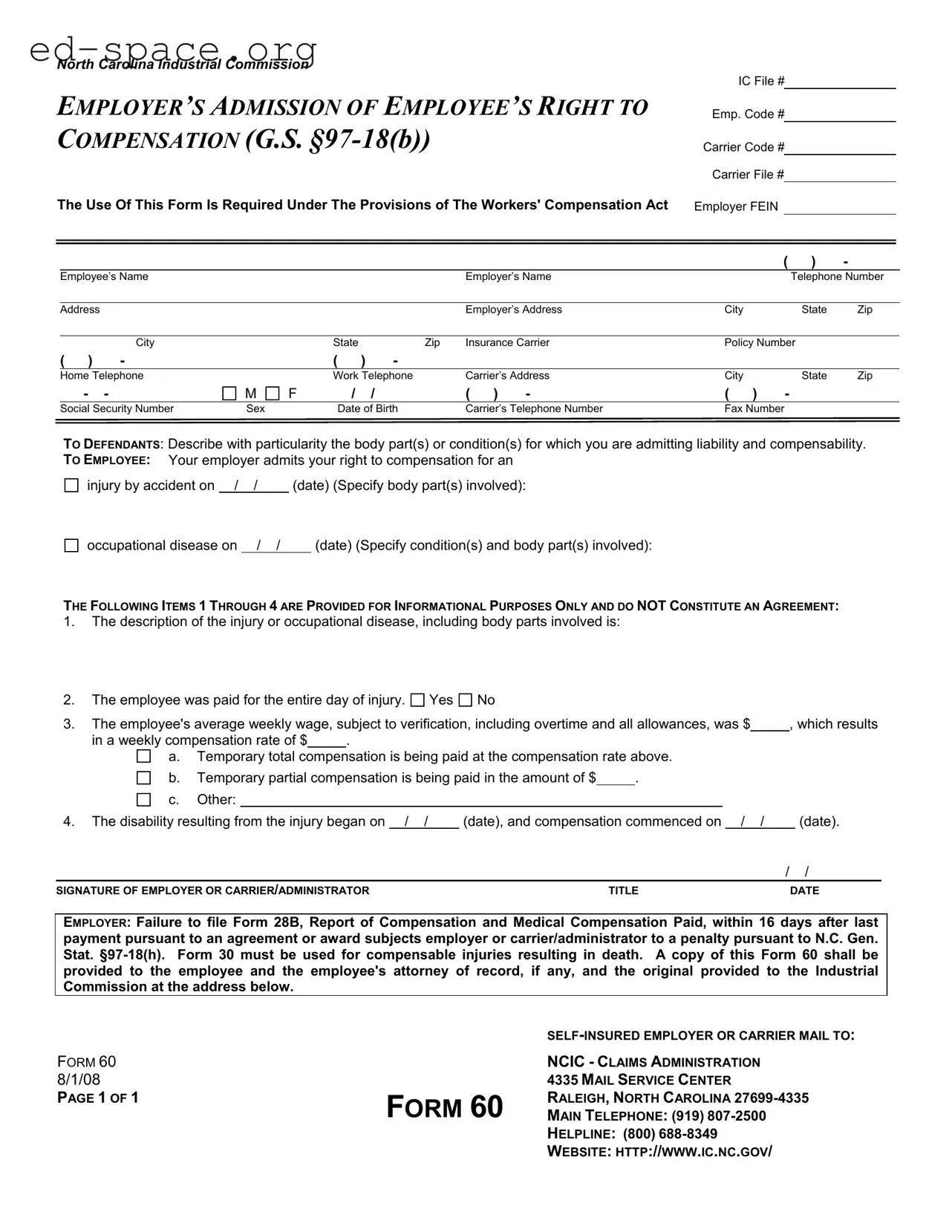
The North Carolina 60 form serves as a crucial document within the framework of the state's Workers' Compensation Act, facilitating the process of admitting an employee's right to compensation following a workplace injury or occupational disease. This form is utilized by employers to formally acknowledge their liability for compensable injuries, providing essential information such as the employee's name, the nature of the injury, and the circumstances surrounding it. Key details include the date of the incident, the specific body parts affected, and the employee's average weekly wage, which is instrumental in determining the compensation rate. The form also outlines the employer's obligations, such as the requirement to file a subsequent report of compensation and medical payments, ensuring compliance with state regulations. By clearly delineating the responsibilities of both employers and employees, the North Carolina 60 form plays a pivotal role in streamlining the claims process and safeguarding the rights of injured workers.
NORTH CAROLINA INDUSTRIAL COMMISSION
IC File #
EMPLOYER’S ADMISSION OF EMPLOYEE’S RIGHT TO
COMPENSATION (G.S.
Emp. Code #
Carrier Code # Carrier File #
The Use Of This Form Is Required Under The Provisions of The Workers' Compensation Act |
Employer FEIN |
|
|
|
|
|
|||||||||
|
|
|
|
|
|
|
|
|
|
|
( |
) |
- |
|
|
|
Employee’s Name |
|
|
|
|
|
Employer’s Name |
|
|
|
Telephone Number |
|
|||
|
|
|
|
|
|
|
|
|
|
|
|
|
|
|
|
|
Address |
|
|
|
|
|
|
Employer’s Address |
City |
|
|
State |
Zip |
|
|
|
|
|
|
|
|
|
|
|
|
|
|||||
|
|
City |
|
State |
|
Zip |
Insurance Carrier |
Policy Number |
|
|
|||||
( ) |
- |
|
( |
) |
- |
|
|
|
|
|
|
|
|
|
|
|
Home Telephone |
|
Work Telephone |
|
Carrier’s Address |
City |
|
|
State |
Zip |
|
||||
- |
- |
M |
F |
/ |
/ |
|
( ) |
- |
( ) |
- |
|
|
|
||
|
Social Security Number |
Sex |
|
Date of Birth |
|
Carrier’s Telephone Number |
Fax Number |
|
|
|
|||||
TO DEFENDANTS: Describe with particularity the body part(s) or condition(s) for which you are admitting liability and compensability.
TO EMPLOYEE: Your employer admits your right to compensation for an
injury by accident on / |
/ |
(date) (Specify body part(s) involved): |
||
|
|
|
|
|
occupational disease on |
/ / |
|
(date) (Specify condition(s) and body part(s) involved): |
|
THE FOLLOWING ITEMS 1 THROUGH 4 ARE PROVIDED FOR INFORMATIONAL PURPOSES ONLY AND DO NOT CONSTITUTE AN AGREEMENT:
1.The description of the injury or occupational disease, including body parts involved is:
2.The employee was paid for the entire day of injury.
Yes
No
3. |
The employee's average weekly wage, subject to verification, including overtime and all allowances, was $ |
, which results |
||||||||||||
|
in a weekly compensation rate of $ |
|
. |
|
|
|
|
|
|
|
|
|
|
|
|
a. Temporary total compensation is being paid at the compensation rate above. |
|
|
|||||||||||
|
b. Temporary partial compensation is being paid in the amount of $ |
. |
|
|
|
|
|
|||||||
|
c. Other: |
|
|
|
|
|
|
|
|
|
|
|
|
|
4. |
The disability resulting from the injury began on / / |
(date), and compensation commenced on / / |
|
(date). |
||||||||||
|
|
|
|
|
|
|
|
|
/ |
|
/ |
|||
SIGNATURE OF EMPLOYER OR CARRIER/ADMINISTRATOR |
|
|
TITLE |
DATE |
||||||||||
EMPLOYER: Failure to file Form 28B, Report of Compensation and Medical Compensation Paid, within 16 days after last payment pursuant to an agreement or award subjects employer or carrier/administrator to a penalty pursuant to N.C. Gen. Stat.
|
|
|
FORM 60 |
|
NCIC - CLAIMS ADMINISTRATION |
8/1/08 |
|
4335 MAIL SERVICE CENTER |
PAGE 1 OF 1 |
FORM 60 |
RALEIGH, NORTH CAROLINA |
|
MAIN TELEPHONE: (919) |
|
|
|
HELPLINE: (800) |
|
|
WEBSITE: HTTP://WWW.IC.NC.GOV/ |
| Fact Name | Details |
|---|---|
| Governing Law | The North Carolina 60 form is governed by the Workers' Compensation Act, specifically G.S. §97-18(B). |
| Purpose | This form is used by employers to admit an employee's right to compensation for work-related injuries or occupational diseases. |
| Filing Requirement | Employers must file this form with the North Carolina Industrial Commission to acknowledge liability. |
| Employee Information | It collects essential information about the employee, including name, Social Security number, and date of birth. |
| Compensation Details | The form outlines compensation details, including average weekly wage and compensation rates for temporary total or partial disability. |
| Submission Deadline | Failure to file the required Form 28B within 16 days after the last payment can result in penalties. |
| Distribution | A copy of the completed Form 60 must be provided to the employee and their attorney, if applicable. |
| Contact Information | The form includes contact details for the North Carolina Industrial Commission, including a helpline and website. |
| Signature Requirement | The form must be signed by the employer or carrier/administrator, indicating acknowledgment of the information provided. |
After completing the North Carolina 60 form, it will need to be submitted to the Industrial Commission. Ensure that a copy is provided to the employee and their attorney, if applicable. This form is essential for acknowledging an employee's right to compensation for work-related injuries or diseases.
What is the North Carolina 60 form?
The North Carolina 60 form, also known as the Employer’s Admission of Employee’s Right to Compensation, is a document used in the workers' compensation process. It allows employers to formally admit that an employee has the right to compensation for an injury or occupational disease that occurred during work. This form is crucial for ensuring that employees receive the benefits they are entitled to under North Carolina's workers' compensation laws.
When should the North Carolina 60 form be filed?
This form should be filed as soon as an employer acknowledges that an employee has suffered a compensable injury or occupational disease. Timely submission is essential, as it allows for the prompt processing of claims and ensures that the employee can start receiving benefits without unnecessary delays.
What information is required on the North Carolina 60 form?
The form requires several key pieces of information, including the employer's and employee's names, contact details, and the specifics of the injury or occupational disease. It also asks for the employee's average weekly wage, which is used to determine compensation rates. Additionally, the form must include dates related to the injury and the start of compensation payments.
How does the North Carolina 60 form affect compensation payments?
By filing the North Carolina 60 form, the employer admits liability for the employee's injury, which allows compensation payments to begin. The form outlines the compensation rate and whether temporary total or partial compensation is being paid. This admission helps expedite the claims process and provides clarity for both the employee and the employer.
What happens if the North Carolina 60 form is not filed?
If the North Carolina 60 form is not filed, the employer may face penalties as outlined in North Carolina General Statute §97-18(h). Failure to comply can lead to complications in the claims process, potentially delaying benefits for the injured employee. It is in the best interest of both parties to ensure this form is submitted promptly.
Can an employee contest the information on the North Carolina 60 form?
Yes, an employee has the right to contest any information presented on the North Carolina 60 form. If there are discrepancies or if the employee believes that the admission of liability is incorrect, they can seek clarification or file a dispute with the North Carolina Industrial Commission. It is important for employees to understand their rights and seek assistance if needed.
What should be done after the North Carolina 60 form is completed?
Once the North Carolina 60 form is completed, it should be provided to the employee and their attorney, if applicable. The original form must then be submitted to the North Carolina Industrial Commission. This ensures that all parties have the necessary documentation and that the claim can be processed efficiently.
Is there a deadline for submitting the North Carolina 60 form?
While there is no specific deadline mentioned for the submission of the North Carolina 60 form, it is advisable to file it as soon as liability is acknowledged. Timeliness is key in workers' compensation cases to avoid delays in compensation and to ensure compliance with state regulations.
Where can I find more information about the North Carolina 60 form?
For more information about the North Carolina 60 form and the workers' compensation process, you can visit the North Carolina Industrial Commission's website at http://www.ic.nc.gov/. Additionally, the Commission's helpline at (800) 688-8349 can provide assistance and answer any questions you may have.
Incomplete Information: One of the most common mistakes is failing to fill out all required fields. Missing details like the employee’s name or the date of the injury can lead to delays or complications in processing the claim.
Incorrect Dates: Entering the wrong dates for the injury or when compensation began can create confusion. Ensure that the dates are accurate and correspond with the events as they occurred.
Failure to Specify Body Parts or Conditions: When describing the injury or occupational disease, some may neglect to specify the body parts involved. This lack of detail can hinder the claim's approval process.
Average Weekly Wage Errors: Miscalculating the average weekly wage, including overtime and allowances, can lead to incorrect compensation rates. Double-check these figures to ensure accuracy.
Neglecting to Sign: Forgetting to sign the form is a frequent oversight. Without a signature, the form is not valid, and the claim cannot proceed.
Not Providing a Copy to the Employee: It is essential to provide a copy of the Form 60 to the employee and their attorney, if applicable. Failing to do so can result in misunderstandings or disputes later on.
Ignoring Filing Deadlines: Some individuals overlook the importance of filing the form within the required time frame. Delays can lead to penalties and may negatively impact the claim.
The North Carolina 60 form is a crucial document in the workers' compensation process. It serves as an admission by the employer regarding an employee's right to compensation for workplace injuries. Alongside this form, several other documents are commonly utilized to ensure a comprehensive approach to claims and compensation. Below is a list of these forms, each with a brief description of its purpose.
Each of these forms plays a significant role in the workers' compensation process in North Carolina. They help ensure that both employers and employees understand their rights and obligations. Properly completing and submitting these documents is essential for a smooth claims process.
When filling out the North Carolina 60 form, it is crucial to follow certain guidelines to ensure accuracy and compliance. Here are five things to do and five things to avoid:
Understanding the North Carolina 60 form is essential for both employers and employees involved in workers' compensation claims. However, several misconceptions can lead to confusion. Here are six common misconceptions about the North Carolina 60 form:
Clarifying these misconceptions can help both employers and employees navigate the workers' compensation process more effectively.
Here are key takeaways for filling out and using the North Carolina 60 form: