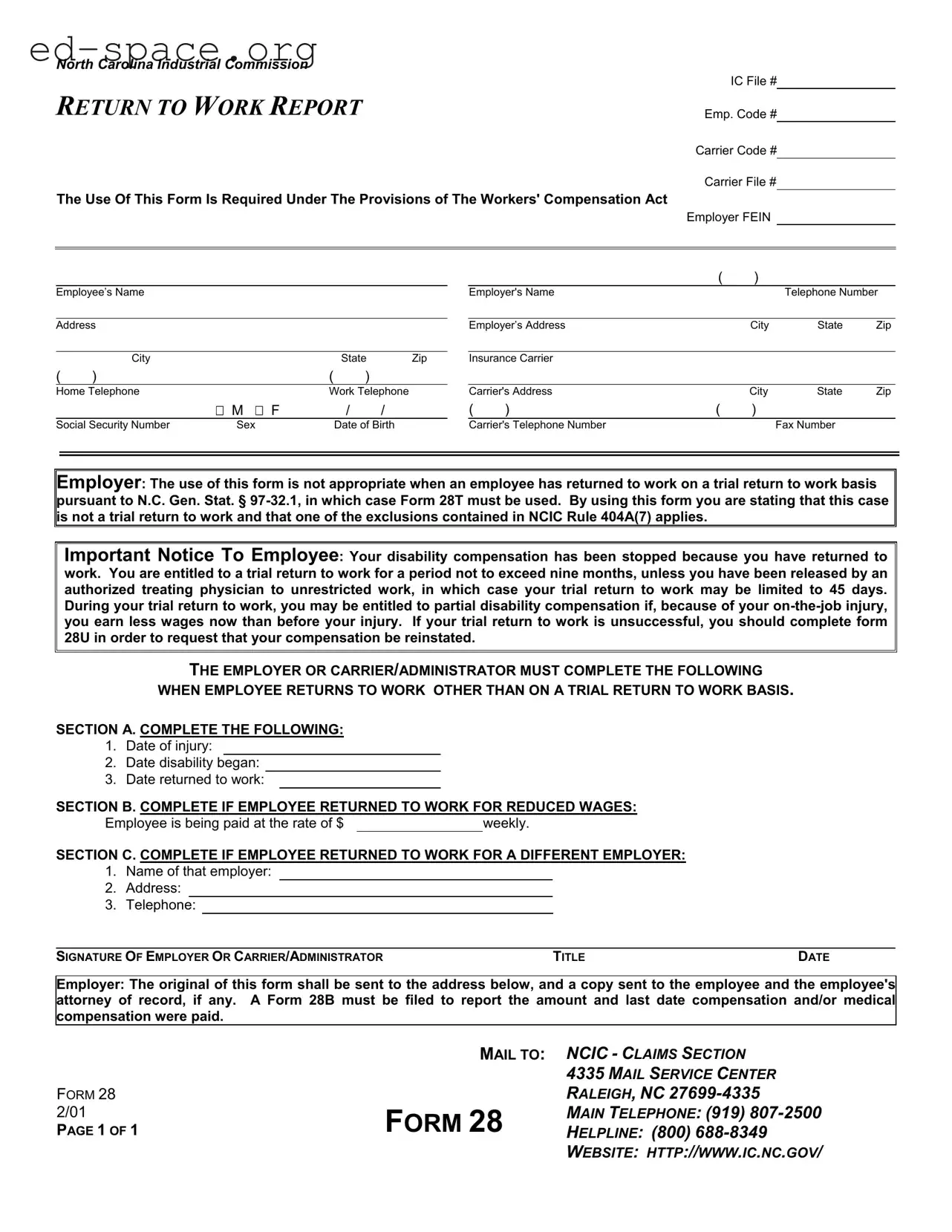
The North Carolina 28 form, also known as the Return to Work Report, plays a crucial role in the state's workers' compensation system. This form is required when an employee returns to work after a period of disability due to a workplace injury. It includes essential information such as the employee's name, contact details, and the specifics of their employment, including the employer's information and insurance carrier details. Notably, this form is not applicable for employees who are returning on a trial basis; in such cases, a different form, the 28T, must be utilized. The North Carolina Industrial Commission mandates that employers or their insurance carriers complete this form to confirm that the employee's return is not classified as a trial return to work. Additionally, the form addresses situations where an employee may have returned to work for reduced wages or with a different employer. It is important for employees to understand that their disability compensation may cease upon returning to work, although they may be eligible for partial disability compensation if their earnings are lower than before the injury. Clear instructions are provided for submitting the form, ensuring that both the employee and their attorney, if applicable, receive copies for their records. Overall, the North Carolina 28 form is a vital document that facilitates the transition back to work while maintaining compliance with state regulations.

NORTH CAROLINA INDUSTRIAL COMMISSION
IC File #
RETURN TO WORK REPORT
Emp. Code #
Carrier Code # Carrier File #
The Use Of This Form Is Required Under The Provisions of The Workers' Compensation Act
Employer FEIN
Employee’s Name
Address
|
City |
|
|
State |
Zip |
( |
) |
|
( |
) |
|
Home Telephone |
|
Work Telephone |
|||
|
|
M F |
|
/ |
/ |
Social Security Number |
Sex |
|
Date of Birth |
||
|
|
( |
) |
|
|
Employer's Name |
|
|
Telephone Number |
||
|
|
|
|
|
|
Employer’s Address |
|
City |
State |
Zip |
|
|
|
|
|
|
|
Insurance Carrier |
|
|
|
|
|
|
|
|
|
|
|
Carrier's Address |
|
City |
State |
Zip |
|
( |
) |
( |
) |
|
|
Carrier's Telephone Number |
|
|
Fax Number |
|
|
Employer: The use of this form is not appropriate when an employee has returned to work on a trial return to work basis pursuant to N.C. Gen. Stat. §
Important Notice To Employee: Your disability compensation has been stopped because you have returned to work. You are entitled to a trial return to work for a period not to exceed nine months, unless you have been released by an authorized treating physician to unrestricted work, in which case your trial return to work may be limited to 45 days. During your trial return to work, you may be entitled to partial disability compensation if, because of your
THE EMPLOYER OR CARRIER/ADMINISTRATOR MUST COMPLETE THE FOLLOWING
WHEN EMPLOYEE RETURNS TO WORK OTHER THAN ON A TRIAL RETURN TO WORK BASIS.
SECTION A. COMPLETE THE FOLLOWING:
1.Date of injury:
2.Date disability began:
3.Date returned to work:
SECTION B. COMPLETE IF EMPLOYEE RETURNED TO WORK FOR REDUCED WAGES:
Employee is being paid at the rate of $ |
|
weekly. |
SECTION C. COMPLETE IF EMPLOYEE RETURNED TO WORK FOR A DIFFERENT EMPLOYER:
1.Name of that employer:
2.Address:
3.Telephone:
SIGNATURE OF EMPLOYER OR CARRIER/ADMINISTRATOR |
TITLE |
DATE |
Employer: The original of this form shall be sent to the address below, and a copy sent to the employee and the employee's attorney of record, if any. A Form 28B must be filed to report the amount and last date compensation and/or medical compensation were paid.
|
MAIL TO: NCIC - CLAIMS SECTION |
|
|
|
4335 MAIL SERVICE CENTER |
FORM 28 |
|
RALEIGH, NC |
2/01 |
FORM 28 |
MAIN TELEPHONE: (919) |
PAGE 1 OF 1 |
HELPLINE: (800) |
|
WEBSITE: HTTP://WWW.IC.NC.GOV/
| Fact Name | Description |
|---|---|
| Purpose | The North Carolina 28 form is used to report an employee's return to work after a disability due to a work-related injury. |
| Governing Law | This form is governed by the North Carolina Workers' Compensation Act, specifically N.C. Gen. Stat. § 97-32.1. |
| Trial Return to Work | The form should not be used if the employee is returning to work on a trial basis; in such cases, Form 28T is required. |
| Compensation Notice | Employees must be informed that their disability compensation has been stopped due to their return to work. |
| Partial Disability | If an employee earns less due to their injury, they may be eligible for partial disability compensation during their trial return to work. |
| Submission Requirements | The original form must be sent to the NC Industrial Commission, with copies provided to the employee and their attorney, if applicable. |
| Contact Information | For questions, individuals can contact the NC Industrial Commission at (919) 807-2500 or (800) 688-8349. |
Completing the North Carolina 28 form is a necessary step following an employee's return to work after a work-related injury. Accurate and timely submission of this form is crucial to ensure compliance with the Workers' Compensation Act. The following steps will guide you through the process of filling out the form correctly.
What is the purpose of the North Carolina 28 form?
The North Carolina 28 form, also known as the Return to Work Report, is used to notify the North Carolina Industrial Commission when an employee returns to work after a period of disability due to a work-related injury. This form is essential for documenting that the employee is no longer receiving disability compensation and helps ensure compliance with the Workers' Compensation Act in North Carolina.
When should the North Carolina 28 form be used?
This form should be used when an employee has returned to work and is not on a trial return to work basis. If an employee is returning to work on a trial basis, the appropriate form to use is the Form 28T. By submitting the North Carolina 28 form, the employer confirms that one of the exclusions outlined in NCIC Rule 404A(7) applies to the employee's situation.
What information is required to complete the North Carolina 28 form?
To complete the North Carolina 28 form, the employer or carrier/administrator must provide several key details. This includes the employee's name, address, and Social Security number, along with the employer's information. Additionally, the form requires specific dates: the date of injury, the date disability began, and the date the employee returned to work. If the employee returned to work for reduced wages or with a different employer, that information must also be included.
What should employees know about their rights when returning to work?
Employees should be aware that their disability compensation may be stopped once they return to work. However, they are entitled to a trial return to work period, which can last up to nine months unless they have been released for unrestricted work. During this trial period, if the employee earns less due to their injury, they may qualify for partial disability compensation. If the trial return is unsuccessful, the employee should complete Form 28U to request reinstatement of their compensation.
Where should the completed North Carolina 28 form be sent?
The original North Carolina 28 form should be mailed to the North Carolina Industrial Commission's Claims Section at 4335 Mail Service Center, Raleigh, NC 27699-4335. Additionally, a copy of the form must be provided to the employee and their attorney, if applicable. This ensures that all parties are informed of the employee's return to work status.
What happens if the information on the North Carolina 28 form is incorrect?
If there are inaccuracies on the North Carolina 28 form, it is crucial to address them promptly. Incorrect information can lead to delays in processing and may affect the employee's compensation status. If changes are needed, the employer or carrier should correct the form and resubmit it to the Industrial Commission as soon as possible to ensure compliance and proper documentation.
Incorrect Form Usage: Many people mistakenly use the North Carolina 28 form when they should be using Form 28T for trial returns to work. Ensure you choose the correct form based on your situation.
Missing Employer Information: Failing to provide complete employer details, such as the employer's name and address, can lead to delays. Double-check that all required fields are filled out accurately.
Incorrect Dates: Entering the wrong dates for injury, disability, or return to work can create confusion. Verify that each date is accurate before submission.
Omitting Employee Details: Leaving out essential employee information, like Social Security Number or contact details, can hinder processing. Make sure to include all necessary information.
Inaccurate Wage Reporting: If the employee returned to work for reduced wages, it’s crucial to report the correct weekly pay rate. An error here could affect compensation calculations.
Neglecting to Sign: The form requires a signature from the employer or carrier/administrator. Forgetting to sign can result in the form being rejected.
Not Sending Copies: Failing to send copies of the completed form to the employee and their attorney can lead to misunderstandings. Always distribute copies as required.
Ignoring Submission Guidelines: Not adhering to the submission instructions, such as mailing the original to the correct address, can cause delays. Follow the mailing instructions carefully.
Missing Additional Forms: If applicable, remember to file Form 28B to report compensation details. Neglecting this can lead to incomplete records.
The North Carolina 28 form is an important document in the workers' compensation process. It is used to report an employee's return to work after a period of disability. Along with this form, there are several other documents that may be necessary to complete the workers' compensation process. Here’s a list of some of those documents, along with a brief description of each.
Each of these forms plays a crucial role in ensuring that the workers' compensation process runs smoothly. It is important to complete and submit them correctly to avoid any delays or issues with claims. Always consult with a legal advisor or workers' compensation specialist if you have questions about these documents.
When filling out the North Carolina 28 form, it is essential to follow specific guidelines to ensure accuracy and compliance. Here are eight important dos and don'ts to keep in mind:
By adhering to these guidelines, you can help facilitate a smoother process and ensure that all parties involved are properly informed and compliant with the requirements of the Workers' Compensation Act.
Understanding the North Carolina 28 form is essential for both employers and employees involved in workers' compensation cases. However, several misconceptions can lead to confusion. Below are nine common misconceptions about the North Carolina 28 form, along with clarifications to help you navigate this important document.
By addressing these misconceptions, both employers and employees can better understand their rights and responsibilities regarding the North Carolina 28 form. Clarity in this process can lead to smoother transitions back to work and ensure compliance with state regulations.
Here are some key takeaways about filling out and using the North Carolina 28 form: