Homepage Blank North Carolina 21 PDF Form
Article Guide

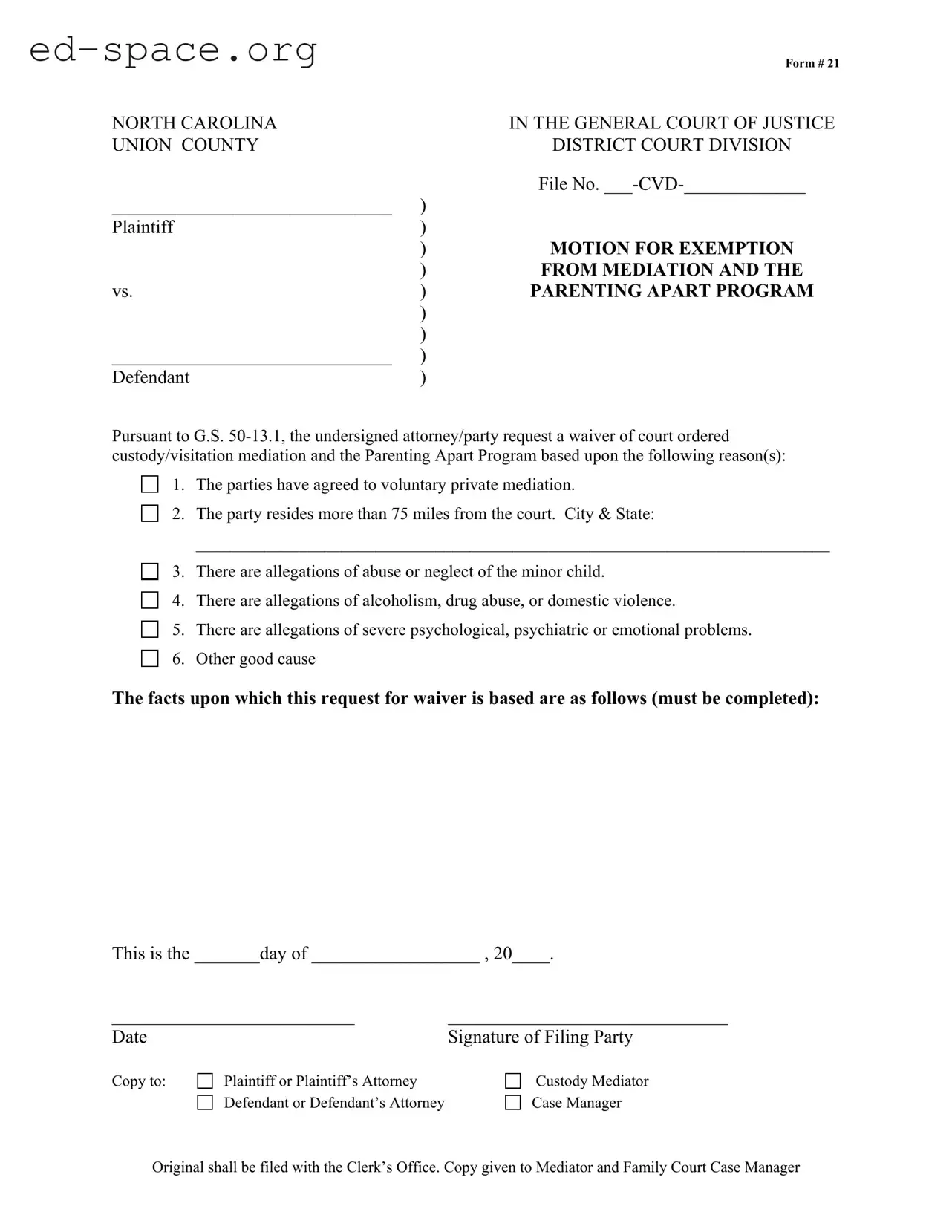
The North Carolina 21 form plays a crucial role in the family court system, particularly when it comes to custody and visitation matters. This form is a formal request for exemption from court-ordered mediation and the Parenting Apart Program, which are typically required in custody disputes. The form allows parties to present specific reasons for seeking this waiver, ensuring that the court can consider unique circumstances that may affect the welfare of the child involved. Key reasons for requesting an exemption include agreements for voluntary private mediation, significant distances from the court, or serious allegations such as abuse, neglect, or substance issues. Additionally, the form provides space for parties to outline any other compelling reasons that justify their request. By completing this form, individuals can help facilitate a more tailored approach to their custody situation, emphasizing the importance of addressing each case's individual needs.

Document Preview


Form # 21

NORTH CAROLINA


IN THE GENERAL COURT OF JUSTICE

UNION COUNTY


DISTRICT COURT DIVISION


File No. ___-CVD-_____________

______________________________

)


Plaintiff

)


)

MOTION FOR EXEMPTION


)

FROM MEDIATION AND THE

vs.

)

PARENTING APART PROGRAM


)


)


______________________________

)


Defendant

)


Pursuant to G.S. 50-13.1, the undersigned attorney/party request a waiver of court ordered custody/visitation mediation and the Parenting Apart Program based upon the following reason(s):

1. The parties have agreed to voluntary private mediation.

2. The party resides more than 75 miles from the court. City & State:

__________________________________________________________________________

3. There are allegations of abuse or neglect of the minor child.

4. There are allegations of alcoholism, drug abuse, or domestic violence.

5. There are allegations of severe psychological, psychiatric or emotional problems.

6. Other good cause

The facts upon which this request for waiver is based are as follows (must be completed):

This is the _______day of __________________ , 20____.

__________________________

______________________________

Date

Signature of Filing Party

Copy to:

Plaintiff or Plaintiff’s Attorney Defendant or Defendant’s Attorney

Custody Mediator Case Manager

Original shall be filed with the Clerk’s Office. Copy given to Mediator and Family Court Case Manager

Form Specifications

Fact Name Details
Form Title Motion for Exemption from Mediation and the Parenting Apart Program
Governing Law North Carolina General Statute G.S. 50-13.1
Jurisdiction Union County District Court Division
File Number Format ___-CVD-_____________
Distance Requirement Parties residing more than 75 miles from the court may request an exemption.
Allegations Considered Abuse, neglect, alcoholism, drug abuse, domestic violence, or severe psychological issues can justify an exemption.
Signature Requirement The filing party must sign the form to validate the request.
Copy Distribution Copies must be provided to the Plaintiff or Plaintiff’s Attorney, Defendant or Defendant’s Attorney, Custody Mediator, and Case Manager.
Filing Instructions The original form should be filed with the Clerk’s Office.

North Carolina 21: Usage Guidelines

After gathering the necessary information, you are ready to fill out the North Carolina 21 form. This form is used to request a waiver from mediation and the Parenting Apart Program. Ensure you have all relevant details at hand, as accuracy is essential for processing your request.

  1. Begin by entering the file number in the designated space: File No. ___-CVD-_____________.
  2. In the first section, write the name of the plaintiff and defendant as follows:
    • Under "Plaintiff," write the name of the person initiating the motion.
    • Under "Defendant," write the name of the other party involved.
  3. Next, check the box next to "MOTION FOR EXEMPTION FROM MEDIATION AND THE PARENTING APART PROGRAM."
  4. In the section that starts with "Pursuant to G.S. 50-13.1," list the reasons for requesting a waiver by checking the appropriate boxes. You may choose from:
    • The parties have agreed to voluntary private mediation.
    • The party resides more than 75 miles from the court.
    • There are allegations of abuse or neglect of the minor child.
    • There are allegations of alcoholism, drug abuse, or domestic violence.
    • There are allegations of severe psychological, psychiatric, or emotional problems.
    • Other good cause.
  5. Provide a detailed explanation of the facts supporting your request in the space provided.
  6. Fill in the date on which you are submitting the form, specifying the day, month, and year.
  7. Sign the form in the space marked for the signature of the filing party.
  8. Make copies of the completed form for the following parties:
    • Plaintiff or Plaintiff’s Attorney
    • Defendant or Defendant’s Attorney
    • Custody Mediator
    • Case Manager
  9. File the original form with the Clerk’s Office.

Your Questions, Answered

What is the North Carolina 21 form?

The North Carolina 21 form is a legal document used in family court cases, specifically in custody and visitation matters. It allows a party to request an exemption from mandatory mediation and the Parenting Apart Program. The form is filed in the General Court of Justice in Union County and must include specific reasons for the exemption.

When should I use the North Carolina 21 form?

This form is appropriate when you believe that mediation is not suitable for your case. Common reasons include having already agreed to private mediation, living more than 75 miles from the court, or if there are serious allegations such as abuse, neglect, or substance issues. It is essential to provide clear reasons and facts to support your request.

What information do I need to provide when filling out the form?

You will need to provide your name, the name of the other party, and the case number. Additionally, you must specify the reason for your request for exemption. This could include details about the distance from the court, any allegations of abuse, or other relevant circumstances. It is crucial to be thorough and precise in this section.

How do I submit the North Carolina 21 form?

The completed form must be filed with the Clerk’s Office in the appropriate district court. After filing, you should provide copies to the other party (or their attorney), the custody mediator, and the family court case manager. Keeping a copy for your records is also advisable.

What happens after I submit the form?

Once the form is submitted, the court will review your request for exemption. If the court finds your reasons valid, it may grant the waiver from mediation and the Parenting Apart Program. You will be notified of the court's decision, and further instructions will be provided if necessary.

Can I appeal the court's decision regarding the exemption?

If the court denies your request for exemption, you may have the option to appeal the decision. However, the appeal process can be complex and may require additional legal steps. Consulting with an attorney who specializes in family law can help you understand your options and the likelihood of a successful appeal.

Is there a deadline for submitting the North Carolina 21 form?

Yes, there are typically deadlines for filing motions in family court. It is important to check with the court or your attorney to ensure you submit the form within the required timeframe. Delays could affect your case, so timely submission is crucial.

Common mistakes

  1. Incomplete Information: One common mistake is failing to provide all necessary details in the section where the facts supporting the request for waiver are required. This can lead to delays or rejection of the motion.

  2. Incorrect Signature: The form must be signed by the appropriate party. If the wrong person signs or if the signature is missing, the court may not accept the form.

  3. Failure to Specify Reasons: It is essential to clearly state the reason for requesting the exemption. Simply checking boxes without elaborating on the circumstances can result in the court needing more information.

  4. Not Filing with the Clerk’s Office: After completing the form, it is crucial to file it with the Clerk’s Office. Neglecting to do so can lead to the motion not being considered by the court.

Documents used along the form

When dealing with custody and visitation issues in North Carolina, several forms and documents may accompany the North Carolina 21 form. Each of these documents serves a specific purpose in the legal process. Below is a list of commonly used forms that may be relevant in such cases.

  • Form AOC-CV-100 - This is the general civil summons form used to notify the defendant of the legal action being taken against them. It provides essential information about the case and the court's jurisdiction.
  • Form AOC-CV-200 - This is a complaint form where the plaintiff outlines their claims and the relief sought. It establishes the basis for the court's involvement in the custody or visitation matter.
  • Form AOC-CV-300 - This form is used to request a temporary custody order. It is essential when immediate custody arrangements are necessary before the final hearing.
  • Form AOC-CV-400 - This is a motion for modification of custody. It allows a party to request changes to an existing custody order based on new circumstances.
  • Form AOC-CV-500 - This document is a response to a motion for custody or visitation. It allows the other party to present their side and any objections to the proposed changes.
  • Form AOC-CV-600 - This is a notice of hearing form that informs parties of the scheduled court date for their case. It ensures that all involved are aware of when they need to appear in court.
  • Form AOC-CV-700 - This form serves as a request for a parenting plan. It outlines the proposed arrangements for the child's care and visitation, promoting cooperation between parents.
  • Form AOC-CV-800 - This is a waiver of service form, which allows a defendant to acknowledge receipt of the complaint without formal service, expediting the process.

Understanding these forms and their purposes can help individuals navigate custody and visitation proceedings more effectively. Timely and accurate completion of these documents is crucial for ensuring that the legal process runs smoothly.

Similar forms

The North Carolina 21 form is primarily used in custody and visitation cases to request an exemption from mandatory mediation and the Parenting Apart Program. Several other legal documents serve similar purposes in various contexts. Here are nine documents that share similarities with the North Carolina 21 form:

  • Motion for Temporary Custody - This document requests the court to grant temporary custody of a child, often highlighting urgent circumstances that necessitate immediate attention, similar to how the North Carolina 21 form addresses specific needs for mediation exemptions.
  • Motion to Modify Custody - Used to request changes to existing custody arrangements, this motion may cite reasons like changes in circumstances or the best interests of the child, paralleling the North Carolina 21 form's focus on the child's welfare.
  • Affidavit of Domestic Violence - This document provides sworn statements regarding incidents of domestic violence, often used in custody cases. It shares the North Carolina 21 form's emphasis on safety concerns for children.
  • Request for Protective Order - Similar in intent, this request seeks legal protection from harm, often due to abuse or threats. Both documents prioritize the safety and well-being of involved parties.
  • Notice of Hearing - This document informs parties of upcoming court proceedings. While it serves a different function, it is crucial in the legal process, just as the North Carolina 21 form is essential for mediation exemptions.
  • Parenting Plan - A detailed agreement outlining custody and visitation arrangements, this document is often submitted to the court. It complements the North Carolina 21 form by addressing how parenting will be handled post-mediation.
  • Petition for Child Support - This document requests financial support for a child, emphasizing the child's needs, akin to how the North Carolina 21 form highlights specific circumstances affecting mediation.
  • Consent Order - This legal agreement, approved by the court, outlines terms agreed upon by both parties. It shares the collaborative spirit of the North Carolina 21 form, which seeks to streamline processes based on mutual agreement.
  • Motion for Visitation Rights - This document requests specific visitation privileges, often in contested custody cases. Like the North Carolina 21 form, it addresses the complexities of parental rights and child welfare.

Understanding these documents can help navigate the complexities of family law in North Carolina. Each serves a unique purpose while often overlapping in their focus on the best interests of children and the safety of all parties involved.

Dos and Don'ts

When filling out the North Carolina 21 form, it is important to approach the task with care. Here are four key things to keep in mind:

  • Do read the instructions thoroughly before starting. Understanding the requirements will help ensure that you provide all necessary information.
  • Do provide accurate and truthful information. Inaccuracies can lead to delays or complications in the legal process.
  • Don't leave any required fields blank. Each section is important for the court to consider your request.
  • Don't submit the form without reviewing it for errors. A careful review can prevent mistakes that may affect the outcome of your motion.

By following these guidelines, you can navigate the process more smoothly and with greater confidence.

Misconceptions

Misconceptions about the North Carolina 21 form can lead to confusion for those navigating custody and visitation issues. Here are nine common misunderstandings:

  1. The North Carolina 21 form is only for custody disputes. Many believe this form is exclusively for custody matters, but it can also address visitation issues.
  2. You must attend mediation if you file the form. Some think that filing the North Carolina 21 form means mediation is mandatory. In fact, the form is a request for exemption from mediation.
  3. All reasons for exemption must be documented. While it helps to provide evidence, not every reason listed on the form requires extensive documentation. Personal testimony can be sufficient in some cases.
  4. The form guarantees a waiver from mediation. Submitting the form does not automatically ensure that the court will grant the exemption. The court will consider the reasons provided.
  5. You cannot file the form if both parties agree to mediation. If both parties have agreed to private mediation, the form can still be used to request a waiver from court-ordered mediation.
  6. Only allegations of abuse or neglect qualify for exemption. While serious allegations can justify a waiver, there are other valid reasons, such as distance from the court or other good cause.
  7. The form must be filed by an attorney. Individuals can file the form themselves, but having legal representation can be beneficial for clarity and guidance.
  8. The North Carolina 21 form is the same as other states' forms. Each state has its own specific forms and requirements, so the North Carolina 21 form may differ significantly from similar forms in other states.
  9. Filing the form means you will not have to participate in any programs. Even if the form is granted, the court may still require participation in other programs or evaluations.

Understanding these misconceptions can help individuals navigate the complexities of custody and visitation processes more effectively.

Key takeaways

Filling out and using the North Carolina 21 form can be straightforward if you keep a few key points in mind. Here are some important takeaways:

  • Understand the purpose: This form is used to request an exemption from court-ordered mediation and the Parenting Apart Program.
  • Identify valid reasons: You must provide a valid reason for the exemption, such as voluntary mediation or distance from the court.
  • Be specific: Clearly state the facts that support your request for a waiver. This section must be completed thoroughly.
  • Check your eligibility: Ensure that your situation meets the criteria listed in the form, such as allegations of abuse or neglect.
  • Complete all sections: Fill out all required fields, including the date and signatures of the parties involved.
  • File correctly: Submit the original form to the Clerk’s Office and provide copies to the mediator and family court case manager.
  • Keep records: Retain copies of the submitted form and any related documents for your records.

By following these takeaways, you can navigate the process more easily and ensure that your request is properly considered.