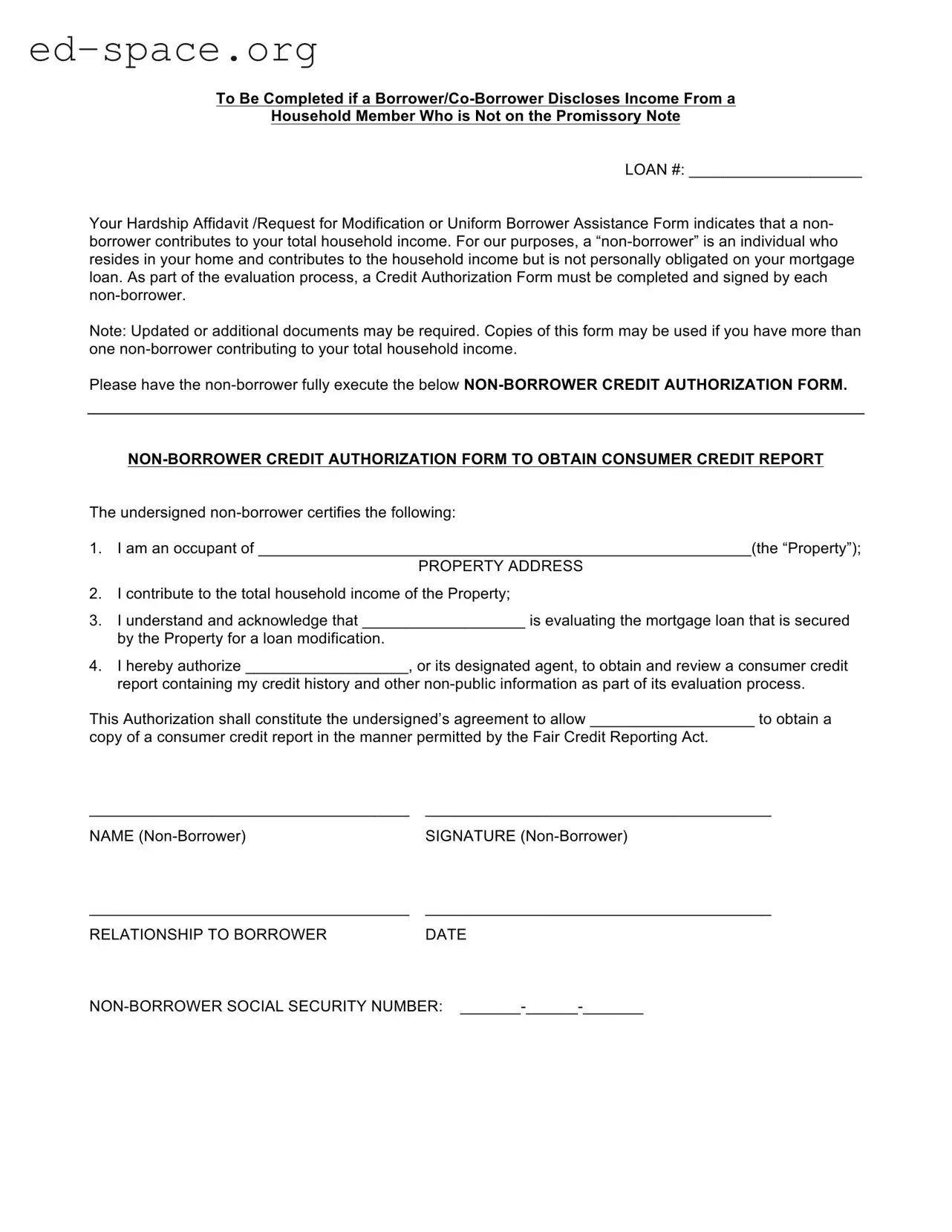
The Non Borrower Credit Authorization form plays a crucial role in the mortgage loan modification process, particularly when a borrower discloses that a household member contributes to the overall income but is not listed on the promissory note. This form is specifically designed for situations where a non-borrower, defined as an individual residing in the borrower's home and contributing financially, needs to provide consent for a credit evaluation. Completing this form is essential for lenders to assess the full financial picture of the household, as it allows them to obtain a consumer credit report for the non-borrower. Each non-borrower must sign the form, affirming their contribution to the household income and understanding that their credit history will be reviewed as part of the loan modification evaluation. If multiple non-borrowers are involved, copies of the form can be used to ensure all necessary parties provide their authorization. It is important to note that additional documentation may be required, highlighting the need for clear communication and thorough preparation during this process.

To Be Completed if a
Household Member Who is Not on the Promissory Note
LOAN #: ____________________
Your Hardship Affidavit /Request for Modification or Uniform Borrower Assistance Form indicates that a non- borrower contributes to your total household income. For our purposes, a
Note: Updated or additional documents may be required. Copies of this form may be used if you have more than one
Please have the
The undersigned
1.I am an occupant of _________________________________________________________(the “Property”);
PROPERTY ADDRESS
2.I contribute to the total household income of the Property;
3.I understand and acknowledge that ___________________ is evaluating the mortgage loan that is secured by the Property for a loan modification.
4.I hereby authorize ___________________, or its designated agent, to obtain and review a consumer credit report containing my credit history and other
This Authorization shall constitute the undersigned’s agreement to allow ___________________ to obtain a
copy of a consumer credit report in the manner permitted by the Fair Credit Reporting Act.
_____________________________________ |
________________________________________ |
NAME |
SIGNATURE |
_____________________________________ |
________________________________________ |
RELATIONSHIP TO BORROWER |
DATE |
| Fact Name | Description |
|---|---|
| Purpose of the Form | This form is used when a borrower or co-borrower discloses income from a household member who is not on the promissory note. It helps lenders assess the total household income for loan modification purposes. |
| Definition of Non-Borrower | A non-borrower is an individual who lives in the borrower's home and contributes to the household income but is not legally responsible for the mortgage loan. |
| Credit Authorization Requirement | Each non-borrower must complete and sign the Credit Authorization Form to allow the lender to obtain their consumer credit report as part of the evaluation process. |
| Use of Multiple Forms | If there are multiple non-borrowers contributing to the household income, copies of the form can be used for each individual to ensure all contributions are documented. |
| Governing Law | The use of this form and the authorization to obtain a credit report is governed by the Fair Credit Reporting Act, which sets guidelines for how consumer credit information can be accessed and used. |
Once the Non-Borrower Credit Authorization form is completed, it will be submitted as part of the evaluation process for a loan modification. This form is essential for verifying the contribution of a non-borrower to the household income. It is important to ensure that all information is accurate and that the form is signed where required.
What is the Non Borrower Credit Authorization form?
The Non Borrower Credit Authorization form is a document required when a borrower or co-borrower discloses that a household member, who is not on the mortgage loan, contributes to the total household income. This form allows the lender to obtain a consumer credit report for the non-borrower to evaluate the mortgage loan for potential modification.
Who qualifies as a non-borrower?
A non-borrower is defined as an individual who lives in the same household as the borrower and contributes to the household income but is not legally responsible for the mortgage. This could include family members, roommates, or anyone else who shares financial responsibilities in the home.
Why is the Non Borrower Credit Authorization form necessary?
This form is necessary because it allows the lender to access the non-borrower's credit history. This information is crucial for assessing the overall financial situation of the household, especially when evaluating a loan modification request. It ensures that all income contributors are considered in the decision-making process.
What information is required on the form?
The form requires several pieces of information, including the non-borrower's name, relationship to the borrower, property address, and social security number. Additionally, the non-borrower must sign the form to authorize the lender to obtain their credit report.
Can multiple non-borrowers use the same form?
No, each non-borrower must complete their own Non Borrower Credit Authorization form. However, copies of the form can be used if there are multiple non-borrowers contributing to the household income. Each individual must provide their own details and signature for the authorization to be valid.
What happens after the form is submitted?
Once the Non Borrower Credit Authorization form is submitted, the lender will use the information to obtain the non-borrower's credit report. This report will be reviewed as part of the evaluation process for the mortgage loan modification. Additional documentation may be requested if necessary.
Is there a deadline for submitting the form?
Failing to provide the loan number at the top of the form. This number is crucial for processing your request.
Not including the property address. Ensure the address is complete and accurate to avoid delays.
Leaving the signature line blank. The non-borrower must sign the form to validate the authorization.
Overlooking the relationship to the borrower section. Clearly state how the non-borrower is related to the borrower.
Not providing the date of signing. This information is essential for record-keeping and processing timelines.
Using an incorrect Social Security Number. Double-check this number for accuracy to prevent issues with credit checks.
Failing to understand the implications of authorizing a credit report. The non-borrower should be aware of what this entails.
Not using additional copies of the form if there are multiple non-borrowers. Each non-borrower needs their own signed form.
Neglecting to read the fine print. Ensure all terms and conditions are understood before signing.
Submitting the form without confirming that all required fields are filled out completely. Incomplete forms can lead to delays or rejections.
When completing the Non Borrower Credit Authorization form, several other documents may be required to ensure a thorough evaluation of the mortgage loan modification request. Below is a list of commonly used forms and documents that accompany the authorization process.
Having these documents ready can streamline the loan modification process. It ensures that all necessary information is available for review, helping to facilitate a quicker and more efficient evaluation.
The Non Borrower Credit Authorization form is important for situations where a household member, not listed on the mortgage, contributes to the household income. Several other documents serve similar purposes in the context of credit authorization and financial evaluation. Below are seven documents that share similarities with the Non Borrower Credit Authorization form:
When filling out the Non Borrower Credit Authorization form, it’s important to follow certain guidelines to ensure accuracy and compliance. Here’s a list of what to do and what to avoid.
Following these steps will help ensure that your Non Borrower Credit Authorization form is completed correctly. If you have questions, reach out for assistance.
Misconceptions about the Non Borrower Credit Authorization form can lead to confusion and missteps in the loan modification process. The following list addresses seven common misconceptions:
Understanding these misconceptions can help individuals navigate the loan modification process more effectively and ensure that all necessary steps are taken.
When filling out and using the Non Borrower Credit Authorization form, it is important to consider the following key points: