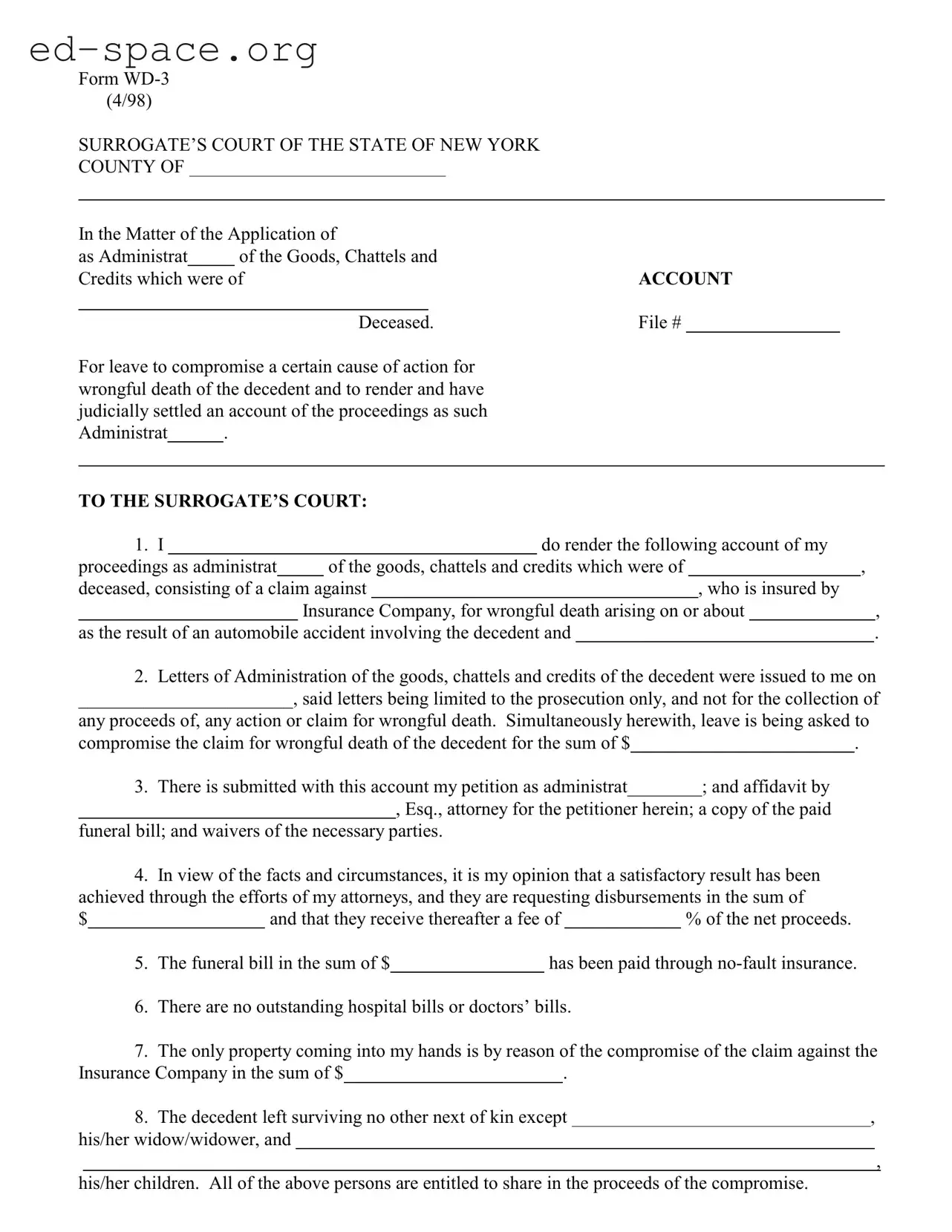
The New York WD-3 form plays a crucial role in the administration of estates, particularly in cases involving wrongful death claims. This form is utilized by an administrator to seek court approval for settling a wrongful death claim and to provide a detailed account of the estate's financial activities. It outlines the administrator's actions, including the receipt of funds from a compromise with an insurance company and the payment of funeral expenses. Additionally, the WD-3 requires the administrator to disclose any claims against the estate and the identities of interested parties, ensuring transparency throughout the process. By submitting this form, the administrator not only seeks to resolve the estate's financial matters but also aims to ensure that all beneficiaries receive their rightful shares. Understanding the nuances of the WD-3 form is essential for anyone navigating the complexities of estate administration in New York.

Form
SURROGATE’S COURT OF THE STATE OF NEW YORK
COUNTY OF
In the Matter of the Application of |
|
|
|
|
|
|
|
|
|
||||||||||
as Administrat |
|
|
of the Goods, Chattels and |
|
|
|
|
|
|
|
|
|
|||||||
Credits which were of |
|
|
|
|
|
|
ACCOUNT |
|
|
|
|||||||||
|
|
|
|
|
|
|
|
|
|
|
|
|
|
|
|
|
|
|
|
|
|
|
|
|
|
|
|
Deceased. |
|
File # |
|
|
|
||||||
For leave to compromise a certain cause of action for |
|
|
|
|
|
|
|
|
|
||||||||||
wrongful death of the decedent and to render and have |
|
|
|
|
|
|
|
|
|
||||||||||
judicially settled an account of the proceedings as such |
|
|
|
|
|
|
|
|
|
||||||||||
Administrat |
|
|
. |
|
|
|
|
|
|
|
|
|
|
|
|
|
|
|
|
|
|
|
|
|
|
|
|
|
|
||||||||||
TO THE SURROGATE’S COURT: |
|
|
|
|
|
|
|
|
|
||||||||||
1. I |
|
|
|
|
|
|
|
|
|
do render the following account of my |
|
|
|
||||||
proceedings as administrat |
|
|
of the goods, chattels and credits which were of |
|
|
, |
|
||||||||||||
deceased, consisting of a claim against |
|
|
|
|
|
, who is insured by |
|
|
|
||||||||||
|
|
|
|
|
|
|
Insurance Company, for wrongful death arising on or about |
|
|
, |
|||||||||
as the result of an automobile accident involving the decedent and |
|
. |
|||||||||||||||||
|
|
|
|
|
|
|
|
|
|
|
|
|
|
|
|
|
|
|
|
2.Letters of Administration of the goods, chattels and credits of the decedent were issued to me on
_______________________, said letters being limited to the prosecution only, and not for the collection of any proceeds of, any action or claim for wrongful death. Simultaneously herewith, leave is being asked to
compromise the claim for wrongful death of the decedent for the sum of $ |
|
. |
3.There is submitted with this account my petition as administrat________; and affidavit by
,Esq., attorney for the petitioner herein; a copy of the paid funeral bill; and waivers of the necessary parties.
4.In view of the facts and circumstances, it is my opinion that a satisfactory result has been achieved through the efforts of my attorneys, and they are requesting disbursements in the sum of
$ |
|
|
and that they receive thereafter a fee of |
|
% of the net proceeds. |
||
5. |
The funeral bill in the sum of $ |
|
has been paid through |
||||
6.There are no outstanding hospital bills or doctors’ bills.
7.The only property coming into my hands is by reason of the compromise of the claim against the
Insurance Company in the sum of $ |
|
. |
|
|
8. The decedent left surviving no other next of kin except |
|
, |
||
his/her widow/widower, and
,
his/her children. All of the above persons are entitled to share in the proceeds of the compromise.
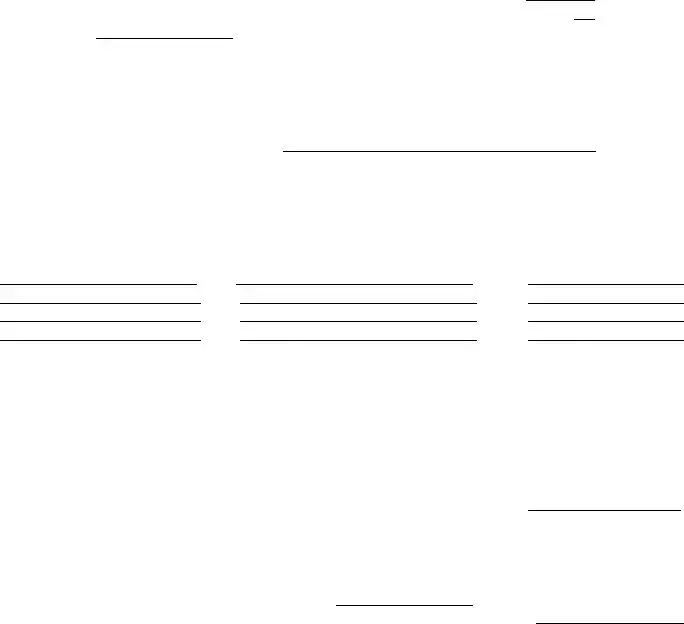
(NOTE: WHERE THERE ARE NO DISTRIBUTEES UNDER A DISABILITY, THE RENDERING OF AN ACCOUNT IS USUALLY NOT REQUIRED.)
(NOTE: REIMBURSEMENT OF FUNDS PAID FOR FUNERAL AND OTHER ADMINISTRATIVE EXPENSES, UNDER MOST CIRCUMSTANCES, ARE ALLOWABLE, AS ARE STATUTORY COMMISSIONS TO THE ADMINISTRAT(OR)(RIX). IF REIMBURSEMENT OR COMMISSIONS ARE NOT SOUGHT, THE PETITION SHOULD CONTAIN A WAIVER THEREOF).
9.There are no other claims or creditors of the estate that have been presented to or have come into my hands or knowledge except for the following:
a)The Commissioner of Social Services has submitted a claim of $
for public assistance rendered to decedent and his/her family for the years
. This claim was rejected.
b) |
has submitted a claim for $ |
|
||||
|
|
based on |
|
|
|
|
This claim was rejected. |
|
|
|
|||
c) Decedent’s father/mother,
has sought a share of the recovery based on an alleged pecuniary loss. This claim was rejected.
10. The following are the only persons interested in this proceeding:
|
[L IST NAMES OF DISTRIBUTEES, ETC .] |
|
NAME |
RELATIONSHIP |
DATE OF BIRTH |
County Department |
|
||
of Social Services |
|
Possible Creditor |
|
New York State Tax Commission |
Possible Creditor |
||
|
|
|
Attorneys |
|
|
|
Defendant |
Insurance Company |
Defendant’s Insurance Company |
||
11.I charge myself as follows with the amount to be received on compromise of the claim for wrongful death against
Insurance Company: |
$ |

12. I credit myself as follows: |
|
|
|
|
||||||||
a) With the amount to be paid to |
|
|
, |
|
||||||||
|
|
|
|
|
|
|
|
|
|
|
|
|
Esqs., attorneys, including disbursements: |
|
$ |
||||||||||
b) With the amount to be paid to |
|
|
, |
|
||||||||
|
|
|
|
|
|
|
|
|
|
|
|
|
widow/widower and distributee: ( |
%) |
$ |
||||||||||
|
|
|
|
|
|
|
|
|
|
|||
c) With the amount to be paid to the guardian of the person |
||||||||||||
and property of |
|
|
|
|
|
|
|
, |
|
|
||
infant, jointly with the Trust Officer of |
|
|
|
|
|
|||||||
Bank ( |
|
|
%): |
|
|
|
|
|
$ |
|||
d) with the amount to be paid to |
|
|
, |
|||||||||
|
|
|
|
|
|
|
|
|
|
|||
son/daughter ( |
%): |
|
|
|
|
$ |
||||||
|
|
|
|
Total: |
|
|
$ |
|||||
Leaving no balance. |
|
|
|
|
|
|
|
|
|
|
||
Dated:
STATE OF NEW YORK |
|
COUNTY OF |
SS.: |
being duly sworn, deposes and says:
That I am the administrat_______ /accountant in the above estate, having been duly appointed by a
decree of this Court.
The foregoing account of proceedings contains to the best of my knowledge and belief a true and complete statement of my receipts and disbursements in the estate of
of all monies and other property belonging to the estate or fund which have come into my hands or which have been received by any person or persons by my order or authority for use since my appointment, and a full and true statement of account of the manner in which I have disposed of same and all property remaining in my hands at the present time, and a full and true account of the nature of each and every transaction may by me since my appointment.
|
I do not know of any error or omission in said account to the prejudice of any person interested in |
|||||
said estate or fund. |
|
|
|
|
|
|
|
|
|
|
|
|
|
|
|
___________________________________ |
||||
Sworn to before me this |
|
|
|
|
|
|
day of |
|
|
. |
|
|
|
Notary Public
(Form |
| Fact Name | Description |
|---|---|
| Purpose | The New York WD-3 form is used to seek court approval for compromising a wrongful death claim and settling an estate's account. |
| Governing Law | This form is governed by the New York Surrogate's Court Procedure Act. |
| Filing Requirement | It must be filed in the Surrogate's Court of the county where the decedent resided. |
| Administrator Role | The form must be completed by the appointed administrator of the decedent's estate. |
| Claim Details | It requires detailed information about the wrongful death claim, including the amount being compromised. |
| Attachments | Accompanying documents must include a petition, an attorney's affidavit, and waivers from necessary parties. |
| Funeral Expenses | Reimbursement for funeral expenses paid through no-fault insurance is typically included in the account. |
| Outstanding Claims | The form must disclose any outstanding claims or creditors against the estate. |
| Distribution of Proceeds | It outlines how the proceeds from the compromise will be distributed among the decedent's heirs. |
| Notarization | The form must be sworn before a notary public to validate the information provided. |
Filling out the New York WD-3 form is an important step in managing the estate of a deceased person. This process involves providing details about the administration of the estate and any claims related to wrongful death. After completing the form, it will need to be submitted to the Surrogate’s Court for review and approval.
What is the New York WD-3 form?
The New York WD-3 form is a legal document used in Surrogate’s Court. It allows an administrator to seek permission to settle a wrongful death claim and to provide a detailed account of the estate's financial activities. This form is essential for ensuring that all transactions related to the estate are transparent and legally sound.
Who needs to fill out the WD-3 form?
The WD-3 form must be completed by the administrator of an estate. This person is typically appointed by the court to manage the deceased's assets and handle any claims against the estate. If there is a wrongful death claim, the administrator must file this form to settle the claim and account for the estate's finances.
What information is required on the WD-3 form?
The form requires several pieces of information. This includes details about the deceased, the claim against the insurance company, and the amounts involved in the settlement. Additionally, the administrator must provide information about any funeral expenses, outstanding bills, and the beneficiaries of the estate. It’s important to be thorough and accurate when filling out this form.
What happens after submitting the WD-3 form?
Once the WD-3 form is submitted to the Surrogate’s Court, the court will review the application. If everything is in order, the court may grant permission to compromise the wrongful death claim. The administrator will then be able to distribute the funds according to the approved plan. It is essential to follow up to ensure that all steps are completed correctly.
Are there any fees associated with filing the WD-3 form?
Yes, there may be fees associated with filing the WD-3 form. These can include court filing fees and potential attorney fees for legal representation. It is advisable to check with the Surrogate’s Court for the specific fees applicable to your case. Budgeting for these expenses is an important part of the process.
Can the WD-3 form be amended after submission?
Amendments to the WD-3 form can be made if necessary. If there are any errors or changes in the information provided, the administrator should promptly notify the court. It is crucial to keep all records accurate and up to date to avoid complications in the estate settlement process.
Incomplete Information: Failing to fill in all required fields can delay the processing of your application. Ensure every section is complete, including names, dates, and amounts.
Incorrect Names: Using incorrect names for the decedent, administrator, or other parties can lead to complications. Double-check spelling and accuracy.
Missing Signatures: Omitting signatures where required can invalidate the form. Ensure that all necessary parties sign the document.
Failure to Attach Supporting Documents: Not including necessary documents, such as waivers or affidavits, may result in delays. Always attach all required paperwork.
Inaccurate Financial Figures: Providing incorrect amounts for claims, expenses, or distributions can lead to legal issues. Verify all financial figures before submission.
Ignoring Deadlines: Submitting the form after the deadline can jeopardize your case. Be aware of all relevant timelines.
Not Consulting an Attorney: Attempting to fill out the form without legal guidance can lead to mistakes. Consulting an attorney can provide clarity and reduce errors.
Misunderstanding the Role of the Administrator: Not fully grasping the responsibilities of the administrator can lead to incomplete or inaccurate filings. Ensure you understand your role.
Neglecting to Review the Form: Failing to review the completed form before submission can result in overlooked errors. Always take the time to proofread.
The New York WD-3 form is often accompanied by several other documents that are essential for the administration of an estate, particularly in cases involving wrongful death claims. Each of these documents serves a specific purpose in the legal process. Below is a list of forms and documents commonly used alongside the WD-3 form.
These documents collectively support the WD-3 form and facilitate the legal process of estate administration. Proper preparation and submission of these forms can help ensure a smoother resolution of estate matters.
When filling out the New York WD-3 form, it’s essential to be thorough and accurate. Here are some helpful tips on what you should and shouldn’t do:
Filling out this form can be daunting, but taking your time and following these guidelines will help ensure a smoother experience. Good luck!
Understanding the New York WD-3 form is crucial for anyone involved in the administration of an estate. However, several misconceptions can lead to confusion. Here are five common misconceptions:
Clarifying these misconceptions can help ensure a smoother process for all parties involved. It is essential to approach the WD-3 form with accurate information and understanding.
When filling out and using the New York WD-3 form, consider the following key takeaways:
By following these guidelines, the process of completing the WD-3 form can be streamlined, ensuring that all necessary information is provided for judicial review.