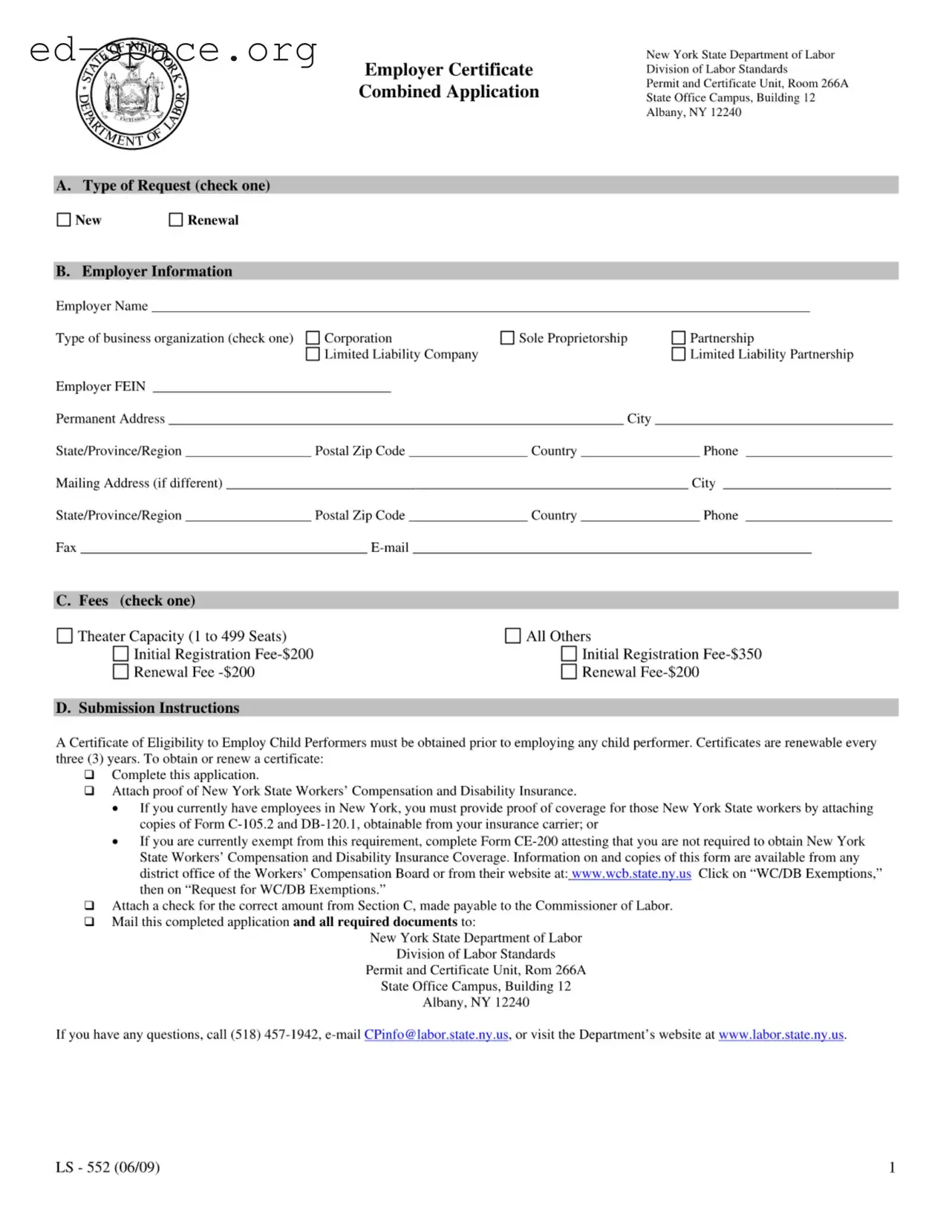
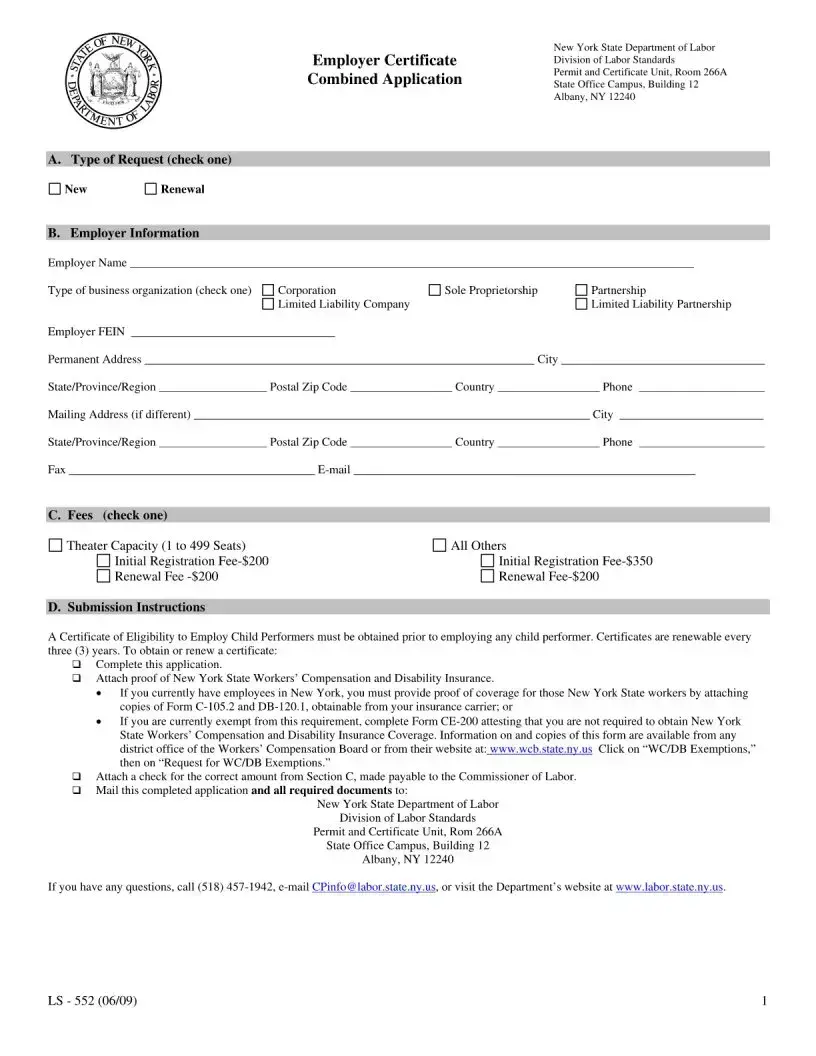
The New York LS 552 form is a crucial document for employers looking to hire child performers in the state. This form serves as a combined application for a Certificate of Eligibility to Employ Child Performers, which is mandatory before any employment can begin. Employers must specify whether they are applying for a new certificate or renewing an existing one. Key information required includes the employer's name, type of business organization, and contact details. Additionally, the form outlines the associated fees, which vary based on theater capacity and registration type. Employers are reminded of their responsibilities, including the establishment of a trust account for child performers' earnings and ensuring satisfactory academic performance. The application process involves submitting proof of insurance coverage and ensuring that all employed child performers possess valid permits. It is essential to adhere to all relevant laws and regulations to maintain compliance and ensure the welfare of child performers.
| Fact Name | Description |
|---|---|
| Form Purpose | The LS 552 form is used to apply for or renew a Certificate of Eligibility to Employ Child Performers in New York State. |
| Governing Law | This form is governed by New York State Labor Law, specifically regulations regarding the employment of child performers. |
| Fees | The initial registration fee is $200 for theater capacity of 1 to 499 seats and $350 for all others. Renewal fees are $200. |
| Submission Instructions | Applicants must complete the form, attach proof of New York State Workers’ Compensation and Disability Insurance, and mail it to the specified address. |
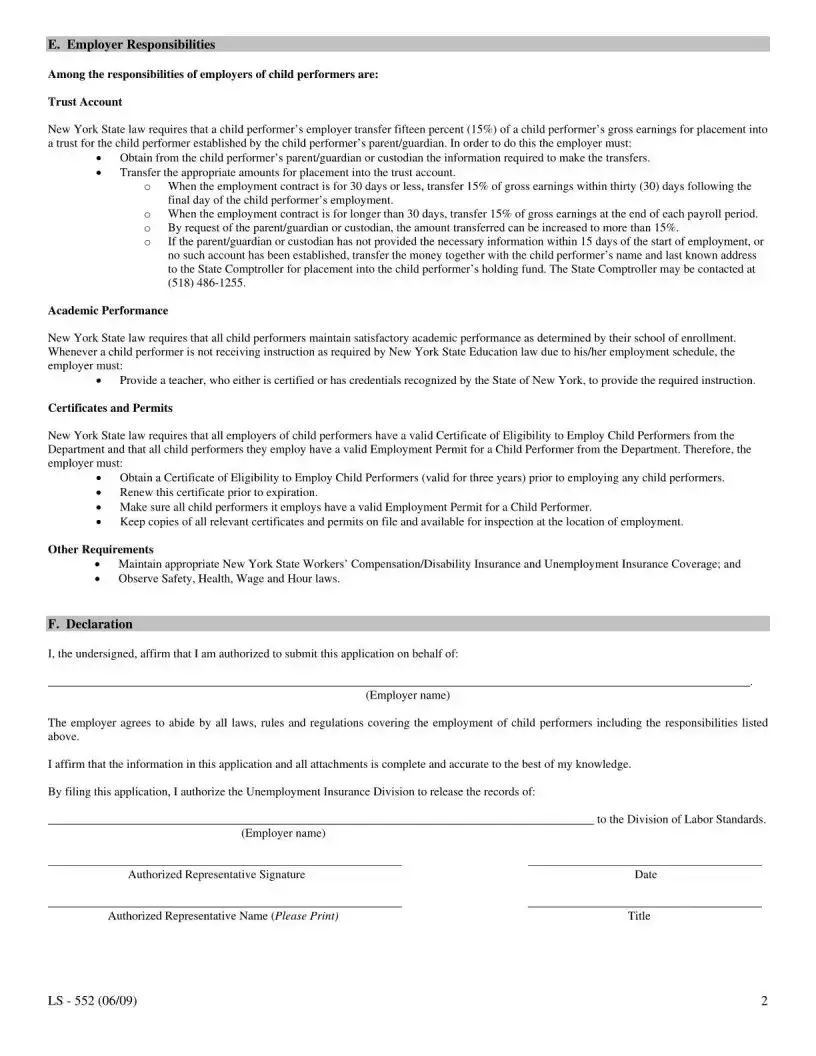
| Employer Responsibilities | Employers must maintain a trust account for child performers, ensure satisfactory academic performance, and hold valid certificates and permits. |
Completing the New York LS 552 form is essential for employers wishing to hire child performers. The process involves providing accurate information about the employer and adhering to specific requirements related to insurance and trust accounts. Follow these steps carefully to ensure your application is complete.
What is the New York LS 552 form?
The New York LS 552 form is an application used by employers to obtain a Certificate of Eligibility to Employ Child Performers. This certificate is required before hiring any child performers in New York State. The form also serves as a renewal application for existing certificates, which must be renewed every three years.
Who needs to fill out the LS 552 form?
Any employer who intends to hire child performers in New York State must complete the LS 552 form. This includes various types of business organizations such as corporations, sole proprietorships, limited liability companies, partnerships, and limited liability partnerships.
What information is required on the LS 552 form?
The form requires detailed employer information, including the employer's name, type of business organization, Federal Employer Identification Number (FEIN), and permanent and mailing addresses. Additionally, employers must specify whether they are applying for a new certificate or renewing an existing one.
What fees are associated with the LS 552 form?
There are different fees based on the type of registration. For theater capacity of 1 to 499 seats, the initial registration fee is $200, and the renewal fee is also $200. For all other types of registrations, the initial registration fee is $350, while the renewal fee is $200.
What documents must be submitted with the LS 552 form?
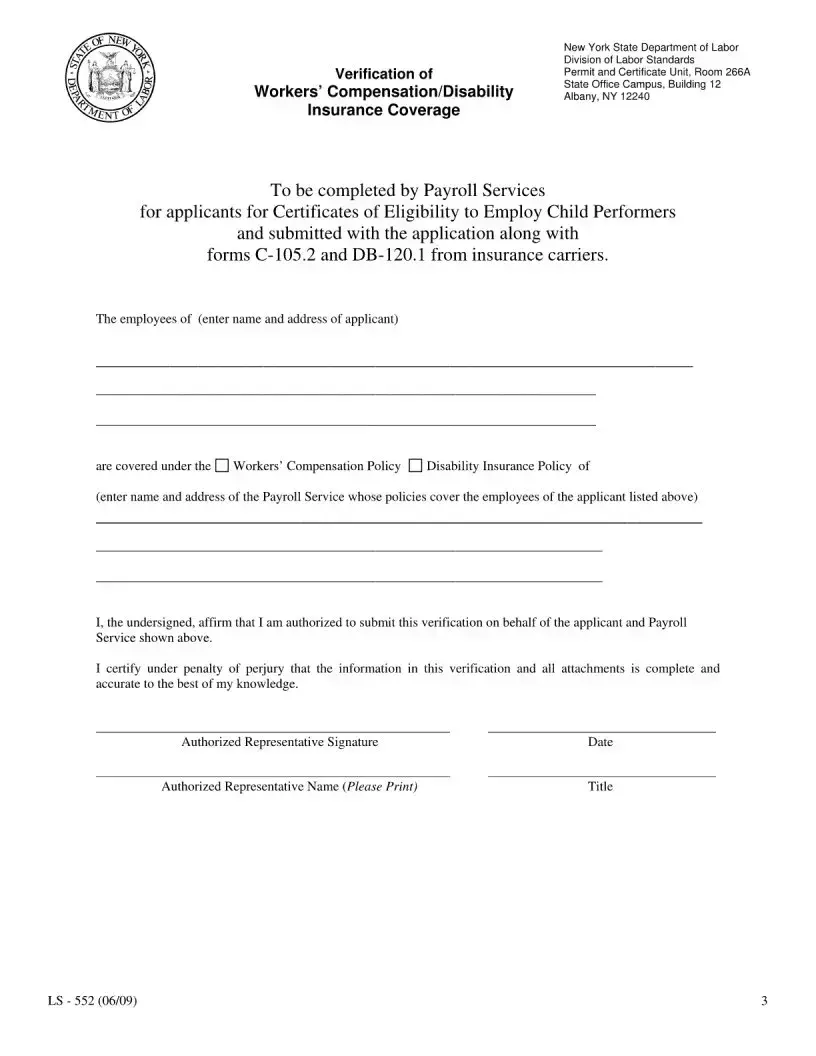
Employers must attach proof of New York State Workers’ Compensation and Disability Insurance. If they currently have employees in New York, they need to provide specific forms from their insurance carrier. Alternatively, if they are exempt from this requirement, they must complete and attach Form CE-200.
How should the LS 552 form be submitted?
Once completed, the LS 552 form and all required documents should be mailed to the New York State Department of Labor, Division of Labor Standards, at the specified address. Employers should also include a check for the appropriate fee made payable to the Commissioner of Labor.
What are the employer's responsibilities when employing child performers?
Employers must manage several responsibilities, including establishing a trust account for the child performer’s earnings, ensuring satisfactory academic performance, and maintaining valid certificates and permits. They are also responsible for providing a certified teacher if the child performer is not receiving adequate instruction due to their work schedule.
How can employers ensure compliance with child performer laws?
To comply with New York State laws, employers should keep copies of all relevant certificates and permits on file, maintain appropriate insurance coverage, and adhere to safety, health, wage, and hour laws. Regularly reviewing these requirements will help ensure compliance.
Where can employers find more information about the LS 552 form?
Employers can find additional information by visiting the New York State Department of Labor's website or by contacting the department directly via phone or email. The website offers resources and guidance on the application process and related regulations.
Incomplete Employer Information: Failing to provide all required details such as the employer's name, type of business, and FEIN can lead to delays or rejection of the application.
Incorrect Fee Selection: Choosing the wrong fee based on the theater capacity or type of request (new or renewal) can result in processing issues.
Missing Proof of Insurance: Not attaching proof of New York State Workers’ Compensation and Disability Insurance is a common oversight that can halt the application process.
Neglecting to Include Required Forms: Failing to attach Form C-105.2 or DB-120.1 when applicable can lead to complications, especially if the employer has existing employees.
Ignoring Trust Account Requirements: Not transferring the required 15% of a child performer’s earnings into a trust account can result in legal consequences.
Overlooking Academic Performance Obligations: Employers must ensure that child performers maintain satisfactory academic performance. Neglecting this duty can lead to violations of state law.
Failing to Renew Certificates: Not renewing the Certificate of Eligibility to Employ Child Performers before it expires can prevent the employer from legally hiring child performers.
Not Keeping Required Documentation: Employers must maintain copies of all relevant certificates and permits on file. Failing to do so can complicate compliance checks.
Incorrect Declaration Signature: The application must be signed by an authorized representative. An incorrect or missing signature can invalidate the application.
The New York Ls 552 form is a crucial document for employers seeking to hire child performers. Alongside this form, several other documents are often required to ensure compliance with state regulations. Each document serves a specific purpose, contributing to the overall framework of legal and ethical employment practices for child performers.
In conclusion, understanding and gathering these documents alongside the New York Ls 552 form is essential for employers. This process not only ensures compliance with legal requirements but also promotes the welfare and rights of child performers in the entertainment industry.
When filling out the New York LS 552 form, it is essential to follow specific guidelines to ensure a smooth application process. Below are six things you should and shouldn't do.
Following these guidelines will help ensure that your application is processed efficiently and without unnecessary delays.
Many believe that the LS 552 form is only necessary for new employers looking to hire child performers. In reality, this form is also required for renewals every three years, regardless of whether the employer is new or established.
Some assume that once a child performer is hired, they possess a valid Employment Permit. However, it is the employer's responsibility to ensure that each child performer has a valid permit before employment begins.
It is a common misunderstanding that the LS 552 form can be submitted without attaching proof of New York State Workers’ Compensation and Disability Insurance. This documentation is mandatory for processing the application.
Some employers believe that setting up a trust account for child performers is optional. In fact, New York State law mandates that 15% of a child performer's gross earnings must be placed into a trust account.
There is a misconception that employers do not need to maintain records of permits and certificates. In truth, employers must keep copies of all relevant documents on file for inspection.
Many think that the application fees are uniform across all types of businesses. However, the LS 552 form has different fee structures depending on the type of business and the capacity of the theater.
Some employers may believe that academic performance requirements for child performers are not strict. In fact, employers must ensure that child performers maintain satisfactory academic performance as defined by their school.
There is a belief that the LS 552 form can be submitted online. Currently, the application must be mailed in with all required documents, as electronic submission is not available.
Some may think they can hire child performers without obtaining the Certificate of Eligibility first. This is incorrect; the certificate must be acquired before any employment can take place.
While some believe the application process is straightforward, it requires careful attention to detail and adherence to various regulations. Employers should prepare for potential delays if documentation is incomplete or incorrect.
Filling out and using the New York LS 552 form involves several important steps and considerations. Here are key takeaways to keep in mind:
By understanding these key points, employers can navigate the application process more effectively and ensure compliance with New York State laws regarding the employment of child performers.