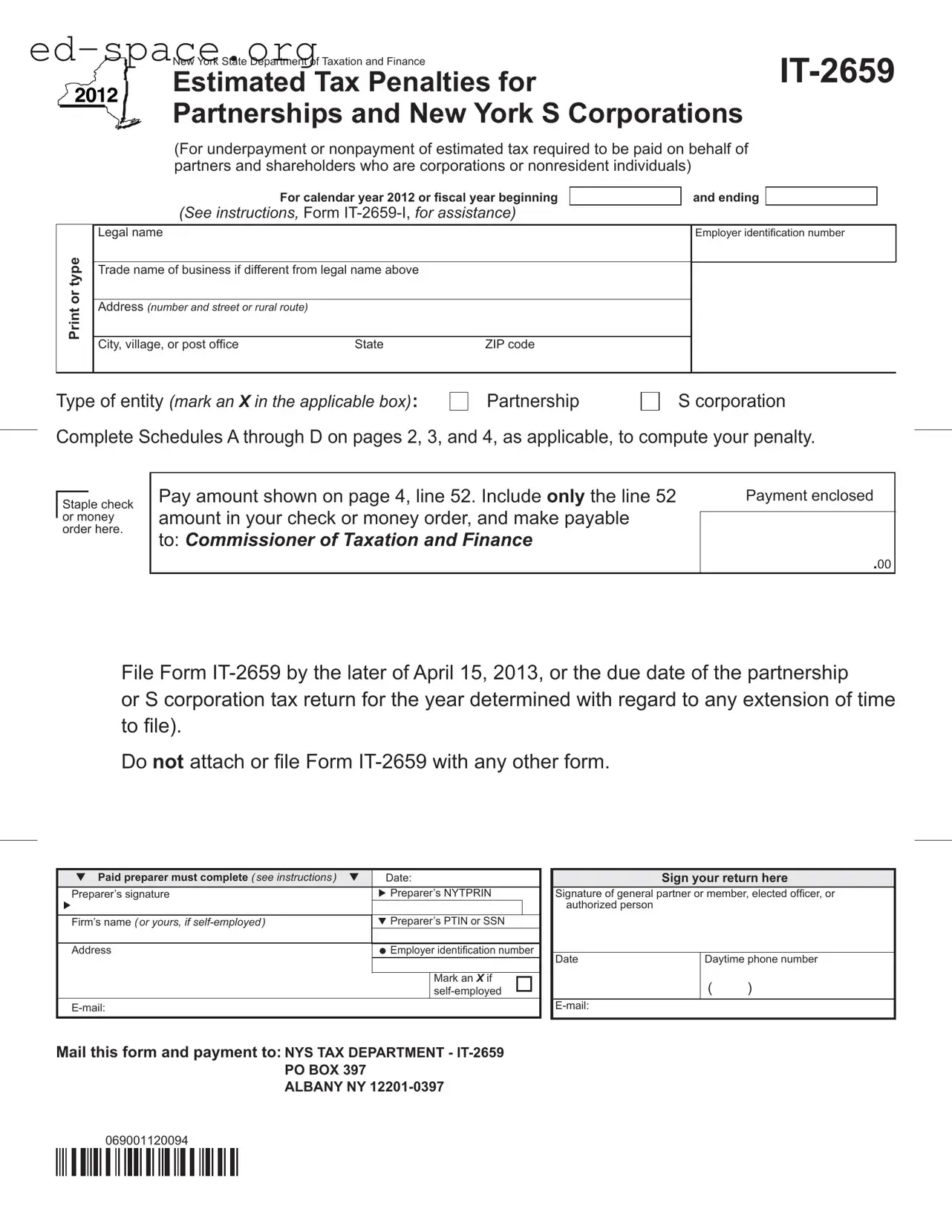
The New York IT-2659 form serves as a crucial document for partnerships and New York S corporations, specifically addressing the estimated tax penalties that may arise from underpayment or nonpayment of taxes owed on behalf of partners and shareholders. This form is primarily utilized by entities that are responsible for making estimated tax payments for their partners or shareholders, particularly those who are nonresident individuals or corporations. It requires filers to provide essential information such as the legal name, trade name, address, and employer identification number of the business. Additionally, the form includes detailed schedules that guide users through the calculation of any penalties incurred due to underpayment of estimated taxes, ensuring that all relevant income and deductions are accurately reported. The IT-2659 must be filed by a specific deadline, typically aligned with the due date of the partnership or S corporation tax return, and it is important to note that this form should not be submitted alongside other tax documents. By adhering to these guidelines, entities can avoid unnecessary penalties and ensure compliance with New York State tax regulations.
New York State Department of Taxation and Finance |
|
||||
Estimated Tax Penalties for |
|
||||
|
|
|
|||
Partnerships and New York S Corporations |
|||||
(For underpayment or nonpayment of estimated tax required to be paid on behalf of |
|||||
partners and shareholders who are corporations or nonresident individuals) |
|
|
|
||
|
|
|
|
|
|
For calendar year 2012 or iscal year beginning |
|
|
and ending |
|
|
(See instructions, Form IT‑2659‑I, for assistance) |
|
|
|
|
|
|
|
|
|
||
Print or type
Legal name
Trade name of business if different from legal name above
Address (number and street or rural route)
City, village, or post ofice |
State |
ZIP code |
Employer identiication number
Type of entity (mark an X in the applicable box):
Partnership
S corporation
Complete Schedules A through D on pages 2, 3, and 4, as applicable, to compute your penalty.
Staple check or money order here.
Pay amount shown on page 4, line 52. Include only the line 52
amount in your check or money order, and make payable to: COMMISSIONER OF TAXATION AND FINANCE
Payment enclosed
.00
File Form IT‑2659 by the later of April 15, 2013, or the due date of the partnership
or S corporation tax return for the year determined with regard to any extension of time to ile).
Do not attach or ile Form IT‑2659 with any other form.
Paid preparer must complete (see instructions) |
Date: |
||
Preparer’s signature |
Preparer’s NYTPRIN |
||
|
|
|
|
|
|
|
|
Firm’s name (or yours, if |
Preparer’s PTIN or SSN |
|
|
|
|
|
|
Address |
Employer identiication number |
||
|
|
|
|
|
|
Mark an X if |
|
|
|
self‑employed |
|
E‑mail: |
|
|
|
Mail this form and payment to: NYS TAX DEPARTMENT -
ALBANY NY
Sign your return here
Signature of general partner or member, elected oficer, or authorized person
Date |
Daytime phone number |
( )
E‑mail:
069001120094
Page 2 of 4
Schedule A – Computation of estimated tax underpayment (if any). All ilers must complete this part. Only include partners and shareholders who are subject to estimated tax paid on their behalf by the partnership or New York S corporation (see instructions).
Current year
1Total of all nonresident individual partners’ or shareholders’ distributive
|
or pro rata shares of 2012 income earned from New York sources.... |
1 |
|
.00 |
|
|
2 |
Total of all nonresident individual partners’ or shareholders’ shares of |
|
|
|
|
|
|
2012 partnership deductions allocated to New York (see instructions) |
2 |
|
.00 |
|
|
3 |
Subtract line 2 from line 1 |
3 |
|
.00 |
|
|
4 |
Individual tax rate (8.82%) |
4 |
|
.0882 |
|
|
5 |
Multiply line 3 by line 4 |
5 |
|
.00 |
|
|
6 |
Total of all nonresident individual partners’ or shareholders’ distributive |
|
|
|
|
|
|
or pro rata shares of 2012 partnership or S corporation credits |
6 |
|
.00 |
|
|
7 |
2012 estimated tax required to be paid on behalf of nonresident individuals (subtract line 6 from line 5) |
............. 7 |
||||
8 |
Total of all corporate partners’ distributive shares of 2012 income earned from NY sources |
8 |
|
.00 |
|
|
9 |
Corporation tax rate (7.1%) |
9 |
|
.071 |
|
|
10 |
Multiply line 8 by line 9 |
10 |
|
.00 |
|
|
11 |
Total of all corporate partners’ distributive shares of 2012 partnership credits |
11 |
|
.00 |
|
|
12 |
2012 estimated tax required to be paid on behalf of corporations (subtract line 11 from line 10) |
|
12 |
|||
13 |
Total estimated tax required to be paid for 2012 (add lines 7 and 12) |
|
|
13 |
||
14 |
90% of the estimated tax required to be paid for 2012 (multiply line 13 by 90% (.90)) |
14 |
||||
.00
.00
.00
.00
Prior year
15Total of all nonresident individual partners’ or shareholders’ distributive
|
or pro rata shares of 2011 income earned from New York sources .... |
|
15 |
|
.00 |
|
|
16 |
Total of all nonresident individual partners’ or shareholders’ shares of |
|
|
|
|
|
|
|
2011 partnership deductions allocated to New York (see instructions).. |
|
16 |
|
.00 |
|
|
17 |
Subtract line 16 from line 15 |
|
17 |
|
.00 |
|
|
18 |
Individual tax rate (8.97%) |
|
18 |
|
.0897 |
|
|
19 |
Multiply line 17 by line 18 |
|
19 |
|
.00 |
|
|
20 |
Total of all nonresident individual partners’ or shareholders’ distributive |
|
|
|
|
|
|
|
or pro rata shares of 2011 partnership or S corporation credits |
20 |
|
.00 |
|
|
|
21 |
2011 estimated tax computed for individuals (subtract line 20 from line 19) |
.......................................................... |
|
21 |
|||
22 |
Total of all corporate partners’ distributive shares of 2011 income earned from NY sources |
|
22 |
|
.00 |
|
|
23 |
Corporation tax rate (7.1%) |
|
23 |
|
.071 |
|
|
24 |
Multiply line 22 by line 23 |
|
24 |
|
.00 |
|
|
25 |
Total of all corporate partners’ distributive shares of 2011 partnership credits |
|
25 |
|
.00 |
|
|
26 |
2011 estimated tax computed for corporations (subtract line 25 from line 24) |
|
26 |
||||
27 |
Total estimated tax computed for 2011 (add lines 21 and 26) |
|
27 |
||||
|
If the sum of lines 17 and 22 is more than $150,000, and the entity is not primarily |
|
|
|
|||
|
engaged in farming or ishing, complete line 28 and continue with Schedule B. If the |
|
|
|
|||
|
sum of lines 17 and 22 is $150,000 or less, skip line 28 and continue with Schedule B. |
|
|
|
|||
28 |
Multiply line 27 by 110% (1.10) |
|
28 |
||||
.00
.00
.00
.00
Schedule B – Short method for computing the penalty. Complete lines 29 through 34 if you paid four equal estimated tax installments (on the due dates), or if you made no payments of estimated tax. Otherwise, you must complete Schedule C.
29If you were not required to make an entry on line 28, enter the lesser of lines 14 or 27.
|
If you were required to make an entry on line 28, enter the lesser of lines 14 or 28 |
29 |
.00 |
30 |
Enter the total amount of estimated tax payments made for 2012 |
30 |
.00 |
31 |
Total underpayment for the year (subtract line 30 from line 29; if zero or less you do not owe the penalty) |
31 |
.00 |
32 |
Multiply line 31 by .04976 and enter the result |
32 |
.00 |
33 |
If the amount on line 31 was paid on or after April 15, 2013, enter 0. If the amount on line 31 was paid |
|
|
|
before April 15, 2013, make the following computation to ind the amount to enter on this line: |
|
|
|
Amount on line 31 × number of days before April 15, 2013 × .00020 = |
33 |
.00 |
34 |
Penalty (subtract line 33 from line 32; enter here and on line 51) |
34 |
.00 |
(continued)
069002120094
|
|
|
|
|
|
|
|
Page 3 of 4 |
|||
|
|
|
|
|
|
|
|
|
|
|
|
Schedule C – Regular method |
|
|
|
|
|
|
|
|
|
|
|
Part 1 – Computing the underpayment |
|
|
|
|
|
|
|
|
|
|
|
|
Payment due dates |
|
A |
4/15/12 |
B |
6/15/12 |
C |
9/15/12 |
|
D |
1/15/13 |
35 |
Required installments (see instructions) |
35 |
|
.00 |
|
.00 |
|
|
.00 |
|
.00 |
36 |
Estimated tax paid |
36 |
|
.00 |
|
.00 |
|
|
.00 |
|
.00 |
Complete lines 37 through 39, one column |
|
|
|
|
|
|
|
|
|
|
|
at a time, starting in column A. |
|
|
|
|
|
|
|
|
|
|
|
37 |
Overpayment or underpayment from prior period .... |
37 |
|
|
|
.00 |
|
|
.00 |
|
.00 |
38 |
If line 37 is an overpayment, add lines 36 |
|
|
|
|
|
|
|
|
|
|
|
and 37; if line 37 is an underpayment, |
|
|
|
|
|
|
|
|
|
|
|
subtract line 37 from line 36 (see instructions) |
38 |
|
.00 |
|
.00 |
|
|
.00 |
|
.00 |
39 |
Underpayment (subtract line 38 from line 35) |
|
|
|
|
|
|
|
|
|
|
|
or overpayment (subtract line 35 from |
|
|
|
|
|
|
|
|
|
|
|
line 38; see instructions) |
39 |
|
.00 |
|
.00 |
|
|
.00 |
|
.00 |
Part 2 – Computing the penalty |
|
|
|
|
|
|
|
|
|
|
|
|
Payment due dates |
|
A |
4/15/12 |
B |
6/15/12 |
C |
9/15/12 |
|
D |
1/15/13 |
|
40 Amount of underpayment (from line 39) |
40 |
|
.00 |
|
.00 |
|
|
.00 |
|
.00 |
First installment (April 15 - June 15, 2012) |
|
|
|
|
|
|
|
|
|
|
|
41April 15 ‑ June 15 =
(61 ÷ 366) × 7.5% = .01249
|
|
|
- or - |
|
||||
April 15 ‑ |
|
|
= |
|
|
|
|
|
|
|
|
|
|
|
|
|
|
( |
|
|
÷ 366) × 7.5% = |
. |
|
|
|
|
|
|
41 |
|
|||||
42 Multiply line 40, column A, by line 41 ............ 42 |
.00 |
|||||||
Second installment (June 15 - September 15, 2012)
43June 15 ‑ September 15 = (92 ÷ 366) × 7.5% = .01884
-or -
June 15 ‑ |
|
= ( |
|
÷ 366) × 7.5% = |
. |
|
43 |
|
|
|
|||||||
|
|
|
|
|
|
|
|
|
44 Multiply line 40, column B, by line 43 |
44 |
.00 |
||||||
Third installment (September 15, 2012 - January 15, 2013)
45September 15 ‑ December 31 = (107 ÷ 366) × 7.5% = .02192
January 1 ‑ January 15 |
= (15 ÷ 365) × 7.5% = .00307 |
|
|
|
|||||
|
|
|
|
|
.02499 |
Total |
|
|
|
|
|
- or - |
|
|
|
|
|
||
|
|
|
|
|
|
|
|
||
September 15 ‑ |
|
|
= ( |
|
÷ 366) × 7.5% = |
. |
|
|
|
|
|
|
|
|
|
|
|
||
January 1 ‑ |
= ( |
|
÷ 365) × 7.5% = |
. |
|
|
|
||
|
|
|
|
|
|
|
Total |
45 |
|
|
|
|
|
|
|
|
|
||
|
|
|
|
|
|
|
|
||
46 Multiply line 40, column C, by line 45 |
|
|
|
|
|
||||
|
|
46 |
.00 |
||||||
Fourth installment (January 15 - April 15, 2013)
47January 15 ‑ April 15 = (90 ÷ 365) × 7.5% = .01848
-or -
|
January 15 ‑ |
|
= ( |
|
÷ 365) × 7.5% = |
. |
|
|
|
|
|
|
|
|
47 |
|
|||
48 |
Multiply line 40, column D, by line 47 |
............................................................................................................................ 48 |
.00 |
||||||
49 |
Penalty (add lines 42, 44, 46, and 48) |
49 |
.00 |
||||||
(continued)
069003120094
Page 4 of 4
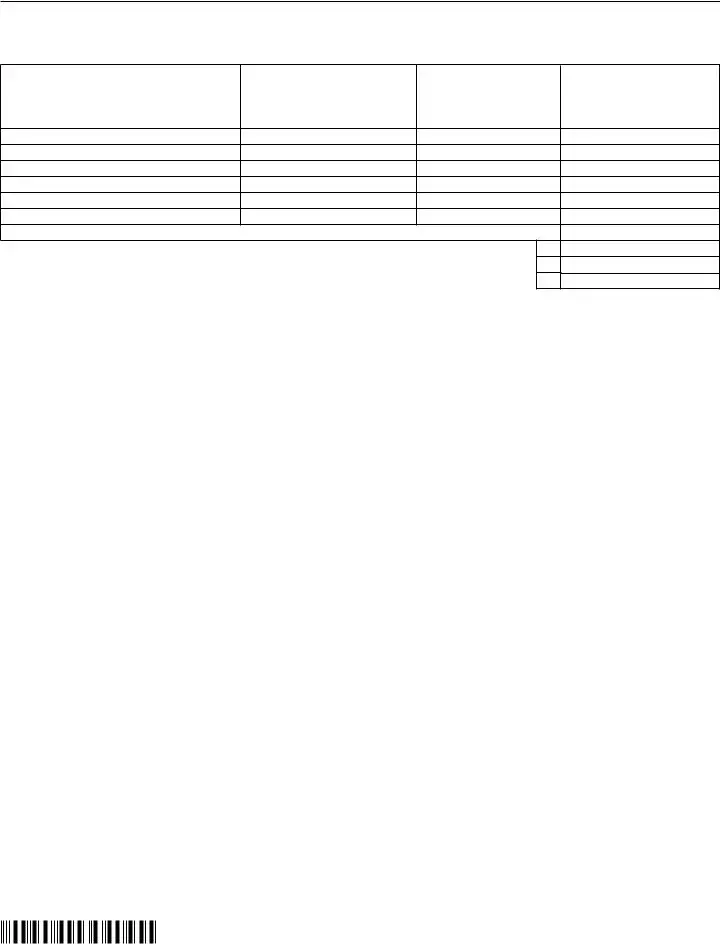
Schedule D – Failure to pay estimated tax on behalf of partners or shareholders who are corporations or nonresident individuals. Only include partners and shareholders who are subject to estimated tax paid on their behalf by the partnership or New York S corporation (see instructions). If you are listing more than six partners or shareholders, attach additional sheet(s) using the same four‑column format as in the chart below. Include all column D totals from additional sheets on the line provided.
A
Name of
partner/shareholder
B
Identifying number
(EIN/SSN)
C
Number of quarters (1‑4)
during the year estimated tax
was not paid
D
Column C × $50
Column D total from attached sheet(s) (if any) |
||
50 |
Penalty (total of column D) |
50 |
51 |
Penalty (from line 34) |
51 |
52 |
Total penalty (add lines 49, 50, and 51, as applicable; enter here and in Payment enclosed box on the front page) |
52 |
.00
.00
.00
069004120094
| Fact Name | Fact Description |
|---|---|
| Form Purpose | The IT-2659 form is used for reporting estimated tax penalties for partnerships and New York S corporations. |
| Governing Laws | This form is governed by New York State Tax Law, specifically concerning the taxation of partnerships and S corporations. |
| Filing Deadline | Form IT-2659 must be filed by April 15, 2013, or the due date of the partnership or S corporation tax return. |
| Payment Instructions | Payments should be made payable to the "Commissioner of Taxation and Finance" and included with the form submission. |
| Estimated Tax Calculation | Tax penalties are calculated based on underpayments of estimated tax for both individual and corporate partners. |
| Nonresident Individuals | The form includes provisions for nonresident individual partners and shareholders subject to estimated tax payments. |
| Schedules Requirement | Filers must complete Schedules A through D to compute the penalty accurately. |
Filling out the New York IT-2659 form requires careful attention to detail. This form is used to report any estimated tax penalties for partnerships and New York S corporations. Completing it accurately is essential for ensuring compliance with state tax regulations. Follow the steps below to fill out the form correctly.
What is the purpose of the New York IT-2659 form?
The New York IT-2659 form is used to calculate estimated tax penalties for partnerships and New York S corporations. It specifically addresses underpayment or nonpayment of estimated tax required to be paid on behalf of partners and shareholders who are either corporations or nonresident individuals.
Who needs to file the IT-2659 form?
Partnerships and New York S corporations that have nonresident individual partners or shareholders must file the IT-2659 form if they are required to pay estimated taxes on behalf of those individuals. This includes any entity that has partners or shareholders subject to estimated tax obligations.
When is the IT-2659 form due?
The IT-2659 form must be filed by the later of April 15 of the following year or the due date of the partnership or S corporation tax return. If an extension has been granted for filing the tax return, the due date for the IT-2659 form is also extended accordingly.
What information is required on the IT-2659 form?
The form requires the legal name and trade name of the business, address, employer identification number, and type of entity. Additionally, it includes schedules for computing the estimated tax underpayment and any penalties that may apply.
How is the penalty for underpayment calculated?
The penalty is calculated based on the amount of underpayment of estimated tax. The form includes specific lines for entering the total estimated tax required, payments made, and the resulting underpayment. The penalty is then computed using a set percentage based on the underpayment amount.
What are the payment options for the IT-2659 form?
Payments can be made via check or money order, which should be stapled to the form. The payment must be made payable to the "Commissioner of Taxation and Finance." It is crucial to include only the amount shown on line 52 of the form in the payment.
Can the IT-2659 form be filed electronically?
The IT-2659 form must be mailed to the New York State Tax Department. As of the latest guidelines, electronic filing is not available for this specific form, so physical submission is required.
What should be done if there are more than six partners or shareholders?
If the partnership or S corporation has more than six partners or shareholders, additional sheets must be attached using the same format as provided in the form. All totals from these additional sheets should be included in the appropriate lines on the IT-2659 form.
What happens if the form is filed late?
Filing the IT-2659 form late may result in additional penalties. The penalties for late filing are calculated based on the amount of underpayment and the duration of the delay. It is advisable to file the form as soon as possible to minimize penalties.
Where should the IT-2659 form be mailed?
The completed IT-2659 form and payment should be mailed to the following address: NYS TAX DEPARTMENT - IT-2659, PO BOX 397, ALBANY NY 12201-0397. It is important to ensure that the form is sent to the correct address to avoid processing delays.
Incorrect Entity Type Selection: One common mistake is failing to accurately mark the correct entity type. Ensure that you select either "Partnership" or "S Corporation" by marking an X in the appropriate box. This choice affects your tax obligations.
Omitting Required Schedules: Many filers neglect to complete the necessary Schedules A through D. Each schedule is crucial for calculating penalties and must be filled out as applicable.
Missing Signature: Another frequent error is forgetting to sign the form. The signature of a general partner, member, or authorized person is required. Without it, the form may be deemed incomplete.
Incorrect Payment Amount: Some individuals mistakenly include an incorrect payment amount. Only the amount shown on page 4, line 52 should be included in your check or money order.
Filing Deadline Ignorance: Ignoring the filing deadline can lead to penalties. Remember, Form IT-2659 must be filed by the later of April 15 or the due date of your tax return.
Failure to Attach Payment: Lastly, failing to staple your payment to the form can result in delays. Always ensure your check or money order is securely attached to the front of the form.
The New York IT-2659 form is essential for partnerships and S corporations to report estimated tax penalties. Various other documents often accompany this form to ensure compliance with tax regulations and to facilitate accurate reporting. Below is a list of related forms and documents that may be required.
Each of these forms plays a critical role in ensuring compliance with New York tax laws. It is essential for partnerships and S corporations to be aware of these documents to avoid penalties and ensure accurate reporting of their tax obligations.
The New York IT-2659 form is designed for partnerships and S corporations to report estimated tax penalties. Several other documents serve similar purposes in various contexts. Below is a list of five documents that share similarities with the IT-2659 form:
When filling out the New York IT-2659 form, it is essential to follow specific guidelines to ensure accuracy and compliance. Here are seven things you should and shouldn't do:
Understanding the New York IT-2659 form is crucial for partnerships and S corporations to avoid penalties. However, several misconceptions can lead to confusion and potential financial repercussions. Here are four common misconceptions:
This form applies to both partnerships and S corporations. Both types of entities must report estimated tax penalties for their partners and shareholders who are subject to estimated tax. Ignoring this can result in unnecessary penalties.
Even if there are no penalties, filing the IT-2659 form is still required. This form serves to report the estimated tax payments made on behalf of partners and shareholders, ensuring compliance with state tax laws.
The due date for the IT-2659 form is the later of April 15 or the due date of the partnership or S corporation tax return. This can vary based on the entity's tax situation and any extensions filed.
Not all partners and shareholders are exempt. Only those who do not meet certain income thresholds or specific criteria are exempt from estimated tax payments. It is essential to review each partner's or shareholder's situation to determine their tax obligations accurately.
When dealing with the New York IT-2659 form, understanding its purpose and how to fill it out correctly is crucial for partnerships and S corporations. Here are some key takeaways to keep in mind:
By keeping these points in mind, you can navigate the IT-2659 form with greater confidence and ensure compliance with New York tax regulations.