Homepage Blank New York Et 133 PDF Form
Article Guide

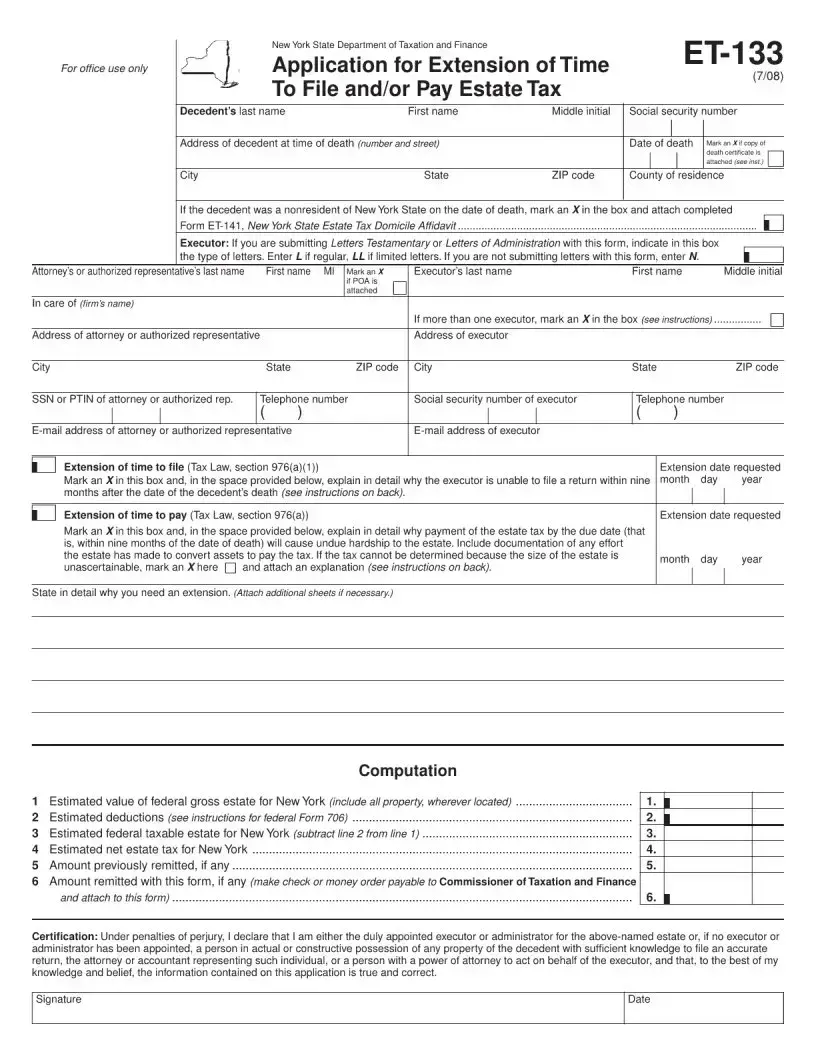
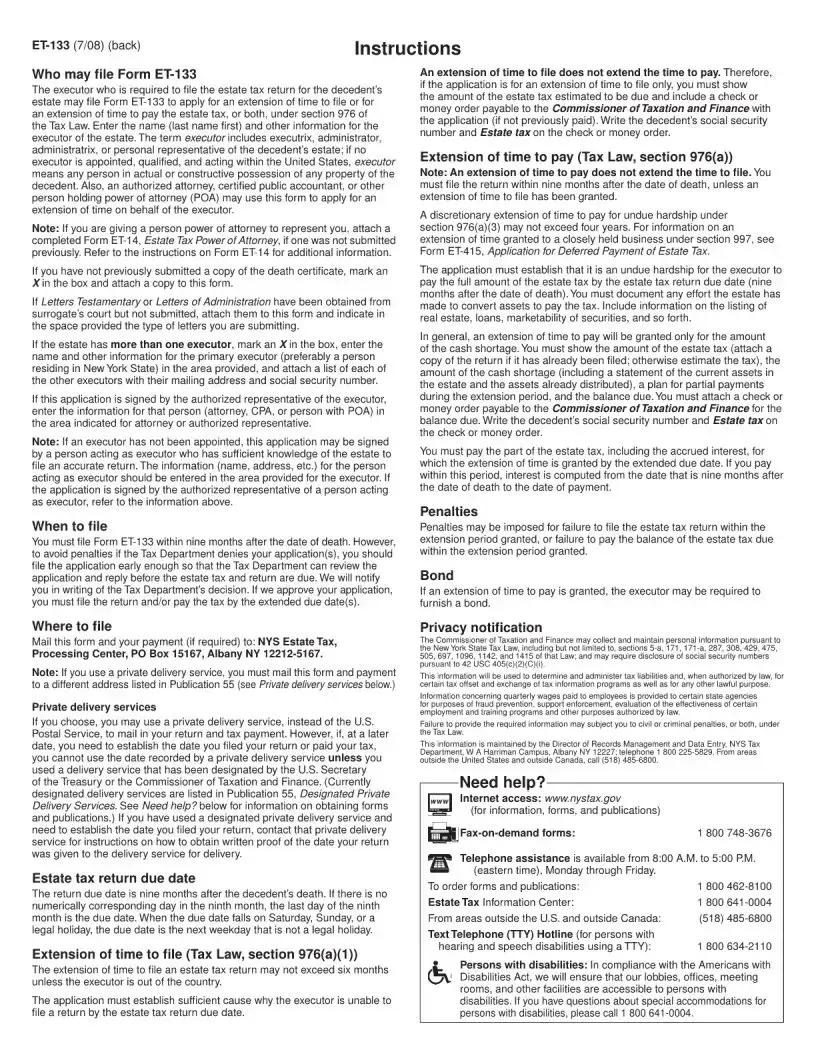
The New York ET-133 form is a crucial document for those managing the estate of a deceased individual in New York State. Executors, administrators, or authorized representatives can use this form to request an extension of time to file the estate tax return or to pay the estate tax. It is essential to submit this application within nine months of the decedent's death to avoid penalties. The form requires detailed information about the decedent, including their name, Social Security number, and address at the time of death. Additionally, it asks for information regarding the executor or authorized representative, including contact details and the nature of their authority. If the estate is facing challenges that hinder timely filing or payment, the form allows for explanations to be provided. This includes documenting any efforts made to liquidate assets for tax payment. Overall, the ET-133 form serves as a formal request for additional time, ensuring that executors can meet their obligations without undue hardship while complying with New York tax laws.
Document Preview

Form Specifications

Fact Name Description
Form Purpose The ET-133 form is used to apply for an extension of time to file and/or pay estate tax in New York State.
Governing Law This form is governed by New York Tax Law, section 976.
Filing Deadline Form ET-133 must be filed within nine months after the date of the decedent's death to avoid penalties.
Executor Definition The term "executor" refers to the individual responsible for managing the decedent's estate, including executrix, administrator, or personal representative.
Power of Attorney An authorized attorney or representative can file the form on behalf of the executor if they hold a power of attorney.
Documentation Requirement If applicable, a copy of the death certificate must be attached to the ET-133 form when it is submitted.
Extension Explanation The form requires a detailed explanation of why the executor cannot file or pay the estate tax by the due date.

New York Et 133: Usage Guidelines

Completing the New York ET-133 form requires careful attention to detail. This application is essential for those seeking an extension of time to file or pay estate tax. Following the steps outlined below will help ensure that the form is filled out correctly and submitted on time.

  1. Begin by entering the decedent’s last name, first name, and middle initial in the designated fields.
  2. Provide the decedent's social security number.
  3. Fill in the address of the decedent at the time of death, including the number and street, city, state, and ZIP code.
  4. Indicate the county of residence.
  5. If the decedent was a nonresident of New York State at the time of death, mark the appropriate box and attach Form ET-141.
  6. In the section for the executor, indicate the type of letters being submitted (regular, limited, or none) by marking the corresponding box.
  7. Enter the attorney's or authorized representative's last name, first name, and middle initial, along with their firm’s name if applicable.
  8. Complete the address of the attorney or authorized representative, including city, state, and ZIP code.
  9. Mark the box if a power of attorney (POA) is attached.
  10. Fill in the executor's last name, first name, and middle initial.
  11. Provide the address of the executor, including city, state, and ZIP code.
  12. Enter the social security number or PTIN of the attorney or authorized representative.
  13. Include the telephone number and email address of the attorney or authorized representative.
  14. Enter the social security number and email address of the executor.
  15. Mark the box for an extension of time to file, if applicable, and explain why the executor is unable to file within the nine-month period.
  16. Mark the box for an extension of time to pay, if needed, and explain why payment by the due date will cause undue hardship.
  17. If applicable, mark the box indicating that the size of the estate is unascertainable and attach an explanation.
  18. Specify the extension date requested by filling in the month, day, and year.
  19. State in detail why an extension is needed. Attach additional sheets if necessary.
  20. Sign and date the application, certifying that the information provided is true and correct.

Once the form is completed, it must be mailed to the NYS Estate Tax Processing Center. Ensure that all necessary attachments, such as the death certificate and letters testamentary, are included. By following these steps, the executor can effectively submit the application for an extension.

Your Questions, Answered

What is the New York ET-133 form?

The New York ET-133 form is an application for an extension of time to file and/or pay estate tax. Executors of an estate can use this form to request more time if they are unable to meet the original deadlines set by the state. It is important for the executor to provide details about why the extension is needed.

Who can file the ET-133 form?

The ET-133 form can be filed by the executor of the estate. This includes executors, executrices, administrators, or personal representatives. If no executor has been appointed, any person in possession of the decedent’s property can file. An attorney or accountant with power of attorney can also file on behalf of the executor.

When should the ET-133 form be filed?

The ET-133 form must be filed within nine months after the date of the decedent's death. It is advisable to submit the form early to avoid penalties, as the Tax Department needs time to review the application and respond before the estate tax is due.

What information is required on the ET-133 form?

When completing the ET-133 form, you will need to provide the decedent's name, social security number, and address at the time of death. You must also include details about the executor, such as their name and contact information. If you are requesting an extension, you need to explain why you cannot file or pay on time.

Where should the ET-133 form be sent?

You should mail the completed ET-133 form to the NYS Estate Tax Processing Center at PO Box 15167, Albany NY 12212-5167. If you are using a private delivery service, you will need to check Publication 55 for the correct address to use.

What happens after I submit the ET-133 form?

Once you submit the ET-133 form, the Tax Department will review your application and notify you in writing of their decision. If your application is approved, you will receive an extended deadline for filing the estate tax return and/or making the payment.

Common mistakes

  1. Incomplete Personal Information: Many individuals fail to provide all required details about the decedent, such as the full name, social security number, or address at the time of death. Missing any of this information can delay the processing of the application.

  2. Neglecting to Attach Necessary Documents: A common mistake is not attaching the death certificate or other essential documents like Letters Testamentary. These documents are crucial for verifying the application and should always be included when submitting the form.

  3. Insufficient Explanation for Extensions: When requesting an extension, applicants often provide vague or incomplete explanations. It is important to clearly outline the reasons for needing more time to file or pay estate taxes, along with any supporting documentation.

  4. Incorrect Filing Method: Some people mistakenly use a private delivery service without ensuring it is designated by the U.S. Secretary of the Treasury. This can lead to complications in establishing the filing date, which is important for meeting deadlines.

Documents used along the form

The New York ET-133 form is a crucial document for executors seeking an extension of time to file or pay estate tax. However, it is often accompanied by several other important forms and documents that help facilitate the estate tax process. Below is a list of these documents, along with a brief description of each.

  • Form ET-141, New York State Estate Tax Domicile Affidavit: This form is required if the decedent was a nonresident of New York at the time of death. It helps establish the decedent's domicile for tax purposes, which can significantly impact estate tax obligations.
  • Form ET-14, Estate Tax Power of Attorney: This document grants authority to an individual, such as an attorney or accountant, to act on behalf of the executor. It is essential if the executor wishes to have someone else handle the estate tax filing and payment process.
  • Letters Testamentary: These legal documents are issued by a surrogate's court and authorize the executor to manage the decedent's estate. They are necessary for the executor to prove their authority when dealing with financial institutions and other entities.
  • Letters of Administration: Similar to Letters Testamentary, these documents are granted when the decedent did not leave a will. They appoint an administrator to manage the estate, ensuring that the estate is settled according to state laws.
  • Death Certificate: A certified copy of the death certificate is often required to establish the date of death and validate the estate tax filing. This document is essential for both the ET-133 form and the estate tax return.
  • Form IT-2658, New York State Estate Tax Return: This is the primary form used to report the estate's value and calculate the estate tax owed. It is typically due within nine months of the decedent's death, unless an extension is granted.
  • Form ET-706, New York State Estate Tax Return: This form is used for larger estates that exceed a certain threshold. It provides a detailed account of the estate's assets and liabilities, which is critical for determining the estate tax liability.
  • Financial Statements: Executors may need to provide financial statements or documentation of the estate's assets and debts. This information is vital for accurately assessing the estate's value and ensuring compliance with tax obligations.

Understanding the various forms and documents that accompany the New York ET-133 form is essential for executors navigating the estate tax process. Each document plays a unique role in ensuring compliance with state tax laws and facilitating the efficient management of the decedent's estate.

Similar forms

  • Form ET-141, New York State Estate Tax Domicile Affidavit: Similar to the ET-133, this form is used to establish the domicile of the decedent for estate tax purposes. It is necessary when the decedent was a nonresident of New York State.
  • Form ET-14, Estate Tax Power of Attorney: This document allows an individual to appoint someone else to act on their behalf regarding estate tax matters. It is often submitted alongside the ET-133 to authorize representation.
  • Form ET-706, New York State Estate Tax Return: This form is the primary document for reporting estate taxes. The ET-133 can be filed to request an extension for submitting this return.
  • Form IT-201, New York State Resident Income Tax Return: Although primarily for income tax, this form can be related to estate matters when income is generated from the estate before it is settled.
  • Form 706, United States Estate (and Generation-Skipping Transfer) Tax Return: This federal form is similar in purpose to the ET-706, reporting estate taxes at the federal level. Extensions can be requested using the ET-133.
  • Form 2848, Power of Attorney and Declaration of Representative: This form allows individuals to appoint a representative to act on their behalf for tax matters, similar to the ET-14.
  • Form 1041, U.S. Income Tax Return for Estates and Trusts: This form is used to report income generated by the estate. Extensions for filing can be requested through the ET-133.
  • Form 1099, Miscellaneous Income: This document reports income earned by the estate. While not directly similar, it is relevant in the context of estate tax filings and may require extensions for accurate reporting.

Dos and Don'ts

When filling out the New York ET-133 form, it is crucial to follow certain guidelines to ensure your application is processed smoothly. Here are four important things to do and avoid:

  • Do attach the death certificate. If you have not previously submitted a copy, mark the box indicating it is attached.
  • Do provide detailed explanations. When requesting an extension, clearly explain why you need more time to file or pay the estate tax.
  • Do include all necessary signatures. Ensure that the application is signed by the executor or an authorized representative.
  • Do file within the nine-month deadline. Submit the form as soon as possible to avoid penalties.
  • Don’t forget to indicate the type of letters. If you are submitting Letters Testamentary or Letters of Administration, make sure to specify which type you are providing.
  • Don’t leave out essential information. Failing to fill in required fields, such as the decedent’s social security number, can delay processing.
  • Don’t use an incorrect mailing address. Ensure you send the form to the NYS Estate Tax Processing Center to avoid misdelivery.
  • Don’t assume your application will be automatically approved. Be prepared to provide additional documentation if requested by the Tax Department.

By adhering to these guidelines, you can help ensure a more efficient process when submitting your ET-133 form.

Misconceptions

Many people have misconceptions about the New York ET-133 form. Understanding these can help clarify the process and ensure compliance. Here are seven common misconceptions:

  • Only executors can file the ET-133 form. While the executor is typically responsible, authorized representatives such as attorneys or accountants can also submit the form on behalf of the executor.
  • The ET-133 form is only for requesting an extension to file. In fact, it can also be used to request an extension for paying the estate tax, or for both filing and payment.
  • A death certificate is not necessary for filing. This is incorrect. If you have not submitted a death certificate previously, you must attach a copy when filing the ET-133.
  • The form must be filed within nine months after the decedent's death. While it is true that the form must be filed within this timeframe, it is advisable to submit it earlier to allow the Tax Department to review it before the due date.
  • All executors must be residents of New York State. This is a misconception. If the decedent was a nonresident, the form can still be filed by someone in possession of the decedent's property, regardless of their location.
  • Filing the ET-133 guarantees an extension. This is misleading. The Tax Department will review your application and notify you of their decision. Approval is not guaranteed.
  • Using a private delivery service is not allowed. In reality, you can use a private delivery service to send the form, but you must ensure it is one designated by the U.S. Secretary of the Treasury for your submission to be considered timely.

By addressing these misconceptions, individuals can better navigate the complexities of the ET-133 form and fulfill their responsibilities effectively.

Key takeaways

Filling out and using the New York ET-133 form requires careful attention to detail. Here are some key takeaways to consider:

  • Ensure you file the ET-133 within nine months of the decedent's death to avoid penalties.
  • If applicable, attach a copy of the death certificate and any Letters Testamentary or Administration.
  • Clearly explain the reasons for requesting an extension, whether for filing or payment, in the designated sections.
  • Use a designated private delivery service if mailing the form, as this can affect the proof of filing date.