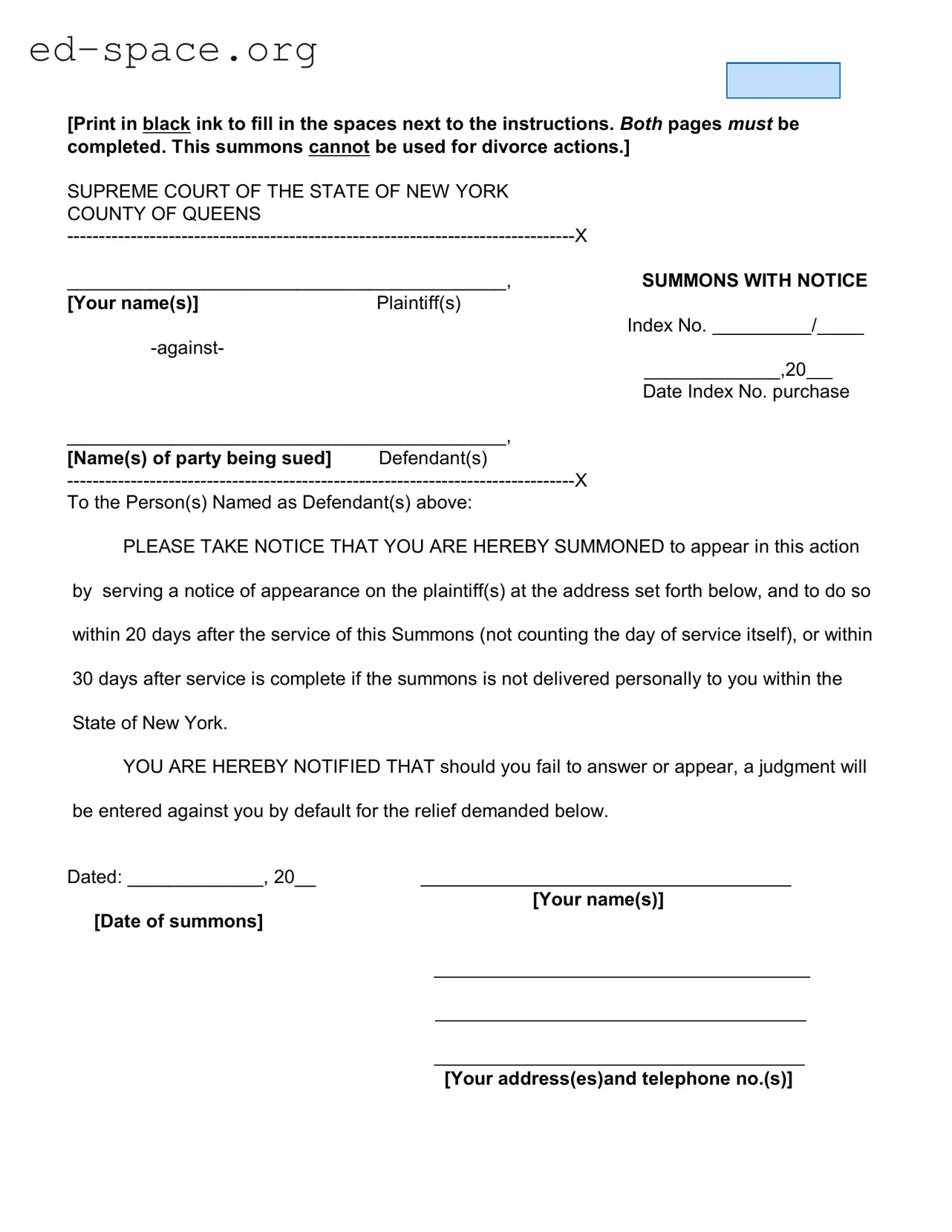
When navigating the complexities of the legal system, understanding the New York Court Summons form is crucial for both plaintiffs and defendants. This form serves as the official notice to a defendant that they are being sued and outlines the essential steps they must take in response. It is important to note that this summons cannot be used for divorce actions, ensuring that it is reserved for other civil matters. The summons requires the plaintiff to fill in their name and address, as well as the name and address of the defendant. The form specifies that defendants have 20 days to respond if served personally within New York, or 30 days if served in another manner. Failure to respond can lead to a default judgment, meaning the court may rule in favor of the plaintiff without hearing the defendant's side. Additionally, the summons must include a brief description of the nature of the case and the relief sought, which might involve monetary damages or other remedies. Lastly, it designates Queens County as the venue for trial, based on specific criteria like the residence of the parties involved. Understanding these components can empower individuals to effectively engage with the legal process.

[Print in black ink to fill in the spaces next to the instructions. Both pages must be completed. This summons cannot be used for divorce actions.]
SUPREME COURT OF THE STATE OF NEW YORK
COUNTY OF QUEENS
X |
|
|
|
|
||
__________________________________________, |
SUMMONS WITH NOTICE |
|||||
[Your name(s)] |
Plaintiff(s) |
Index No. |
/ |
|
|
|
|
|
|
||||
|
|
|
|
|
|
|
_____________,20
Date Index No. purchase
__________________________________________,
[Name(s) of party being sued] Defendant(s)
To the Person(s) Named as Defendant(s) above:
PLEASE TAKE NOTICE THAT YOU ARE HEREBY SUMMONED to appear in this action
by serving a notice of appearance on the plaintiff(s) at the address set forth below, and to do so within 20 days after the service of this Summons (not counting the day of service itself), or within 30 days after service is complete if the summons is not delivered personally to you within the State of New York.
YOU ARE HEREBY NOTIFIED THAT should you fail to answer or appear, a judgment will be entered against you by default for the relief demanded below.
Dated: _____________, 20__
[Your name(s)]
[Date of summons]
[Your address(es)and telephone no.(s)]

Defendant(s) ____________________________________________________________
[Address(es) of party being sued]
Notice: The nature of this action is [briefly describe the nature of your case against the defendant(s), such as, breach of contract, negligence]:
The relief sought is [briefly describe the kind of relief you are asking for, such as, money damages of $25,000]
Should defendant(s) fail to appear herein, judgment will be entered by default for the sum of [amount of money demanded], with interest form the date of [date from which interest on the amount demanded is
claimed] and the costs of this action.
Venue:
Plaintiff(s) designate Queens County as the place of trial. The basis of this designation is [check box that applies]:
Plaintiff(s) residence in Queens County
Defendant(s) residence in Queens County
Other [See CPLR Article 5]:
| Fact Name | Details |
|---|---|
| Form Purpose | This summons is used to initiate a civil lawsuit in New York, excluding divorce actions. |
| Governing Law | The form is governed by the New York Civil Practice Law and Rules (CPLR). |
| Completion Requirement | Both pages of the summons must be completed in black ink. |
| Response Time | Defendants have 20 days to respond after service, or 30 days if not personally served. |
| Default Judgment | If the defendant fails to appear, a default judgment may be entered against them. |
| Index Number | An Index Number is required for tracking the case within the court system. |
| Nature of Action | The plaintiff must briefly describe the nature of the case, such as breach of contract. |
| Relief Sought | Plaintiffs should specify the type and amount of relief they are requesting. |
| Venue Designation | Queens County is designated as the trial venue based on specific criteria. |
| Contact Information | Plaintiffs must provide their address and phone number on the form. |
Filling out the New York Court Summons form requires careful attention to detail. After completing the form, it will need to be served to the defendant. This summons serves as a formal notice to the defendant about the legal action being taken. Below are the steps to properly fill out the form.
What is a New York Court Summons form?
The New York Court Summons form is a legal document that notifies a defendant that they are being sued. It outlines the basic details of the case, including the names of the parties involved, the nature of the action, and the relief being sought. This form is essential for initiating a civil lawsuit in the Supreme Court of New York, specifically in Queens County.
Who can use the New York Court Summons form?
This form can be used by individuals or entities (like businesses) who are plaintiffs in a civil action, except in divorce cases. If you are looking to file a lawsuit for reasons such as breach of contract or negligence, this is the appropriate form to start the process.
How do I fill out the New York Court Summons form?
When filling out the form, use black ink to ensure clarity. You will need to provide your name as the plaintiff, the name of the defendant, the index number, and the nature of the case. Make sure to describe the relief you are seeking and include your contact information. Both pages of the form must be completed for it to be valid.
What happens after I serve the Summons?
Once the Summons is served to the defendant, they have a specific timeframe to respond. The defendant must serve a notice of appearance within 20 days if they receive the Summons in person or within 30 days if it was served by mail or other means. If they fail to respond, a default judgment may be entered against them, which means you could win your case without further legal proceedings.
What should I do if I receive a Summons?
If you receive a Summons, it is crucial to take it seriously. You should read the document carefully to understand what is being claimed against you. It is advisable to consult with a legal professional who can guide you on how to respond appropriately within the given timeframe.
What if I need to change the details on the Summons?
If you need to change any information after the Summons has been issued, you may need to file an amended Summons. This process typically requires additional steps, including notifying the defendant of the changes. It’s best to consult with a legal expert to ensure compliance with court rules.
Can I file a Summons without a lawyer?
Yes, individuals can file a Summons without a lawyer, but it is generally recommended to seek legal advice. The legal process can be complex, and an attorney can help ensure that all paperwork is filled out correctly and filed on time, which can significantly affect the outcome of your case.
What is the significance of the venue in the Summons?
The venue indicates where the lawsuit will be tried. In the Summons, you can designate Queens County as the venue based on factors such as your residence or that of the defendant. Choosing the correct venue is important because it can influence the convenience of the proceedings and the applicable laws.
What are the consequences of not responding to a Summons?
If you do not respond to a Summons, a default judgment may be entered against you. This means the court could rule in favor of the plaintiff without hearing your side of the case. It’s essential to respond promptly to protect your rights and interests.
Using the Wrong Ink Color: The instructions specify to print in black ink. Using any other color can lead to issues with legibility and acceptance.
Failing to Complete Both Pages: Both pages of the summons must be filled out. Omitting one can result in the summons being rejected.
Not Including Your Name: The form requires the plaintiff's name at the top. Forgetting to include this information can cause confusion about who is initiating the action.
Incorrectly Stating the Date: Ensure that the date is filled out correctly. An incorrect date can affect the timeline for the defendant's response.
Not Providing Complete Addresses: The addresses of both the plaintiff and defendant must be complete. Missing information can hinder the court's ability to contact the parties involved.
Neglecting to Specify the Nature of the Action: A brief description of the case is required. Failing to do this can lead to ambiguity about the claims being made.
When initiating a legal action in New York, the Court Summons form is often accompanied by several other important documents. Each of these documents plays a crucial role in the legal process, ensuring that all parties are informed and that the case proceeds smoothly. Below are some commonly used forms and documents that may accompany the New York Court Summons.
Understanding these accompanying documents is vital for anyone involved in a legal action. Each form has its purpose and contributes to the overall process of resolving disputes in a fair and orderly manner. Being familiar with these documents can help ensure that all parties are adequately prepared and informed as the case progresses.
The New York Court Summons form serves a specific purpose in legal proceedings. However, there are several other documents that share similarities with it. Each of these documents plays a role in the legal process, ensuring that parties are properly notified and given the opportunity to respond. Below are five documents that are similar to the New York Court Summons form, along with explanations of their similarities.
Understanding these documents can help individuals navigate the legal system more effectively. Each one serves a unique function, but they all share the common goal of promoting fairness and transparency in legal proceedings.
When filling out the New York Court Summons form, it’s essential to follow certain guidelines to ensure accuracy and compliance. Below is a list of dos and don’ts to help you navigate the process.
Understanding the New York Court Summons form is crucial for anyone involved in a legal action. However, several misconceptions can lead to confusion. Here are four common misunderstandings:
By clarifying these misconceptions, individuals can better navigate the complexities of the legal system and ensure they meet all necessary requirements.
Filling out and using the New York Court Summons form requires attention to detail. Here are key takeaways to ensure proper completion and use: