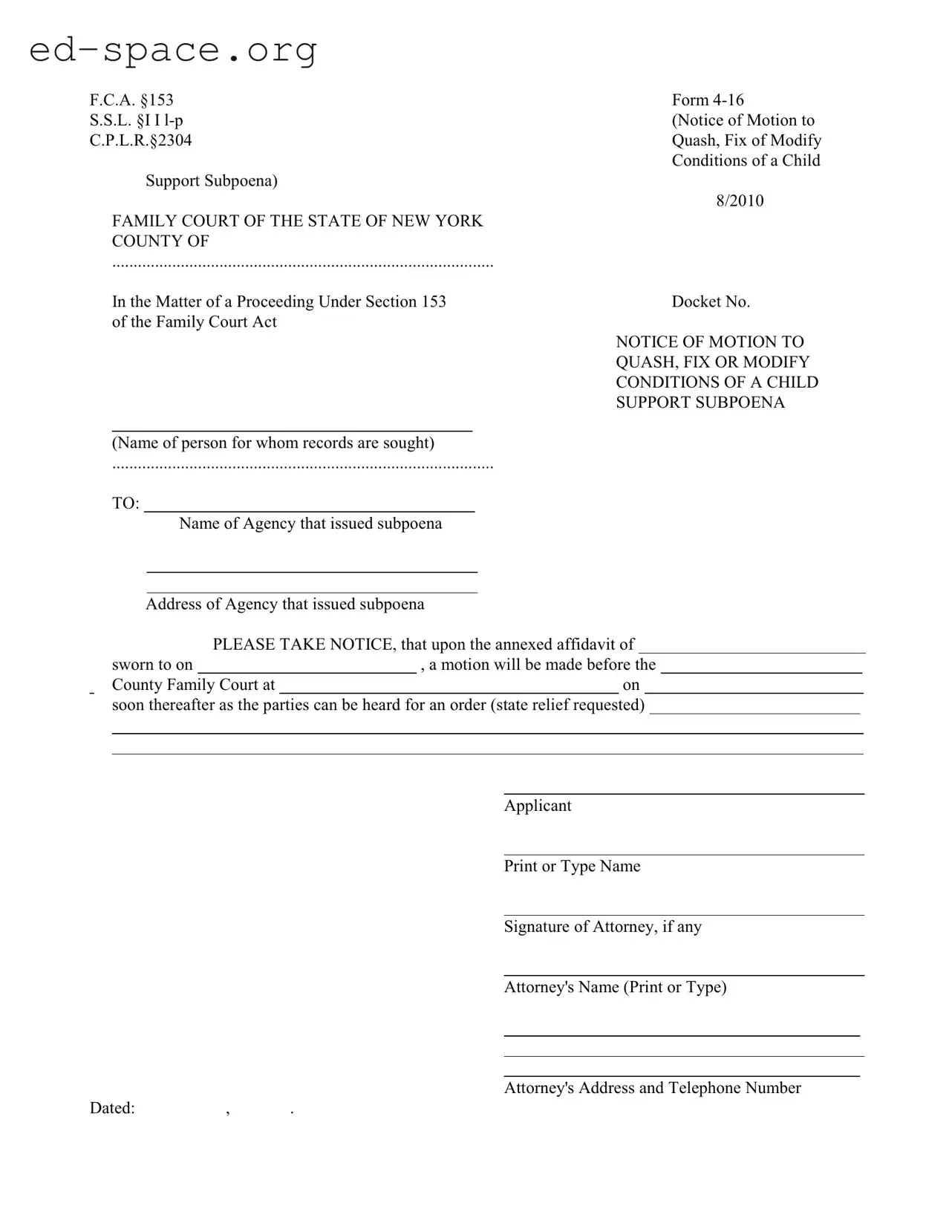
The New York Form 4-16 serves a crucial role in the family court system, particularly when it comes to child support matters. This form is designed for individuals or entities seeking to quash, fix, or modify the conditions of a child support subpoena. It is essential for those who believe that the subpoena may be overly burdensome or unjust. The form requires the applicant to provide specific details, including the name of the agency that issued the subpoena and the relevant docket number associated with the family court proceeding. Additionally, it necessitates an affidavit that outlines the reasons for the requested relief, ensuring that the court has a clear understanding of the applicant's position. By following the proper procedures outlined in this form, individuals can effectively communicate their concerns to the court, helping to protect their rights while navigating the complexities of child support obligations. Understanding how to complete and submit this form accurately is vital for anyone involved in a family court proceeding related to child support.
F.C.A. §153
S.S.L. §I I
C.P.L.R.§2304
Support Subpoena)
FAMILY COURT OF THE STATE OF NEW YORK COUNTY OF
.........................................................................................
In the Matter of a Proceeding Under Section 153 of the Family Court Act
Form
(Notice of Motion to Quash, Fix of Modify Conditions of a Child
8/2010
Docket No.
NOTICE OF MOTION TO
QUASH, FIX OR MODIFY
CONDITIONS OF A CHILD
SUPPORT SUBPOENA
(Name of person for whom records are sought)
.........................................................................................
TO:
Name of Agency that issued subpoena
Address of Agency that issued subpoena
PLEASE TAKE NOTICE, that upon the annexed affidavit of
sworn to on |
|
, a motion will be made before the |
|
|||
County Family Court at |
|
|
on |
|
||
soon thereafter as the parties can be heard for an order (state relief requested)
Applicant
Print or Type Name
Signature of Attorney, if any
Attorney's Name (Print or Type)
Attorney's Address and Telephone Number
Dated:,.
Form
.............................................................................Docket No.
In The M atter of a Proceeding Under Section 153 of the Family Court Act
AFFIDAVIT IN SUPPORT OF
M OTION TO QUASH, FIX OR
M ODIFY CONDITIONS OF A
CHILD SUPPORT SUBPOENA
(Name of person for whom records are sought)
............................................................................
STATE OF NEW YORK |
) |
|
:ss.: |
COUNTY OF |
) |
|
|
|
|
|
|
being duly sworn deposes and states: |
||
1 |
. Upon information and belief, a Family Court proceeding (has) (has not) been filed. (If filed, state Docket Number |
|||||||
|
|
|
.) |
|
|
|
|
|
2 |
.That a child support subpoena was served upon (specify individual or entity) |
|||||||
|
|
|
at |
|
|
|
(copy attached) |
|
3.That relief from the following directive(s) in said subpoena should be granted for the following reasons:
Applicant
Print or Type Name
Signature of Attorney, if any
Attorney's Name (Print or Type)
Attorney's Address and Telephone Number
Sworn to |
before me this |
|
|
|||
day of |
|
|
, |
|
|
. |
(Deputy) Clerk of the Court
Notary Public
| Fact Name | Details |
|---|---|
| Governing Law | The New York Family Court Act (F.C.A. §153), Social Services Law (S.S.L. §111-p), and Civil Practice Law and Rules (C.P.L.R. §2304) govern the use of Form 4-16. |
| Purpose of Form | Form 4-16 serves as a Notice of Motion to quash, fix, or modify conditions of a child support subpoena, providing a legal mechanism for individuals to contest subpoenas related to child support matters. |
| Filing Process | Applicants must file the form in the appropriate Family Court, indicating the relief requested and providing necessary details about the subpoena and the parties involved. |
| Affidavit Requirement | The form requires an affidavit to be annexed, which must be sworn to by the applicant, detailing the reasons for seeking to quash or modify the subpoena. |
| Service of Notice | Notice of the motion must be served to the agency that issued the subpoena, ensuring that all parties are informed of the legal proceedings. |
| Deadline for Hearing | The motion will be heard at the Family Court as soon as the parties can be heard, emphasizing the importance of timely resolution in child support matters. |
Filling out the New York 4 16 form is an essential step when seeking to address issues related to a child support subpoena. Once completed, this form will be submitted to the Family Court, allowing you to formally request modifications or quashing of the subpoena's conditions.
What is the purpose of the New York 4 16 form?
The New York 4 16 form is used to formally request the Family Court to quash, fix, or modify the conditions of a child support subpoena. This form is essential when an individual or entity believes that the subpoena is unreasonable or burdensome. By filing this motion, the applicant seeks relief from specific directives outlined in the subpoena that may infringe on their rights or privacy.
Who can file a New York 4 16 form?
Any individual or entity that has received a child support subpoena can file a New York 4 16 form. This includes parents, guardians, or other parties involved in a child support case. If the recipient believes that the subpoena's demands are excessive or unwarranted, they have the right to challenge it through this form.
What information is required to complete the New York 4 16 form?
To complete the New York 4 16 form, you will need to provide several key pieces of information. This includes the name of the person for whom records are sought, the name and address of the agency that issued the subpoena, and the docket number of the related Family Court proceeding. Additionally, you must detail the specific relief you are requesting and provide an affidavit supporting your motion.
How is the New York 4 16 form submitted?
The New York 4 16 form must be submitted to the Family Court in the county where the case is being heard. You will typically file it in person or through your attorney. After filing, a hearing date will be set, and all parties involved will be notified. It is important to ensure that all required information is accurate and complete to avoid delays in the process.
What happens after filing the New York 4 16 form?
Once the New York 4 16 form is filed, a motion hearing will be scheduled. During this hearing, the applicant will present their case for why the subpoena should be quashed, fixed, or modified. The court will then consider the arguments from both sides before making a decision. It is crucial for the applicant to prepare thoroughly, as the outcome will depend on the strength of the arguments presented.
Incomplete Information: Failing to provide all required details can lead to delays. Ensure that you fill in the name of the person for whom records are sought and the agency that issued the subpoena.
Incorrect Docket Number: Entering the wrong docket number can cause confusion. Double-check this information to avoid complications in your case.
Missing Signatures: Not signing the form can result in rejection. Both the applicant and any attorney must sign where indicated.
Failure to Attach Supporting Documents: Forgetting to include necessary attachments, such as the affidavit or the copy of the subpoena, can hinder your motion. Always check that all required documents are included.
Not Specifying Relief Requested: Vague requests can lead to misunderstandings. Clearly state what you are asking for in the motion to ensure the court understands your needs.
The New York 4 16 form is a critical document used in family court proceedings, particularly for addressing issues related to child support subpoenas. In addition to this form, several other documents are often utilized in conjunction with it. Below is a list of these forms, each serving a specific purpose in the legal process.
Each of these documents plays a vital role in the family court process, ensuring that all parties have the necessary information and legal backing to proceed effectively. Understanding these forms can help streamline communication and enhance the chances of a favorable outcome in child support matters.
The New York 4 16 form, which is primarily used for motions related to child support subpoenas, shares similarities with several other legal documents. Each of these documents serves a specific purpose within family law and related proceedings. Below is a list of documents that are comparable to the New York 4 16 form:
When filling out the New York 4 16 form, it is important to follow specific guidelines to ensure the process goes smoothly. Here are five things you should and shouldn't do:
By following these guidelines, you can help ensure that your motion is processed efficiently and effectively.
This form can be utilized by any party involved in a child support case, not just parents. Guardians and other interested parties may also file a motion using this form.
The 4 16 form specifically allows individuals to request modifications to child support subpoenas. This process is in place to ensure that the needs of the child and the circumstances of the parties are fairly considered.
Filing the form initiates a legal process, but it does not guarantee a favorable outcome. The court will review the motion and make a decision based on the merits of the case.
While filing in person is an option, many jurisdictions allow for electronic filing. It is important to check local court rules for specific filing procedures.
Ignoring a subpoena can lead to legal consequences. It is crucial to respond appropriately, either by complying or by filing a motion using the 4 16 form.
This form is specifically designed for child support subpoenas. Other types of subpoenas may require different forms and procedures.
While it is possible to file the form without an attorney, legal representation can help navigate the complexities of family court and improve the chances of a successful outcome.
The form can be filed regardless of whether a court date has been set. It serves as a notice of motion to address the subpoena in court.
The affidavit is a critical component of the 4 16 form. It provides the court with necessary information to evaluate the motion and should be completed thoroughly.
When dealing with the New York 4 16 form, understanding its purpose and proper usage is essential. Here are key takeaways to keep in mind: