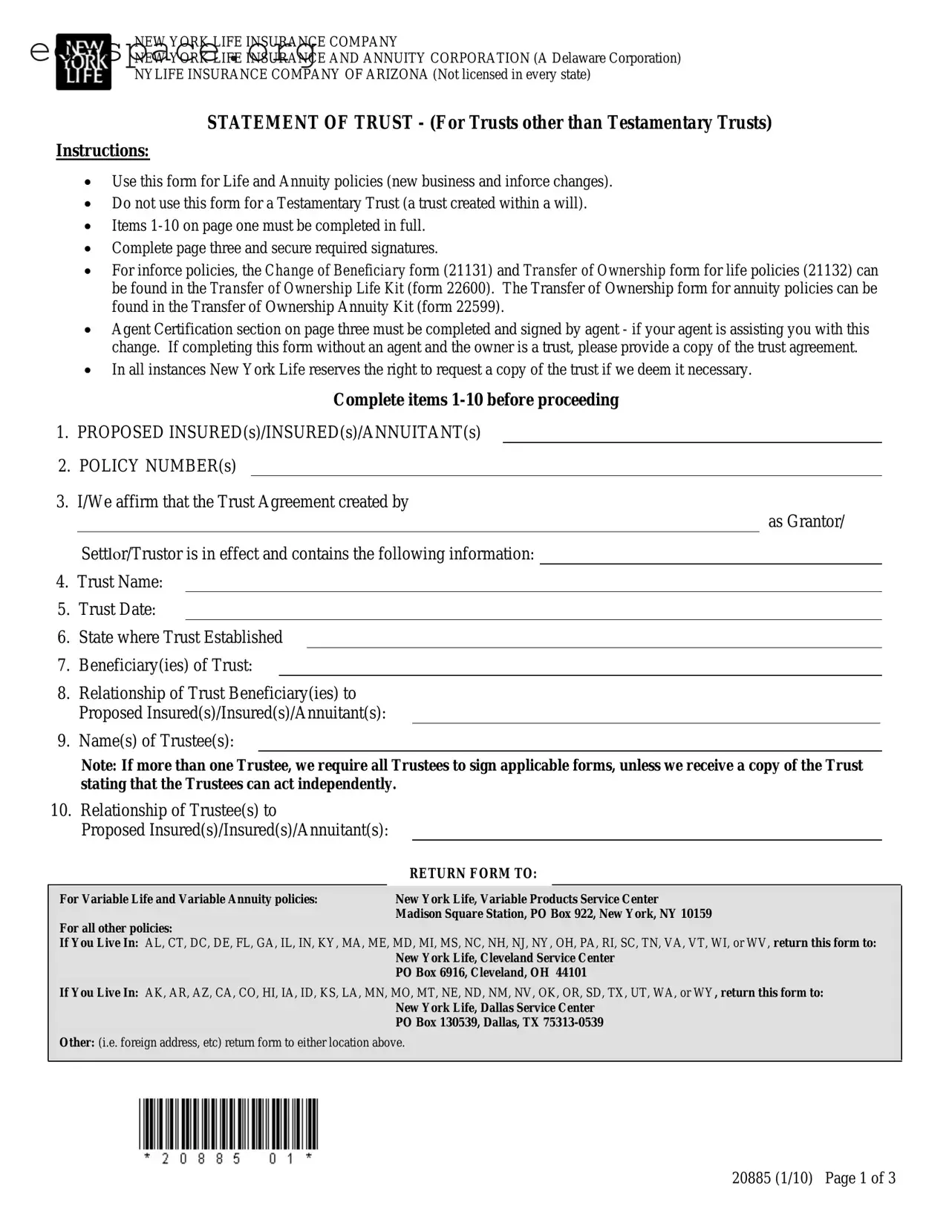
The New York 20885 form is an essential document for individuals looking to designate a trust as the beneficiary of life insurance or annuity policies. This form is specifically designed for trusts that are not created within a will, known as testamentary trusts. When filling out the 20885 form, it is crucial to complete the first ten items on the first page, which include details about the proposed insured, policy numbers, and pertinent information about the trust itself, such as its name, date of establishment, and beneficiaries. Additionally, the form requires the signatures of all trustees unless the trust agreement specifies otherwise. For those managing in-force policies, supplementary forms for changing beneficiaries or transferring ownership may also be necessary. It’s important to note that New York Life reserves the right to request a copy of the trust agreement if needed. The form concludes with a section for agent certification, ensuring that any assistance provided by an agent is documented appropriately. Understanding the requirements and instructions outlined in the 20885 form is vital for ensuring that trusts are properly recognized as beneficiaries, thereby facilitating a smooth process in the event of a claim.

NEW YORK LIFE INSURANCE COMPANY
NEW YORK LIFE INSURANCE AND ANNUITY CORPORATION (A Delaware Corporation)
NYLIFE INSURANCE COMPANY OF ARIZONA (Not licensed in every state)
STATEMENT OF TRUST - (For Trusts other than Testamentary Trusts)
Instructions:
•Use this form for Life and Annuity policies (new business and inforce changes).
•Do not use this form for a Testamentary Trust (a trust created within a will).
•Items
•Complete page three and secure required signatures.
•For inforce policies, the Change of Beneficiary form (21131) and Transfer of Ownership form for life policies (21132) can be found in the Transfer of Ownership Life Kit (form 22600). The Transfer of Ownership form for annuity policies can be found in the Transfer of Ownership Annuity Kit (form 22599).
•Agent Certification section on page three must be completed and signed by agent - if your agent is assisting you with this change. If completing this form without an agent and the owner is a trust, please provide a copy of the trust agreement.
•In all instances New York Life reserves the right to request a copy of the trust if we deem it necessary.
Complete items
1.PROPOSED INSURED(s)/INSURED(s)/ANNUITANT(s)
2.POLICY NUMBER(s)
3. I/We affirm that the Trust Agreement created by
as Grantor/
SettLOr/Trustor is in effect and contains the following information:
4.Trust Name:
5.Trust Date:
6.State where Trust Established
7.Beneficiary(ies) of Trust:
8.Relationship of Trust Beneficiary(ies) to Proposed Insured(s)/Insured(s)/Annuitant(s):
9. Name(s) of Trustee(s):
Note: If more than one Trustee, we require all Trustees to sign applicable forms, unless we receive a copy of the Trust stating that the Trustees can act independently.
10.Relationship of Trustee(s) to
Proposed Insured(s)/Insured(s)/Annuitant(s):
|
|
RETURN FORM TO: |
|
|
|
|
|
|
|
|
For Variable Life and Variable Annuity policies: |
New York Life, Variable Products Service Center |
|
|
|
|
Madison Square Station, PO Box 922, New York, NY 10159 |
|
|
For all other policies:
If You Live In: AL, CT, DC, DE, FL, GA, IL, IN, KY, MA, ME, MD, MI, MS, NC, NH, NJ, NY, OH, PA, RI, SC, TN, VA, VT, WI, or WV, return this form to:
New York Life, Cleveland Service Center
PO Box 6916, Cleveland, OH 44101
If You Live In: AK, AR, AZ, CA, CO, HI, IA, ID, KS, LA, MN, MO, MT, NE, ND, NM, NV, OK, OR, SD, TX, UT, WA, or WY, return this form to:
New York Life, Dallas Service Center
PO Box 130539, Dallas, TX
Other: (i.e. foreign address, etc) return form to either location above.
20885 (1/10) Page 1 of 3

Please read this page and secure required signatures on page three.
STATEMENT REGARDING TRUST AS POLICY BENEFICIARY
I/We affirm that the beneficiary designation for each policy listed agrees with a Trust Agreement created by the Grantor and dated as shown on page one.
For Life Insurance Policies:
If, before the proceeds are paid, the Insurer(s) receives proof that the Trust as policy beneficiary is not in effect at the Insured’s death, the proceeds shall be paid to the contingent beneficiary(ies), if any. Otherwise, the proceeds shall be paid in a single sum to the Owner, if the Owner is living at that time. If the Owner is not living at that time, the single sum shall be paid to the Owner’s Estate.
For Annuity Contracts:
Please see your Agent/Registered Representative for payment methods available upon death of the Owner/Annuitant.
For Life Insurance Policies and Annuity Contracts:
Before the Insurer(s) pays the proceeds at death, it may ask for proof that the Trust is in effect;
The Owner possesses all rights of ownership of each policy including the right to change the beneficiary designation at any time even if there is a contrary provision in the Trust Agreement. This applies to revocable and irrevocable trusts; The Insurer(s) will not have any liability after it pays the proceeds of each policy, as set forth in this Statement;
The Interest of the Trust(s) in each of these policies shall be subject to any assignment of that policy made before or after this Statement.
STATEMENT REGARDING TRUST AS OWNER
I/We affirm that the Trust Agreement created by the Grantor as shown on page one (and the trust date as shown on page one) agrees with the following:
1.The Trustee(s) have full authority to pay premiums.
2.The Trust Agreement contains no limitations on the ownership rights of the Trust(s) as owner(s) of the insurance/annuity policies.
20885 (1/10) Page 2 of 3

IMPORTANT: The Internal Revenue Service (IRS) requires that the named Owner complete the following:
(The IRS does not require your consent to any provision of this document other than the certifications required to avoid backup withholding).
Taxpayer Identification Number and Backup Withholding Certifications
Policyowner’s Taxpayer Identification Number is
Under penalties of perjury, I certify that the number shown above is my correct Taxpayer Identification Number. I further certify that I am a U.S. person (including a U.S. resident alien).
I also certify that (please check only one box):
I have been notified by the IRS that I am subject to backup withholding.
I am not subject to backup withholding because (a) I have not been notified that I am subject to backup withholding as a result of failure to report all interest or dividends, or (b) the IRS has notified me that I am no longer subject to backup withholding.
/ |
/ |
|
X |
|
X |
|
Date |
|
|
Grantor(s) signature |
|
Grantor(s) signature, if required |
|
/ |
/ |
|
X |
|
X |
|
|
|
|
|
|
|
|
Date |
|
|
Trustee(s) signature |
|
Trustee(s) signature, if required |
|
/ |
/ |
|
X |
|
X |
|
Date |
|
|
Proposed Insured(s)/Insured(s)/Annuitant(s) signature |
|
Additional Signature, if required |
|
/ |
/ |
|
X |
|
X |
|
Date |
|
|
Applicant(s)/Owner(s) signature, if other than above |
|
Additional Signature, if required |
|
\
\
If the indicated policy is
Print Name & Title of OfficerPrint Name & Title of Officer
/ |
/ |
|
X |
|
X |
Date |
|
|
Officer’s Signature |
|
Officer’s Signature |
AGENT CERTIFICATION
(if Agent assists with completion of form)
By signing below I attest that I have reviewed the identifying trust document(s) described on page one and that the document(s) appeared to be genuine and original.
Print Name of Agent/Registered Representative
X |
/ |
/ |
|
Agent/Registered Representative’s Signature |
|
Date |
|
20885 (1/10) Page 3 of 3
| Fact Name | Fact Description |
|---|---|
| Purpose | This form is used for Life and Annuity policies, specifically for trusts that are not testamentary. |
| Exclusions | The form should not be used for Testamentary Trusts, which are created within a will. |
| Completion Requirement | Items 1-10 on page one must be fully completed for the form to be valid. |
| Signature Requirement | Required signatures must be secured on page three, including those of all trustees if applicable. |
| Agent Involvement | If an agent assists in completing the form, the Agent Certification section must be signed by the agent. |
| Trust Document | New York Life reserves the right to request a copy of the trust agreement if deemed necessary. |
| Policy Return Address | Forms must be returned to specific service centers based on the type of policy and the state of residence. |
| IRS Compliance | The form includes certifications related to taxpayer identification and backup withholding as required by the IRS. |
| Governing Law | This form is governed by New York State law regarding trusts and insurance policies. |
Completing the New York 20885 form is a straightforward process. This form is essential for trusts that are not created within a will. It requires specific information about the trust and its beneficiaries. Follow the steps below to ensure you fill out the form correctly.
After completing items 1-10, proceed to page three to secure the necessary signatures. If you are working with an agent, they will need to sign in the Agent Certification section. Make sure to return the form to the appropriate New York Life address based on your location and the type of policy. If you have any questions, consider reaching out to your agent for assistance.
What is the purpose of the New York 20885 form?
The New York 20885 form is used to designate a trust as the beneficiary for life insurance and annuity policies. It applies to both new business and changes to existing policies. This form ensures that the trust's details are properly recorded and that the insurance company recognizes the trust as the beneficiary. It's important to note that this form should not be used for testamentary trusts, which are created within a will.
What information do I need to provide when filling out the form?
When completing the New York 20885 form, you must fill out items 1-10 on the first page. This includes details about the proposed insured, policy numbers, the trust's name and date, the state where the trust was established, and information about the trust beneficiaries and trustees. Additionally, if the owner is a trust, a copy of the trust agreement must be provided. Make sure all required signatures are secured, especially if an agent is assisting with the process.
Where do I send the completed form?
The destination for your completed New York 20885 form depends on the type of policy you have and your state of residence. For variable life and variable annuity policies, send it to the Variable Products Service Center in New York. If your policy falls under other categories, the form should be sent to either the Cleveland Service Center or the Dallas Service Center, depending on your location. Be sure to check the specific instructions on the form to ensure it reaches the right office.
What happens if the trust is not in effect at the time of the insured's death?
If the insurance company receives proof that the trust as a policy beneficiary is not in effect at the insured's death, the proceeds will be paid to the contingent beneficiaries, if any are named. If there are no contingent beneficiaries, the proceeds will be paid to the owner of the policy, provided they are still living. If the owner has passed away, the proceeds will go to the owner's estate. This highlights the importance of ensuring that the trust remains valid and in effect.
Failing to complete all required items on the form. Items 1-10 on page one must be filled out completely. Incomplete forms may lead to delays or rejection.
Using the form for a Testamentary Trust. This form is specifically for trusts other than those created within a will. Using it incorrectly can result in significant processing issues.
Not providing a copy of the trust agreement when the owner is a trust. If you are completing the form without an agent, this document is essential for verification purposes.
Ignoring the need for signatures from all trustees. If there are multiple trustees, all must sign the applicable forms unless the trust allows for independent action.
Neglecting to check the appropriate box regarding backup withholding. This certification is a requirement by the IRS and must be accurately completed to avoid complications.
Forgetting to secure agent certification if an agent assists with the form. This section must be completed and signed to validate the assistance provided.
Not returning the form to the correct service center based on your state of residence. Each state has designated service centers, and sending the form to the wrong location can cause unnecessary delays.
The New York 20885 form is used primarily for trusts related to life insurance and annuity policies. When dealing with such policies, various other forms and documents may also be required to ensure proper management and compliance. Below is a list of related documents that are often used in conjunction with the New York 20885 form.
Understanding these documents can help ensure that all aspects of managing life insurance and annuity policies are handled efficiently. Proper documentation is essential for protecting the interests of all parties involved, particularly when trusts are part of the equation.
The New York 20885 form serves as a Statement of Trust for life insurance and annuity policies. It is similar to several other documents that also pertain to trust management and beneficiary designations. Below is a list of six documents that share similarities with the New York 20885 form:
When filling out the New York 20885 form, it is essential to follow specific guidelines to ensure the process is smooth and compliant. Here are nine things you should and shouldn't do:
Adhering to these guidelines will help ensure that the New York 20885 form is filled out correctly and efficiently.
This form is specifically designed for trusts other than testamentary trusts. A testamentary trust is created within a will, and this form is not applicable in such cases.
While the trustee’s signature is important, all trustees must sign the applicable forms unless the trust document states otherwise. This ensures that all parties are in agreement.
In fact, items 1-10 must be completed in full. This includes essential details like the trust name, date, and the relationship of beneficiaries to the insured.
It’s important to note that the insurer may request proof that the trust is still in effect before any proceeds are paid out. This step is crucial for ensuring compliance with the trust agreement.
While individuals can complete the form on their own, if the owner is a trust, it is advisable to provide a copy of the trust agreement. This helps clarify any questions regarding the trust’s authority and structure.
When filling out and using the New York 20885 form, there are several important considerations to keep in mind. Here are key takeaways: