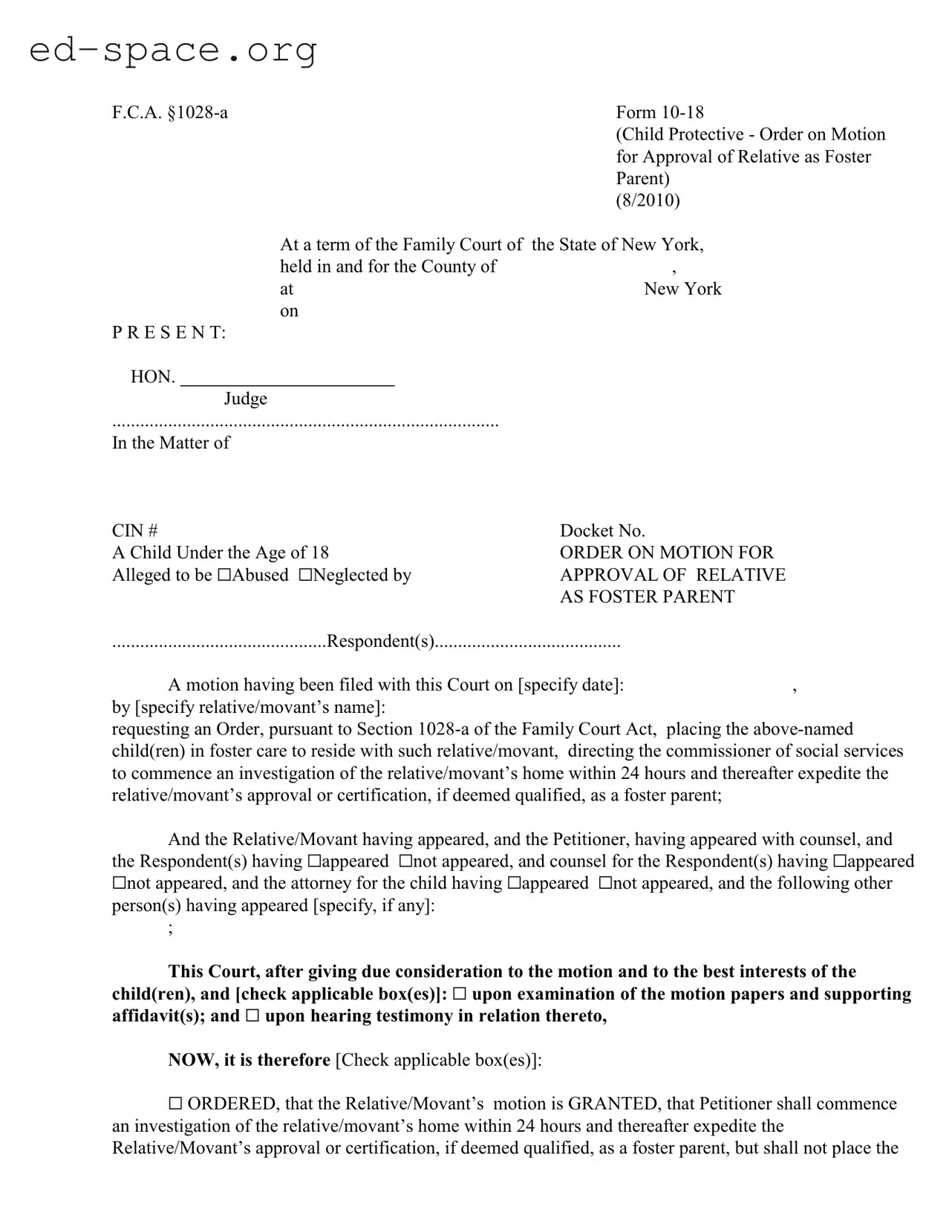
The New York 10-18 form, formally known as the Order on Motion for Approval of Relative as Foster Parent, plays a crucial role in the child welfare system. This form is utilized within the Family Court of New York to facilitate the placement of children under the age of 18 with relatives who seek to become foster parents. The process begins when a relative files a motion requesting the court's approval for this arrangement. The form outlines essential steps, including a directive for the commissioner of social services to conduct a home investigation within 24 hours of the motion's filing. It emphasizes the importance of expediting the approval or certification of the relative as a foster parent, contingent upon their qualifications. The court considers the best interests of the child throughout the proceedings, taking into account the appearances of various parties, including the relative/movant, the petitioner, and the attorney for the child. Ultimately, the court issues an order that either grants or denies the motion, with specific instructions regarding the next steps based on the investigation's outcome. The form also includes provisions for appeal, ensuring that parties are aware of their rights following the court's decision.
F.C.A. |
Form |
||
|
|
|
(Child Protective - Order on Motion |
|
|
|
for Approval of Relative as Foster |
|
|
|
Parent) |
|
|
|
(8/2010) |
|
At a term of the Family Court of |
the State of New York, |
|
|
held in and for the County of |
, |
|
|
at |
New York |
|
|
on |
|
|
P R E S E N T: |
|
||
HON. |
|
|
|
|
Judge |
|
|
................................................................................... |
|
||
In the Matter of |
|
||
CIN # |
Docket No. |
A Child Under the Age of 18 |
ORDER ON MOTION FOR |
Alleged to be GAbused GNeglected by |
APPROVAL OF RELATIVE |
|
AS FOSTER PARENT |
..............................................Respondent(s) |
|
A motion having been filed with this Court on [specify date]: |
, |
by [specify relative/movant’s name]: |
|
requesting an Order, pursuant to Section |
placing the |
child(ren) in foster care to reside with such relative/movant, directing the commissioner of social services to commence an investigation of the relative/movant’s home within 24 hours and thereafter expedite the relative/movant’s approval or certification, if deemed qualified, as a foster parent;
And the Relative/Movant having appeared, and the Petitioner, having appeared with counsel, and the Respondent(s) having Gappeared Gnot appeared, and counsel for the Respondent(s) having Gappeared Gnot appeared, and the attorney for the child having Gappeared Gnot appeared, and the following other person(s) having appeared [specify, if any]:
;
This Court, after giving due consideration to the motion and to the best interests of the
child(ren), and [check applicable box(es)]: G upon examination of the motion papers and supporting affidavit(s); and G upon hearing testimony in relation thereto,
NOW, it is therefore [Check applicable box(es)]:
G ORDERED, that the Relative/Movant’s motion is GRANTED, that Petitioner shall commence an investigation of the relative/movant’s home within 24 hours and thereafter expedite the Relative/Movant’s approval or certification, if deemed qualified, as a foster parent, but shall not place the

Form |
Page 2 |
child(ren) with the Relative/Movant until and unless he or she is finally approved or certified as a foster parent, or, if the Relative/Movant is deemed upon investigation not to qualify as a foster parent, Petitioner shall report that determination to the Court, the parties and the attorney for the child forthwith;
OR
G ORDERED, that the Relative/Movant’s motion is DENIED; (and it is further) G ORDERED, that
ENTER
Judge of the Family Court
Dated:,
PURSUANT TO § 1113 OF THE FAMILY COURT ACT, AN APPEAL FROM THIS ORDER MUST BE TAKEN WITHIN 30 DAYS OF RECEIPT OF THE ORDER BY APPELLANT IN COURT, 30 DAYS AFTER SERVICE BY A PARTY OR THE ATTORNEY FOR THE CHILD UPON THE APPELLANT OR 35 DAYS FROM THE DATE OF MAILING OF THE ORDER TO THE APPELLANT BY THE CLERK OF THE COURT, WHICHEVER IS EARLIEST.
Check applicable box:
“Order mailed on [specify date(s) and to whom mailed]:
“Order received in court on [specify date(s) and to whom given]:
| Fact Name | Details |
|---|---|
| Governing Law | The New York 10 18 form is governed by F.C.A. §1028-a of the Family Court Act. |
| Purpose | This form is used to request approval for a relative to become a foster parent for a child under the age of 18. |
| Filing Requirement | A motion must be filed with the Family Court, specifying the relative's name and the date of the motion. |
| Investigation Timeline | The commissioner of social services is required to commence an investigation of the relative's home within 24 hours of the motion. |
| Approval Process | If deemed qualified, the relative may be expedited for approval or certification as a foster parent. |
| Hearing Necessity | The court may grant the motion based on examination of the motion papers or after hearing testimony. |
| Appeal Information | An appeal from the order must be taken within 30 days of receipt or 35 days from mailing, whichever is earlier. |
Filling out the New York 10-18 form requires careful attention to detail. This form is an essential step in the process of seeking approval for a relative to become a foster parent. Once completed, the form will be submitted to the Family Court, where it will be reviewed as part of the motion for approval. Following the submission, the court will take the necessary actions to assess the situation.
What is the New York 10 18 form?
The New York 10 18 form is an official document used in Family Court to request approval for a relative to become a foster parent. This form is part of the process outlined in Section 1028-a of the Family Court Act. It is specifically designed for situations where a child under the age of 18 is alleged to be abused or neglected, and a relative wishes to care for that child in a foster capacity.
Who can file a New York 10 18 form?
A relative of the child, such as a grandparent, aunt, uncle, or sibling, can file the New York 10 18 form. The relative must be willing to provide a safe and nurturing environment for the child. It’s essential that the relative demonstrates their commitment and capability to care for the child during this process.
What happens after the form is submitted?
Once the New York 10 18 form is submitted, the court will review the motion. The commissioner of social services is then directed to investigate the relative's home within 24 hours. This investigation assesses whether the relative qualifies to be approved or certified as a foster parent. The court prioritizes the best interests of the child throughout this process.
What criteria are used to approve a relative as a foster parent?
The approval process involves several criteria, including the relative's ability to provide a safe living environment, their background checks, and their understanding of the responsibilities involved in fostering a child. The social services department will conduct a thorough evaluation to ensure that the relative meets all necessary requirements.
What if the relative is not approved as a foster parent?
If the investigation determines that the relative does not qualify to be a foster parent, the commissioner of social services must inform the court, the parties involved, and the attorney for the child. The child will then need to be placed in an alternative foster care situation, as the relative cannot take custody without proper approval.
Can the decision be appealed?
Yes, if the motion is denied, the relative has the right to appeal the decision. According to the Family Court Act, an appeal must be filed within 30 days of receiving the order. This timeline is crucial, so it’s important to act promptly if you wish to challenge the court's decision.
How long does the entire process take?
The timeline for the process can vary. The initial investigation by social services must be completed within 24 hours of the court's order. However, the overall timeline for approval or denial may take longer, depending on the complexity of the case and the availability of necessary evaluations. It's essential to stay in communication with the court and social services for updates.
Filling out the New York 10 18 form can be a daunting task, especially when the stakes involve the welfare of a child. Mistakes can lead to delays or even denials of the motion. Here are four common mistakes individuals often make when completing this important form:
Many people forget to fill in all required fields. Omitting details such as the child's name, date of the motion, or the relative's name can result in the form being rejected. Always double-check that every section is complete.
Some individuals mistakenly enter the wrong dates, which can cause confusion regarding timelines. For instance, specifying the date of the motion incorrectly can affect the court's understanding of the case. Ensure that all dates align with the events being described.
It is crucial to check all applicable boxes on the form. Some may overlook this step, which can lead to misunderstandings about the nature of the request. Each box serves a specific purpose, so be thorough in your review.
Submitting the form without the necessary supporting documents can hinder the approval process. Relevant affidavits or evidence should accompany the motion to substantiate the request for approval as a foster parent. Always attach the required documentation to strengthen your case.
By avoiding these common pitfalls, individuals can enhance their chances of a smooth and successful process in the Family Court system. Careful attention to detail is essential when navigating legal forms.
The New York 10 18 form is crucial in child protective proceedings, particularly when a relative seeks approval to become a foster parent. Several other forms and documents often accompany this form in the legal process. Each of these documents serves a specific purpose in facilitating the court's review and decision-making regarding the welfare of the child involved.
Each of these documents plays a vital role in the legal process surrounding child welfare cases in New York. Together, they help ensure that the best interests of the child are prioritized and that the relative seeking foster parent approval is thoroughly evaluated.
The New York 10 18 form, which pertains to the approval of relatives as foster parents, shares similarities with several other legal documents. Below are eight documents that have comparable functions or processes:
When filling out the New York 10 18 form, it’s crucial to follow specific guidelines to ensure your application is processed smoothly. Here’s a list of things you should and shouldn’t do:
By adhering to these guidelines, you can help ensure that your motion for approval as a foster parent is handled efficiently.
Understanding the New York 10 18 form can be challenging, and several misconceptions often arise. Here are ten common misunderstandings, along with clarifications for each:
By addressing these misconceptions, individuals can better understand the purpose and process of the New York 10 18 form, ensuring a smoother experience for all involved.
Filling out and using the New York 10 18 form requires careful attention to detail. Below are key takeaways to consider: