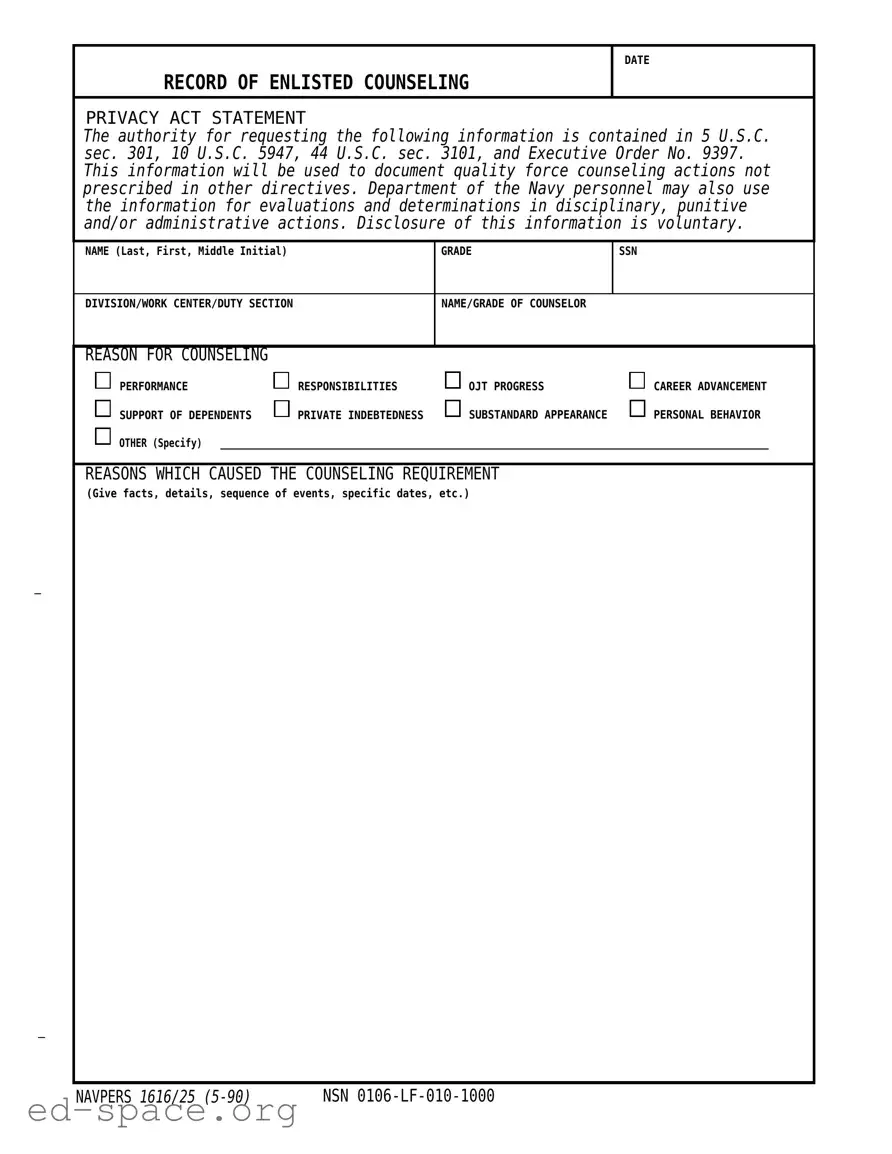
The NAVPERS 1616/25 form serves a crucial role in documenting counseling sessions for enlisted personnel within the Department of the Navy. This form is designed to facilitate quality force counseling actions that are not covered by other directives. It encompasses a variety of important elements, including personal details such as the service member's name, grade, and Social Security number, as well as the name and grade of the counselor. The form outlines the reasons for counseling, which can range from performance responsibilities and on-the-job training progress to issues related to personal behavior and substandard appearance. Additionally, it provides a space for detailing the specific circumstances that led to the counseling, allowing for a comprehensive account of events. The NAVPERS 1616/25 also includes a section where the member and counselor can collaboratively develop a plan aimed at ensuring continued superior performance or addressing any identified problems. This plan is essential for preempting future issues and fostering a supportive environment for the service member. Importantly, the form emphasizes that the disclosure of information is voluntary, and it is governed by various legal authorities, including the Privacy Act. Overall, the NAVPERS 1616/25 form is a vital tool for maintaining accountability and promoting personal and professional growth within the Navy.

-
-
DATE
RECORD OF ENLISTED COUNSELING
PRIVACY ACT STATEMENT
The authority for requesting the following information is contained in 5 U.S.C. sec. 301, 10 U.S.C. 5947, 44 U.S.C. sec. 3101, and Executive Order No. 9397. This information will be used to document quality force counseling actions not prescribed in other directives. Department of the Navy personnel may also use the information for evaluations and determinations in disciplinary, punitive and/or administrative actions. Disclosure of this information is voluntary.
NAME (Last, First, Middle Initial) |
|
GRADE |
SSN |
|||||||||||||
|
|
|
|
|
|
|
|
|
|
|
|
|
|
|
|
|
DIVISION/WORK CENTER/DUTY SECTION |
|
NAME/GRADE OF COUNSELOR |
|
|
|
|
|
|
||||||||
|
|
|
|
|
|
|
|
|
|
|
|
|
|
|
|
|
REASON FOR COUNSELING |
|
|
|
|
|
|
|
|
|
|
||||||
|
|
PERFORMANCE |
|
|
|
RESPONSIBILITIES |
|
|
OJT PROGRESS |
|
|
|
|
CAREER ADVANCEMENT |
||
|
|
|
|
|
|
|
|
|||||||||
|
|
SUPPORT OF DEPENDENTS |
|
|
PRIVATE INDEBTEDNESS |
|
|
SUBSTANDARD APPEARANCE |
|
|
|
|
PERSONAL BEHAVIOR |
|||
|
|
|
|
|
|
|
||||||||||
|
|
OTHER (Specify) |
|
|
|
|
|
|
|
|
|
|
|
|||
|
|
|
|
|
|
|
|
|
|
|
|
|||||
REASONS WHICH CAUSED THE COUNSELING REQUIREMENT
(Give facts, details, sequence of events, specific dates, etc.)
NAVPERS 1616/25 |
NSN |

PLAN (DEVELOPED BY THE MEMBER AND COUNSELOR) TO CONTINUE SUPERIOR PERFORMANCE OR TO OVERCOME PROBLEM(S) AND PRECLUDE FUTURE INVOLVEMENT
(Outline all resolutions discussed and indicate which actions the member has personally elected to pursue.)
Signature of Counselor/Date |
Signature of Member/Date |
I do/do not desire to make a statement.
Signature of Member/Date
-
NAVPERS 1616/25 |
• U.S. GPO: |
| Fact Name | Description |
|---|---|
| Authority for Information | The form is authorized under several laws, including 5 U.S.C. sec. 301, 10 U.S.C. 5947, and 44 U.S.C. sec. 3101, as well as Executive Order No. 9397. |
| Purpose of Form | This form documents quality force counseling actions and is used for evaluations and determinations in disciplinary and administrative actions. |
| Voluntary Disclosure | Providing information on the form is voluntary. Individuals can choose whether or not to disclose their information. |
| Content Requirements | Users must include details such as reasons for counseling, performance responsibilities, and plans for improvement or problem resolution. |
Filling out the NAVPERS 1616/25 form is a straightforward process that requires attention to detail. This form is used to document counseling sessions within the Navy, ensuring that all necessary information is captured accurately. Below are the steps to complete the form effectively.
Once the form is completed, it should be submitted according to your command's procedures for documentation and record-keeping. Ensuring that all details are accurate and clear will facilitate effective communication and support your professional development.
What is the NAVPERS 1616/25 form?
The NAVPERS 1616/25 form is a document used by the Department of the Navy to record counseling sessions for enlisted personnel. It serves as a tool for documenting various counseling actions that are not covered by other directives. The form is designed to help maintain quality force standards and can be utilized in evaluations and administrative actions.
What information is required on the NAVPERS 1616/25 form?
The form requires several pieces of information, including the member's name, grade, Social Security Number (SSN), and division or duty section. It also asks for the name and grade of the counselor, the reason for counseling, and specific details about the issues that led to the counseling session. Additionally, it includes a section for outlining a plan for improvement or continued performance.
Who can use the NAVPERS 1616/25 form?
This form is primarily used by Department of the Navy personnel, including counselors and enlisted members. It is meant to facilitate discussions about performance, behavior, and other issues that may affect a member’s career. Counselors, typically in a supervisory role, are responsible for filling out and discussing the form with the enlisted member.
What are the main reasons for counseling listed on the form?
The form includes several reasons for counseling, such as performance responsibilities, on-the-job training progress, career advancement, support of dependents, private indebtedness, substandard appearance, and personal behavior. Counselors can also specify other reasons as needed. Each reason is intended to address specific areas of concern regarding the member’s performance or conduct.
Is disclosure of information on the NAVPERS 1616/25 form mandatory?
No, disclosure of information on the NAVPERS 1616/25 form is voluntary. However, providing accurate and complete information can be crucial for effective counseling and for the member’s career development. The form is designed to facilitate constructive dialogue and support the member’s growth.
What is the purpose of the counseling session documented on the form?
The primary purpose of the counseling session is to address specific performance or behavioral issues and to develop a plan for improvement. This proactive approach aims to help the member continue performing at a superior level or to overcome any problems that may hinder their success. The form serves as a record of this process.
What happens after the counseling session is completed?
Once the counseling session is completed, both the counselor and the member sign the form to acknowledge that the discussion took place. The member has the option to make a statement regarding the counseling session, which can be included in their record. The completed form is then retained for future reference, particularly for evaluations and administrative actions.
Can the member provide input on the plan developed during the counseling session?
Yes, the member is encouraged to actively participate in developing the plan during the counseling session. This collaborative approach ensures that the member feels ownership of the plan and is more likely to commit to the actions outlined. The form specifically includes a section for the member to indicate which actions they have personally elected to pursue.
How does the NAVPERS 1616/25 form relate to the Privacy Act?
The NAVPERS 1616/25 form is governed by the Privacy Act, which protects personal information from unauthorized disclosure. The authority for requesting the information on the form is outlined in various legal statutes. This ensures that while the information is collected for counseling purposes, it is handled with care and confidentiality.
Where can I obtain the NAVPERS 1616/25 form?
The NAVPERS 1616/25 form can typically be obtained through official Navy channels, such as personnel offices or online resources provided by the Department of the Navy. It is important for members to access the most current version of the form to ensure compliance with any updates or changes in procedures.
Not including the full name in the correct format (Last, First, Middle Initial).
Forgetting to provide the Social Security Number (SSN), which is essential for identification.
Leaving out the grade of the individual, which is necessary for proper categorization.
Neglecting to specify the reason for counseling, which should be clearly stated.
Failing to detail the reasons that caused the counseling requirement, including facts and specific dates.
Not including the signature of the counselor and date, which are required for validation.
Overlooking the member's signature and date, which confirms their acknowledgment of the counseling.
Not indicating whether the member desires to make a statement, which is an important choice to document.
The NAVPERS 1616/25 form is essential for documenting counseling sessions within the Navy. However, several other forms and documents often accompany it to ensure comprehensive record-keeping and compliance with military regulations. Here’s a list of related documents that may be useful.
Using these forms in conjunction with the NAVPERS 1616/25 helps create a well-rounded view of a service member's performance and development. Together, they ensure that personnel records are complete and accurate, which is vital for career advancement and compliance with military standards.
The NAVPERS 1616/25 form serves a specific purpose within the Navy, primarily focusing on documenting counseling sessions for enlisted personnel. However, several other documents share similar functions in various contexts. Below is a list of six documents that align closely with the NAVPERS 1616/25 form, highlighting their similarities.
These documents, while tailored to different branches or purposes, all share a common goal: to promote accountability, development, and improvement among personnel. Understanding their similarities can enhance awareness of how various forms contribute to effective management and support within military organizations.
When filling out the Navpers 1616 25 form, it is essential to follow specific guidelines to ensure accuracy and compliance. Below is a list of things you should and shouldn't do.
Understanding the Navpers 1616 25 form is crucial for those involved in the Navy's counseling process. However, several misconceptions can lead to confusion. Below is a list of common misunderstandings about this form, along with clarifications.
Being aware of these misconceptions can help members navigate the counseling process more effectively. Open communication and understanding of the purpose of the Navpers 1616 25 form can lead to more productive outcomes.
Understanding the NAVPERS 1616/25 form is crucial for effective counseling within the Navy. Here are some key takeaways to consider:
Utilizing the NAVPERS 1616/25 form effectively can lead to constructive outcomes in professional development and personal growth.