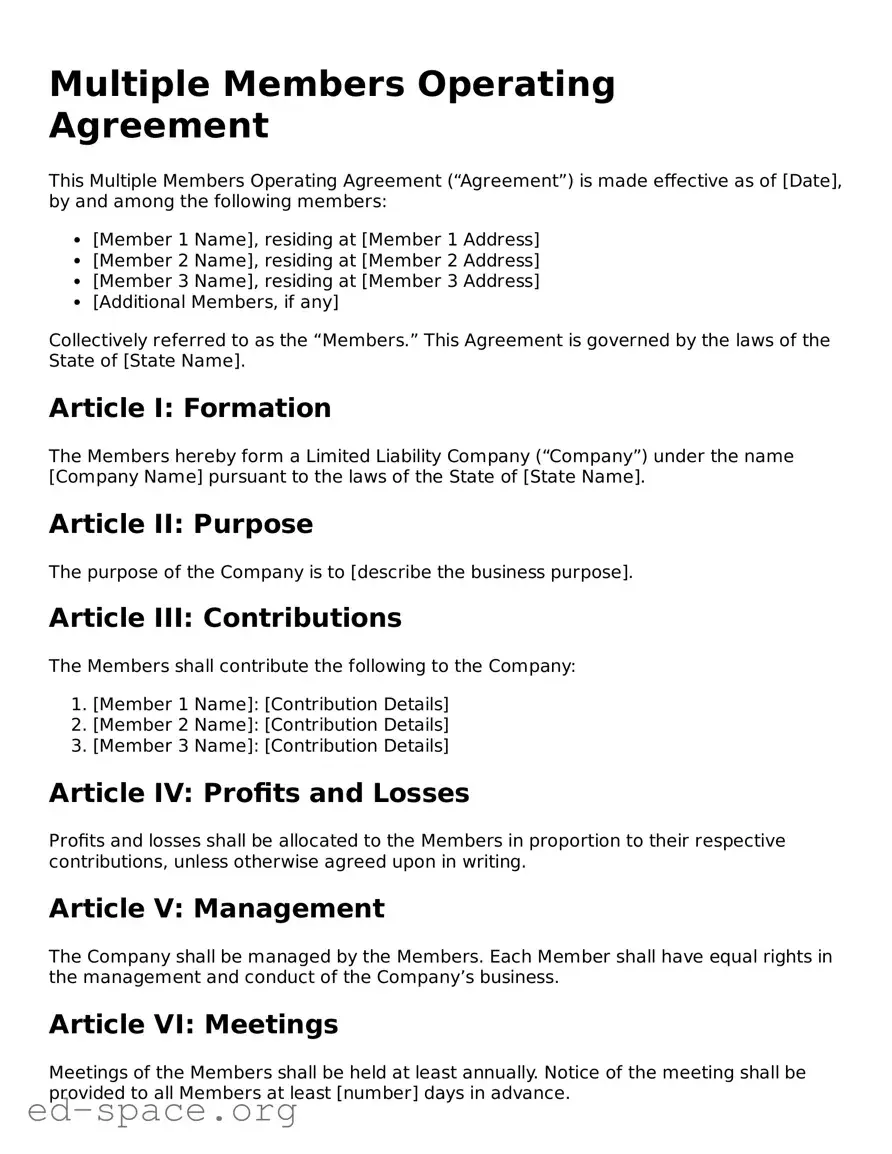
When embarking on the journey of forming a limited liability company (LLC) with multiple members, a crucial step involves establishing a Multiple Members Operating Agreement. This document serves as the backbone of your LLC, outlining the rights, responsibilities, and obligations of each member involved. It encompasses essential aspects such as the management structure, profit and loss distribution, and the procedures for adding or removing members. By detailing the decision-making processes and member roles, this agreement fosters clarity and helps prevent disputes. Furthermore, it addresses the financial contributions of each member and the protocols for handling potential conflicts. A well-crafted operating agreement not only ensures compliance with state laws but also provides a framework for the LLC's future, promoting a harmonious and productive business environment.
Multiple Members Operating Agreement
This Multiple Members Operating Agreement (“Agreement”) is made effective as of [Date], by and among the following members:
Collectively referred to as the “Members.” This Agreement is governed by the laws of the State of [State Name].
Article I: Formation
The Members hereby form a Limited Liability Company (“Company”) under the name [Company Name] pursuant to the laws of the State of [State Name].
Article II: Purpose
The purpose of the Company is to [describe the business purpose].
Article III: Contributions
The Members shall contribute the following to the Company:
Article IV: Profits and Losses
Profits and losses shall be allocated to the Members in proportion to their respective contributions, unless otherwise agreed upon in writing.
Article V: Management
The Company shall be managed by the Members. Each Member shall have equal rights in the management and conduct of the Company’s business.
Article VI: Meetings
Meetings of the Members shall be held at least annually. Notice of the meeting shall be provided to all Members at least [number] days in advance.
Article VII: Indemnification
The Company shall indemnify each Member against any losses or liabilities incurred in connection with the Company, except in cases of gross negligence or willful misconduct.
Article VIII: Amendments
This Agreement may be amended only by a written agreement signed by all Members.
Article IX: Governing Law
This Agreement shall be governed by and construed in accordance with the laws of the State of [State Name].
IN WITNESS WHEREOF, the Members have executed this Operating Agreement as of the date first above written.
______________________________
[Member 1 Name]
______________________________
[Member 2 Name]
______________________________
[Member 3 Name]
______________________________
[Additional Members, if any]
| Fact Name | Description |
|---|---|
| Purpose | The Multiple Members Operating Agreement outlines the management structure and operational guidelines for a multi-member LLC. |
| Governing Law | The agreement is governed by the laws of the state in which the LLC is formed, such as Delaware, California, or Texas. |
| Members' Rights | This document details the rights and responsibilities of each member, ensuring clarity and reducing potential disputes. |
| Capital Contributions | It specifies the initial capital contributions of each member, which is crucial for financial planning and equity distribution. |
| Profit Distribution | The agreement outlines how profits and losses will be shared among members, often based on their ownership percentages. |
| Decision-Making Process | It defines the decision-making process, including voting rights and the required majority for different types of decisions. |
| Member Withdrawal | Provisions for member withdrawal or resignation are included, detailing the process and any financial implications. |
| Amendments | The agreement can be amended, but typically requires a majority vote from the members to ensure consensus. |
| Dispute Resolution | It often includes a dispute resolution mechanism, such as mediation or arbitration, to handle conflicts without litigation. |
| Duration | The agreement may specify a duration for the LLC's existence or state that it will continue until dissolved by the members. |
Completing the Multiple Members Operating Agreement form is an essential step for businesses with multiple members. This document outlines the roles, responsibilities, and agreements among members, ensuring smooth operations and clear expectations. Follow these steps to fill out the form accurately.
What is a Multiple Members Operating Agreement?
A Multiple Members Operating Agreement is a legal document that outlines the management structure and operating procedures for a limited liability company (LLC) with multiple members. This agreement details the roles and responsibilities of each member, decision-making processes, and how profits and losses will be distributed. It serves as a foundational document that helps prevent misunderstandings and disputes among members by clearly defining expectations and operational guidelines.
Why is a Multiple Members Operating Agreement important?
This agreement is crucial for several reasons. First, it provides clarity on how the LLC will be managed, which is essential for smooth operations. Second, it protects the interests of all members by establishing rules for decision-making and profit-sharing. Additionally, having a written agreement can help resolve disputes more efficiently, as it serves as a reference point for the members. Without this agreement, members may face uncertainty and potential conflicts regarding their rights and obligations.
What should be included in a Multiple Members Operating Agreement?
A comprehensive Multiple Members Operating Agreement should include several key elements. It should outline the names and contributions of each member, the percentage of ownership, and the process for adding new members. Furthermore, it should detail how decisions will be made, including voting rights and procedures. Additionally, the agreement should address how profits and losses will be allocated, the process for resolving disputes, and the procedures for member withdrawal or dissolution of the LLC. Including these elements helps ensure that all members are on the same page and can operate the business effectively.
Can a Multiple Members Operating Agreement be modified?
Yes, a Multiple Members Operating Agreement can be modified, but the process for doing so should be clearly outlined within the agreement itself. Typically, amendments require the consent of a certain percentage of members, which is often specified in the original document. It is important for all members to agree on any changes to ensure that the agreement remains effective and reflects the current intentions of the members. Regularly reviewing and updating the agreement can help adapt to changes in the business or membership structure.
Neglecting to Define Roles and Responsibilities: Many individuals fail to clearly outline the roles and responsibilities of each member. This omission can lead to confusion and disputes down the line. Each member should understand their specific duties to ensure smooth operations.
Inadequate Capital Contributions: It is common for members to overlook specifying the amount of capital each member will contribute. Without this clarity, disagreements may arise regarding financial obligations and profit-sharing.
Ignoring Voting Rights: Members often forget to detail the voting rights associated with each member’s stake in the business. This information is crucial for decision-making processes and can prevent potential conflicts.
Failing to Address Dispute Resolution: A significant mistake is not including a clear dispute resolution process. Without a defined method for resolving disagreements, members may find themselves in prolonged conflicts that could jeopardize the business.
Overlooking Exit Strategies: Members frequently neglect to outline exit strategies for when a member wishes to leave the business. This can create complications in ownership transfer and financial settlements, leading to further disputes.
Not Seeking Legal Guidance: Many individuals attempt to complete the agreement without consulting a legal professional. This can result in overlooking important legal considerations, which may have long-term implications for the business.
The Multiple Members Operating Agreement is a crucial document for any multi-member LLC, as it outlines the management structure, responsibilities, and rights of each member. However, it often accompanies several other important forms and documents that help ensure the smooth operation of the business. Below is a list of commonly used documents alongside the Operating Agreement.
Each of these documents plays a vital role in the establishment and operation of a multi-member LLC. Together, they create a comprehensive framework that helps protect the interests of all members while ensuring compliance with legal requirements.
The Multiple Members Operating Agreement is a critical document for businesses with multiple owners. It outlines the management structure, responsibilities, and operational procedures of the business. Several other documents serve similar purposes in different contexts. Here is a list of seven such documents:
When filling out the Multiple Members Operating Agreement form, it is essential to approach the task with care and attention to detail. Here are ten important guidelines to follow:
Understanding a Multiple Members Operating Agreement is crucial for any group of individuals looking to form a limited liability company (LLC). However, several misconceptions often cloud this important document. Here are nine common misconceptions:
Many people believe that only large companies need an operating agreement. In reality, even small LLCs benefit from having one. It helps outline the management structure and responsibilities, regardless of the size of the business.
Some think that a standard template will suffice for any LLC. Each business is unique, and the operating agreement should reflect the specific needs and goals of the members involved.
There’s a misconception that an operating agreement has no legal weight. In fact, it is a legally binding document that can be enforced in court if disputes arise among members.
While it is highly recommended that all members sign, some states allow for an operating agreement to be valid even if not all members have signed it. However, having all signatures is best practice.
Many believe that once the operating agreement is created, it can be forgotten. However, it should be reviewed and updated regularly to reflect any changes in membership or business operations.
Some think that the operating agreement is solely about finances. In fact, it also addresses management roles, decision-making processes, and what happens if a member leaves or passes away.
While states do provide default rules for LLCs, these may not align with the members' intentions. Having a tailored operating agreement ensures that the specific wishes of the members are clearly outlined.
Some people think they can draft an operating agreement after the business is up and running. It’s best to create this document during the formation of the LLC to avoid complications later on.
While the name suggests it’s only for multiple members, single-member LLCs can also benefit from an operating agreement. It helps clarify the owner’s intentions and can provide additional legal protections.
Being aware of these misconceptions can help ensure that all members of an LLC understand the importance and function of a Multiple Members Operating Agreement. This clarity can lead to smoother operations and better relationships among members.
Filling out a Multiple Members Operating Agreement is a crucial step for any business with multiple owners. This document outlines the structure and rules governing the operation of the business. Here are some key takeaways to consider:
Taking the time to carefully fill out and use the Multiple Members Operating Agreement form can save time, money, and relationships among business partners.