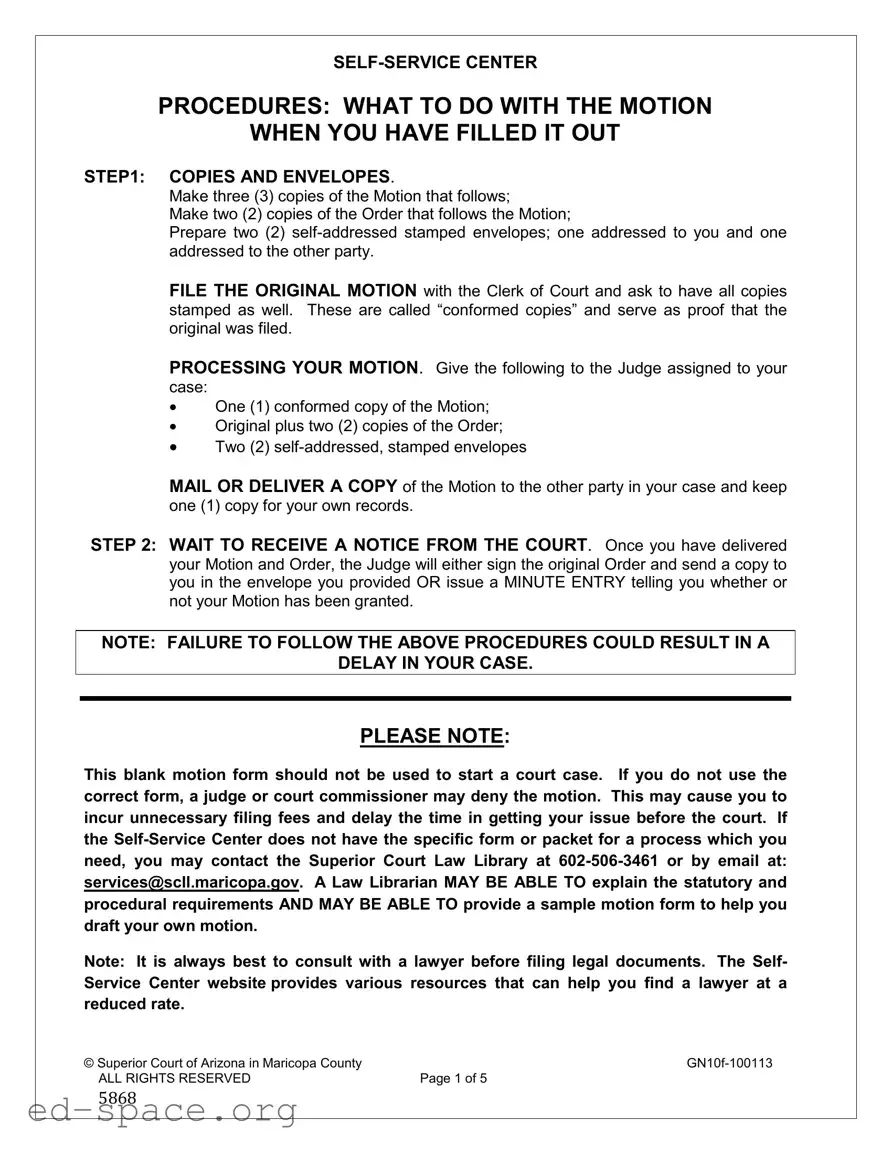
The Motion Maricopa County form serves as a crucial tool for individuals seeking to present their requests before the court in a structured manner. This form not only facilitates the filing process but also ensures that parties adhere to the procedural requirements set forth by the court. When filling out the motion, it is essential to prepare multiple copies, including the original and conformed copies, which serve as proof of filing. Additionally, the process requires the inclusion of self-addressed stamped envelopes, ensuring that both the filing party and the opposing party receive necessary documentation. Once the motion is submitted, the judge will review it and either sign the original order or provide a minute entry that communicates the decision regarding the motion. This clarity is vital, as failure to follow the outlined procedures can lead to delays in the case. It is also important to note that this motion form is not intended to initiate a new court case; using an incorrect form may result in the denial of the motion and additional costs. Individuals are encouraged to consult legal resources or professionals when navigating this process to avoid potential pitfalls and ensure a smoother experience in court.

PROCEDURES: WHAT TO DO WITH THE MOTION
WHEN YOU HAVE FILLED IT OUT
STEP1: COPIES AND ENVELOPES.
Make three (3) copies of the Motion that follows;
Make two (2) copies of the Order that follows the Motion;
Prepare two (2)
FILE THE ORIGINAL MOTION with the Clerk of Court and ask to have all copies stamped as well. These are called “conformed copies” and serve as proof that the original was filed.
PROCESSING YOUR MOTION. Give the following to the Judge assigned to your case:
•One (1) conformed copy of the Motion;
•Original plus two (2) copies of the Order;
•Two (2)
MAIL OR DELIVER A COPY of the Motion to the other party in your case and keep one (1) copy for your own records.
STEP 2: WAIT TO RECEIVE A NOTICE FROM THE COURT. Once you have delivered your Motion and Order, the Judge will either sign the original Order and send a copy to you in the envelope you provided OR issue a MINUTE ENTRY telling you whether or not your Motion has been granted.
NOTE: FAILURE TO FOLLOW THE ABOVE PROCEDURES COULD RESULT IN A
DELAY IN YOUR CASE.
PLEASE NOTE:
This blank motion form should not be used to start a court case. If you do not use the correct form, a judge or court commissioner may deny the motion. This may cause you to incur unnecessary filing fees and delay the time in getting your issue before the court. If the
Note: It is always best to consult with a lawyer before filing legal documents. The Self- Service Center website provides various resources that can help you find a lawyer at a reduced rate.
© Superior Court of Arizona in Maricopa County |
|
ALL RIGHTS RESERVED |
Page 1 of 5 |
5868

Person Filing: |
|
|
|
|
Address (if not protected): |
|
|
|
|
City, State, Zip Code: |
|
|
|
|
Telephone: |
|
|
|
|
Email Address: |
|
|
|
|
Lawyer’s Bar Number: |
|
|
FOR CLERK’S USE ONLY |
|
Representing |
Self, without a Lawyer or |
Attorney for |
Petitioner OR |
Respondent |
SUPERIOR COURT OF ARIZONA
IN MARICOPA COUNTY
Case Number:
Name of Plaintiff or Petitioner
Title:
Name of Defendant or Respondent
Explain what you want the Court to order. The Judge may grant, deny, or change your request (or “motion”). A ruling will be issued by “minute entry.”
© Superior Court of Arizona in Maricopa County |
|
ALL RIGHTS RESERVED |
Page 2 of 5 |
5868

Today’s Date:
Your Signature
© Superior Court of Arizona in Maricopa County |
|
ALL RIGHTS RESERVED |
Page 3 of 5 |
5868

Case No.
This page must be completed and attached to the LAST page of your Motion/Request
I filed the ORIGINAL of the attached document(s) with the Clerk of the Superior Court
in Maricopa County on: |
|
|
|
. |
|
Month |
Date |
Year |
|
I mailed/delivered a COPY of the attached document(s) to the Judicial Officer assigned
to my case, Judge (or Commissioner): |
|
, on |
|
(Judicial Officer assigned to your case) |
|
Month Date Year
I mailed/delivered a COPY of the attached document(s) on this date:
To: __________________________________
Month Date Year
(You must mail a copy of all documents to the other side and his/her lawyer)
Name of Other Side |
Name of Other Side’s Lawyer |
|
|
Address |
Lawyer’s Address |
|
|
City, State, Zip |
City, State, Zip |
By signing below, I state to the Court, under penalty of law, that the information stated on these pages is true and correct to the best of my knowledge and belief.
I further state that I have filed/mailed the attached document(s) as shown above. I understand that if I do not file/mail the attached document(s) as shown above, the judge in my case will not read my request/motion.
Your signature
© Superior Court of Arizona in Maricopa County |
|
ALL RIGHTS RESERVED |
Page 4 of 5 |
5868

Person Filing: |
|
|
|
|
Address (if not protected): |
|
|
|
|
City, State, Zip Code: |
|
|
|
|
Telephone: |
|
|
|
|
Email Address: |
|
|
|
|
Lawyer’s Bar Number: |
|
|
FOR CLERK’S USE ONLY |
|
|
|
|
|
|
Representing |
Self, without a Lawyer or |
Attorney for |
Petitioner OR |
Respondent |
SUPERIOR COURT OF ARIZONA
IN MARICOPA COUNTY
Case Number:
Name of Plaintiff or Petitioner
ORDER
Name of Defendant or Respondent
When you submit a motion [a request] to the Court, you may submit your own proposed version of the Order you want the Judge to sign. IF this motion is a stipulation [an agreement or joint request] presented by two or more parties, you MUST submit your own proposed version of the Order. [Maricopa County Local Rule 3.2 (i)(1)].
The Judicial Officer will make a decision on your request and may sign the page that you submitted, or more likely will direct the Clerk to make a “minute entry” recording the decision. A “minute entry” is a note in the records of the Court’s proceedings. The minute entry will be printed, reviewed, approved and signed by the Judge, and sent to all parties.
If you have submitted your own proposed Order, you must include a copy of the Request and the Order and a stamped envelope addressed to each party who has “entered an appearance” in the case. This means named parties or anyone that has filed papers in the case. [Maricopa County Local Rule 3.2 (i)(1)].
IT IS ORDERED THAT:
DONE IN OPEN COURT: |
. |
|
|
|
|
|
|
|
|
JUDGE/COMMISSIONER |
|
© Superior Court of Arizona in Maricopa County |
|
|
|||
ALL RIGHTS RESERVED |
|
Page 5 of 5 |
|||
5868
| Fact Name | Details |
|---|---|
| Purpose of the Motion | The Motion is a formal request to the court to order a specific action or ruling. |
| Required Copies | You must make three copies of the Motion and two copies of the Order to be filed with the court. |
| Self-Addressed Envelopes | Prepare two self-addressed stamped envelopes, one for yourself and one for the other party involved. |
| Filing Procedure | The original Motion should be filed with the Clerk of Court, and all copies must be stamped as conformed copies. |
| Judge's Decision | The Judge will either sign the original Order or issue a Minute Entry indicating the decision on your Motion. |
| Consequences of Non-Compliance | Failure to follow the outlined procedures may delay your case or result in the denial of your Motion. |
| Consultation Recommendation | It is advised to consult with a lawyer before filing legal documents to ensure compliance with all requirements. |
| Governing Law | This form is governed by the Maricopa County Local Rule 3.2 and the Superior Court rules of Arizona. |
Once you have filled out the Motion Maricopa County form, it is important to follow specific steps to ensure that your motion is processed correctly. This involves making copies, preparing envelopes, and submitting your documents to the court. Adhering to these procedures will help prevent delays in your case.
By following these steps carefully, you can ensure that your motion is filed correctly and that the court receives all necessary documentation. Remember, any oversight could result in delays, so attention to detail is crucial.
What is the purpose of the Motion Maricopa County form?
The Motion Maricopa County form is used to formally request the court to take a specific action or make a ruling in your case. This form allows you to present your request clearly and provides the judge with the necessary information to make a decision. It is essential to use the correct form to avoid delays or denials in your case.
How do I properly fill out and submit the Motion?
To submit the Motion, start by filling it out completely, providing all required information. After filling it out, make three copies of the Motion and two copies of the accompanying Order. Prepare two self-addressed stamped envelopes: one for yourself and one for the other party involved in the case. Then, file the original Motion with the Clerk of Court and request that all copies be stamped as conformed copies. This step is crucial, as it serves as proof of filing.
What should I do after submitting my Motion?
Once you have filed your Motion and Order, you must deliver a copy of the Motion to the other party involved in your case. Keep one copy for your records. After this, wait to receive a notice from the court. The judge will either sign the original Order and send it back to you or issue a minute entry indicating whether your Motion has been granted or denied.
What happens if I do not follow the submission procedures correctly?
Failure to follow the outlined procedures can lead to delays in your case. If you do not use the correct form or fail to file the necessary documents, the judge may deny your Motion. This could result in additional filing fees and prolonged resolution of your issue. It is vital to adhere to the guidelines to ensure your Motion is considered promptly.
Can I use this Motion form to start a new court case?
No, the Motion Maricopa County form should not be used to initiate a new court case. It is specifically designed for requests related to ongoing cases. If you need to start a new case, you must use the appropriate forms designated for that purpose. Using the wrong form may lead to complications and delays.
Is it advisable to consult a lawyer before filing my Motion?
Yes, it is always a good idea to consult with a lawyer before filing legal documents. A legal professional can provide guidance tailored to your situation, ensuring that you understand the statutory and procedural requirements. The Self-Service Center also offers resources to help you find legal assistance, often at reduced rates.
Failing to make the required number of copies. Individuals often overlook the need to create three copies of the Motion and two copies of the Order. This oversight can lead to delays.
Not preparing self-addressed stamped envelopes. It is crucial to provide two self-addressed stamped envelopes, one for yourself and one for the other party. Forgetting this step can result in not receiving important documents.
Neglecting to file the original Motion with the Clerk of Court. Without filing the original, the process cannot proceed, and the Motion may not be considered by the Judge.
Submitting the wrong form. Using an incorrect form can lead to a denial of the Motion by the Judge or court commissioner, potentially incurring unnecessary fees.
Failing to deliver a copy of the Motion to the other party. It is essential to mail or deliver a copy of the Motion to ensure that all parties are informed and can respond accordingly.
Not waiting for a notice from the court. After submitting the Motion and Order, individuals must wait for a response from the Judge. Rushing this step can lead to confusion about the status of the Motion.
Ignoring the need for a proposed Order in case of a stipulation. If the Motion is a joint request from multiple parties, a proposed Order must be included; otherwise, the Motion may be denied.
Not consulting with a lawyer before filing. While self-filing is an option, seeking legal advice can help clarify the process and ensure that all requirements are met.
When filing a Motion in Maricopa County, several other forms and documents are often required or recommended to ensure proper processing and compliance with court rules. Below is a list of these documents, along with brief descriptions of each.
Each of these documents plays a crucial role in the motion process. Ensuring that you have all necessary forms prepared can help prevent delays and complications in your case. Always consider seeking legal advice to navigate these requirements effectively.
When filling out the Motion Maricopa County form, there are important steps to follow. Here is a list of what you should and shouldn't do:
Following these guidelines will help ensure your motion is processed smoothly. Take your time and double-check your work to avoid unnecessary delays.
This is incorrect. The form is specifically designed for submitting motions in ongoing cases, not for initiating new legal actions. Using the wrong form may lead to denial and additional filing fees.
In fact, you must prepare three copies of the Motion and two copies of the Order. This ensures that all parties involved, including the court, have the necessary documentation.
Simply mailing the Motion is not enough. You must file the original Motion with the Clerk of Court and obtain conformed copies to serve as proof of filing.
There is no guarantee that the Judge will approve your request. The Judge will review the Motion and either grant, deny, or modify it, which will be communicated through a minute entry.
It is essential to mail or deliver a copy of the Motion to the other party involved in the case. Keeping them informed is a critical part of the process.
While it is possible to file without legal representation, it is highly recommended to consult with a lawyer. They can provide guidance on the best approach and ensure that all procedural requirements are met.
Key Takeaways for Using the Motion Maricopa County Form: