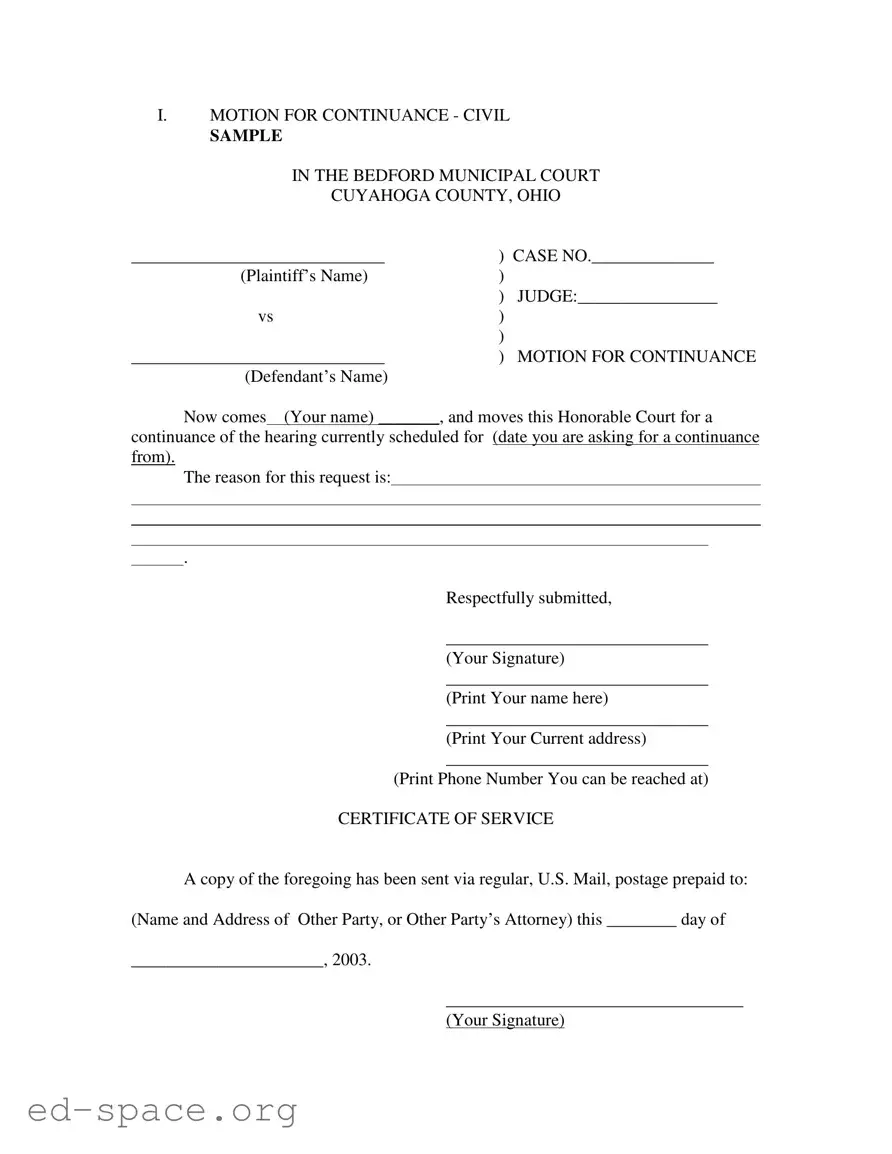
The Motion for Continuance form serves as a formal request to postpone a scheduled court hearing. This document is crucial for individuals involved in civil cases, as it provides a structured way to communicate the need for additional time to prepare or address unforeseen circumstances. Typically, the form includes essential details such as the case number, names of the plaintiff and defendant, and the specific date of the hearing being postponed. It requires the individual requesting the continuance to clearly state their reasons for the request, ensuring that the court understands the justification behind the delay. Additionally, the form must be signed by the requester, who is also responsible for providing their contact information. A Certificate of Service is included to confirm that the other party, or their attorney, has been notified of the motion. This process is designed to maintain transparency and fairness in legal proceedings, allowing all parties involved to have adequate notice of any changes in the schedule.

I.MOTION FOR CONTINUANCE - CIVIL
SAMPLE
IN THE BEDFORD MUNICIPAL COURT
CUYAHOGA COUNTY, OHIO
_____________________________ |
) CASE NO.______________ |
|
(Plaintiffís Name) |
) |
|
|
) |
JUDGE:________________ |
vs |
) |
|
|
) |
|
_____________________________ |
) |
MOTION FOR CONTINUANCE |
(Defendantís Name)
Now comes (Your name) _______, and moves this Honorable Court for a
continuance of the hearing currently scheduled for (date you are asking for a continuance from).
The reason for this request is:
.
Respectfully submitted,
______________________________
(Your Signature)
______________________________
(Print Your name here)
______________________________
(Print Your Current address)
______________________________
(Print Phone Number You can be reached at)
CERTIFICATE OF SERVICE
A copy of the foregoing has been sent via regular, U.S. Mail, postage prepaid to:
(Name and Address of Other Party, or Other Partyís Attorney) this ________ day of
______________________, 2003.
__________________________________
(Your Signature)
| Fact Name | Details |
|---|---|
| Purpose | The Motion for Continuance is used to request a delay in court proceedings. |
| Governing Law | In Ohio, the governing law for continuances is found in Ohio Rules of Civil Procedure, Rule 53. |
| Filing Requirements | The form must include the case number, names of the parties, and the scheduled hearing date. |
| Signature Requirement | The individual filing the motion must sign the document, indicating their request. |
| Service of Process | A certificate of service is required, showing that the other party has been notified. |
| Reason for Request | A valid reason for the continuance must be provided in the motion. |
| Deadline for Filing | The motion should be filed as soon as possible, ideally before the scheduled hearing. |
| Judicial Discretion | The judge has the discretion to grant or deny the motion based on the circumstances. |
| Local Court Rules | Check local court rules for any specific requirements or additional forms that may be needed. |
Once you have gathered all necessary information, you are ready to fill out the Motion For Continuance form. This process involves providing specific details about your case and the reason for your request. After completing the form, it will need to be submitted to the court and served to the other party involved in the case.
What is a Motion for Continuance?
A Motion for Continuance is a formal request to postpone a scheduled court hearing. This motion can be filed by either party involved in a case. It is important to provide a valid reason for the request, such as scheduling conflicts or the need for additional time to prepare.
How do I fill out the Motion for Continuance form?
Begin by entering your name, the case number, and the names of the plaintiff and defendant. Specify the date of the hearing you wish to postpone. Clearly state your reason for requesting the continuance. Finally, sign the form and provide your printed name, address, and phone number for contact purposes.
When should I file a Motion for Continuance?
File your Motion for Continuance as soon as you realize you need to postpone the hearing. The earlier you submit the motion, the better chance you have of it being granted. Always check the court’s rules for any deadlines related to filing such motions.
Do I need to notify the other party when filing a Motion for Continuance?
Yes, you must notify the other party involved in the case. This is done by sending them a copy of your Motion for Continuance via U.S. Mail. Include their name and address in the certificate of service section of the form.
What reasons are acceptable for requesting a continuance?
Acceptable reasons can include personal emergencies, scheduling conflicts, the need for more time to gather evidence, or the unavailability of a key witness. Be sure to explain your reason clearly and concisely in the motion.
Will my request for a continuance always be granted?
No, a request for a continuance may not be granted if the court finds the reason insufficient or if it would unfairly disadvantage the other party. The judge will consider the circumstances before making a decision.
What happens after I file the Motion for Continuance?
After filing, the court will review your motion and decide whether to grant or deny it. You may receive a notice regarding the outcome. If granted, the court will set a new date for the hearing.
Can I attend the hearing if my Motion for Continuance is pending?
Yes, you should attend the hearing unless you receive a notice that your motion has been granted. If the motion is denied, your presence is required unless otherwise instructed by the court.
Is there a fee to file a Motion for Continuance?
Typically, there is no fee specifically for filing a Motion for Continuance. However, check with the court for any local rules or policies that may apply, as fees can vary by jurisdiction.
Neglecting to Provide a Clear Reason for the Continuance: One common mistake is failing to clearly articulate the reason for the request. The court needs to understand why a delay is necessary. Without a solid explanation, the motion may be denied.
Incorrectly Filling Out the Case Information: It's essential to ensure that the case number, names of the parties involved, and the judge's name are accurate. Errors in this section can lead to confusion and delays in processing your motion.
Missing Signature and Contact Information: Some individuals forget to sign the motion or provide their current address and phone number. This information is crucial for the court to contact you regarding your request.
Failing to Serve the Other Party: A motion for continuance must be served to the other party involved in the case. Not doing so can result in the motion being dismissed or denied, as the court may require proof that the other party was informed.
Not Meeting Deadlines: Courts often have strict deadlines for filing motions. Submitting your motion too late can result in it being rejected outright. Always check the court's rules regarding timing.
When filing a Motion for Continuance, several other forms and documents may be required to support the request or to comply with court procedures. Each of these documents plays a crucial role in the legal process, ensuring that all parties are informed and that the court can effectively manage its schedule.
Understanding these associated documents can help streamline the process when filing a Motion for Continuance. Properly preparing and submitting all necessary paperwork not only aids in clarity but also respects the court's time and procedures.
The Motion for Continuance form is similar to several other legal documents. Each serves a specific purpose in court proceedings. Below is a list of ten documents that share similarities with the Motion for Continuance:
When filling out the Motion For Continuance form, it’s important to approach the task with care. Here are six essential do's and don'ts to keep in mind:
Following these guidelines can help ensure that your motion is taken seriously and processed efficiently. Take your time, and don’t hesitate to seek assistance if needed.
When it comes to the Motion for Continuance form, many people have misconceptions that can lead to confusion and mistakes. Here are six common misconceptions:
Understanding these misconceptions is crucial for anyone considering filing a Motion for Continuance. Being informed can help you navigate the legal process more effectively and avoid unnecessary complications.
When filling out the Motion For Continuance form, keep the following key takeaways in mind:
Following these guidelines will help ensure that your Motion For Continuance is properly submitted and considered by the court.