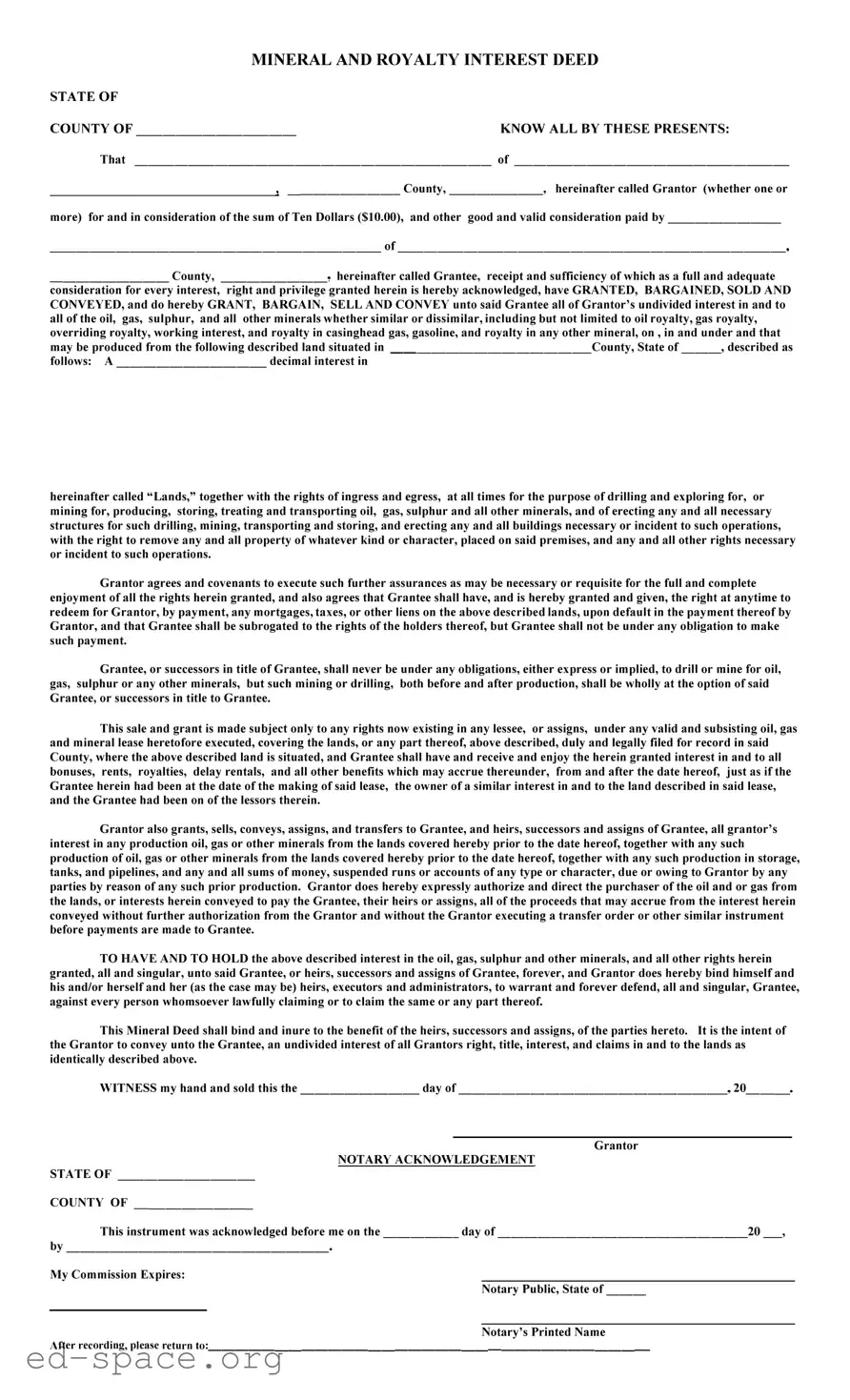
The Mineral Deed form serves as a crucial legal document in the transfer of mineral rights from one party to another. This form outlines the agreement between the Grantor, who is selling their interest, and the Grantee, who is acquiring that interest. It typically involves a nominal consideration, often as little as ten dollars, which signifies the exchange of rights rather than a reflection of the mineral value itself. The deed grants the Grantee all rights to various minerals, including oil, gas, and sulfur, located beneath specified lands. Importantly, it includes provisions for ingress and egress, allowing the Grantee to access the property for exploration and extraction. The Grantor also commits to executing further assurances to ensure the Grantee's enjoyment of the rights conveyed. While the Grantee is not obligated to drill or mine, they gain rights to any existing leases and benefits from production prior to the transfer date. Additionally, the form allows for the direct payment of proceeds from mineral sales to the Grantee, simplifying the transaction process. This document binds the parties and their heirs, ensuring that the rights and obligations persist beyond the initial transfer.

MINERAL AND ROYALTY INTEREST DEED
STATE OF |
|
COUNTY OF |
KNOW ALL BY THESE PRESENTS: |
That |
of |
_________ County, _______, hereinafter called Grantor (whether one or
more) for and in consideration of the sum of Ten Dollars ($10.00), and other good and valid consideration paid by ________
_________ County,
consideration for every interest, right and privilege granted herein is hereby acknowledged, have GRANTED, BARGAINED, SOLD AND CONVEYED, and do hereby GRANT, BARGAIN, SELL AND CONVEY unto said Grantee all of Grantor's undivided interest in and to all of the oil, gas, sulphur, and all other minerals whether similar or dissimilar, including but not limited to oil royalty, gas royalty, overriding royalty, working interest, and royalty in casinghead gas, gasoline, and royalty in any other mineral, on , in and under and that may be produced from the following described land situated in ______________County, State of ___, described as
follows: A ___________ decimal interest in
hereinafter called "Lands," together with the rights of ingress and egress, at all times for the purpose of drilling and exploring for, or mining for, producing, storing, treating and transporting oil, gas, sulphur and all other minerals, and of erecting any and all necessary structures for such drilling, mining, transporting and storing, and erecting any and all buildings necessary or incident to such operations, with the right to remove any and all property of whatever kind or character, placed on said premises, and any and all other rights necessary or incident to such operations.
Grantor agrees and covenants to execute such further assurances as may be necessary or requisite for the full and complete enjoyment of all the rights herein granted, and also agrees that Grantee shall have, and is hereby granted and given, the right at anytime to redeem for Grantor, by payment, any mortgages, taxes, or other liens on the above described lands, upon default in the payment thereof by Grantor, and that Grantee shall be subrogated to the rights of the holders thereof, but Grantee shall not be under any obligation to make such payment.
Grantee, or successors in title of Grantee, shall never be under any obligations, either express or implied, to drill or mine for oil, gas, sulphur or any other minerals, but such mining or drilling, both before and after production, shall be wholly at the option of said Grantee, or successors in title to Grantee.
This sale and grant is made subject only to any rights now existing in any lessee, or assigns, under any valid and subsisting oil, gas and mineral lease heretofore executed, covering the lands, or any part thereof, above described, duly and legally filed for record in said County, where the above described land is situated, and Grantee shall have and receive and enjoy the herein granted interest in and to all bonuses, rents, royalties, delay rentals, and all other benefits which may accrue thereunder, from and after the date hereof, just as if the Grantee herein had been at the date of the making of said lease, the owner of a similar interest in and to the land described in said lease, and the Grantee had been on of the lessors therein.
Grantor also grants, sells, conveys, assigns, and transfers to Grantee, and heirs, successors and assigns of Grantee, all grantor's interest in any production oil, gas or other minerals from the lands covered hereby prior to the date hereof, together with any such production of oil, gas or other minerals from the lands covered hereby prior to the date hereof, together with any such production in storage, tanks, and pipelines, and any and all sums of money, suspended runs or accounts of any type or character, due or owing to Grantor by any parties by reason of any such prior production. Grantor does hereby expressly authorize and direct the purchaser of the oil and or gas from the lands, or interests herein conveyed to pay the Grantee, their heirs or assigns, all of the proceeds that may accrue from the interest herein conveyed without further authorization from the Grantor and without the Grantor executing a transfer order or other similar instrument before payments are made to Grantee.
TO HAVE AND TO HOLD the above described interest in the oil, gas, sulphur and other minerals, and all other rights herein granted, all and singular, unto said Grantee, or heirs, successors and assigns of Grantee, forever, and Grantor does hereby bind himself and his and/or herself and her (as the case may be) heirs, executors and administrators, to warrant and forever defend, all and singular, Grantee, against every person whomsoever lawfully claiming or to claim the same or any part thereof.
This Mineral Deed shall bind and inure to the benefit of the heirs, successors and assigns, of the parties hereto. It is the intent of the Grantor to convey unto the Grantee, an undivided interest of all Grantors right, title, interest, and claims in and to the lands as identically described above.
WITNESS my hand and sold this the ________ day of __________________� 20___
STATE OF
COUNTY OF ________
Grantor
NOTARY ACKNOWLEDGEMENT
This instrument was acknowledged before me on the ______ day of ___________________20 _,
by __________________
My Commission Expires:
Notary Public, State of ___
After recording,
please
Notary's Printed Name
return to:_________________________________
| Fact Name | Details |
|---|---|
| Definition | A mineral deed is a legal document used to transfer ownership of mineral rights from one party (the Grantor) to another (the Grantee). |
| Consideration | The deed typically includes a nominal consideration amount, often set at Ten Dollars ($10.00), to establish a legal basis for the transfer. |
| Rights Granted | The Grantee receives rights to explore, drill, and produce minerals such as oil, gas, and sulfur from the specified land. |
| Governing Law | The laws governing mineral deeds vary by state. For example, in Texas, the Texas Property Code applies, while in Oklahoma, the Oklahoma Statutes Title 52 governs. |
| Binding Effect | The mineral deed binds the Grantor and their heirs, ensuring that the rights granted to the Grantee are preserved for future generations. |
Completing the Mineral Deed form is an important step in transferring mineral rights. Ensure that all information is accurate and complete to avoid any delays or issues. Follow these steps carefully to fill out the form correctly.
Once the form is filled out, it will need to be signed by the Grantor and notarized. After notarization, the document should be recorded with the appropriate county office. This ensures that the transfer of mineral rights is legally recognized and protects the interests of both parties involved.
What is a Mineral Deed?
A Mineral Deed is a legal document that transfers ownership of mineral rights from one party (the Grantor) to another party (the Grantee). This deed allows the Grantee to explore, drill, and produce minerals such as oil and gas from a specified piece of land. It outlines the rights and interests being conveyed, ensuring that the Grantee has the authority to access and utilize those minerals.
What rights are typically included in a Mineral Deed?
The rights included in a Mineral Deed often encompass the extraction of oil, gas, sulfur, and other minerals from the land. Additionally, it grants the Grantee the right to enter the property for exploration and production purposes. This may include constructing necessary facilities and removing equipment from the site. The deed also usually specifies the Grantee’s entitlement to any royalties or bonuses resulting from the mineral extraction.
Is there a minimum amount of consideration required for a Mineral Deed?
Yes, there is typically a nominal amount of consideration required, often as low as ten dollars. This is a legal formality to validate the transaction. However, the actual value of the mineral rights being transferred may be significantly higher. The consideration serves as acknowledgment that a transaction is taking place, even if the amount is minimal.
What happens if the Grantor has existing liens or mortgages on the property?
If there are existing liens or mortgages on the property, the Mineral Deed allows the Grantee to pay off these debts if the Grantor defaults. This means the Grantee can step in to settle any outstanding financial obligations related to the property. However, the Grantee is not required to make these payments, and the deed does not create an obligation for them to do so.
Can the Grantee be forced to drill or mine the minerals?
No, the Grantee is not obligated to drill or mine for minerals. The decision to extract minerals is entirely at the Grantee's discretion. This means they can choose to explore or produce the minerals whenever they see fit, without any pressure to take immediate action.
Incomplete Information: Failing to fill in all required fields can lead to confusion or disputes later. Ensure that all sections, including names, addresses, and county information, are fully completed.
Incorrect Legal Descriptions: Providing inaccurate or vague descriptions of the property can result in legal challenges. Double-check the legal description of the land to ensure it matches official records.
Not Including Consideration: Omitting the consideration amount can invalidate the deed. Always state the agreed-upon amount, even if it is a nominal sum like Ten Dollars ($10.00).
Failure to Notarize: Neglecting to have the deed notarized can render it unenforceable. Make sure to sign the document in the presence of a notary public to validate the transaction.
When dealing with mineral rights and transactions, several important documents often accompany the Mineral Deed form. Each of these documents serves a unique purpose and plays a vital role in ensuring that all parties involved are protected and that the transaction proceeds smoothly. Below is a list of some of the most common forms and documents used in conjunction with the Mineral Deed.
Understanding these documents is crucial for anyone involved in mineral transactions. Each plays a significant role in the overall process, ensuring clarity, legal protection, and proper management of mineral rights. Whether you are a buyer, seller, or simply interested in the field, being familiar with these forms can empower you to navigate the complexities of mineral rights with confidence.
When considering the Mineral Deed form, it is helpful to understand its similarities to other legal documents that convey interests in property or resources. Here are four documents that share key characteristics with a Mineral Deed:
Understanding these similarities can help clarify the nature of mineral rights and the legal frameworks that govern them. Each document plays a crucial role in the management and transfer of property interests, making it essential to grasp their nuances.
When filling out the Mineral Deed form, it's important to be careful and thorough. Here are some key dos and don'ts to keep in mind:
Understanding the Mineral Deed form is crucial for anyone involved in the transfer of mineral rights. However, several misconceptions can lead to confusion. Here are nine common misunderstandings about the Mineral Deed form:
By addressing these misconceptions, individuals can approach the Mineral Deed form with greater clarity and confidence. Understanding the nuances of mineral rights is essential for making informed decisions in real estate and resource management.
When filling out and using the Mineral Deed form, there are several important points to keep in mind. Understanding these key takeaways can help ensure a smooth process.
By paying attention to these aspects, individuals can navigate the Mineral Deed process with greater confidence and clarity.