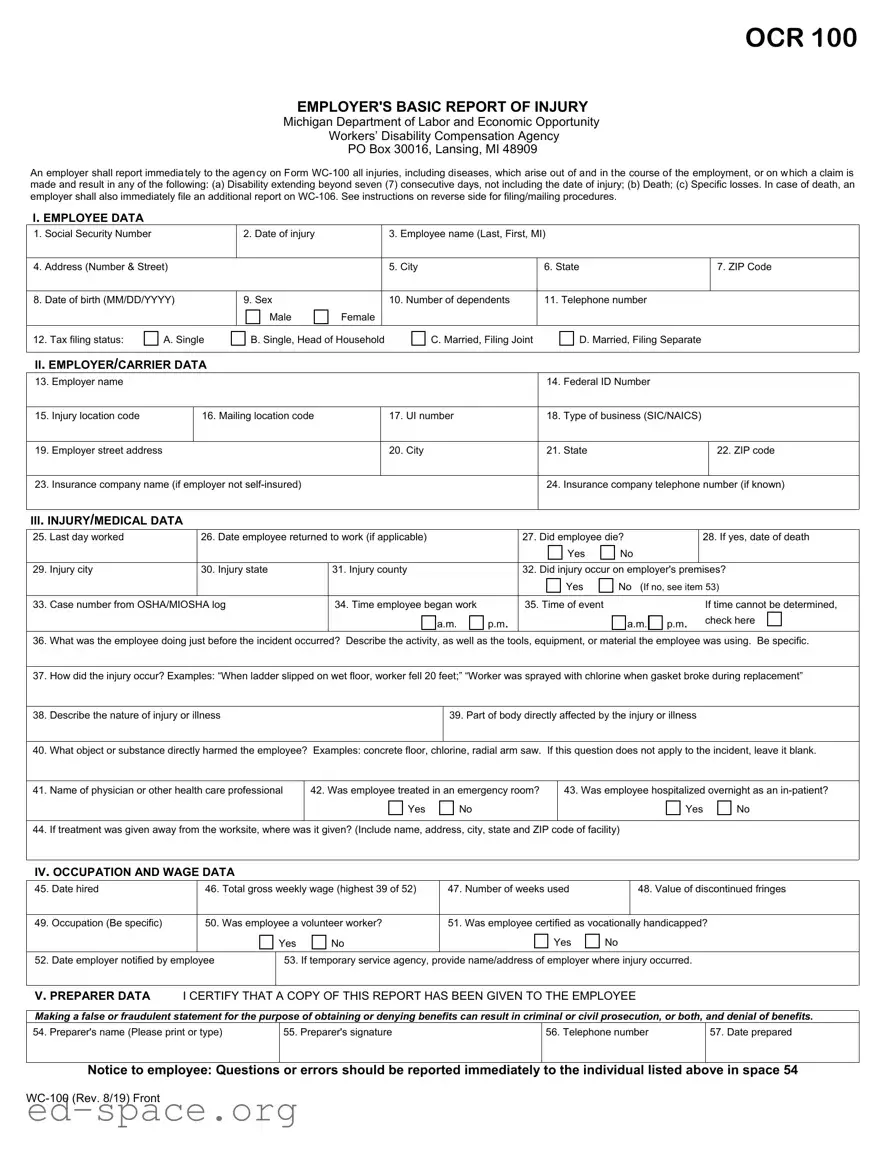
The Michigan WC-100 form serves as a crucial document for employers reporting work-related injuries or illnesses to the state's Workers’ Disability Compensation Agency. This form must be completed promptly when an injury results in significant outcomes such as disability lasting more than seven consecutive days, death, or specific losses. It captures essential employee data, including personal identification details, injury specifics, and employer information. Additionally, it gathers medical data related to the injury, the circumstances surrounding the event, and relevant occupational and wage details. Employers must also include preparer information to certify the accuracy of the report. Adhering to the reporting requirements outlined in the Michigan Occupational Safety and Health Act and related regulations is imperative. Failure to comply can lead to penalties. The WC-100 form not only aids in documenting workplace incidents but also contributes to a broader understanding of workplace safety and injury prevention efforts within Michigan.
OCR 100
EMPLOYER'S BASIC REPORT OF INJURY
Michigan Department of Labor and Economic Opportunity
Workers’ Disability Compensation Agency
PO Box 30016, Lansing, MI 48909
An employer shall report immediately to the agency on Form
I. EMPLOYEE DATA
1. Social Security Number
2. Date of injury
3. Employee name (Last, First, MI)
4. Address (Number & Street)
5. City
6. State
7. ZIP Code
8. Date of birth (MM/DD/YYYY)
12. Tax filing status: |
|
A. Single |
|
9. Sex |
|
|
|
10. Number of dependents |
11. Telephone number |
||||||
|
|
|
Male |
|
Female |
|
|
|
|
|
|
|
|
|
|
|
|
|
|
|
|
|
|||
|
|
B. Single, Head of Household |
|
|
C. Married, Filing Joint |
|
|
D. Married, Filing Separate |
||||
|
|
|
|
|
|
|||||||
II. EMPLOYER/CARRIER DATA
13. Employer name
14. Federal ID Number
15. Injury location code
16. Mailing location code
17. UI number
18. Type of business (SIC/NAICS)
19. Employer street address
20. City
21. State
22. ZIP code
23. Insurance company name (if employer not
24. Insurance company telephone number (if known)
III. INJURY/MEDICAL DATA
25. |
Last day worked |
26. Date employee returned to work (if applicable) |
|
27. Did employee die? |
|
|
28. If yes, date of death |
||||||||||||
|
|
|
|
|
|
|
|
|
|
Yes |
|
No |
|
|
|
|
|
||
|
|
|
|
|
|
|
|
|
|
|
|
|
|
|
|
|
|
|
|
29. |
Injury city |
30. Injury state |
31. Injury county |
|
32. Did injury occur on employer's premises? |
||||||||||||||
|
|
|
|
|
|
|
|
|
|
Yes |
|
No (If no, see item 53) |
|||||||
|
|
|
|
|
|
|
|
|
|
|
|
|
|
|
|||||
33. Case number from OSHA/MIOSHA log |
34. Time employee began work |
|
35. Time of event |
|
|
|
|
If time cannot be determined, |
|||||||||||
|
|
|
|
|
a.m. |
|
p.m. |
|
|
|
|
|
|
a.m. |
|
p.m. |
check here |
|
|
|
|
|
|
|
|
|
|
|
|
|
|
|
|||||||
|
|
|
|
|
|
|
|
|
|
|
|
|
|
||||||
|
|
|
|
|
|
|
|
|
|
|
|
|
|
|
|
|
|
|
|
36.What was the employee doing just before the incident occurred? Describe the activity, as well as the tools, equipment, or material the employee was using. Be specific.
37.How did the injury occur? Examples: “When ladder slipped on wet floor, worker fell 20 feet;” “Worker was sprayed with chlorine when gasket broke during replacement”
38. Describe the nature of injury or illness
39. Part of body directly affected by the injury or illness
40. What object or substance directly harmed the employee? Examples: concrete floor, chlorine, radial arm saw. If this question does not apply to the incident, leave it blank.
|
|
|
|
|
41. Name of physician or other health care professional |
42. Was employee treated in an emergency room? |
43. Was employee hospitalized overnight as an |
||
|
Yes |
No |
Yes |
No |
|
|
|
|
|
44. If treatment was given away from the worksite, where was it given? (Include name, address, city, state and ZIP code of facility) |
|
|||
IV. OCCUPATION AND WAGE DATA
45. Date hired
46. Total gross weekly wage (highest 39 of 52)
47. Number of weeks used
48. Value of discontinued fringes
|
|
|
|
|
|
|
|
|
|
|
|
49. Occupation (Be specific) |
50. Was employee a volunteer worker? |
51. Was employee certified as vocationally handicapped? |
|||||||||
|
|
|
Yes |
|
No |
|
|
Yes |
|
No |
|
|
|
|
|
|
|
|
|||||
|
|
|
|
|
|
||||||
52. Date employer notified by employee |
|
53. If temporary service agency, provide name/address of employer where injury occurred. |
|||||||||
|
|
|
|
|
|
|
|
|
|
|
|
V. PREPARER DATA I CERTIFY THAT A COPY OF THIS REPORT HAS BEEN GIVEN TO THE EMPLOYEE
Making a false or fraudulent statement for the purpose of obtaining or denying benefits can result in criminal or civil prosecution, or both, and denial of benefits.
54. Preparer's name (Please print or type) |
55. Preparer's signature |
56. Telephone number |
57. Date prepared |
Notice to employee: Questions or errors should be reported immediately to the individual listed above in space 54

If you are using this form as a replacement for the Form 301 to document the specifics of an injury or illness for purposes of compliance with the
If you are using this form to report a workers’ compensation injury, follow the instructions in Section A and B.
Section A
This form can be used in lieu of the MIOSHA Form 301, Injury and Illness Incident Report. It is one of the first f orms you must fill out when a recordable
Within 7 calendar days after you receive information that a recordable
According to Public Law of 1970 (P.L.
form on file for 5 years following the year to which it pertains. DO NOT mail this form to the Workers’ Disability Compensation Agency unless it meets the conditions listed below in Section
B.
Section B
You must complete all questions on this form if the injury or disease results in any of the following: (a) Disability extending beyond seven (7) consecutive days, not including the date of injury; (b) Death; (c) Specific loss. The original form must be mailed to the Workers’ Disability Compensation Agency, P.O. Box 30016, Lansing, MI 48909.
Authority: |
Workers' Disability Compensation Act, 408.31(1)(3) |
Completion: |
Mandatory |
Penalty: |
Workers' Disability Compensation Act, 418.631 |
LEO is an equal opportunity employer/program. Auxiliary aids, services and other reasonable accommodations are available upon request to individuals with disabilities.
| Fact Name | Description |
|---|---|
| Form Purpose | The WC-100 form is used by employers in Michigan to report work-related injuries or diseases. |
| Reporting Requirement | Employers must report injuries immediately if they result in disability beyond seven consecutive days, death, or specific losses. |
| Governing Law | This form is governed by the Workers' Disability Compensation Act, specifically sections 408.31(1)(3) and 418.631. |
| Filing Deadline | Employers must complete and submit the form within seven calendar days of learning about a recordable injury or illness. |
| Employee Data | The form requires detailed employee information, including name, Social Security number, and date of birth. |
| Employer Information | Employers must provide their name, Federal ID number, and business type, among other details. |
| Injury Details | Specific questions about the injury, including its nature and how it occurred, must be answered in detail. |
| Emergency Treatment | The form inquires whether the employee received emergency treatment or was hospitalized overnight. |
| Preparer Certification | The individual completing the form must certify that a copy has been provided to the employee and sign it. |
| Record Keeping | Employers are required to keep the completed form on file for five years following the year of the incident. |
Filling out the Michigan WC-100 form is an essential step in reporting workplace injuries. After completing the form, ensure that it is submitted to the appropriate agency promptly, especially if the injury meets specific criteria. This will help facilitate the necessary processes for any claims that may arise.
What is the Michigan WC-100 form?
The Michigan WC-100 form, also known as the Employer's Basic Report of Injury, is a document that employers must complete and submit to the Workers’ Disability Compensation Agency. It is used to report all work-related injuries, including diseases, that occur during employment. This form is essential for documenting incidents that lead to disability, death, or specific losses.
When should the WC-100 form be submitted?
The WC-100 form must be submitted immediately after an injury occurs if it results in a disability that extends beyond seven consecutive days, if there is a death, or if there are specific losses. The employer is responsible for reporting these incidents promptly to ensure compliance with Michigan law.
What information is required on the WC-100 form?
The form requires detailed information about the employee, the employer, and the specifics of the injury. This includes the employee's name, social security number, date of injury, details about the injury, and the employer's information. Additionally, it asks for specifics about the nature of the injury, the part of the body affected, and any medical treatment received.
What happens if the employee dies as a result of the injury?
If an employee dies due to a work-related injury, the employer must complete the WC-100 form and also file an additional report using the WC-106 form. This ensures that all necessary information is reported to the Workers’ Disability Compensation Agency for further processing.
Is the WC-100 form used for all types of workplace injuries?
Yes, the WC-100 form is used for all types of workplace injuries, including those that result in diseases. It is crucial for documenting any incident that leads to a claim for workers’ compensation benefits, ensuring that the employer meets their legal obligations.
How long must employers keep the WC-100 form on file?
Employers are required to keep the WC-100 form on file for five years following the year in which the injury occurred. This retention is important for compliance with the Michigan Occupational Safety and Health Act and helps in tracking the history of workplace injuries.
What should an employer do if they have questions about completing the form?
If an employer has questions or encounters errors while filling out the WC-100 form, they should report these issues immediately to the individual listed in the preparer section of the form. Prompt communication can help resolve any discrepancies and ensure accurate reporting.
Can the WC-100 form be used for purposes other than reporting injuries?
Yes, the WC-100 form can also be used in lieu of the MIOSHA Form 301 to document work-related injuries for compliance with logging requirements. However, when using it for this purpose, employers should follow specific instructions outlined in the form.
What are the penalties for failing to file the WC-100 form correctly?
Failing to file the WC-100 form correctly or submitting false information can result in criminal or civil prosecution, as well as denial of benefits. It is crucial for employers to complete the form accurately to avoid these serious consequences.
How can an employer ensure they are filling out the WC-100 form correctly?
To ensure correct completion of the WC-100 form, employers should carefully read the instructions provided on the form itself. They should also gather all necessary information before starting the form and consider consulting with a legal professional or human resources expert if they have any uncertainties.
Incomplete Employee Information: Failing to provide all necessary details about the employee, such as the social security number or date of birth, can lead to delays in processing the report.
Incorrect Dates: Entering the wrong date of injury or last day worked can create confusion and complicate the claims process.
Missing Employer Information: Omitting critical employer details, like the employer's name or federal ID number, may result in the report being rejected.
Inaccurate Injury Description: Providing vague or unclear descriptions of how the injury occurred can hinder the investigation and resolution of the claim.
Neglecting Medical Data: Failing to include information about the medical treatment received, such as the name of the treating physician or emergency room visits, can affect the validity of the claim.
Not Reporting Deaths Promptly: If an employee dies due to a work-related incident, not filing the additional report (WC-106) immediately can lead to legal complications.
Incorrect Wage Reporting: Misreporting the employee's total gross weekly wage can impact the compensation calculations and result in disputes.
Failure to Sign and Date: Not signing or dating the form can invalidate the submission, as it is essential to certify the accuracy of the information provided.
The Michigan WC-100 form is essential for employers to report workplace injuries and illnesses. Several other forms complement this report, each serving a specific purpose in the workers' compensation process. Below are some of the commonly used documents alongside the WC-100.
Each of these forms plays a crucial role in ensuring that workplace injuries are documented and addressed properly. Employers should familiarize themselves with these documents to facilitate compliance with Michigan's workers' compensation laws.
The Michigan WC-100 form is an important document for reporting workplace injuries and illnesses. However, it shares similarities with several other forms used in various contexts. Here’s a look at ten documents that are similar to the WC-100 form, highlighting how they align in purpose or function.
Each of these forms plays a vital role in maintaining workplace safety and ensuring that employees receive the necessary support after an injury. Understanding their similarities can help employers navigate the complexities of workplace injury reporting more effectively.
When filling out the Michigan WC-100 form, it is crucial to ensure accuracy and completeness. Here are seven important dos and don'ts to keep in mind:
By following these guidelines, you can help ensure that the reporting process goes smoothly and that all necessary information is communicated effectively.
The Michigan WC-100 form is a crucial document for reporting workplace injuries. However, several misconceptions can lead to confusion about its purpose and requirements. Below are five common misconceptions along with clarifications.
This is not true. The form must be completed for any injury that results in a disability lasting more than seven consecutive days, death, or specific losses, regardless of the injury's severity.
In fact, employers are required to report injuries immediately. Delays can lead to complications in claims processing and potential penalties.
This is incorrect. Even if the employee does not seek medical treatment, the form must still be filed if the injury meets the reporting criteria.
The WC-100 does not replace other forms like the MIOSHA Form 301. It serves a specific purpose in the workers' compensation process and must be used alongside other required forms.
While the employer is responsible for submitting the form, it can be completed by a designated preparer. This ensures that all necessary information is accurately reported.
Understanding these misconceptions can help ensure compliance with reporting requirements and facilitate the claims process for injured workers.
Filling out the Michigan WC-100 form is an essential step for employers when reporting workplace injuries. Here are some key takeaways to keep in mind:
By following these guidelines, employers can ensure they are meeting their obligations while providing necessary support to injured employees.