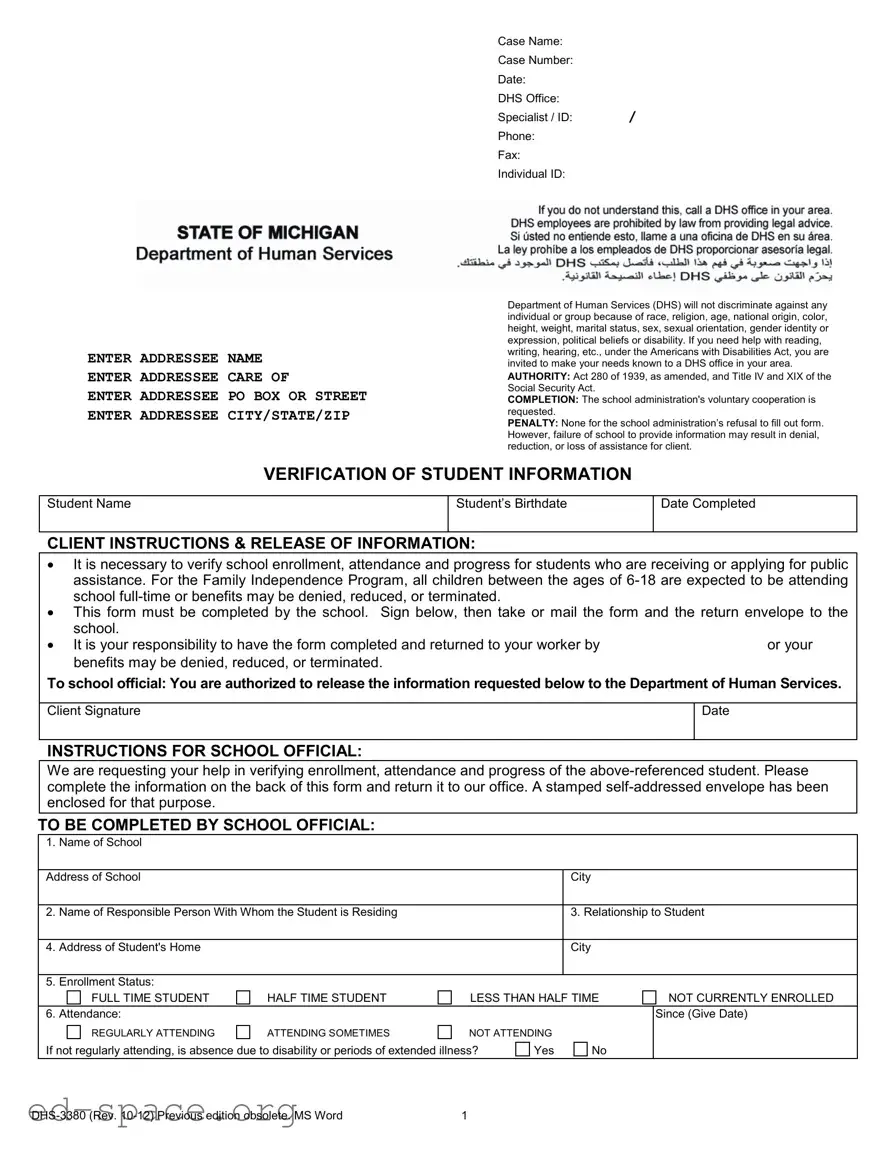
The Michigan Verification Student form plays a crucial role in ensuring that students receiving public assistance are actively engaged in their education. This form is essential for verifying a student's enrollment, attendance, and academic progress, particularly for those involved in the Family Independence Program. Children aged 6 to 18 must attend school full-time to maintain their benefits. The Department of Human Services (DHS) relies on this form to collect necessary information from schools, which includes details about the student's enrollment status, attendance patterns, and the type of educational program they are pursuing. While the school administration's cooperation is requested, it is important to note that there are no penalties for refusing to fill out the form. However, failure to provide the requested information could lead to a denial or reduction of benefits for the student. The form also emphasizes the rights of individuals under the Americans with Disabilities Act, inviting those who may need assistance to communicate their needs. By completing this form, school officials help ensure that students receive the support they need to succeed academically and maintain their eligibility for public assistance.
ENTER ADDRESSEE NAME ENTER ADDRESSEE CARE OF
ENTER ADDRESSEE PO BOX OR STREET ENTER ADDRESSEE CITY/STATE/ZIP
Case Name: |
|
Case Number: |
|
Date: |
|
DHS Office: |
|
Specialist / ID: |
/ |
Phone: |
|
Fax: |
|
Individual ID: |
|
Department of Human Services (DHS) will not discriminate against any individual or group because of race, religion, age, national origin, color, height, weight, marital status, sex, sexual orientation, gender identity or expression, political beliefs or disability. If you need help with reading, writing, hearing, etc., under the Americans with Disabilities Act, you are invited to make your needs known to a DHS office in your area. AUTHORITY: Act 280 of 1939, as amended, and Title IV and XIX of the Social Security Act.
COMPLETION: The school administration's voluntary cooperation is requested.
PENALTY: None for the school administration’s refusal to fill out form. However, failure of school to provide information may result in denial, reduction, or loss of assistance for client.
VERIFICATION OF STUDENT INFORMATION
Student Name
Student’s Birthdate
Date Completed
CLIENT INSTRUCTIONS & RELEASE OF INFORMATION:
•It is necessary to verify school enrollment, attendance and progress for students who are receiving or applying for public assistance. For the Family Independence Program, all children between the ages of
•This form must be completed by the school. Sign below, then take or mail the form and the return envelope to the school.
• It is your responsibility to have the form completed and returned to your worker by |
or your |
benefits may be denied, reduced, or terminated. |
|
To school official: You are authorized to release the information requested below to the Department of Human Services.
Client Signature
Date
INSTRUCTIONS FOR SCHOOL OFFICIAL:
We are requesting your help in verifying enrollment, attendance and progress of the
TO BE COMPLETED BY SCHOOL OFFICIAL:
|
1. |
Name of School |
|
|
|
|
|
|
|
|
|
|
|
|
|
|
|
|
Address of School |
|
|
|
|
City |
|
|
|
|
|
|
|
|
|
|
|
|
2. |
Name of Responsible Person With Whom the Student is Residing |
|
|
3. Relationship to Student |
|||
|
|
|
|
|
|
|
|
|
|
4. |
Address of Student's Home |
|
|
|
|
City |
|
|
|
|
|
|
|
|
|
|
|
5. |
Enrollment Status: |
|
|
|
|
|
|
|
|
FULL TIME STUDENT |
|
HALF TIME STUDENT |
LESS THAN HALF TIME |
NOT CURRENTLY ENROLLED |
||
|
6. |
Attendance: |
|
|
|
|
|
Since (Give Date) |
|
|
REGULARLY ATTENDING |
|
ATTENDING SOMETIMES |
NOT ATTENDING |
|
|
|
|
If not regularly attending, is absence due to disability or periods of extended illness? |
Yes |
No |
|
||||
1 |
|
|
|
|||||
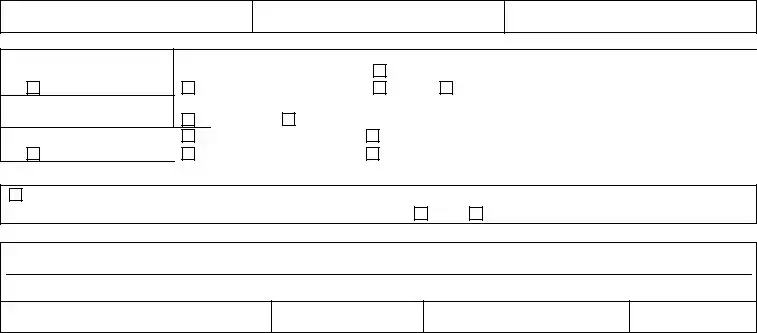
Case Name
Case Number
Specialist
7. Type of Program
8.Curriculum or Major
9.Degree Being Pursued:
HIGH SCHOOL DIPLOMA
|
|
|
|
|
|
VOCATIONAL TRADE OR TECHNICAL TRAINING |
|||
|
|
COLLEGE OR UNIVERSITY |
|
YES |
NO |
Is a High School diploma/GED Required for this program |
|||
|
Participating in Work Study |
|
School Year/Term/Semester Begin Date |
End Date |
|||||
|
|
|
YES |
NO |
|
|
|
|
|
|
|
|
|
|
|
|
|||
|
|
ASSOCIATE OF ARTS DEGREE |
NOT APPLICABLE |
|
Expected Date of Completion/Graduation |
||||
|
|
B.A./B.S |
|
OTHER (Specify) |
|
|
|||
21 Day Compliance Test
Complete if box is checked
10. Has the child regularly attended all school days for the past 21 calendar days?
Yes
No
11. Comments
12. Signature of School Official
Title
Phone Number
Date
2 |
| Fact Name | Details |
|---|---|
| Purpose of the Form | The Michigan Verification Student form is used to verify school enrollment, attendance, and progress for students applying for or receiving public assistance. |
| Governing Laws | This form is governed by Act 280 of 1939, as amended, and Title IV and XIX of the Social Security Act. |
| Client Instructions | Clients must ensure the form is completed by the school and returned to their worker to avoid denial, reduction, or termination of benefits. |
| School's Role | School administration is requested to voluntarily complete the form. However, there is no penalty for refusal. |
| Age Requirement | Children between the ages of 6-18 must be attending school full-time to qualify for the Family Independence Program. |
| Verification Timeline | The form includes a 21-day compliance test to confirm regular attendance over the past three weeks. |
| Disability Accommodations | The Department of Human Services will accommodate individuals with disabilities under the Americans with Disabilities Act. |
Filling out the Michigan Verification Student form is an important step in ensuring that your information is properly verified. This process helps in confirming school enrollment, attendance, and progress for students receiving public assistance. Follow these steps carefully to complete the form accurately.
After submitting the form to the school, a school official will fill out the remaining sections regarding the student’s enrollment and attendance. Ensure that the completed form is returned to your worker to avoid any issues with your benefits.
What is the Michigan Verification Student form?
The Michigan Verification Student form is a document used to verify a student's enrollment, attendance, and academic progress. It is primarily used by the Department of Human Services (DHS) for individuals receiving or applying for public assistance. This form ensures that students meet the necessary educational requirements to maintain their benefits.
Who needs to complete this form?
This form must be completed by the school administration for students who are applying for or receiving public assistance. It is particularly important for children aged 6 to 18, as they are expected to attend school full-time to qualify for certain benefits.
What happens if the school does not complete the form?
If the school fails to provide the necessary information on this form, the client's benefits may be denied, reduced, or terminated. While there is no penalty for the school’s refusal to fill out the form, the consequences for the client can be significant.
How should the form be submitted?
The completed form should be returned to the client, who will then submit it to their DHS worker. It can be mailed or delivered in person. A stamped self-addressed envelope is typically provided to facilitate this process.
What information does the school need to provide?
The school must provide details such as the student's enrollment status, attendance record, type of program, and any relevant comments regarding the student's academic progress. This information helps DHS determine the student's eligibility for assistance.
Is there a deadline for submitting the form?
Yes, it is crucial for the client to ensure that the form is completed and returned to their DHS worker by a specified date. Failure to do so may result in a denial or reduction of benefits.
What if a student is not regularly attending school?
If a student is not regularly attending school, the school official must indicate this on the form. They should also specify if the absence is due to a disability or extended illness, as this information can impact the student’s eligibility for benefits.
What are the legal protections regarding this form?
The DHS will not discriminate against any individual based on race, religion, age, or other factors. Additionally, if assistance is needed due to a disability, individuals are encouraged to communicate their needs to the DHS office. This ensures that everyone has equal access to services.
Missing Addressee Information: One common mistake is failing to fill in the addressee's name, care of address, or PO Box/street address. This information is crucial for proper processing.
Incorrect Student Information: Ensure that the student’s name and birthdate are entered accurately. Any discrepancies can lead to delays or issues with verification.
Incomplete Case Details: Forgetting to include the case name, case number, or DHS office information can hinder the form's processing. All relevant case details must be provided.
Neglecting to Sign: Both the client and the school official must sign the form. An unsigned form will not be accepted, which can result in loss of benefits.
Improper Completion of Enrollment Status: Selecting the wrong enrollment status (full-time, half-time, etc.) can affect the outcome of the assistance application. Be sure to choose the correct status.
Failure to Provide Attendance Dates: Not specifying the date since when the student has been attending can lead to complications. Always include this date for clarity.
Ignoring Comments Section: Leaving the comments section blank may overlook important information that could help in the verification process. Use this space to clarify any unique circumstances.
Omitting Program Type: Not indicating the type of program the student is enrolled in (vocational, K-12, etc.) is a frequent oversight. This information is essential for accurate processing.
Incorrect Degree Information: If the student is pursuing a degree, ensure that the correct degree type is marked. Incorrect information can lead to delays in assistance.
Not Meeting Submission Deadlines: Failing to return the completed form by the specified deadline can result in denial or reduction of benefits. Timeliness is key.
The Michigan Verification Student form is a critical document for students receiving public assistance. However, it often accompanies several other forms and documents that help streamline the verification process. Below are some of the key documents commonly used in conjunction with this form.
Understanding these accompanying documents is essential for both students and schools to ensure compliance with public assistance requirements. Timely submission of these forms can significantly impact the eligibility for benefits, making it imperative to handle them with care.
The Michigan Verification Student form serves a specific purpose in verifying student information for public assistance programs. Several other documents share similar functions, focusing on the verification of educational status, attendance, and progress. Below is a list of documents that are comparable to the Michigan Verification Student form, along with explanations of their similarities.
When filling out the Michigan Verification Student form, it is important to follow specific guidelines to ensure accuracy and compliance. Below is a list of recommended actions and pitfalls to avoid.
Misconceptions about the Michigan Verification Student form can lead to confusion for students, parents, and school officials. Understanding these misconceptions is crucial for ensuring compliance and maintaining public assistance benefits. Below are five common misconceptions:
Clarifying these misconceptions can help ensure that all parties involved understand their responsibilities and the implications of the Michigan Verification Student form.
When filling out and using the Michigan Verification Student form, consider the following key takeaways: