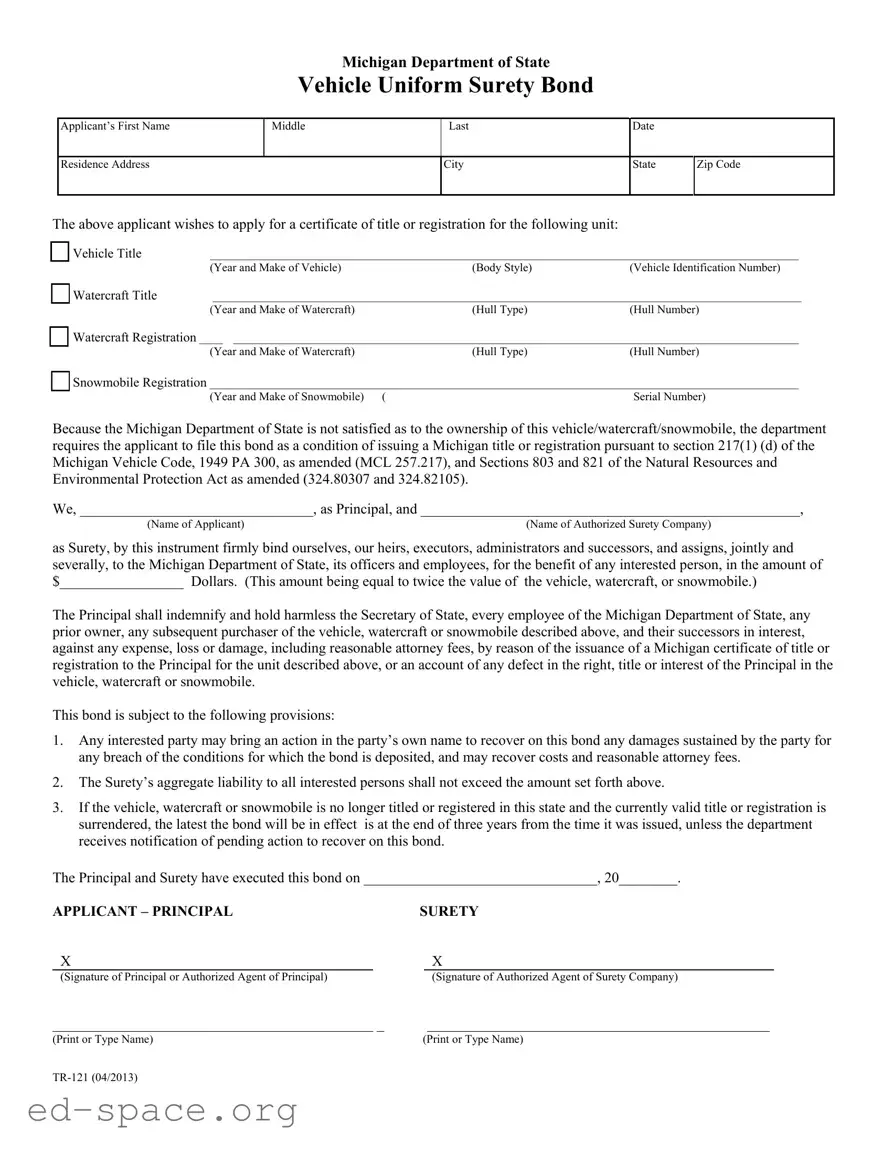
The Michigan Tr 121 form is an essential document for individuals seeking to title or register a vehicle, watercraft, or snowmobile that lacks a clear ownership record. This form serves as a Vehicle Uniform Surety Bond, ensuring that the applicant can provide financial security to the Michigan Department of State. To initiate the process, applicants must provide their full name, address, and details about the unit they wish to title or register, including its year, make, and identification numbers. The bond amount is set at twice the value of the vehicle, watercraft, or snowmobile, which reflects the financial commitment required from the applicant. The form necessitates signatures from both the applicant, referred to as the “Principal,” and an authorized representative from a licensed surety company. This bond protects the Michigan Department of State and any interested parties against potential losses related to ownership disputes. Additionally, it is important to note that the bond remains effective for three years, unless the title or registration is surrendered or there is a pending action to recover on the bond. Understanding the requirements and provisions of the Michigan Tr 121 form is crucial for a smooth application process and to ensure compliance with state regulations.

Michigan Department of State
Vehicle Uniform Surety Bond
Applicant’s First Name |
Middle |
Last |
Date |
|
Residence Address |
|
City |
State |
Zip Code |
The above applicant wishes to apply for a certificate of title or registration for the following unit:
Vehicle Title |
_____________________________________________________________________________________________________ |
||
|
(Year and Make of Vehicle) |
(Body Style) |
(Vehicle Identification Number) |
Watercraft Title |
_____________________________________________________________________________________________________ |
||
|
(Year and Make of Watercraft) |
(Hull Type) |
(Hull Number) |
Watercraft Registration ____ _________________________________________________________________________________________________
(Year and Make of Watercraft)(Hull Type)(Hull Number)
Snowmobile Registration _____________________________________________________________________________________________________
(Year and Make of Snowmobile) ( |
Serial Number) |
Because the Michigan Department of State is not satisfied as to the ownership of this vehicle/watercraft/snowmobile, the department requires the applicant to file this bond as a condition of issuing a Michigan title or registration pursuant to section 217(1) (d) of the Michigan Vehicle Code, 1949 PA 300, as amended (MCL 257.217), and Sections 803 and 821 of the Natural Resources and Environmental Protection Act as amended (324.80307 and 324.82105).
We, ________________________________, as Principal, and ____________________________________________________,
(Name of Applicant)(Name of Authorized Surety Company)
as Surety, by this instrument firmly bind ourselves, our heirs, executors, administrators and successors, and assigns, jointly and severally, to the Michigan Department of State, its officers and employees, for the benefit of any interested person, in the amount of $_________________ Dollars. (This amount being equal to twice the value of the vehicle, watercraft, or snowmobile.)
The Principal shall indemnify and hold harmless the Secretary of State, every employee of the Michigan Department of State, any prior owner, any subsequent purchaser of the vehicle, watercraft or snowmobile described above, and their successors in interest, against any expense, loss or damage, including reasonable attorney fees, by reason of the issuance of a Michigan certificate of title or registration to the Principal for the unit described above, or an account of any defect in the right, title or interest of the Principal in the vehicle, watercraft or snowmobile.
This bond is subject to the following provisions:
1.Any interested party may bring an action in the party’s own name to recover on this bond any damages sustained by the party for any breach of the conditions for which the bond is deposited, and may recover costs and reasonable attorney fees.
2.The Surety’s aggregate liability to all interested persons shall not exceed the amount set forth above.
3.If the vehicle, watercraft or snowmobile is no longer titled or registered in this state and the currently valid title or registration is surrendered, the latest the bond will be in effect is at the end of three years from the time it was issued, unless the department receives notification of pending action to recover on this bond.
The Principal and Surety have executed this bond on ________________________________, 20________.
APPLICANT – PRINCIPAL |
SURETY |
||
X |
|
X |
|
(Signature of Principal or Authorized Agent of Principal) |
|
|
(Signature of Authorized Agent of Surety Company) |
____________________________________________ _ |
_______________________________________________ |
||
(Print or Type Name) |
(Print or Type Name) |
||
|
|
||
Michigan Department of State
Vehicle Uniform Surety Bond
Instruction Sheet
1.Before you can title or register a motor vehicle, trailer, trailer coach, watercraft or snowmobile that has no clearly established record of ownership, you must file a Vehicle Uniform Surety Bond
2.The bond’s amount must equal twice the value of the vehicle, watercraft or snowmobile. A bond may not be needed for
3.The person applying for the title or registration, whether an individual, partnership, firm or corporation, and a representative of the insurance company or bonding agency must sign the surety bond. Applicants are named as the “Principal” and must include their complete residence or business address.
4.The Michigan Department of Licensing and Regulatory Affairs must license the surety company. A duly authorized agent of the surety company must issue the bond. If the agent is a licensed nonresident agent, a licensed resident agent must countersign the bond.
5.The effective date of the bond must be no later than the date of application for the title or registration.
6.A surety bond is issued for three years.
| Fact Name | Fact Description |
|---|---|
| Form Purpose | The Michigan TR 121 form is used to file a Vehicle Uniform Surety Bond when applying for a title or registration for a vehicle, watercraft, or snowmobile with no established ownership record. |
| Governing Law | This form is governed by Section 217(1)(d) of the Michigan Vehicle Code, 1949 PA 300, as amended (MCL 257.217), and Sections 803 and 821 of the Natural Resources and Environmental Protection Act (324.80307 and 324.82105). |
| Bond Amount | The bond amount must equal twice the value of the vehicle, watercraft, or snowmobile for which the title or registration is sought. |
| Exemptions | No bond is required for Michigan-titled vehicles over 10 years old valued at $2,500 or less, or for watercraft or snowmobiles not titled or registered in another state and valued at $2,500 or less. |
| Signatories | The bond must be signed by the applicant, referred to as the "Principal," and a representative of the surety company. |
| Surety Company Licensing | The surety company must be licensed by the Michigan Department of Licensing and Regulatory Affairs. A duly authorized agent must issue the bond. |
| Effective Date | The effective date of the bond must coincide with the date of application for the title or registration. |
| Bond Duration | A surety bond is valid for three years from the date of issuance unless a pending action to recover on the bond is notified to the department. |
| Legal Action | Any interested party may bring legal action to recover damages for any breach of the bond's conditions, including costs and reasonable attorney fees. |
Filling out the Michigan TR-121 form is an important step for those seeking to title or register a vehicle, watercraft, or snowmobile without a clear record of ownership. Follow these steps carefully to ensure all necessary information is included.
What is the Michigan TR 121 form?
The Michigan TR 121 form is a Vehicle Uniform Surety Bond required by the Michigan Department of State. It is necessary for individuals applying for a certificate of title or registration for a vehicle, watercraft, or snowmobile that lacks a clearly established record of ownership. This bond serves as a guarantee of ownership and protects interested parties against potential claims related to the title or registration.
Who needs to file the TR 121 form?
Anyone applying for a title or registration for a motor vehicle, trailer, trailer coach, watercraft, or snowmobile without a clear ownership record must file the TR 121 form. This includes individuals, partnerships, firms, or corporations. The bond is typically required when the vehicle, watercraft, or snowmobile is not titled or registered in another state.
How is the bond amount determined?
The bond amount must equal twice the value of the vehicle, watercraft, or snowmobile. For example, if the vehicle is valued at $3,000, the bond amount would need to be $6,000. However, vehicles that are 10 years or older and valued at $2,500 or less may not require a bond. The same applies to watercraft or snowmobiles that are not titled or registered in another state and worth $2,500 or less.
Who signs the TR 121 form?
The TR 121 form must be signed by the applicant, referred to as the “Principal,” and a representative of the surety company. The Principal must provide their complete residence or business address. The surety company must be licensed by the Michigan Department of Licensing and Regulatory Affairs, and a duly authorized agent of the company must issue the bond.
How long is the bond effective?
The surety bond is effective for three years from the date it is issued. If the vehicle, watercraft, or snowmobile is no longer titled or registered in Michigan and the valid title or registration is surrendered, the bond will remain in effect for a maximum of three years unless the Michigan Department of State receives notification of a pending action to recover on the bond.
What happens if there is a claim against the bond?
If an interested party believes they have sustained damages due to the issuance of a title or registration, they can bring an action in their own name to recover on the bond. They may recover costs and reasonable attorney fees as part of their claim. However, the surety's total liability to all interested persons cannot exceed the bond amount specified in the TR 121 form.
What is the process for filing the TR 121 form?
To file the TR 121 form, the applicant must complete the form and submit it along with their title or registration application to the Michigan Department of State. It is essential that the effective date of the bond aligns with the application date. The bond must be issued by a licensed surety company, and all required signatures must be present on the form.
Where can I get the TR 121 form?
The TR 121 form can be obtained from the Michigan Department of State’s website or at their local offices. It is advisable to ensure that you have the most current version of the form, as updates may occur.
Failing to provide the complete name of the applicant. Ensure that first, middle, and last names are included.
Omitting the residential address. The form requires a full address, including city, state, and zip code.
Not specifying the type of unit accurately. Clearly indicate whether it is a vehicle, watercraft, or snowmobile.
Incorrectly filling out the vehicle or watercraft details. This includes year, make, body style, and identification numbers.
Neglecting to sign the bond. Both the applicant and an authorized agent of the surety company must sign.
Providing an incorrect bond amount. The bond must equal twice the value of the unit being registered.
Not ensuring the effective date of the bond matches the application date. This is crucial for validity.
Using a non-licensed surety company. Verify that the surety company is licensed by the Michigan Department of Licensing and Regulatory Affairs.
Failing to include the signature of a licensed agent if the agent is a nonresident. A resident agent must countersign the bond.
The Michigan TR-121 form is a crucial document for individuals seeking to obtain a certificate of title or registration for a vehicle, watercraft, or snowmobile when ownership is not clearly established. However, several other forms and documents are often used in conjunction with the TR-121 to facilitate the registration process. Below is a brief overview of these related documents.
In summary, the Michigan TR-121 form works in conjunction with several other forms and documents that help establish ownership and facilitate the registration of vehicles, watercraft, and snowmobiles. Understanding these related documents is vital for a smooth application process and to avoid potential delays.
The Michigan TR 121 form is similar to several other documents that serve the purpose of establishing ownership and providing a guarantee for various types of vehicles and watercraft. Here are seven documents that share similarities with the TR 121 form:
When filling out the Michigan TR 121 form, here are some important things to keep in mind:
Misconceptions about the Michigan TR 121 form can lead to confusion regarding the process of obtaining a vehicle, watercraft, or snowmobile title or registration. Below are eight common misconceptions and their clarifications:
The TR 121 form is required for vehicles, watercraft, and snowmobiles that lack a clear record of ownership.
A surety bond must be issued by a company licensed by the Michigan Department of Licensing and Regulatory Affairs.
The bond amount must equal twice the value of the vehicle, watercraft, or snowmobile.
The bond is effective for three years unless the vehicle, watercraft, or snowmobile is no longer registered in Michigan.
Both the applicant and a representative of the surety company must sign the bond for it to be valid.
The TR 121 form must accompany the title or registration application to be processed.
The surety's liability is limited to the bond amount specified in the form.
The effective date of the bond must be no later than the date of the application for title or registration.
When filling out the Michigan TR-121 form, keep these key takeaways in mind: