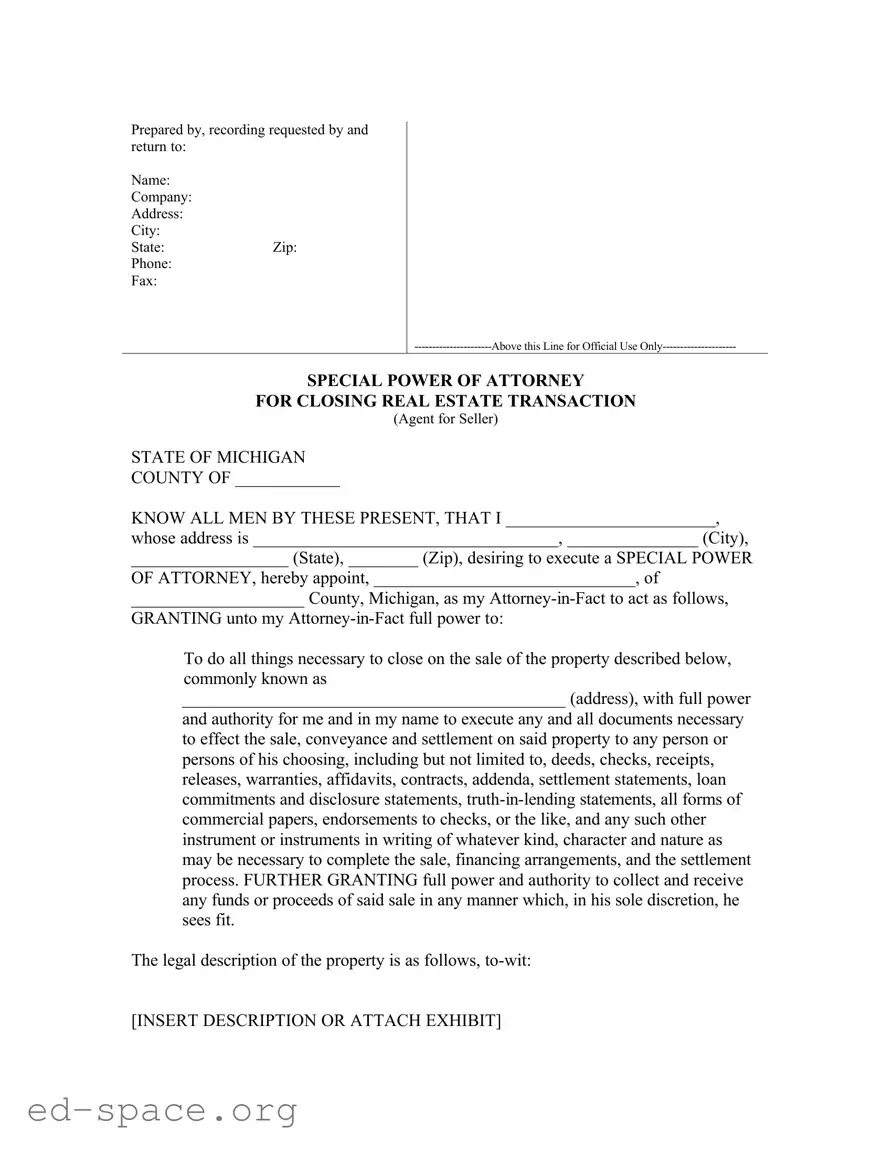
The Michigan Sales form is an important document used in real estate transactions within the state. This form allows a seller to grant a Special Power of Attorney to an agent, empowering them to act on the seller's behalf during the closing process. It includes essential details such as the names and addresses of the parties involved, including the seller, the agent, and witnesses. The form outlines the agent's authority to perform various tasks necessary to complete the sale, such as signing documents, collecting funds, and executing contracts. Additionally, it requires a legal description of the property being sold. The document must be signed, witnessed, and notarized to ensure its validity. This form not only streamlines the closing process but also provides clarity and security for all parties involved.

Prepared by, recording requested by and return to:
Name:
Company:
Address:
City:
State:Zip:
Phone:
Fax:
SPECIAL POWER OF ATTORNEY
FOR CLOSING REAL ESTATE TRANSACTION
(Agent for Seller)
STATE OF MICHIGAN
COUNTY OF ____________
KNOW ALL MEN BY THESE PRESENT, THAT I ________________________,
whose address is ___________________________________, _______________ (City),
__________________ (State), ________ (Zip), desiring to execute a SPECIAL POWER
OF ATTORNEY, hereby appoint, ______________________________, of
____________________ County, Michigan, as my
GRANTING unto my
To do all things necessary to close on the sale of the property described below, commonly known as
____________________________________________ (address), with full power
and authority for me and in my name to execute any and all documents necessary to effect the sale, conveyance and settlement on said property to any person or persons of his choosing, including but not limited to, deeds, checks, receipts, releases, warranties, affidavits, contracts, addenda, settlement statements, loan commitments and disclosure statements,
The legal description of the property is as follows,
[INSERT DESCRIPTION OR ATTACH EXHIBIT]
I hereby ratify and confirm all that said
All acts done by means of this power shall be done in my name, and all instruments and documents executed by my Attorney hereunder shall contain my name, followed by that of my attorney and the description
DATED this the ________ day of ___________________, 20____.
________________________________
Signature
Print Name: ______________________
_______________________________
Witness
Print Name: _____________________
_______________________________
Witness
Print Name: _____________________
STATE OF MICHIGAN
COUNTY OF _________________
The foregoing instrument was acknowledged before me this
_____________________ (date) by
___________________________________________ (name of person acknowledged).
_____________________________
Notary Public
Printed Name: _________________
My Commission Expires:
____________________
Principal Name and Address |
|||
Name: |
|
Name: |
|
|
|
|
|
Address: |
|
Address: |
|
|
|
|
|
City: |
|
City: |
|
|
|
|
|
State: |
Zip: |
State: |
Zip: |
|
|
|
|
Phone: |
|
Phone: |
|
|
|
|
|
|
|
|
|
Witness Name and Address |
Witness Name and Address |
|
|
Name: |
|
Name: |
|
|
|
|
|
Address: |
|
Address: |
|
|
|
|
|
City: |
|
City: |
|
|
|
|
|
State: |
Zip: |
State: |
Zip: |
|
|
|
|
Phone: |
|
Phone: |
|
|
|
|
|
| Fact Name | Details |
|---|---|
| Document Purpose | This form serves as a Special Power of Attorney specifically for closing real estate transactions in Michigan. |
| Governing Law | The form is governed by the laws of the State of Michigan, particularly the Michigan Compiled Laws (MCL) related to powers of attorney. |
| Principal's Information | The form requires the principal's name, address, city, state, and zip code, ensuring clear identification. |
| Attorney-in-Fact | The individual designated as the Attorney-in-Fact must be a resident of Michigan and is granted extensive powers to act on behalf of the principal. |
| Property Description | A detailed description of the property involved in the transaction is necessary, ensuring clarity in the legal authority granted. |
| Authority Granted | The Attorney-in-Fact is authorized to execute various documents including deeds, contracts, and settlement statements, among others. |
| Revocation Process | This Power of Attorney remains valid until a revocation is recorded in the appropriate county recorder's office. |
| Notary Requirement | The form must be acknowledged by a notary public to ensure its legal enforceability. |
| Witnesses | Two witnesses are required to sign the document, providing additional verification of the principal's intent. |
Filling out the Michigan Sales form requires careful attention to detail. This form will enable you to appoint an attorney-in-fact who will act on your behalf in a real estate transaction. Ensure that all information is accurate and complete to avoid any delays in the process.
What is the Michigan Sales form used for?
The Michigan Sales form is primarily used to grant a Special Power of Attorney for closing a real estate transaction. This allows an appointed agent to act on behalf of the seller, enabling them to execute necessary documents to finalize the sale of a property.
Who needs to fill out the Michigan Sales form?
The seller of the property needs to fill out the Michigan Sales form. If the seller cannot be present at the closing, they should appoint an agent to act on their behalf by completing this form.
What information is required on the form?
Key information includes the names and addresses of the seller and the appointed agent, the property’s legal description, and the seller’s signature. Additionally, witness signatures and notary acknowledgment are also needed to validate the document.
Can I use this form for any type of property sale?
Yes, the Michigan Sales form can be used for various types of real estate transactions, including residential and commercial properties. However, it's essential to ensure that all details specific to the property are accurately filled out.
How long is the Special Power of Attorney valid?
The Special Power of Attorney remains valid until it is revoked and that revocation is recorded in the county recorder's office where the property is located. Until then, third parties can rely on the authority granted in the form.
What happens if I change my mind after signing the form?
If you change your mind after signing, you can revoke the Special Power of Attorney. To do this, you must prepare a revocation document and record it in the appropriate county office where the original form was filed.
Do I need a lawyer to complete the Michigan Sales form?
While it's not mandatory to have a lawyer to complete the Michigan Sales form, it can be beneficial. A legal professional can ensure that all details are correct and that the form complies with state laws, helping to avoid any potential issues during the transaction.
Is notarization required for the Michigan Sales form?
Yes, notarization is required. The form must be acknowledged by a notary public to ensure its validity. This step helps confirm the identities of the parties involved and adds an extra layer of protection against fraud.
Incomplete Information: Failing to fill out all required fields can lead to delays. Each section, such as name, address, and phone number, must be completed accurately.
Incorrect Signatures: Not having the proper signatures can invalidate the document. Ensure that all necessary parties sign the form, including witnesses and the notary.
Missing Legal Description: Omitting the legal description of the property is a common error. Always include a complete and accurate description to avoid confusion later.
Improper Notarization: Failing to have the document notarized correctly can cause issues. The notary must complete their section accurately, including their signature and commission expiration date.
Ignoring Local Practices: Some areas may have specific requirements. Be aware of local practices that might differ from the general instructions provided in the form.
The Michigan Sales form is often accompanied by several other important documents that facilitate the real estate transaction process. Below are five commonly used forms and documents that work in conjunction with the Michigan Sales form.
These documents work together to ensure a smooth and legally compliant real estate transaction. Each plays a vital role in protecting the interests of both buyers and sellers throughout the process.
The Michigan Sales form, particularly the Special Power of Attorney for Closing Real Estate Transactions, shares similarities with several other legal documents. Here are ten documents that are comparable, along with explanations of how they relate:
When filling out the Michigan Sales form, there are important dos and don'ts to keep in mind. Follow these guidelines to ensure accuracy and compliance.
Understanding the Michigan Sales form can be tricky, and there are several misconceptions that often arise. Here’s a list of nine common misunderstandings about this important document:
By understanding these misconceptions, you can navigate the Michigan Sales form more effectively and ensure that your real estate transactions proceed smoothly.
The Michigan Sales form is a crucial document for executing a real estate transaction. Below are key takeaways for filling out and using this form effectively: