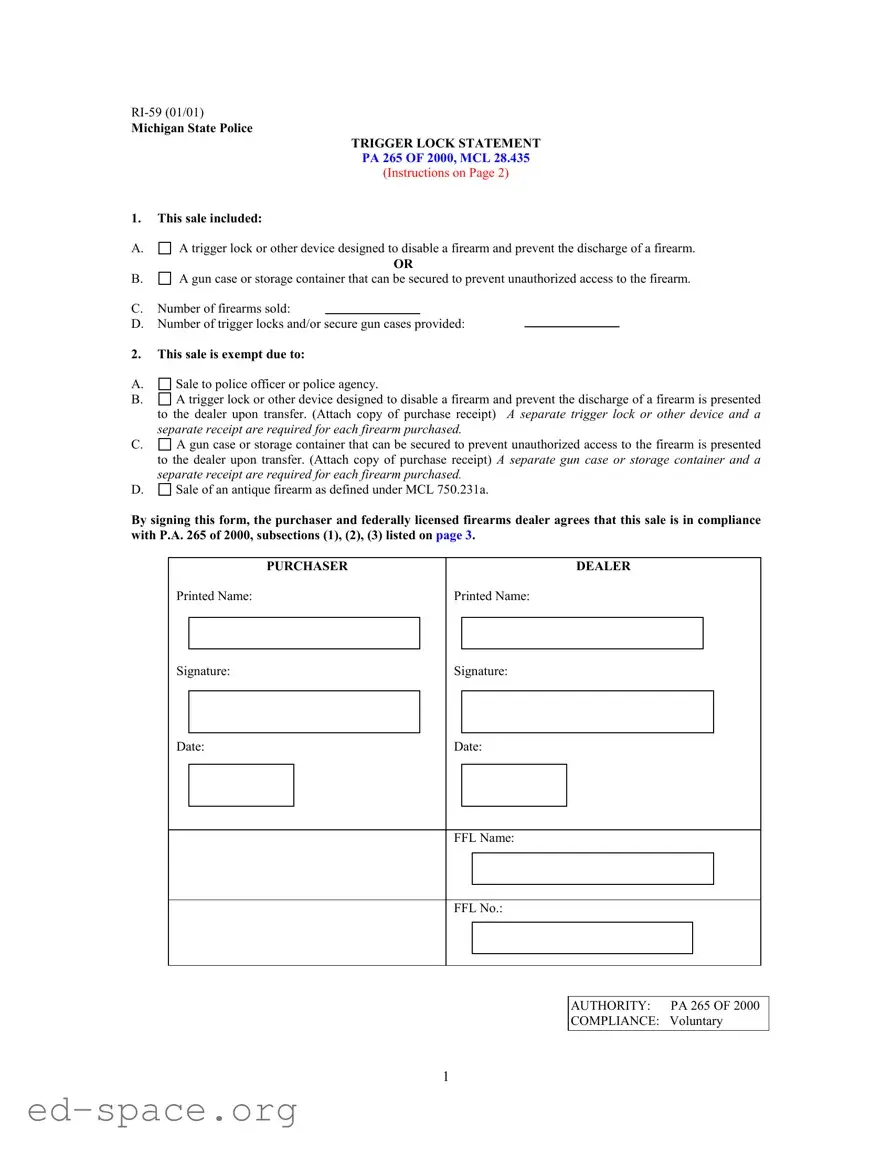
The Michigan RI-59 form plays a crucial role in firearm sales within the state, ensuring that safety measures are in place for responsible ownership. This form requires dealers to provide either a trigger lock or a secure gun case with each firearm sold, promoting safe storage practices. When a firearm is sold, the dealer must document the number of firearms and the corresponding safety devices included in the transaction. Certain exemptions exist, such as sales to law enforcement officers or when the buyer presents a valid trigger lock or gun case receipt. The form also emphasizes compliance with state law, specifically Public Act 265 of 2000, which mandates these safety measures. Both the purchaser and the dealer must sign the form, affirming their agreement to adhere to these regulations. Keeping a copy of the signed form for six years is essential for record-keeping, further reinforcing the commitment to firearm safety in Michigan.
Michigan State Police
TRIGGER LOCK STATEMENT
PA 265 OF 2000, MCL 28.435
(Instructions on Page 2)
1.This sale included:
A.
B.
A trigger lock or other device designed to disable a firearm and prevent the discharge of a firearm.
OR
A gun case or storage container that can be secured to prevent unauthorized access to the firearm.
C.Number of firearms sold:
D.Number of trigger locks and/or secure gun cases provided:
2.This sale is exempt due to:
A. Sale to police officer or police agency.
B. A trigger lock or other device designed to disable a firearm and prevent the discharge of a firearm is presented to the dealer upon transfer. (Attach copy of purchase receipt) A separate trigger lock or other device and a separate receipt are required for each firearm purchased.
C. A gun case or storage container that can be secured to prevent unauthorized access to the firearm is presented to the dealer upon transfer. (Attach copy of purchase receipt) A separate gun case or storage container and a
separate receipt are required for each firearm purchased.
D. Sale of an antique firearm as defined under MCL 750.231a.
By signing this form, the purchaser and federally licensed firearms dealer agrees that this sale is in compliance with P.A. 265 of 2000, subsections (1), (2), (3) listed on page 3.
PURCHASER
DEALER
Printed Name:
Printed Name:
Signature:
Signature:
Date:
Date:
FFL Name:
FFL No.:
AUTHORITY: PA 265 OF 2000
COMPLIANCE: Voluntary
1
Michigan State Police
TRIGGER LOCK STATEMENT INSTRUCTIONS
PA 265 OF 2000, MCL 28.435
1.Dealer should allow purchaser to review MCL 28.435 (page 3).
2.One signed statement is required for each transaction. Multiple sales of firearms in one transaction require only one form. However, each firearm must be accompanied with a trigger lock or storage container.
3.Dealer indicates method of compliance by checking A or B under #1 OR one of A, B, C, D under #2 on page 1.
4.Dealer indicates number of firearms sold and number of trigger locks and/or other storage containers provided under #1, C, and D on page 1.
5.If the purchaser brings a receipt for a trigger lock or other device mentioned in section 15(2)(b)(i) or section 15(2)(b)(ii), THE dealer must attach a copy of the purchase receipt to this form. Each sale of a firearm requires a trigger lock or storage container.
6.It is recommended that a copy of the signed statement (page 1) be attached to ATF form 4473 or be filed individually by date of sale.
7.The signed statement and, if applicable, copies of receipts under section 15(2)(b) or 15(2)(c) must be retained by the federally licensed dealer for six (6) years.
8.Additional copies of this form are available at the Department of State Police website at www.msp.state.mi.us
2
Michigan State Police
TRIGGER LOCK STATUTE
PA 265 OF 2000, MCL 28.435
The following is taken directly from PA 265 of 2000, MCL 28.435:
Sec. 15. (1) Except as provided in subsection (2), a federally licensed dealer shall not sell a firearm in this state unless the sale includes 1 of the following:
(a)A commercially available trigger lock or other device designed to disable the firearm and prevent the discharge of the firearm
(b)A commercially available gun case or storage container that can be secured to prevent unauthorized access to the firearm
(2) This section does not apply to any of the following:
(a)The sale of a firearm to a police officer or a police agency
(b)The sale of a firearm to a person who presents to the federally licensed dealer 1 of the following:
(i)A trigger lock or other device designed to disable the firearm and prevent the discharge of the firearm together with a copy of the purchase receipt for the federally licensed firearm dealer to keep. A separate trigger lock or device and a separate purchase receipt shall be required for each firearm purchased.
(ii)A gun case or storage container that can be secured to prevent unauthorized access to the
Firearm together with a copy of the purchase receipt for the federally licensed firearm dealer to keep. A separate gun case or storage container and a separate purchase receipt shall be required for each firearm purchased.
(c)The sale of an antique firearm. As used in this subdivision, “antique firearm” means that term as defined under section 231a of the Michigan penal code, 1931 PA 328, MCL750.231a.
(d)The sale or transfer of a firearm if the seller is not a federally licensed firearms dealer.
(3)A federally licensed firearms dealer shall not sell a firearm in this state unless the firearm is accompanied with, free of charge, a brochure or pamphlet that includes safety information on the use and storage of a firearm in a home environment.
3
| Fact Name | Description |
|---|---|
| Form Identifier | The form is officially known as RI-59 and is issued by the Michigan State Police. |
| Purpose | This form is used to confirm compliance with the requirement to provide a trigger lock or secure storage for firearms sold in Michigan. |
| Governing Law | The form is governed by Public Act 265 of 2000, specifically MCL 28.435. |
| Sales Requirements | Every firearm sale must include either a trigger lock or a secure storage container to prevent unauthorized access. |
| Exemptions | Certain sales, such as those to police officers or agencies, are exempt from the trigger lock requirement. |
| Receipt Attachment | If a purchaser provides a trigger lock or secure container, a copy of the purchase receipt must be attached to the form. |
| Retention Period | Federally licensed dealers are required to retain the signed statement and any receipts for a period of six years. |
| Multiple Sales | Only one RI-59 form is needed for multiple firearm sales in a single transaction, but each firearm must still have a trigger lock or storage container. |
| Safety Information | Dealers must provide a brochure or pamphlet with safety information when selling a firearm. |
| Form Availability | Additional copies of the RI-59 form can be obtained from the Michigan Department of State Police website. |
Filling out the Michigan RI-59 form is an important step in ensuring compliance with state regulations regarding firearm sales. This form is used by federally licensed dealers to document the sale of firearms, including the provision of safety devices such as trigger locks or secure storage containers. After completing the form, it must be signed by both the purchaser and the dealer. Copies of the necessary receipts should be attached as required, and the completed form must be retained for a specified period.
What is the Michigan RI 59 form?
The Michigan RI 59 form, also known as the Trigger Lock Statement, is a document required by law for the sale of firearms in Michigan. This form ensures that each firearm sale includes a trigger lock or a secure storage container to promote safe handling and storage of firearms. It is part of compliance with Public Act 265 of 2000, which aims to enhance firearm safety in the state.
Who needs to complete the RI 59 form?
The RI 59 form must be completed by both the purchaser and the federally licensed firearms dealer involved in the sale. This ensures that both parties are aware of and agree to the safety requirements associated with the firearm sale. Each transaction involving a firearm requires a separate form, although multiple firearms sold in a single transaction can be documented on one form.
What information is required on the RI 59 form?
The form requires specific details, including the names and signatures of both the purchaser and the dealer, the number of firearms sold, and the number of trigger locks or secure storage containers provided. Additionally, if the purchaser presents a receipt for a trigger lock or storage container, a copy of that receipt must be attached to the form.
Are there any exemptions to the requirements of the RI 59 form?
Yes, there are exemptions. The requirements do not apply if the sale is made to a police officer or police agency. Additionally, if the purchaser presents a trigger lock or secure storage container along with a receipt for each firearm, the sale may also be exempt. Antique firearms, as defined under Michigan law, are another exception.
How long must the RI 59 form be retained?
Federally licensed firearms dealers are required to retain the completed RI 59 form and any attached receipts for a period of six years. This retention period helps ensure compliance with state regulations and provides a record of the transaction for future reference.
Can I obtain additional copies of the RI 59 form?
Yes, additional copies of the RI 59 form can be obtained from the Michigan Department of State Police website. This allows both dealers and purchasers to have access to the form as needed for future transactions.
What happens if I do not include a trigger lock or secure storage container with my firearm purchase?
If a trigger lock or secure storage container is not included with your firearm purchase, the dealer is not permitted to complete the sale. Compliance with the law is mandatory, and the dealer must ensure that all safety requirements are met before transferring ownership of the firearm.
Is there any safety information provided with the RI 59 form?
Yes, as part of the sale process, the federally licensed firearms dealer is required to provide a brochure or pamphlet containing safety information about the use and storage of firearms in a home environment. This is an important step in promoting responsible firearm ownership.
What should I do if I have further questions about the RI 59 form?
If you have additional questions regarding the RI 59 form or the associated requirements, it is advisable to reach out to a licensed firearms dealer or consult the Michigan Department of State Police for further guidance. They can provide clarity and assistance tailored to your specific situation.
Failing to provide the correct number of firearms sold. The form requires a specific count, and inaccuracies can lead to compliance issues.
Not attaching the necessary receipts. If a trigger lock or storage container is presented, a copy of the purchase receipt must be included for each item.
Incorrectly checking the compliance method. Ensure that the appropriate section under #1 or #2 is marked. This is essential for proper processing.
Omitting signatures or dates. Both the purchaser and the dealer must sign and date the form. Missing this step can invalidate the transaction.
Neglecting to keep a copy of the signed statement. It is recommended to attach a copy to ATF form 4473 or file it individually by date of sale for future reference.
The Michigan RI-59 form is an essential document that ensures compliance with state laws regarding the sale of firearms. When dealing with this form, several other documents and forms often accompany it to provide additional information and facilitate the transaction. Below is a list of these forms, each serving a specific purpose in the process.
These documents work together to create a transparent and legally compliant process for firearm sales in Michigan. By understanding each form's role, both dealers and purchasers can ensure that they adhere to the necessary regulations while promoting safety in firearm ownership.
The Michigan RI 59 form serves as a Trigger Lock Statement and is related to several other documents that address firearm sales and safety. Below is a list of ten documents that are similar in purpose or function:
When filling out the Michigan RI-59 form, it is essential to follow specific guidelines to ensure compliance and avoid issues. Here’s a list of things to do and not to do:
Understanding the Michigan RI-59 form can be tricky. Here are seven common misconceptions that people often have:
By clearing up these misconceptions, you can better understand the requirements surrounding the Michigan RI-59 form and ensure compliance during firearm transactions.
Filling out and using the Michigan RI-59 form requires attention to detail and compliance with specific regulations. Here are seven key takeaways to consider: