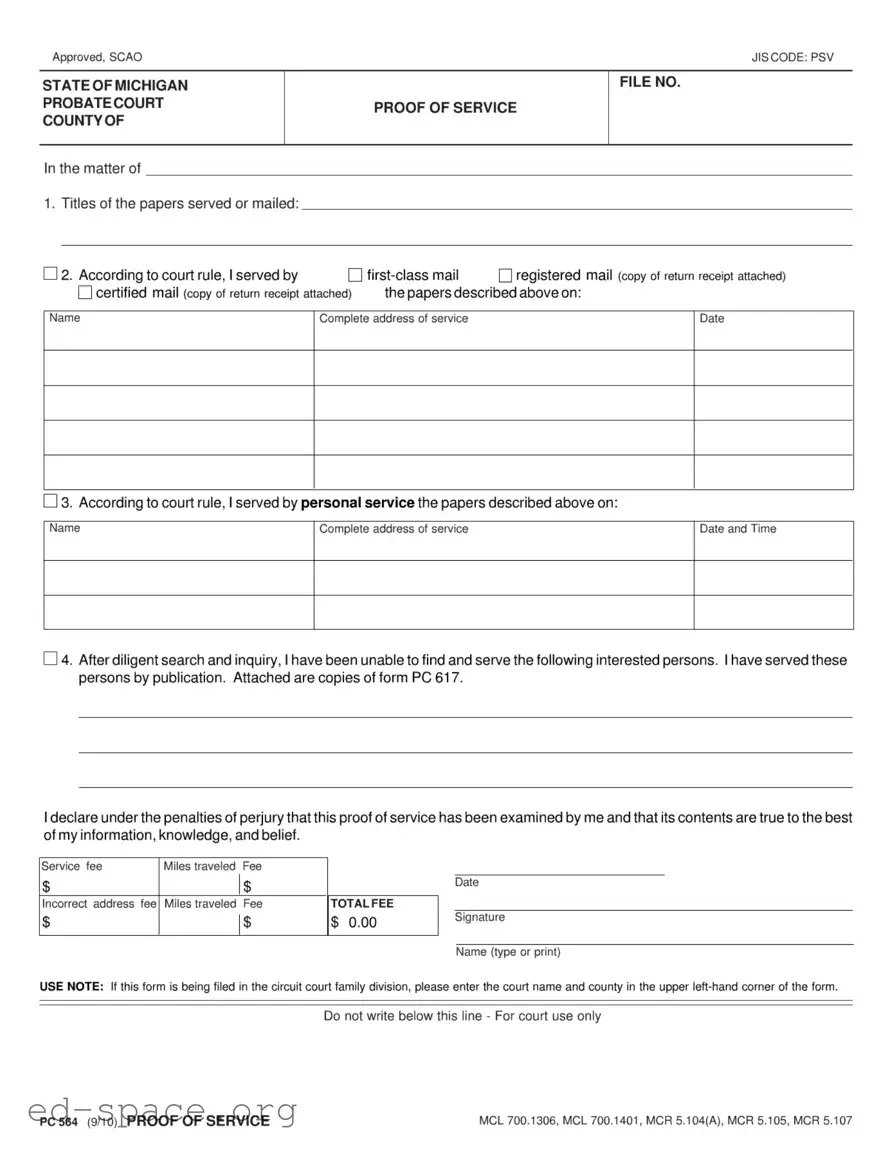
The Michigan Probate form is an essential document used within the probate court system, particularly for matters related to the administration of estates and the distribution of assets after an individual's death. This form serves multiple purposes, primarily focusing on the proof of service, which is a critical step in ensuring that all interested parties are notified of proceedings. It includes sections where individuals can detail how and when they served various legal papers, whether by first-class mail, registered mail, certified mail, or through personal service. Additionally, the form provides a mechanism for individuals who have made diligent efforts to locate interested persons but were unable to find them. In such cases, these individuals may serve notice by publication, which is a means of informing the public about the proceedings. The form also requires a declaration under penalty of perjury, affirming the truthfulness of the information provided, which underscores the importance of accuracy in legal documentation. Finally, there are provisions for calculating service fees and documenting travel expenses, ensuring transparency and accountability in the process. Overall, the Michigan Probate form is a vital tool that helps facilitate the orderly conduct of probate proceedings while safeguarding the rights of all parties involved.
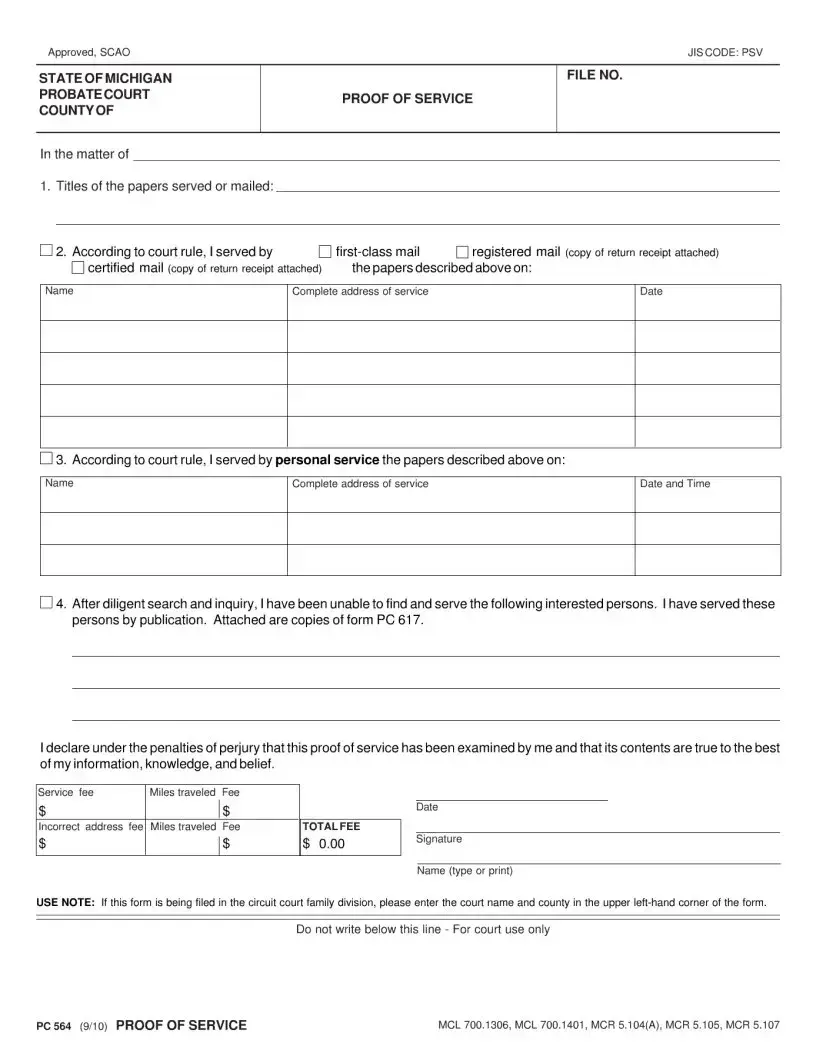
| Fact Name | Description |
|---|---|
| Form Title | The form is titled "Proof of Service" and is used in Michigan probate cases. |
| Governing Laws | This form is governed by MCL 700.1306, MCL 700.1401, MCR 5.104(A), MCR 5.105, and MCR 5.107. |
| Service Methods | You can serve documents via first-class mail, registered mail, or certified mail. |
| Personal Service | Documents may also be served through personal service, which requires the server to deliver the papers directly. |
| Publication Service | If interested persons cannot be located, service can be completed by publication. |
| Fees | The form allows for the inclusion of service fees and miles traveled, which must be documented. |
| Signature Requirement | A signature is required on the form to declare the truthfulness of the information provided. |
| Filing Note | If filed in the circuit court family division, the court name and county must be noted in the upper left corner. |
| Form Version | This version of the form was approved on 9/10 and is identified by the code PC 564. |
Once you have gathered the necessary information, you can proceed to fill out the Michigan Probate form. This form is essential for documenting the service of legal papers in probate matters. Follow the steps below to ensure accurate completion.
What is the Michigan Probate form used for?
The Michigan Probate form is primarily used to provide proof of service in probate court matters. It ensures that all interested parties are properly notified about proceedings related to a deceased person's estate. This form is essential for maintaining transparency and fairness in the probate process.
Who needs to fill out the Michigan Probate form?
This form must be filled out by the individual responsible for serving documents to interested parties in a probate case. Typically, this is the personal representative of the estate or an attorney representing the estate. It is crucial for ensuring that all parties receive proper notice.
What information is required on the form?
The form requires several key pieces of information, including the titles of the papers served, the method of service (such as first-class mail or personal service), the names and addresses of the individuals served, and the date of service. Additionally, if any interested persons could not be located, this must be noted, along with the steps taken to serve them by publication.
How do I serve documents using the Michigan Probate form?
You can serve documents either by mail or personal service. If using mail, you must specify whether it was first-class, certified, or registered mail and attach any return receipts. For personal service, you must provide the date and time of service. After completing the service, fill out the form accurately to document your actions.
What should I do if I cannot locate an interested person?
If you are unable to find an interested person after a diligent search, you may serve them by publication. This involves publishing a notice in a local newspaper to inform them of the proceedings. You must attach copies of the publication as part of your proof of service documentation.
Are there any fees associated with filing the Michigan Probate form?
Yes, there may be fees associated with the service of documents, including costs for mailing and publication. You should include these fees in the total fee section of the form. It is important to keep track of any expenses incurred during the service process for accurate reporting.
What happens if I do not fill out the form correctly?
Filing an incorrect or incomplete form may lead to delays in the probate process. It could also result in legal challenges if interested parties claim they were not properly notified. Therefore, it is essential to review the form carefully and ensure all information is accurate before submission.
Where do I submit the Michigan Probate form?
The completed form should be submitted to the probate court in the county where the estate is being administered. If the form is being filed in the circuit court family division, make sure to include the court name and county in the designated area on the form. Always keep a copy for your records.
Incomplete Information: One of the most common mistakes is failing to provide complete information in the form. This includes not filling out the names, addresses, and dates accurately. Each section must be thoroughly completed to avoid delays in processing.
Incorrect Service Method: Individuals often choose the wrong method of service. For example, if the papers require personal service but the form indicates that service was made by mail, this can lead to complications. It’s crucial to follow the correct procedures outlined in the court rules.
Missing Signatures: Failing to sign the form is another frequent error. The proof of service must be signed by the person who completed the service. Without a signature, the court may reject the form, causing further delays.
Not Following Publication Requirements: When individuals cannot locate interested persons, they must serve by publication. However, many fail to attach the necessary copies of form PC 617. This omission can invalidate the service and prolong the probate process.
The Michigan Probate form is a crucial document in the probate process, but it often accompanies several other forms that are equally important. Each of these documents serves a specific purpose in ensuring that the probate proceedings are conducted fairly and in accordance with the law. Below is a list of commonly used forms and documents in conjunction with the Michigan Probate form.
Understanding these forms can significantly aid individuals navigating the probate process in Michigan. Each document plays a vital role in ensuring that the estate is handled properly and that the rights of all parties involved are respected.
The Michigan Probate form is similar to several other legal documents that serve various purposes in the probate process. Below is a list of eight documents that share similarities with the Michigan Probate form, along with a brief explanation of how they relate:
When filling out the Michigan Probate form, it's important to be thorough and accurate. Here’s a list of things to do and avoid to ensure your submission is successful.
By following these guidelines, you can help ensure that your probate form is completed correctly and processed efficiently by the court.
Misconceptions about the Michigan Probate form can lead to confusion and errors in the probate process. Below are seven common misconceptions, along with clarifications to help individuals understand the form better.
Understanding these misconceptions can help individuals navigate the probate process more effectively and ensure compliance with Michigan's legal requirements.
When filling out and using the Michigan Probate form, there are several important points to keep in mind. Understanding these key takeaways can help ensure a smoother process.
By focusing on these key aspects, you can navigate the Michigan Probate form more effectively and reduce the likelihood of issues arising during the probate process.