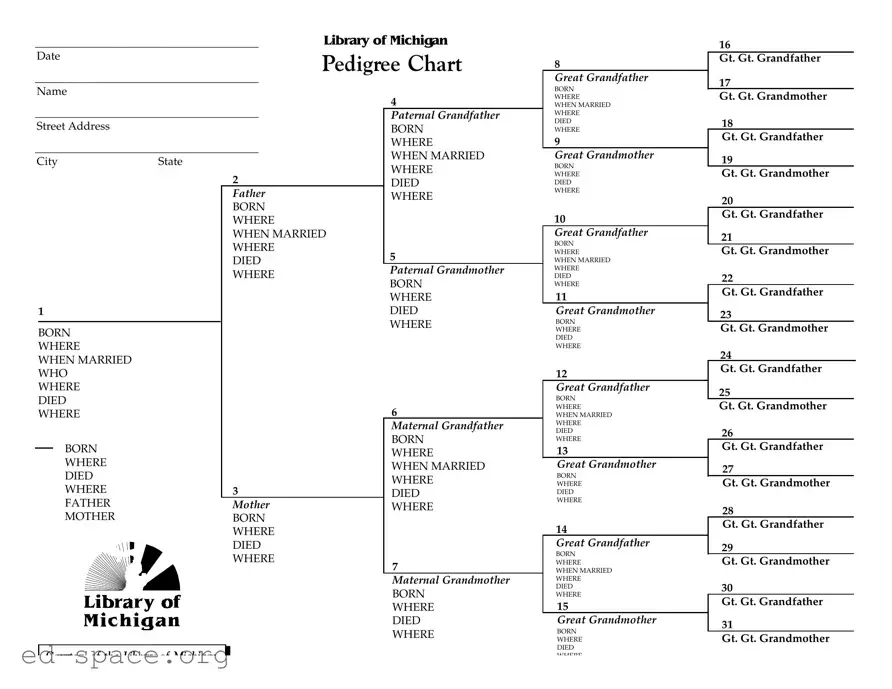
The Michigan Pedigree form serves as a vital tool for individuals seeking to trace their ancestry and document their family lineage. This comprehensive chart captures essential details about each family member, including names, birthplaces, and significant life events such as marriages and deaths. It begins with the individual’s great-grandparents and extends through several generations, allowing for a thorough exploration of familial connections. Each entry prompts users to provide specific information, ensuring that no important detail is overlooked. The form emphasizes the importance of accurate data collection, which can aid in genealogical research and foster a deeper understanding of one’s heritage. By filling out this form, individuals not only preserve their family history but also create a lasting legacy for future generations to explore and cherish.

________________________________________ |
Library of Michigan |
|
Date |
Pedigree Chart |
|
________________________________________ |
||
|
||
Name |
|
8
GREAT GRANDFATHER
BORN
WHERE
16
GT. GT. GRANDFATHER
17
GT. GT. GRANDMOTHER
________________________________________
Street Address
________________________________________
City |
State |
4
PATERNAL GRANDFATHER
BORN WHERE
WHEN MARRIED WHERE
WHEN MARRIED
WHERE
DIED
WHERE
9
GREAT GRANDMOTHER
BORN
WHERE
18
GT. GT. GRANDFATHER
19
GT. GT. GRANDMOTHER
1
BORN WHERE
WHEN MARRIED WHO
WHERE DIED WHERE
BORN
WHERE
DIED
WHERE
FATHER
MOTHER
2
FATHER
BORN WHERE
WHEN MARRIED WHERE
DIED WHERE
3
MOTHER
BORN
WHERE
DIED
WHERE
DIED
WHERE
5
PATERNAL GRANDMOTHER
BORN
WHERE
DIED
WHERE
6
MATERNAL GRANDFATHER
BORN WHERE
WHEN MARRIED WHERE
DIED WHERE
7
MATERNAL GRANDMOTHER
BORN
WHERE
DIED
WHERE
DIED
WHERE
10
GREAT GRANDFATHER
BORN
WHERE
WHEN MARRIED
WHERE
DIED
WHERE
11
GREAT GRANDMOTHER
BORN
WHERE
DIED
WHERE
12
GREAT GRANDFATHER
BORN
WHERE
WHEN MARRIED
WHERE
DIED
WHERE
13
GREAT GRANDMOTHER
BORN
WHERE
DIED
WHERE
14
GREAT GRANDFATHER
BORN
WHERE
WHEN MARRIED
WHERE
DIED
WHERE
15
GREAT GRANDMOTHER
BORN
WHERE
DIED
20
GT. GT. GRANDFATHER
21
GT. GT. GRANDMOTHER
22
GT. GT. GRANDFATHER
23
GT. GT. GRANDMOTHER
24
GT. GT. GRANDFATHER
25
GT. GT. GRANDMOTHER
26
GT. GT. GRANDFATHER
27
GT. GT. GRANDMOTHER
28
GT. GT. GRANDFATHER
29
GT. GT. GRANDMOTHER
30
GT. GT. GRANDFATHER
31
GT. GT. GRANDMOTHER
Courtesy of the Library of Michigan
WHERE
| Fact Name | Description |
|---|---|
| Purpose | The Michigan Pedigree Form is used to document family lineage and ancestry information. |
| Governing Law | This form is governed by Michigan law, specifically the Michigan Compiled Laws (MCL) 333.2833. |
| Required Information | Users must provide details such as names, birthplaces, and dates of significant life events for family members. |
| Generational Structure | The form includes spaces for up to eight generations of ancestors, starting from the individual filling it out. |
| Submission | The completed form may be submitted to the appropriate state office or used for personal records. |
| Accessibility | The form is available online through the Library of Michigan's website, making it easy to access. |
| Historical Use | This form has been utilized for many years to help individuals trace their family history. |
| Confidentiality | Information provided on the form is typically kept private and used solely for genealogical purposes. |
| Additional Resources | The Library of Michigan offers additional resources and support for those interested in genealogy. |
Filling out the Michigan Pedigree form is an important step in documenting your family history. This form will help you gather and organize information about your ancestors, making it easier to trace your lineage. Follow these steps to ensure you complete the form accurately and thoroughly.
What is the Michigan Pedigree form?
The Michigan Pedigree form is a document used to collect and organize genealogical information about an individual's family history. It allows users to trace their ancestry by documenting details such as names, birthplaces, marriage dates, and death dates of family members across multiple generations. This form is particularly useful for individuals interested in genealogy research or those looking to compile a family tree.
How do I fill out the Michigan Pedigree form?
To complete the Michigan Pedigree form, begin by entering your personal information at the top of the chart. Proceed to list your parents, grandparents, and great-grandparents in the designated sections. For each individual, provide relevant details such as their names, birthplaces, marriage dates, and death dates. It is important to be as accurate as possible and to gather information from reliable sources, such as family records or official documents.
Where can I obtain the Michigan Pedigree form?
The Michigan Pedigree form can be accessed through the Library of Michigan's website or directly at their physical location. Additionally, various genealogical organizations and websites may offer downloadable versions of the form. Ensure that you are using the most current version of the form to guarantee compliance with any updates or changes in requirements.
Can I use the Michigan Pedigree form for purposes other than genealogy?
While the primary purpose of the Michigan Pedigree form is to document genealogical information, it may also be useful for other applications, such as medical history research or establishing familial connections for legal matters. However, it is essential to understand that this form is not a legally binding document and should not be used in place of official records when required.
Failing to provide complete names for each ancestor can lead to confusion. Make sure to include first, middle, and last names whenever possible.
Omitting important dates such as birth, marriage, and death can create gaps in the family history. Always double-check that you have included these details.
Not specifying the correct locations for each event is a common mistake. Be as precise as possible, including city, state, and country when applicable.
Using abbreviations or nicknames instead of full names can lead to misunderstandings. Stick to the full legal names of each ancestor.
Forgetting to differentiate between paternal and maternal lines can complicate the chart. Clearly label each side to avoid confusion.
Neglecting to update the form with new information as it becomes available can result in incomplete records. Keep the form current.
Failing to check for spelling errors can undermine the accuracy of the document. Review each entry carefully before submission.
Not signing or dating the form can render it invalid. Ensure that you complete this final step to authenticate your submission.
The Michigan Pedigree form is a vital document for individuals tracing their ancestry and family history. It serves as a foundational tool for collecting and organizing information about one's lineage. However, several other forms and documents can complement this pedigree chart, enhancing the overall understanding of family history. Below is a list of these documents, each playing a unique role in genealogical research.
Utilizing these documents alongside the Michigan Pedigree form can significantly enrich one's genealogical research. Each document adds layers of context and detail, helping to paint a more complete picture of family history.
When filling out the Michigan Pedigree form, it’s important to ensure accuracy and completeness. Here are some dos and don’ts to keep in mind:
Here are five misconceptions about the Michigan Pedigree form:
When filling out the Michigan Pedigree form, keep these key takeaways in mind: