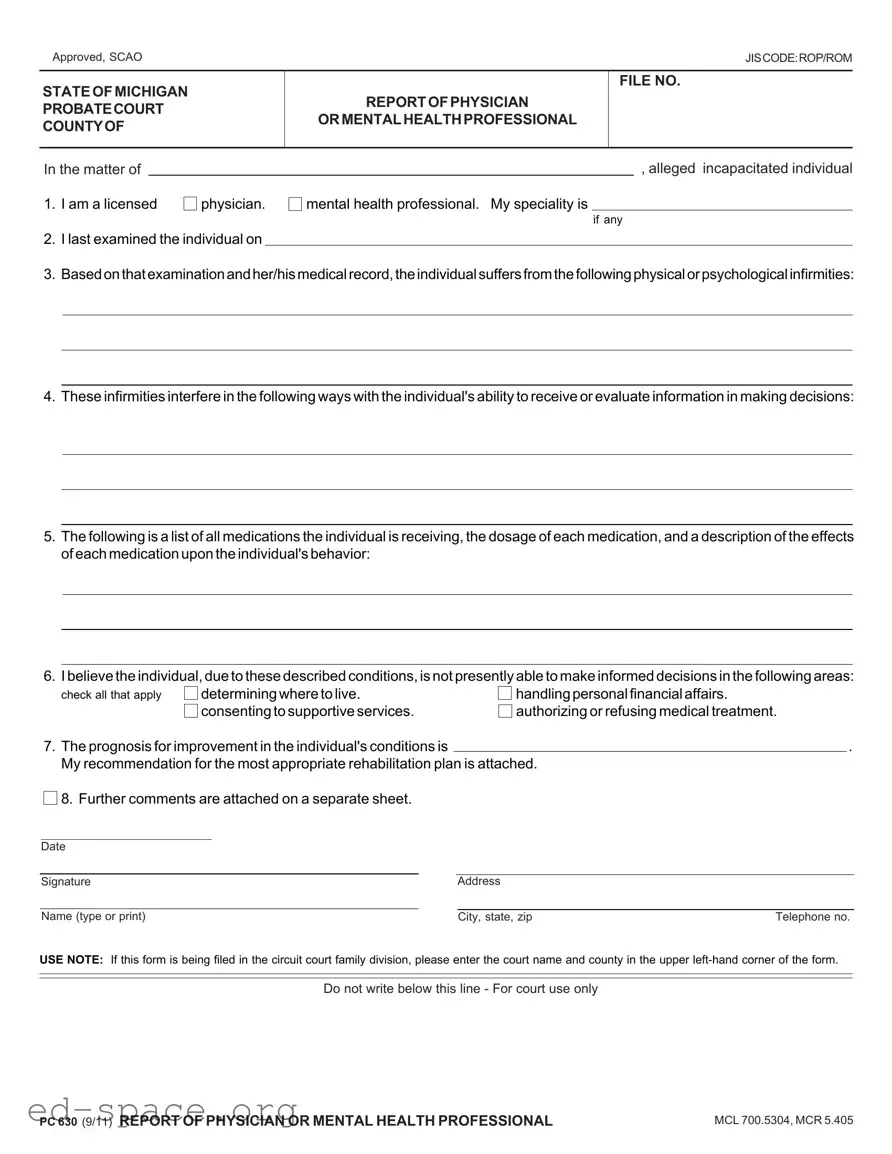
The Michigan PC 630 form serves as a vital document in the probate court system, specifically designed for reporting by licensed physicians or mental health professionals regarding individuals who may be incapacitated. This form captures essential information about the individual's health status, including details about their physical or psychological infirmities. It requires the professional to provide insights into how these conditions affect the individual's ability to make informed decisions. Key sections of the form include a list of medications the individual is taking, along with their dosages and potential effects on behavior. Furthermore, the form prompts the professional to assess the individual's capacity to manage various aspects of life, such as housing, financial affairs, and medical treatment decisions. The prognosis for improvement and recommendations for rehabilitation are also critical components, ensuring that the court receives a comprehensive overview of the individual's situation. By gathering this information, the PC 630 form aids the court in making informed decisions regarding the care and support of those who may be unable to advocate for themselves.

Approved, SCAO |
JISCODE:ROP/ROM |
STATEOFMICHIGAN PROBATECOURT COUNTYOF
REPORTOFPHYSICIAN
ORMENTALHEALTHPROFESSIONAL
FILE NO.
In the matter of
1. I am a licensed
physician.
, alleged incapacitated individual
mental health professional. My speciality is
if any
2.I last examined the individual on
3.Basedonthatexaminationandher/hismedicalrecord,theindividualsuffersfromthefollowingphysicalorpsychologicalinfirmities:
4. These infirmities interfere in the following ways with the individual's ability to receive or evaluate information in making decisions:
5.The following is a list of all medications the individual is receiving, the dosage of each medication, and a description of the effects ofeachmedicationupontheindividual'sbehavior:
6. |
I believe the individual, due to these described conditions, is not presently able to make informed decisions in the following areas: |
|||
|
check all that apply |
determiningwheretolive. |
handlingpersonalfinancialaffairs. |
|
|
|
consentingtosupportiveservices. |
authorizing or refusing medical treatment. |
|
7. |
The prognosis for improvement in the individual's conditions is |
|
. |
|
My recommendation for the most appropriate rehabilitation plan is attached.
8. Further comments are attached on a separate sheet.
Date |
|
|
|
|
|
|
|
Signature |
Address |
|
|
|
|
|
|
Name (type or print) |
City, state, zip |
Telephone no. |
|
USE NOTE: If this form is being filed in the circuit court family division, please enter the court name and county in the upper
Do not write below this line - For court use only
PC 630 (9/11) REPORT OF PHYSICIAN OR MENTAL HEALTH PROFESSIONAL |
MCL 700.5304, MCR 5.405 |
| Fact Name | Details |
|---|---|
| Purpose | The Michigan PC 630 form is used to report on the mental and physical health of an alleged incapacitated individual. |
| Governing Laws | This form is governed by Michigan Compiled Laws (MCL) 700.5304 and Michigan Court Rules (MCR) 5.405. |
| Examining Professional | The form must be completed by a licensed physician or mental health professional who has examined the individual. |
| Content Requirements | It requires details about the individual's medical condition, medications, and ability to make informed decisions. |
| Additional Comments | Further comments can be attached on a separate sheet, providing more context or information as needed. |
Completing the Michigan PC 630 form requires careful attention to detail. This form is essential for reporting on an individual's mental or physical health in legal matters. Make sure to have all necessary information at hand before you start filling it out.
Once the form is completed, review it for accuracy. Ensure all required information is provided before submitting it to the appropriate court or agency. This will help facilitate the process and ensure that the individual's needs are addressed properly.
What is the Michigan PC 630 form?
The Michigan PC 630 form is a report that a licensed physician or mental health professional completes regarding an individual who may be incapacitated. It assesses the individual's ability to make informed decisions based on their physical or psychological conditions.
Who can fill out the PC 630 form?
Only licensed physicians or mental health professionals can complete the PC 630 form. These professionals must have the necessary qualifications to evaluate the individual's mental and physical health.
What information is required on the PC 630 form?
The form requires details about the individual's medical examination, including the date of the last examination, any physical or psychological infirmities, medications being taken, and how these factors impact decision-making abilities.
How does the PC 630 form impact decision-making?
The information provided on the PC 630 form helps determine whether an individual can make informed decisions about their living arrangements, financial affairs, medical treatment, and other important matters. It plays a crucial role in legal proceedings regarding guardianship or conservatorship.
What should be included in the medication section of the form?
This section should list all medications the individual is currently taking, along with their dosages and effects on the individual's behavior. This information is essential for understanding how medications may influence decision-making capacity.
What is the significance of the prognosis section?
The prognosis section provides insight into the expected improvement in the individual's condition. This information can guide the court in making decisions about rehabilitation plans and the need for ongoing support.
Can additional comments be added to the PC 630 form?
Yes, further comments can be attached on a separate sheet. This allows the physician or mental health professional to provide more detailed observations or recommendations that may be relevant to the case.
What happens after the PC 630 form is submitted?
Once the form is submitted to the court, it will be reviewed as part of the legal process. The information will help the court assess the individual's capacity and determine the appropriate legal actions regarding their care and decision-making.
Is there a specific court where the PC 630 form must be filed?
If the form is being filed in the circuit court family division, it is important to enter the court name and county in the designated area at the top of the form. This ensures that the document is processed correctly.
Not including the court name and county in the upper left-hand corner when filing in the circuit court family division. This detail is crucial for proper processing.
Failing to clearly state the specialty of the physician or mental health professional. This information helps establish credibility and context for the evaluation.
Leaving out the date of the last examination. This date is important for understanding the timeliness of the assessment.
Not providing a detailed description of the physical or psychological infirmities that affect the individual. Specificity is key to conveying the severity of the condition.
Overlooking how the infirmities interfere with decision-making. Clear examples help the court understand the individual's capacity.
Neglecting to list all medications, their dosages, and effects. This information is vital for assessing the individual's overall health and mental state.
Not checking all applicable areas where the individual may struggle to make informed decisions. This could lead to an incomplete understanding of their needs.
Failing to provide a prognosis for improvement. This is essential for the court to evaluate potential rehabilitation options.
Not attaching a rehabilitation plan or further comments on a separate sheet. These documents can provide additional insights that are important for the case.
Forgetting to include contact information, such as telephone number and address. This information is necessary for follow-up communication.
The Michigan PC 630 form is an essential document used in cases involving individuals who may be incapacitated. Alongside this form, several other documents are often required to provide a comprehensive view of the individual's condition and needs. Below is a list of related forms and documents that may be utilized in conjunction with the Michigan PC 630.
These forms collectively contribute to a clear understanding of the legal and medical status of individuals who may require guardianship. It is crucial to complete and submit each document accurately to facilitate the process and ensure the best outcomes for those involved.
The Michigan PC 630 form, which is a report from a physician or mental health professional regarding an individual's capacity to make decisions, shares similarities with several other documents. Each of these documents serves a specific purpose related to health assessments, legal capacity, or mental health evaluations. Here are ten documents that are similar:
Filling out the Michigan PC 630 form requires careful attention to detail. To ensure accuracy and compliance, here are some important dos and don'ts to keep in mind:
The Michigan PC 630 form is a critical document used in probate court proceedings, particularly concerning the evaluation of an individual's capacity to make informed decisions. However, several misconceptions surround its use and purpose. Below are six common misconceptions:
Understanding these misconceptions can help individuals navigate the legal landscape surrounding the Michigan PC 630 form more effectively. Accurate information is crucial for ensuring that the rights and needs of those involved are appropriately addressed.
The Michigan PC 630 form is a crucial document used in the probate court system, specifically for reporting on the mental and physical health of an individual who may be incapacitated. Here are some key takeaways regarding its use and completion:
Completing the Michigan PC 630 form accurately and thoroughly is vital for ensuring that the court has the necessary information to make informed decisions regarding the individual's care and legal status.