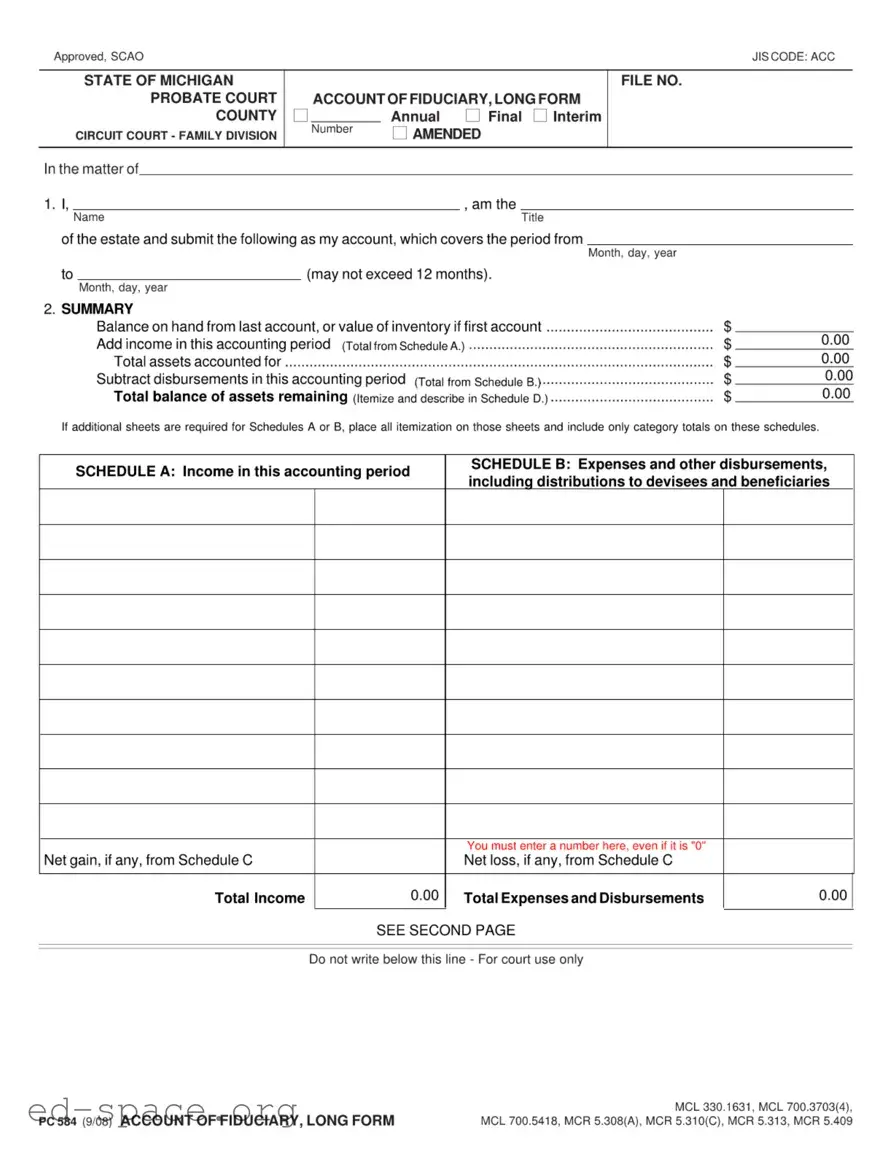
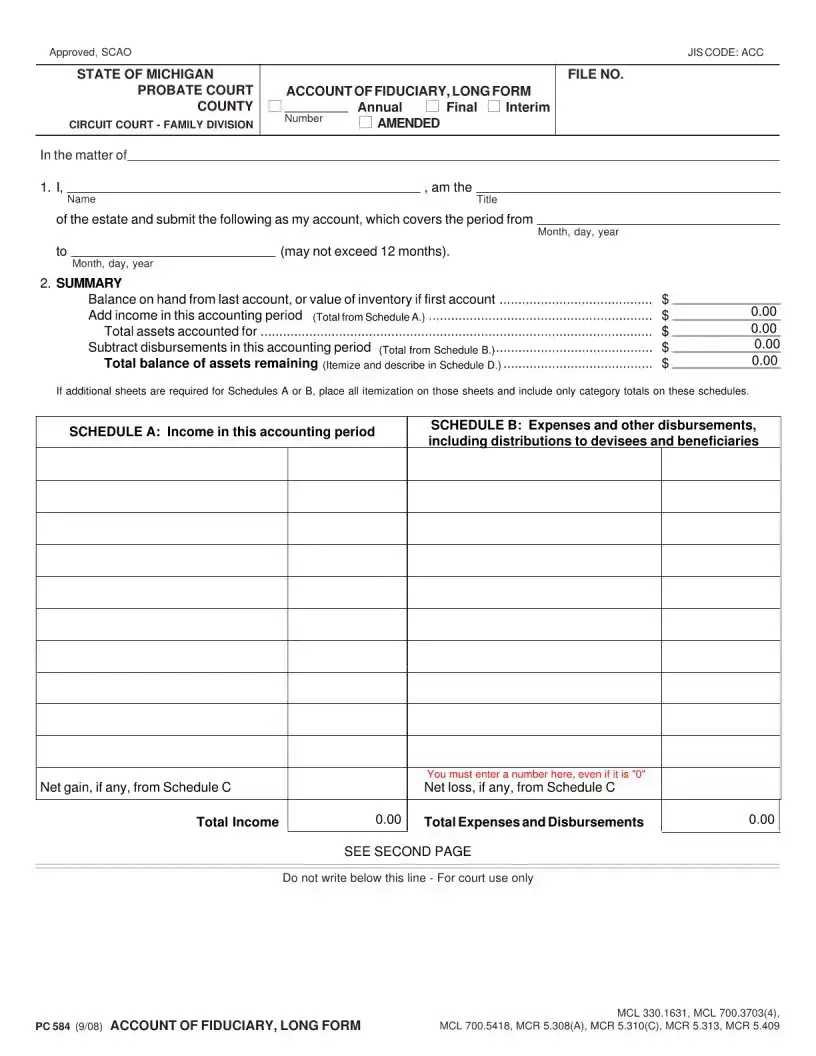
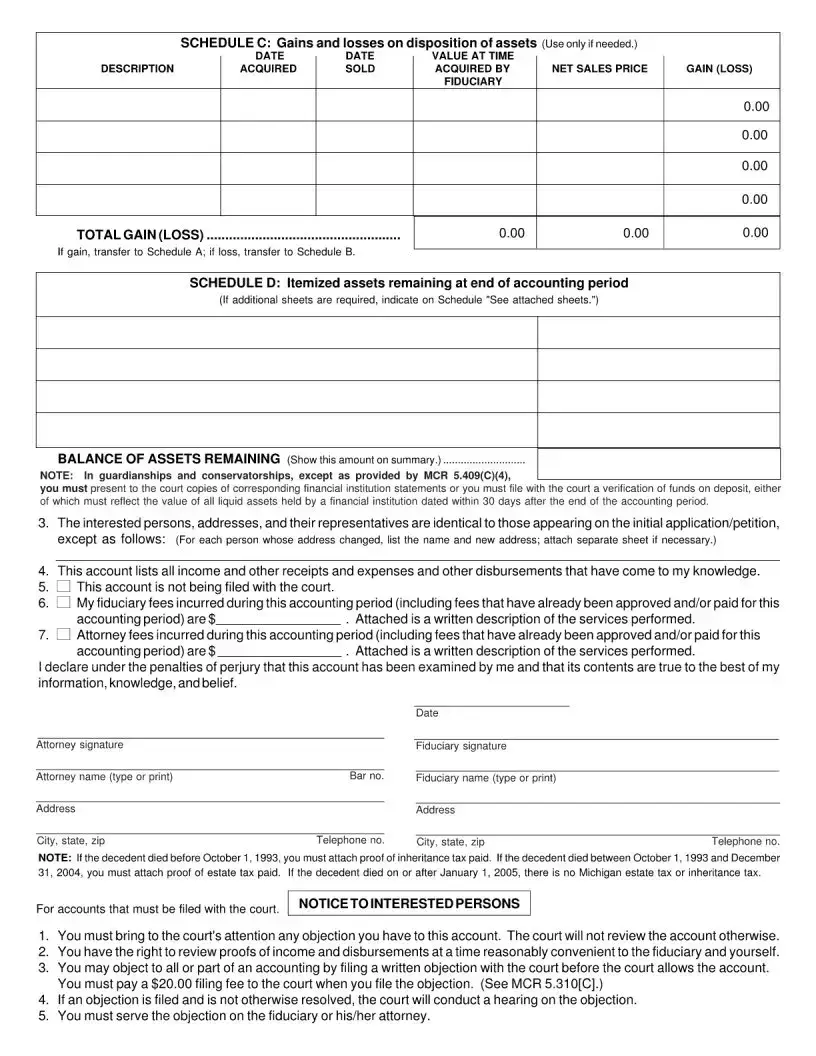
The Michigan PC 584 form, known as the Account of Fiduciary, Long Form, serves as a crucial document in the probate process, particularly for guardianships and conservatorships. This form allows fiduciaries to provide a comprehensive account of their financial management over a specified period, which cannot exceed twelve months. It includes essential sections such as a summary of assets, income, and disbursements, ensuring transparency and accountability. The fiduciary must detail the balance on hand, income received, and expenses incurred, while also itemizing any remaining assets. The form requires a declaration under penalty of perjury, affirming the accuracy of the information provided. Additionally, it stipulates the necessity for supporting documents, such as financial institution statements, to verify liquid assets. This ensures that all interested parties are adequately informed and have the opportunity to raise any objections or concerns regarding the accounting. The structured layout of the PC 584 facilitates clarity and organization, making it easier for both fiduciaries and the court to navigate the financial matters at hand.
| Fact Name | Fact Description |
|---|---|
| Form Purpose | The Michigan PC 584 form is used to report the financial activities of a fiduciary, detailing income, expenses, and remaining assets during a specified accounting period. |
| Filing Requirements | This form must be filed with the court in certain cases, particularly when managing estates under probate law. |
| Governing Laws | The form is governed by several Michigan laws, including MCL 330.1631, MCL 700.3703(4), and MCL 700.5418, as well as Michigan Court Rules (MCR) such as 5.308(A) and 5.310(C). |
| Account Period | The accounting period covered by the form cannot exceed 12 months, ensuring that financial activities are reported regularly. |
| Income Reporting | All income received during the accounting period must be itemized and reported in Schedule A of the form. |
| Objection Process | Interested persons have the right to object to the account by filing a written objection with the court, which requires a $20.00 filing fee. |
| Verification of Funds | In guardianships and conservatorships, financial institution statements must be provided to verify liquid assets held, dated within 30 days after the accounting period ends. |
Completing the Michigan PC 584 form involves several key steps to ensure all required information is accurately reported. This form is essential for fiduciaries managing estates, and it must be filled out carefully to reflect all financial activities during the specified accounting period.
What is the Michigan PC 584 form?
The Michigan PC 584 form, known as the Account of Fiduciary, Long Form, is a document used in probate court to provide a detailed account of the financial activities of a fiduciary. This form covers a specified accounting period and includes information about income, expenses, and the remaining balance of assets.
Who needs to file the Michigan PC 584 form?
This form is typically filed by fiduciaries, such as guardians or conservators, who manage the financial affairs of an estate or individual. It is essential for those responsible for handling assets to provide a clear and accurate account of their management during the specified period.
What information is required on the form?
The form requires detailed information, including the fiduciary's name, title, and the accounting period. It also asks for a summary of the balance on hand, income received, expenses paid, and the remaining assets. Additional schedules may be needed to itemize income and expenses thoroughly.
How often must the Michigan PC 584 form be filed?
The form should be filed annually, covering a maximum period of 12 months. If there are significant changes in the estate's financial situation or if required by the court, additional filings may be necessary.
What are the consequences of not filing the form?
Failing to file the Michigan PC 584 form can lead to legal repercussions, including potential penalties for the fiduciary. The court may not approve the fiduciary's actions or may require additional scrutiny of the fiduciary's management of the estate.
What attachments are necessary when submitting the form?
When submitting the PC 584 form, fiduciaries must attach any relevant financial institution statements or verification of funds. This documentation must reflect the value of all liquid assets and be dated within 30 days after the end of the accounting period.
Can interested persons object to the account?
Yes, interested persons have the right to object to the account. They must file a written objection with the court before the account is approved. A filing fee of $20.00 is required when submitting an objection.
What happens if an objection is filed?
If an objection is filed and not resolved, the court will schedule a hearing to address the objection. The fiduciary or their attorney must be served with the objection notice to ensure they are aware of the concerns raised.
What should be done if the decedent died before October 1, 1993?
If the decedent passed away before October 1, 1993, proof of inheritance tax paid must be attached to the PC 584 form. For decedents who died between October 1, 1993, and December 31, 2004, proof of estate tax paid is required. There is no estate or inheritance tax for decedents who died on or after January 1, 2005.
Inaccurate Dates: Failing to accurately enter the accounting period dates can lead to confusion. Ensure that the start and end dates are correct and do not exceed 12 months.
Missing Signatures: Both the fiduciary and the attorney must sign the form. Omitting one or both signatures can result in the form being rejected.
Incorrect Balances: Double-check the balance calculations. Errors in totaling income, disbursements, or remaining assets can create discrepancies.
Neglecting Attachments: Failing to attach required documents, such as financial institution statements or descriptions of services performed, can lead to delays.
Incomplete Information: Ensure that all sections are filled out completely. Leaving sections blank can raise red flags and prompt further scrutiny.
Ignoring Changes in Interested Persons: If there are changes in the addresses or representatives of interested persons, these must be noted. Neglecting this can lead to legal complications.
Misclassification of Gains and Losses: Gains and losses must be properly categorized on the form. Misplacing these figures can affect the overall financial picture.
Not Filing on Time: Ensure the form is filed within the required timeframe. Late submissions can result in penalties or legal issues.
The Michigan PC 584 form, known as the "Account of Fiduciary, Long Form," is an essential document used in probate court proceedings to provide a detailed account of a fiduciary's management of an estate. Along with this form, several other documents are often required or helpful in the process. Below is a list of five such documents, each serving a specific purpose in the context of estate management.
These documents collectively enhance the clarity and accountability of the fiduciary's financial management, ensuring that all parties involved have access to necessary information. Properly completing and submitting these forms can help facilitate smoother probate proceedings and protect the interests of beneficiaries.
The Michigan PC 584 form, used for accounting by fiduciaries, shares similarities with several other important documents in the realm of estate management and financial reporting. Here are four documents that align closely with the PC 584 form:
Understanding these documents can enhance your grasp of fiduciary responsibilities and ensure compliance with relevant regulations. Each form plays a critical role in maintaining transparency and accountability in estate management.
When filling out the Michigan PC 584 form, it’s important to follow certain guidelines to ensure accuracy and compliance. Here’s a list of things you should and shouldn’t do:
By following these guidelines, you can help ensure that your Michigan PC 584 form is filled out correctly and efficiently.
Understanding the Michigan PC 584 form can be challenging, especially with the many misconceptions surrounding it. Here’s a list of common misunderstandings to help clarify the purpose and requirements of this form.
By understanding these misconceptions, individuals can navigate the Michigan PC 584 form more effectively and ensure compliance with legal requirements.
The Michigan PC 584 form is used to provide a detailed account of a fiduciary's management of an estate over a specific period. This period cannot exceed 12 months.
Accurate and complete information is crucial. Ensure all income, expenses, and remaining assets are itemized properly in the designated schedules.
When filling out the form, include a summary section that outlines the balance on hand, total income, and total expenses. This gives a clear overview of the estate's financial status.
In guardianships and conservatorships, it’s necessary to provide financial institution statements or verification of funds to reflect liquid assets held within 30 days of the accounting period's end.
All interested persons must be listed, including any address changes. This ensures transparency and keeps everyone informed about the estate's management.
Fiduciary and attorney fees must be reported, along with a written description of services performed. This documentation is essential for accountability.
Objections to the account must be filed with the court before it is allowed. A $20.00 filing fee is required for any objections, which emphasizes the importance of timely communication with the court.