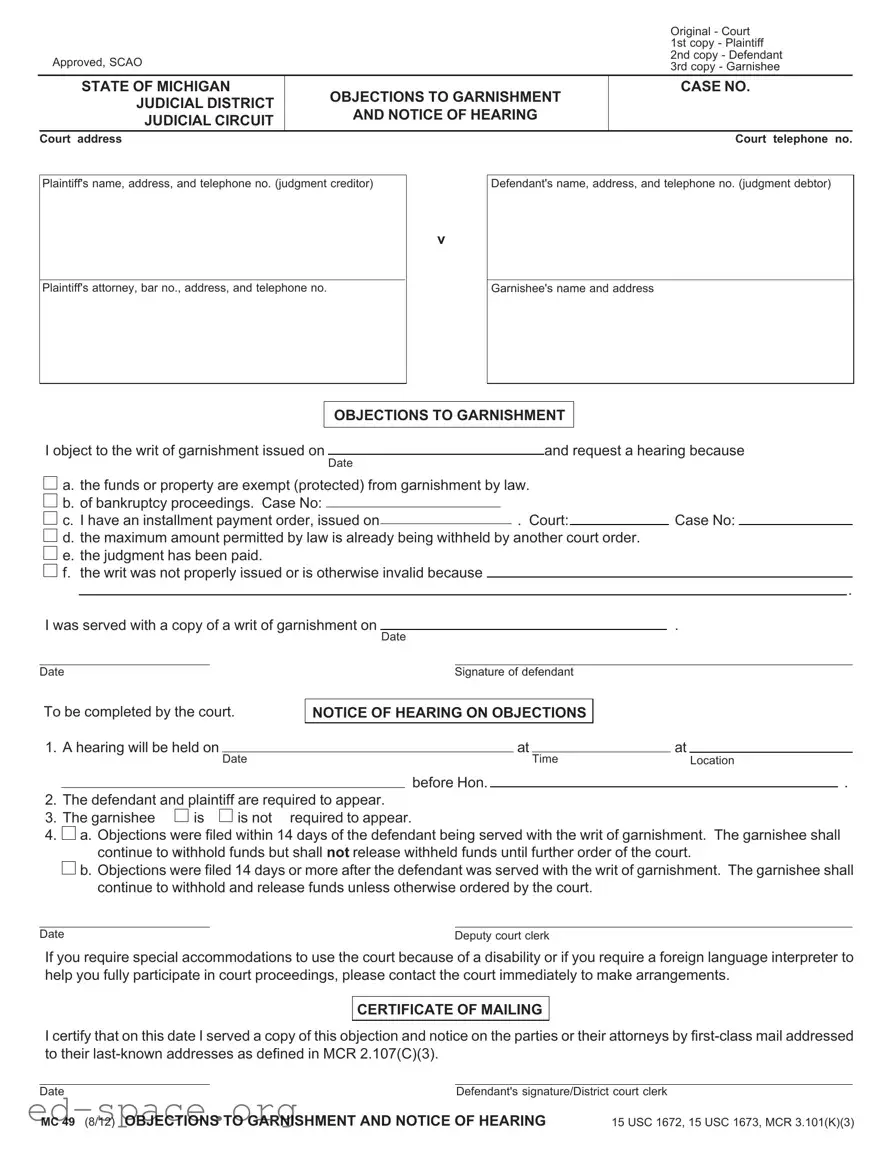
The Michigan MC 49 form serves as a crucial tool for individuals who wish to contest a writ of garnishment. This form allows defendants—often referred to as judgment debtors—to formally object to the garnishment of their funds or property, providing a structured process to voice their concerns. Key elements of the MC 49 include the identification of the parties involved, such as the plaintiff, defendant, and garnishee, as well as the court details. It outlines specific grounds for objection, which may include claims that the funds are legally exempt from garnishment, ongoing bankruptcy proceedings, or that the judgment has already been satisfied. Additionally, the form sets forth the procedure for filing objections and the requirement for a hearing, ensuring that both the defendant and plaintiff are notified and can participate. The form emphasizes the importance of timely action, as objections must typically be filed within 14 days of service of the writ. Furthermore, it offers guidance on how to complete and submit the form, including the necessity of serving copies to all relevant parties. Understanding the MC 49 is essential for those navigating the complexities of garnishment and seeking to protect their rights.

|
Original - Court |
|
|
1st copy - Plaintiff |
|
Approved, SCAO |
2nd copy - Defendant |
|
3rd copy - Garnishee |
||
|
STATE OF MICHIGAN JUDICIAL DISTRICT JUDICIAL CIRCUIT
OBJECTIONS TO GARNISHMENT
AND NOTICE OF HEARING
CASE NO.
Court address |
Court telephone no. |
Plaintiff's name, address, and telephone no. (judgment creditor)
Defendant's name, address, and telephone no. (judgment debtor)
v
Plaintiff's attorney, bar no., address, and telephone no.
Garnishee's name and address
OBJECTIONS TO GARNISHMENT
I object to the writ of garnishment issued on |
|
and request a hearing because |
|
Date
a. the funds or property are exempt (protected) from garnishment by law.
b. of bankruptcy proceedings. Case No:
c. I have an installment payment order, issued on. Court:Case No:
d. the maximum amount permitted by law is already being withheld by another court order.
e. the judgment has been paid.
f. the writ was not properly issued or is otherwise invalid because
.
I was served with a copy of a writ of garnishment on |
|
. |
||
|
|
Date |
||
|
|
|
|
|
Date |
|
Signature of defendant |
||
To be completed by the court.
1. A hearing will be held on
Date
NOTICE OF HEARING ON OBJECTIONS
atat
TimeLocation
before Hon. |
|
. |
|
2. |
The defendant and plaintiff are required to appear. |
||
3. |
The garnishee |
is |
is not required to appear. |
4. a. Objections were filed within 14 days of the defendant being served with the writ of garnishment. The garnishee shall continue to withhold funds but shall not release withheld funds until further order of the court.
b. Objections were filed 14 days or more after the defendant was served with the writ of garnishment. The garnishee shall continue to withhold and release funds unless otherwise ordered by the court.
Date |
Deputy court clerk |
If you require special accommodations to use the court because of a disability or if you require a foreign language interpreter to help you fully participate in court proceedings, please contact the court immediately to make arrangements.
CERTIFICATE OF MAILING
I certify that on this date I served a copy of this objection and notice on the parties or their attorneys by
Date |
Defendant's signature/District court clerk |
|
MC 49 (8/12) |
OBJECTIONS TO GARNISHMENT AND NOTICE OF HEARING |
15 USC 1672, 15 USC 1673, MCR 3.101(K)(3) |
Instructions for Filing and Serving an Objection to Garnishment (Form MC 49)
If you received a writ of garnishment (form MC 12, MC 13, or MC 52), you can object to that garnishment only if:
•your money is exempt (protected) from garnishment by law (see the list of exempt funds on the back of your writ of garnishment form),
•you filed for bankruptcy and those proceedings are pending or the debt has been discharged,
•you have an installment payment order signed by a judge (form MC 15a),
•the maximum amount of money that can be garnished by law is already being withheld by another court order,
•you already paid the judgment in full,
•the garnishment was not properly issued (for example, it was issued on false information) or the garnishment
is invalid (for example, the interest, costs, or judgment amount are inaccurate).
You cannot use this form to challenge the judgment or because you are unable to pay the judgment.
1.How do I file an Objection?
You file an objection by completing the form and filing it with the same court that signed the writ of garnishment. There is no cost.
2.Fill out the Objection form.
Write in the court number, case number, the court address and telephone number, and the names, addresses, and telephone numbers of the plaintiff and the defendant exactly as they are on the writ of garnishment.
Write in the date the garnishment was issued (see the lower
Write in the date you complete the form and sign your name.
3.Make four copies of the completed objection form.
4.File the Objection with the court.
File all four copies of your objection with the court in person or by
5.Serve the Objection.
If your case is in the district court, the court will serve the objection and will return one copy to you.
If your case is in the circuit court, when you get the three remaining copies of the objection with the Notice of Hearing completed, serve a copy on the plaintiff and a copy on the garnishee by
For information on preparing for a hearing generally, see the Michigan Court’s
| Fact Name | Details |
|---|---|
| Purpose of Form | The Michigan MC 49 form is used to file objections to a writ of garnishment and to notify the court of a hearing regarding those objections. |
| Governing Laws | The form is governed by federal laws, including 15 USC 1672 and 15 USC 1673, as well as the Michigan Court Rules (MCR) 3.101(K)(3). |
| Filing Requirements | To file an objection, complete the form and submit it to the court that issued the garnishment. There is no filing fee involved. |
| Objection Reasons | Valid reasons for objection include exemptions from garnishment, pending bankruptcy, installment payment orders, and improper issuance of the garnishment. |
| Deadline for Filing | Objections must be filed within 14 days of receiving the writ of garnishment to ensure the garnishee continues to withhold funds. |
| Hearing Notification | A hearing will be scheduled, and both the defendant and plaintiff must appear. The garnishee may not be required to attend. |
| Certificate of Mailing | The form includes a certificate of mailing, which must be completed to confirm that all parties received notice of the objection and hearing. |
| Exempt Funds | Certain funds are protected from garnishment, such as social security benefits and unemployment compensation. Refer to the back of the writ for a complete list. |
| Required Copies | When filing, make four copies of the completed objection form. The court will return three copies with the notice of hearing completed. |
| Document Preparation | Bring all supporting documents to the hearing that correspond to the objections checked on the form. This is crucial for a successful hearing. |
After completing the Michigan MC 49 form, it is essential to file it with the court that issued the garnishment. This process ensures that your objections are officially recorded, and a hearing can be scheduled to address your concerns. Follow the steps below to accurately fill out and submit the form.
1. What is the Michigan MC 49 form?
The Michigan MC 49 form is a legal document used to file objections to a writ of garnishment. It allows individuals to contest the garnishment of their funds or property by providing reasons for the objection and requesting a hearing. This form is essential for defendants who believe that their funds are exempt or that the garnishment is invalid.
2. Who can file an objection using the MC 49 form?
Any defendant who has received a writ of garnishment can file an objection using the MC 49 form. This includes individuals whose funds are exempt from garnishment, those undergoing bankruptcy proceedings, or those who have already paid the judgment in full.
3. How do I complete the MC 49 form?
To complete the MC 49 form, fill in the required details, including court information, case number, and the names and addresses of the plaintiff and defendant. Indicate the reason for your objection by checking the appropriate box. Ensure you provide the date you were served with the writ and your signature at the end of the form.
4. What are the reasons I can object to garnishment?
You can object to garnishment for several reasons, including: the funds are exempt from garnishment by law, you are involved in bankruptcy proceedings, you have an installment payment order, the maximum amount allowed is already being withheld, the judgment has been paid, or the writ was improperly issued.
5. Is there a fee to file the MC 49 form?
No, there is no fee to file the MC 49 form. It can be submitted to the court without any associated costs, making it accessible for individuals seeking to contest a garnishment.
6. How do I file the MC 49 form?
To file the MC 49 form, complete it and submit it to the same court that issued the writ of garnishment. You must provide four copies of the completed form. If filing by mail, include a self-addressed, postage-paid envelope for the court to return the copies to you.
7. What happens after I file the MC 49 form?
After filing the MC 49 form, a hearing will be scheduled. You will receive a Notice of Hearing, which will indicate the date and time of the hearing. Both the defendant and plaintiff are required to attend, while the garnishee may not need to appear.
8. What should I bring to the hearing?
It is important to bring all relevant documents to support your objections at the hearing. This includes any evidence that substantiates your claims regarding the exemption of funds, bankruptcy status, or any other reason for your objection.
9. Can I challenge the underlying judgment with the MC 49 form?
No, the MC 49 form cannot be used to challenge the underlying judgment itself. It is specifically designed to address issues related to the garnishment process and the validity of the writ issued against you.
10. Where can I find more information about the garnishment process?
For additional information about the garnishment process and preparing for a hearing, individuals can visit the Michigan Court’s Self-Help Center online. This resource provides guidance and information on various legal procedures, including garnishments.
Incorrectly Filling Out Personal Information: People often forget to accurately enter their names, addresses, and telephone numbers. This information must match what is on the writ of garnishment.
Missing Dates: Failing to include the date the garnishment was issued or the date the defendant was served can lead to delays or rejection of the objection.
Not Checking All Applicable Reasons: Individuals sometimes check only one reason for their objection instead of all that apply. It is crucial to fully explain all grounds for the objection.
Insufficient Copies: People may forget to make the required four copies of the completed objection form. This can prevent the court from processing the objection properly.
Improper Filing: Filing the objection with the wrong court can result in dismissal. It must be submitted to the same court that issued the writ of garnishment.
Neglecting to Serve All Parties: Failing to serve a copy of the objection to the plaintiff and the garnishee can lead to complications. It is essential to follow proper service procedures.
Not Bringing Supporting Documents: Some individuals arrive at the hearing without necessary documents. It is important to bring all relevant paperwork to support the objections listed.
When dealing with garnishment issues in Michigan, several forms and documents may accompany the Michigan MC 49 form. Understanding these documents can help you navigate the process more effectively.
Familiarizing yourself with these forms can empower you during the garnishment process. Each document serves a unique purpose and can significantly impact your case. Always ensure that you have the necessary paperwork ready and seek assistance if needed.
The Michigan MC 49 form is an important document related to objections to garnishment. It shares similarities with several other legal documents that serve various purposes in the judicial process. Below are seven documents that are comparable to the MC 49 form, along with explanations of their similarities:
Understanding the similarities between these documents is crucial for navigating the legal landscape effectively. Each serves a specific function, yet they all contribute to the broader framework of judicial processes in Michigan.
When filling out the Michigan MC 49 form, there are important guidelines to follow. Here’s a list of things you should and shouldn’t do to ensure your objection to garnishment is processed correctly.
By adhering to these guidelines, you can help ensure that your objection is processed smoothly and efficiently. Always double-check your form before submission to avoid any potential issues.
Understanding the Michigan MC 49 form can be tricky, and there are several misconceptions that people often have. Here are four common misunderstandings:
By clearing up these misconceptions, individuals can better navigate the garnishment process and protect their rights.
Understanding the Michigan MC 49 form is essential for anyone facing garnishment. Here are key takeaways to help navigate this process:
By following these steps, you can effectively manage your objections to garnishment and protect your rights.