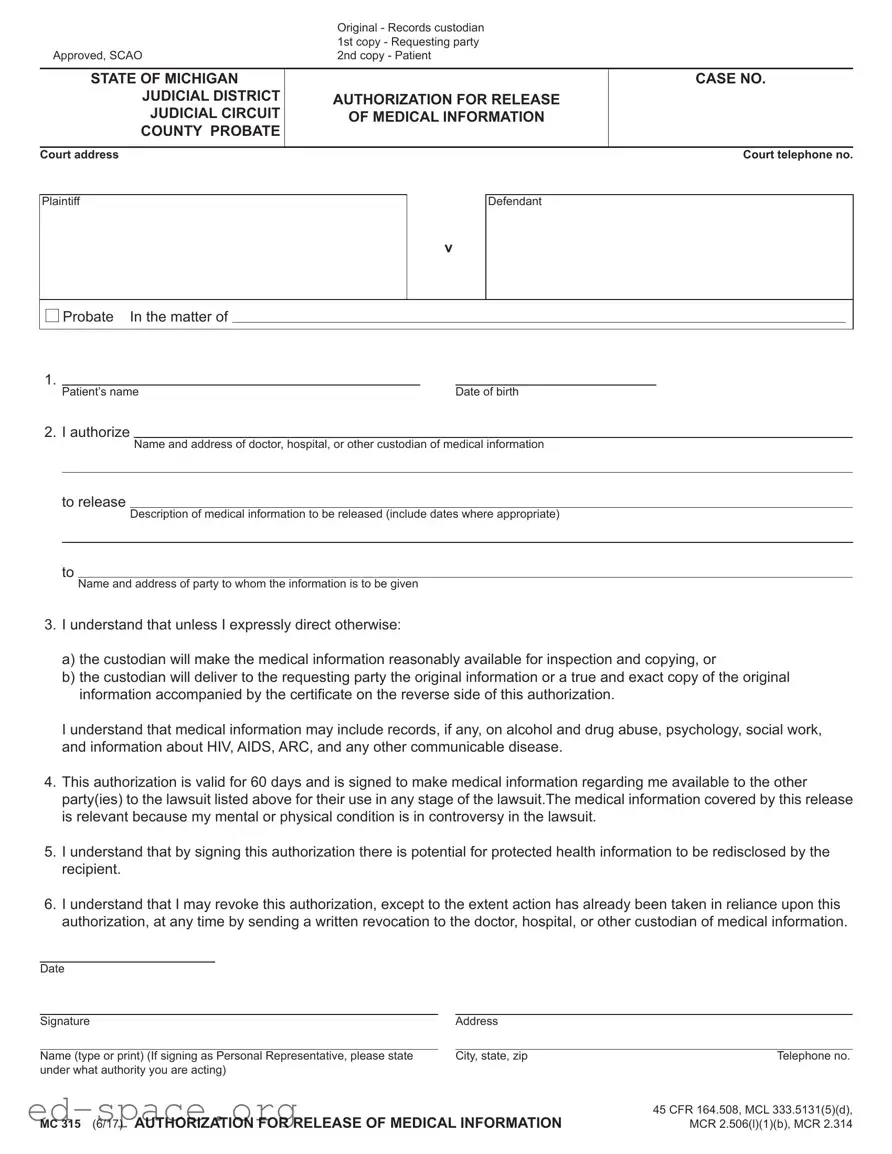
The Michigan MC 315 form is an essential document used in the legal process to authorize the release of medical information. This form plays a crucial role in ensuring that relevant medical records are made available during legal proceedings, particularly when a person's physical or mental condition is in question. It includes specific details such as the patient's name, date of birth, and the name and address of the medical provider responsible for the records. The form outlines the type of medical information to be released, which may encompass sensitive data, including records related to mental health, substance abuse, and communicable diseases. The authorization is valid for 60 days, allowing the requesting party to access the necessary information for their case. Importantly, the form also addresses the potential risks associated with the disclosure of protected health information, emphasizing that the recipient may share the information further. Additionally, the patient retains the right to revoke the authorization at any time, providing a layer of control over their medical information. Understanding the components and implications of the Michigan MC 315 form is vital for individuals involved in legal matters that require medical documentation.

|
Original - Records custodian |
|
1st copy - Requesting party |
Approved, SCAO |
2nd copy - Patient |
STATE OF MICHIGAN JUDICIAL DISTRICT JUDICIAL CIRCUIT COUNTY PROBATE
AUTHORIZATION FOR RELEASE
OF MEDICAL INFORMATION
CASE NO.
Court address |
Court telephone no. |
Plaintiff
Defendant
|
|
|
v |
|||
|
|
|
|
|
|
|
|
Probate In the matter of |
|
|
|
|
|
|
|
|
|
|
|
|
1. |
|
|
|
|
|
|
|
Patient’s name |
|
|
Date of birth |
||
2. I authorize
Name and address of doctor, hospital, or other custodian of medical information
to release
Description of medical information to be released (include dates where appropriate)
to
Name and address of party to whom the information is to be given
3.I understand that unless I expressly direct otherwise:
a)the custodian will make the medical information reasonably available for inspection and copying, or
b)the custodian will deliver to the requesting party the original information or a true and exact copy of the original information accompanied by the certificate on the reverse side of this authorization.
I understand that medical information may include records, if any, on alcohol and drug abuse, psychology, social work, and information about HIV, AIDS, ARC, and any other communicable disease.
4.This authorization is valid for 60 days and is signed to make medical information regarding me available to the other party(ies) to the lawsuit listed above for their use in any stage of the lawsuit.The medical information covered by this release is relevant because my mental or physical condition is in controversy in the lawsuit.
5.I understand that by signing this authorization there is potential for protected health information to be redisclosed by the recipient.
6.I understand that I may revoke this authorization, except to the extent action has already been taken in reliance upon this authorization, at any time by sending a written revocation to the doctor, hospital, or other custodian of medical information.
Date
Signature
Name (type or print) (If signing as Personal Representative, please state under what authority you are acting)
Address
City, state, zip |
Telephone no. |
|
45 CFR 164.508, MCL 333.5131(5)(d), |
MC 315 (6/17) AUTHORIZATION FOR RELEASE OF MEDICAL INFORMATION |
MCR 2.506(l)(1)(b), MCR 2.314 |

Authorization for Release of Medical Information (6/17) Page |
|
of |
|
|
|
Case No. |
|
|
|
||
|
|
|
|
|
|
|
|
|
|||
|
|
|
CERTIFICATE |
|
|
|
|
|
|||
1. |
I am the custodian of medical information for |
|
|
|
|
|
. |
||||
|
|
Organization |
|
|
|
|
|||||
2. |
I received the attached authorization for release of medical information on |
|
. |
|
|||||||
|
|
|
|
|
|
|
|
Date |
|||
3.I have examined the original medical information regarding this patient and have attached a true and complete copy of the information that was described in the authorization.
4.This certificate is made in accordance with Michigan Court Rule.
I declare that the statements above are true to the best of my information, knowledge, and belief.
Date |
Signature |
|
|
|
|
|
Name (type or print) |
|
|
|
|
|
Address |
|
|
|
|
|
City, state, zip |
Telephone no. |
| Fact Name | Description |
|---|---|
| Form Title | The official title of the form is "Authorization for Release of Medical Information." This form is used in Michigan's judicial system to facilitate the sharing of medical records. |
| Governing Laws | The form is governed by several laws, including 45 CFR 164.508, MCL 333.5131(5)(d), and Michigan Court Rules MCR 2.506(l)(1)(b) and MCR 2.314. |
| Purpose | This form allows a patient to authorize a medical provider to release their medical information to another party involved in a legal matter, ensuring compliance with privacy laws. |
| Validity Period | The authorization granted by the patient is valid for 60 days from the date of signing, after which a new authorization must be obtained. |
| Patient's Rights | Patients have the right to revoke the authorization at any time, provided that they do so in writing and that no actions have already been taken based on the authorization. |
| Medical Information Scope | The form allows for the release of a broad range of medical information, including sensitive data related to mental health, substance abuse, and communicable diseases. |
| Recipient's Responsibilities | The recipient of the medical information must handle it responsibly, understanding that there is a potential for redisclosure of protected health information. |
| Custodian's Role | The custodian of medical information is responsible for ensuring that the information released is accurate and complete, as well as for maintaining the confidentiality of the records. |
| Signature Requirement | The form must be signed by the patient or their personal representative, who must indicate the authority under which they are acting if signing on behalf of the patient. |
To complete the Michigan MC 315 form, follow these clear steps. This form is essential for authorizing the release of medical information and must be filled out accurately to ensure that all necessary information is provided. After completing the form, it will need to be submitted to the appropriate parties for processing.
What is the Michigan MC 315 form?
The Michigan MC 315 form is an authorization document that allows a patient to release their medical information to another party. This form is often used in legal proceedings where the patient’s mental or physical condition is in question. It ensures that the medical records are shared in compliance with state laws and regulations.
Who needs to fill out the MC 315 form?
The patient whose medical information is being requested must fill out the MC 315 form. If the patient is unable to sign due to incapacity, a personal representative may sign on their behalf. The representative must indicate their authority to act for the patient when completing the form.
How long is the authorization valid?
The authorization provided by the MC 315 form is valid for 60 days from the date of signing. After this period, a new authorization must be completed if the medical information is still needed.
What types of medical information can be released?
The form allows for the release of various types of medical information, including records related to physical health, mental health, substance abuse, and communicable diseases like HIV/AIDS. It is important to specify the information to be released on the form.
Can I revoke the authorization once it is signed?
Yes, you can revoke the authorization at any time. However, the revocation will only take effect after the custodian of the medical information receives your written notice. If the custodian has already acted based on the authorization, that action will not be affected.
What happens to my medical information after it is released?
Once your medical information is released, the recipient may have the ability to redisclose it. This means that the information could be shared with others without your consent. It is important to be aware of this risk before signing the authorization.
How do I submit the MC 315 form?
You should submit the completed MC 315 form to the medical provider or custodian of your medical records. Ensure that all required sections are filled out accurately, including your signature and the date. The custodian will then process the request as specified in the form.
What if I have questions about filling out the form?
If you have questions about the MC 315 form, consider contacting a legal professional or the custodian of your medical records for assistance. They can provide guidance on how to complete the form correctly and what information is necessary.
Is there a fee for obtaining my medical records?
There may be a fee associated with obtaining copies of your medical records. This fee can vary depending on the provider and the amount of information requested. It is advisable to inquire about any potential costs before submitting your request.
Failing to include the patient's name and date of birth. This information is essential for identifying the correct medical records.
Not providing the name and address of the doctor, hospital, or other custodian of medical information. This detail is necessary for the release process.
Leaving out the description of medical information to be released. It is important to specify what records are needed.
Not including the name and address of the party receiving the information. This ensures the records go to the right person.
Overlooking the expiration date of the authorization. The form is only valid for 60 days, and this must be noted.
Not signing the form. A signature is required to validate the authorization.
Failing to indicate if signing as a personal representative. If applicable, the authority under which the person is acting should be stated.
Leaving out the contact information. Providing a telephone number and address helps with any follow-up questions.
Not understanding the implications of the release. It is crucial to know that protected health information may be redisclosed by the recipient.
The Michigan MC 315 form serves as an important document for authorizing the release of medical information. However, it is often accompanied by other forms and documents that facilitate the process of obtaining and sharing medical records. Understanding these additional documents can help individuals navigate the legal landscape more effectively.
Each of these documents plays a crucial role in the management of medical information and the protection of patient rights. By understanding their purposes and how they relate to the Michigan MC 315 form, individuals can better navigate the complexities of medical information disclosure.
The Michigan MC 315 form is an important document for authorizing the release of medical information. Several other forms serve similar purposes in different contexts. Here is a list of nine documents that share similarities with the Michigan MC 315 form:
Each of these documents plays a vital role in protecting patient privacy while allowing necessary medical information to be shared with authorized parties.
When filling out the Michigan MC 315 form, it is important to follow certain guidelines to ensure accuracy and compliance. Here is a list of things you should and shouldn't do:
Here are seven common misconceptions about the Michigan MC 315 form, along with clarifications to help you understand its purpose and use.