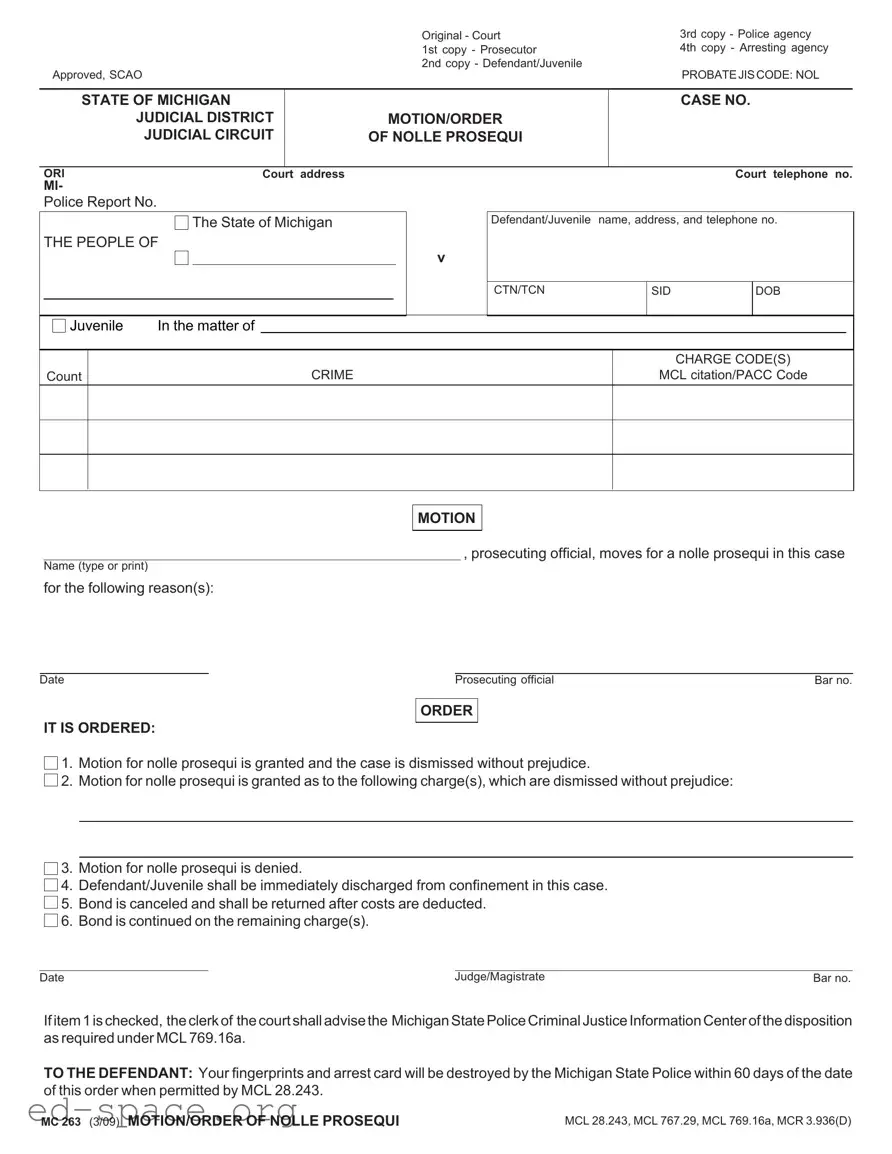
The Michigan MC 263 form serves a critical function within the state's judicial process, specifically regarding the motion for nolle prosequi. This form is utilized by prosecuting officials to formally request the dismissal of criminal charges against a defendant or juvenile. It is essential to understand that a nolle prosequi motion allows for the case to be dismissed without prejudice, meaning that the prosecution can potentially refile the charges in the future. The form includes several key components, such as the identification of the court, the case number, and the details of the defendant or juvenile involved. Additionally, it outlines the reasons for the motion and the specific charges being dismissed. The judge or magistrate's order is a crucial part of the form, as it determines whether the motion is granted or denied. If granted, the form ensures that the defendant is discharged from confinement, and any bonds are addressed accordingly. The Michigan State Police is also notified to destroy fingerprints and arrest records within a specified timeframe, ensuring the protection of the defendant's privacy. Overall, the MC 263 form is a vital document that facilitates the judicial process while upholding the rights of individuals involved in legal proceedings.
Original - Court |
3rd copy - Police agency |
1st copy - Prosecutor |
4th copy - Arresting agency |
2nd copy - Defendant/Juvenile |
|
Approved, SCAO |
PROBATEJISCODE: NOL |
STATE OF MICHIGAN JUDICIAL DISTRICT JUDICIAL CIRCUIT
MOTION/ORDER
OF NOLLE PROSEQUI
CASE NO.
ORI |
Court address |
MI-
Police Report No.
The State of Michigan
THE PEOPLE OF
v
Court telephone no.
Defendant/Juvenile name, address, and telephone no.
CTN/TCN
SID
DOB
Juvenile |
In the matter of |
Count
CRIME
CHARGE CODE(S)
MCL citation/PACC Code
MOTION
Name (type or print)
for the following reason(s):
Date
IT IS ORDERED:
, prosecuting official, moves for a nolle prosequi in this case
Prosecuting official |
Bar no. |
ORDER
1. Motion for nolle prosequi is granted and the case is dismissed without prejudice.
2. Motion for nolle prosequi is granted as to the following charge(s), which are dismissed without prejudice:
3. |
Motion for nolle prosequi is denied. |
|
||
4. |
Defendant/Juvenile shall be immediately discharged from confinement in this case. |
|
||
5. |
Bond is canceled and shall be returned after costs are deducted. |
|
||
6. |
Bond is continued on the remaining charge(s). |
|
||
|
|
|
|
|
Date |
|
|
Judge/Magistrate |
Bar no. |
Ifitem1ischecked, theclerkof thecourtshalladvisethe MichiganStatePoliceCriminalJusticeInformationCenterofthedisposition as required under MCL 769.16a.
TO THE DEFENDANT: Your fingerprints and arrest card will be destroyed by the Michigan State Police within 60 days of the date of this order when permitted by MCL 28.243.
MC 263 (3/09) MOTION/ORDER OF NOLLE PROSEQUI |
MCL 28.243, MCL 767.29, MCL 769.16a, MCR 3.936(D) |
| Fact Name | Fact Description |
|---|---|
| Form Purpose | The Michigan MC 263 form is used to request a nolle prosequi, which is a legal term indicating that the prosecution is discontinuing the case against the defendant or juvenile. |
| Distribution Copies | The form requires multiple copies to be distributed: the original goes to the court, the first copy to the prosecutor, the second copy to the defendant or juvenile, the third copy to the police agency, and the fourth copy to the arresting agency. |
| Legal Authority | The governing laws associated with the MC 263 form include MCL 28.243, MCL 767.29, MCL 769.16a, and MCR 3.936(D). |
| Order Outcomes | The judge or magistrate can grant or deny the motion for nolle prosequi, which may result in the case being dismissed without prejudice or the defendant being discharged from confinement. |
Filling out the Michigan MC 263 form requires careful attention to detail. This form is essential for the motion or order of nolle prosequi in a legal case. Once completed, it will be submitted to the appropriate court and processed accordingly. Follow the steps below to ensure accuracy.
After completing the form, ensure that all copies are distributed correctly: the original goes to the court, the first copy to the prosecutor, the second to the defendant or juvenile, the third to the police agency, and the fourth to the arresting agency. Timely submission is crucial for the process to move forward smoothly.
What is the Michigan MC 263 form?
The Michigan MC 263 form is a legal document used in court to request a nolle prosequi. This means the prosecutor is asking to dismiss a case without prejudice, which allows the case to be reopened in the future if necessary.
Who files the MC 263 form?
The prosecutor files the MC 263 form. This is typically done when the prosecutor believes there is not enough evidence to continue with the case or for other legal reasons that warrant dismissal.
What does "without prejudice" mean?
What happens after the MC 263 form is filed?
Will my fingerprints and arrest record be destroyed?
What if the motion for nolle prosequi is denied?
Can a defendant appeal the nolle prosequi decision?
What should I do if I receive a copy of the MC 263 form?
What is the significance of the judge's order on the form?
Where should the completed MC 263 form be submitted?
Failing to provide accurate defendant information, including name, address, and telephone number. This can lead to delays in processing the form.
Neglecting to include the correct case number. Without this information, the court may not be able to locate the relevant case file.
Using an incorrect court address or telephone number. This mistake can result in miscommunication and further complications in the case.
Omitting the charge codes or MCL citations. These codes are essential for identifying the specific charges being dismissed.
Not signing the form or failing to provide the prosecuting official's bar number. This omission can invalidate the motion.
Incorrectly checking the boxes related to the motion outcome. Each box must accurately reflect the intended motion to avoid confusion.
Forgetting to include a reason for the motion. Providing a rationale is crucial for the court's understanding and approval of the request.
Failing to attach necessary supporting documents. Additional documentation may be required to substantiate the motion.
Not keeping copies of the completed form for personal records. Retaining a copy is important for future reference and tracking.
Submitting the form to the wrong court or agency. Ensure that the form is directed to the appropriate jurisdiction to prevent delays.
The Michigan MC 263 form, which is a motion/order for nolle prosequi, is often accompanied by several other important documents. Each of these forms serves a specific purpose in the legal process and helps ensure that all parties involved have the necessary information and records. Below is a list of commonly used documents that may accompany the MC 263 form.
These documents collectively support the legal process surrounding the MC 263 form. Each plays a vital role in ensuring transparency and fairness in the judicial system, ultimately aiding in the resolution of the case.
The Michigan MC 263 form, which is used for a motion or order of nolle prosequi, shares similarities with several other legal documents. Each of these documents serves a specific purpose in the legal process. Below is a list of nine documents that are similar to the MC 263 form, along with explanations of their similarities.
When filling out the Michigan MC 263 form, it is important to follow certain guidelines to ensure accuracy and compliance. Below is a list of things you should and should not do.
Here are ten misconceptions about the Michigan MC 263 form, along with explanations for each:
When filling out and using the Michigan MC 263 form, keep these key takeaways in mind: